Live Cell Encapsulation Market Size, Share & Industry Analysis, By Product (Consumables, Instruments, and Software & Services), By Application (Cell Therapy & Regenerative Medicine, Drug Discovery & Toxicity Testing, and Others), By Cell Type (Primary Cells, Stem Cells, Engineered/Therapeutic Cells, Cell Clusters & Organoids, and Others), By Biomaterial Type (Natural Polymers, Synthetic Polymers, Hybrid/Composite Biomaterials, and Others), By End User (Pharmaceutical & Biotechnology Companies, Academic & Research Institutes, CROs/CDMOs, and Others), and Regional Forecast, 2026-2034
 Download Free Sample
Live Cell Encapsulation Market Size and Future Outlook
 Listen to Audio Version
The global live cell encapsulation market size was valued at USD 382.3 million in 2025 and is projected to grow from USD 429.5 million in 2026 to USD 1,090.0 million by 2034, exhibiting a CAGR of 12.35% during the forecast period. North America dominated the live cell encapsulation market with a market share of 39.7% in 2025.
The global market comprises various encapsulated cell therapy platforms, biomaterial-based microcapsules, macro encapsulation devices, hydrogel matrices, and others used to protect living cells while allowing nutrient, oxygen, and therapeutic molecule exchange. The demand for live cell encapsulation technologies is increasing as researchers and biotechnology companies focus on cell based therapies for diabetes, regenerative medicine, oncology, and long-term biologic delivery. These solutions are being developed to improve cell survival, reduce immune rejection, limit the need for systemic immunosuppression, and support controlled therapeutic release. Key companies are advancing encapsulation platforms, implantable cell devices, and biomaterial solutions to improve the safety, durability, and scalability of cell-based treatments.
- For instance, in March 2025, Neurotech Pharmaceuticals received the U.S. FDA approval for ENCELTO for the treatment of macular telangiectasia type 2. ENCELTO uses encapsulated cell therapy to continuously deliver therapeutic doses of ciliary neurotrophic factor to the retina, supporting the clinical acceptance of live-cell encapsulation as a long-duration therapeutic delivery approach.
Furthermore, major players, such as Corning Incorporated, Merck KGaA, Roquette Frères, and Thermo Fisher Scientific Inc, are realigning resources toward new product launches and collaborations to strengthen their market presence.
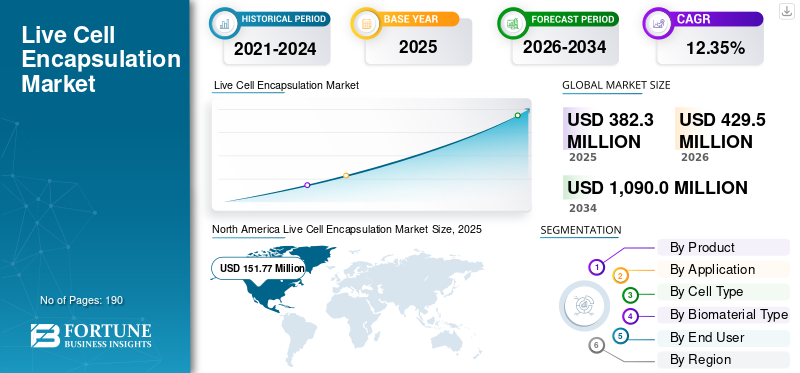
Download Free sample to learn more about this report.
LIVE CELL ENCAPSULATION MARKET KEY TAKEAWAYS
 Global Market Size & Forecast
- 2025 Market Size: USD 382.3 million
- 2026 Market Size: USD 429.5 million
- 2034 Forecast Market Size: USD 1,090.0 million
- CAGR: 12.35% from 2026–2034
 Market Share
- North America dominated the market with a 39.7% share in 2025.
- The Consumables segment held the largest market share in 2025.
- The Cell Therapy & Regenerative Medicine segment held the largest market share in 2025.
 Key Regional Highlights
North America
Reached USD 151.77 million in 2025, driven by strong cell therapy research, regenerative medicine, and biotechnology investments.
Europe
The market is projected to reach USD 119.5 million by 2026, growing at a 11.62% CAGR, supported by regenerative medicine programs and advanced therapy research.
Asia Pacific
The market is projected to reach USD 101.8 million by 2026, driven by stem cell research, expanding biomanufacturing, and supportive innovation policies.
U.S.
The market is projected to reach USD 159.0 million by 2026, accounting for 37.01% of global revenue.
Japan
The market is projected to reach USD 24.6 million by 2026, accounting for 5.72% of global revenue.
Read More

LIVE CELL ENCAPSULATION MARKET TRENDS
Growing Use of Bio-Hybrid Implantable Devices in Regenerative Medicine is a Prominent Trend
The shift toward bio-hybrid implantable devices is a significant market trend. Companies are moving beyond simple cell delivery toward systems that can support long-term cell survival inside the body. These devices are designed to create a protected and vascularized space where therapeutic cells can remain functional while reducing direct immune attack. These factors are crucial given that many regenerative medicine applications require durable cell activity. As a result, bio-hybrid implantable devices are gaining attention for their ability to combine biomaterials, living cells, and controlled therapeutic delivery in a single platform. This trend is expected to support the market as companies focus on improving clinical durability, reducing dependence on lifelong immunosuppression, and expanding the use of encapsulated cell therapies for chronic disease treatment.
- For instance, in March 2025, Sernova Biotherapeutics received clearance for an IND application from the U.S. FDA for the Cell Pouch Bio-hybrid Organ with autograft thyroid cells in patients with hypothyroidism. The Cell Pouch platform combines biomaterials with living tissues to create a bio-hybrid organ, supporting the broader use of implantable encapsulated cell systems in regenerative medicine.
MARKET DYNAMICS
MARKET DRIVERS
Download Free sample to learn more about this report.
Rising Demand for Cell-Based Therapies in Chronic Disease Management to Drive Market Growth
The global market is anticipated to grow with the increasing prevalence of chronic diseases such as Type 1 diabetes, endocrine disorders, retinal diseases, and degenerative conditions require therapies that provide long-term functional benefits. Live cell encapsulation meets this need by protecting therapeutic cells from immune attack while allowing them to release insulin, proteins, growth factors, and other biologically active molecules within the body. This creates a strong catalyst for market growth as encapsulated cells can act as living therapeutic systems, helping reduce treatment burden and supporting more durable disease control. As cell therapy companies continue developing stem-cell-derived platforms, the demand for encapsulation materials, devices, and delivery systems is expected to increase.
- For instance, in January 2026, Encellin showcased interim clinical results from the ongoing Phase 1 trial of its Encapsulated Cell Replacement Therapy platform in Type 1 diabetes. The studies supported the potential of live cell encapsulation to protect therapeutic cells, maintain cell viability, and advance long-term disease management in diabetes.
MARKET RESTRAINTS
Technical and Regulatory Complexity Limiting Commercial Scale-Up of Encapsulation Therapies May Restrain Market Growth
The market faces a major restraint due to immune reactions and fibrosis around implanted capsules. The body can recognize encapsulation materials as foreign, even when the therapeutic cells are physically protected. These factors can lead to the attachment of inflammatory cells and fibrotic tissue formation around the capsule, reducing the movement of oxygen, nutrients, glucose, insulin, and waste products across the membrane. As a result, encapsulated cells may gradually lose function, reducing treatment durability and limiting clinical success. These challenges also increase the need for better biomaterials, improved device design, and longer preclinical and clinical testing, thereby raising development costs and slowing commercialization. Furthermore, the failure of immunosuppression and reduced clinical activity adds to the limiting of the market growth prospects.
- For instance, in March 2025, Vertex Pharmaceuticals discontinued the further clinical development of VX-264, its encapsulated islet cell therapy for Type 1 diabetes, after Phase 1/2 study data failed to show sufficient efficacy. The therapy was designed to use stem-cell-derived pancreatic islet cells inside an immunoprotective device to avoid the need for immunosuppression.
MARKET OPPORTUNITIES
Expansion of Encapsulated Cell Therapy for Type 1 Diabetes Treatment to Offer Lucrative Growth Opportunities
The global market is expected to witness strong growth opportunities from Type 1 diabetes treatment. Current insulin-based care helps manage blood glucose but does not restore the function of natural insulin-producing cells. Encapsulated cell therapy can address this gap by placing insulin-producing islet cells or stem-cell-derived pancreatic cells inside protective devices that allow glucose and insulin exchange while reducing immune attack. This creates a major opportunity, as a successful encapsulated system could reduce dependence on repeated insulin administration and the need for systemic immunosuppression. The global product demand is expected to rise as more companies develop implantable, retrievable, and immune-protective cell platforms.
- For instance, in March 2023, Vertex Pharmaceuticals received FDA approval of the VX-264 IND application, a novel encapsulated cell therapy for Type 1 diabetes. The therapy used stem-cell-derived, fully differentiated pancreatic islet cells encapsulated in an immunoprotective device. It was designed to treat Type 1 diabetes without requiring immunosuppression, underscoring the potential of encapsulated cell therapy platforms in diabetes care.
MARKET CHALLENGES
Scaling Up GMP-Compatible Manufacturing for Encapsulated Cell Products Creates Challenges for Market Expansion
The global market faces a major challenge in scaling up GMP-compatible manufacturing, as encapsulated cell products require living cells, biomaterials, device components, and sterile processing to work together with high consistency. Unlike conventional drugs, these products must maintain cell viability, capsule uniformity, oxygen and nutrient exchange, and batch-to-batch reproducibility throughout production. This creates a challenge given that even small variations in cell quality, capsule size, biomaterial composition, or aseptic handling can affect clinical performance and regulatory acceptance.
As companies move from research-stage production to clinical and commercial supply, they need automated, closed, and validated manufacturing systems, which increase costs, time, and technical complexity, thereby posing a key challenge for manufacturing scale-up.
- For instance, in October 2022, TreeFrog Therapeutics announced plans to move toward GMP manufacturing by receiving a GMP cell encapsulation device from Invetech. Additional GMP encapsulation devices have been planned to support regenerative medicine and immuno-oncology programs. Such development highlights that companies must invest in specialized GMP-grade encapsulation equipment and CDMO-based production before advancing encapsulated cell therapies into human studies. It also shows the manufacturing complexity that can slow global live cell encapsulation market growth.
Segmentation Analysis
By Product
Recurring Use of Encapsulation Consumables Pushed Consumables Segment Dominance in 2025
Based on product, the market is categorized into consumables, instruments, and software & services.
By product, the consumables segment dominated the market in 2025 as live cell encapsulation requires the repeated use of alginates, hydrogels, polymers, culture media, cross-linking agents, sterile solutions, and assay materials across various workflows. Consumables are needed for every encapsulation batch, cell culture cycle, formulation run, and quality testing step. As a result, the recurring demand from pharmaceutical companies, academic labs, CROs, and cell therapy developers drives higher-volume consumption. The growing use of encapsulation in cell therapy, 3D culture, and tissue engineering further increases the demand for standardized and sterile consumable materials. The high recurring demand encourages key companies to focus on new product launches to strengthen their positions.
- For instance, in October 2024, UPM Biomedicals launched FibGel, an injectable nanocellulose hydrogel for permanent implantable medical devices. The FibGel is made from birch wood cellulose and water and is designed for medical applications such as soft tissue repair, orthopedics, and regenerative medicine.
The software & services segment is expected to grow at a CAGR of 16.47% over the forecast period.
To know how our report can help streamline your business, Speak to Analyst
By Application
Cell Therapy & Regenerative Medicine Segment Led the Market with Surging Development of Living Therapeutic Systems
Based on application, the market is segmented into cell therapy & regenerative medicine, drug discovery & toxicity testing, disease modeling & organoid research, tissue engineering & 3D bioprinting, bioproduction & cell-based manufacturing, probiotics & microbiome delivery, and others.
In 2025, the cell therapy & regenerative medicine segment held the largest share given that live-cell encapsulation is primarily used to enhance the safety and durability of therapeutic cells after administration. Encapsulation helps protect cells from immune attack while allowing them to release insulin, proteins, antibodies, enzymes, or growth factors inside the body. This is important for chronic and hard-to-treat diseases where repeated drug dosing may not provide long-term functional benefit. As a result, companies are increasingly using encapsulation platforms to develop living therapeutic systems that can work for longer periods and reduce the need for systemic immunosuppression through strategic collaborations.
- For instance, in March 2025, Likarda joined forces with a Gates Foundation grant to support its Core-Shell Spherification hydrogel encapsulation system for antibody-secreting cell therapy, intending to protect antibody-producing cells in the body for up to one year.
The tissue engineering & 3D bioprinting segment is projected to grow at a CAGR of 12.98% during the forecast period.
By Cell Type
High Functional Relevance Drove the Dominance of the Primary Cells Segment in 2025
Based on cell type, the market is segmented into primary cells, stem cells, engineered/therapeutic cells, cell clusters & organoids, microbial cells, and others.
In 2025, the primary cells segment dominated the global market share as they closely mimic natural human or animal cell function and are widely used in therapeutic and translational research. In live cell encapsulation, primary cells such as islet cells, hepatocytes, and other functional tissue-derived cells are preferred when biological activity, hormone secretion, protein production, or disease-relevant responses are critical. This creates greater demand given that primary cells offer greater clinical relevance than standard immortalized cell lines. As a result, encapsulated primary cells are widely studied for diabetes, liver disease, regenerative medicine, and cell replacement therapies. Therefore, their functional relevance and therapeutic value support their dominant market position.
- For instance, in May 2025, Sernova Biotherapeutics announced positive interim data from its Cell Pouch™ Bio-hybrid Organ’s ongoing Phase 1/2 clinical trial for patients with Type 1 diabetes. The company stated that the platform uses human donor islets or stem-cell-derived islet-like clusters to create a bio-hybrid organ for T1D and the data supported donor islet engraftment and functional activity. This bolsters the dominance of primary cells, as donor islet cells provide direct biological function and strong clinical relevance for live-cell encapsulation-based cell-replacement therapy.
The engineered/therapeutic cells segment is projected to grow at a CAGR of 14.41% during the forecast period.
By Biomaterial Type
Strong Biocompatibility to Impel the Dominance of the Natural Polymers Segment
Based on biomaterial type, the market is segmented into natural polymers, synthetic polymers, hybrid/composite biomaterials, smart/functional biomaterials, and others.
The natural polymers segment is likely to dominate the global live cell encapsulation market share. Materials such as alginate, collagen, chitosan, gelatin, and cellulose-based polymers offer strong biocompatibility, mild gelation conditions, and cell-friendly encapsulation environments, driving the dominance of the segment. These materials are widely used given that they can form semi-permeable matrices that support nutrient exchange while protecting cells from direct immune exposure. As a result, natural polymers are preferred in both therapeutic and research applications, highlighting their lower cell toxicity and supporting their market dominance.
- For instance, in May 2024, Roquette Frères showcased breakthrough alginate technologies for biomedical innovation, including alginate biopolymers for cell therapy, polymer-based encapsulation, delivery, regenerative medicine, and 3D cell culture Such development supports the dominance of natural polymers due to their ability to support cell encapsulation and controlled exchange of nutrients and therapeutic molecules.
The others segment is projected to grow at a CAGR of 12.68% during the forecast period.
By End User
Pharmaceutical and Biotechnology Companies Led the Market Owing to their Strong Therapeutic Development Pipelines
Based on end user, the market is segmented into pharmaceutical & biotechnology companies, academic & research institutes, CROs/CDMOs, hospitals & transplant centers, diagnostic & testing laboratories, and others.
In 2025, the pharmaceutical and biotechnology companies segment dominated the market. They are actively developing encapsulated cell therapies, biologic delivery platforms, regenerative medicine products, and advanced disease models. These companies have the funding, technical teams, manufacturing capabilities, and clinical development pipelines needed to move encapsulation technologies from research into regulated therapeutic products. Their demand is also higher given that live-cell encapsulation requires specialized biomaterials, validated devices, GMP-compliant processes, and long-term safety testing.
- For instance, in November 2025, Avant Technologies collaborated with Austrianova, under which Klothonova would use Austrianova’s Cell-in-a-Box encapsulation platform to encapsulate genetically modified cells that overexpress Klotho proteins, showing active biotech-led development of encapsulated cell platforms.
The hospitals & transplant centers segment is projected to grow at a CAGR of 13.61% over the forecast period.
Live Cell Encapsulation Market Regional Outlook
By geography, the market is categorized into Europe, North America, Asia Pacific, Latin America, and the Middle East & Africa.
North America
North America Live Cell Encapsulation Market Size, 2025 (USD Million)
To get more information on the regional analysis of this market, Download Free sample
North America held the dominant share in 2024 with a value of USD 135.78 million and maintained its leading position in 2025, recording a valuation of USD 151.77 million. The region is witnessing growth due to strong cell therapy research, advanced diabetes and regenerative medicine pipelines, and high investment from biotechnology companies. The region also benefits from a mature clinical trial infrastructure and the faster adoption of advanced therapy platforms.
U.S. Live Cell Encapsulation Market
Given North America's substantial contribution and the U.S. dominance in the region, the U.S. market is estimated to touch around USD 159.0 million in 2026, accounting for roughly 37.01% of the global market.
Europe
The Europe market is projected to grow at a CAGR of 11.62% over the analysis period, the second-highest among all regions, and reach a valuation of USD 119.5 million by 2026. Strong academic research, government-backed regenerative medicine programs, and rising focus on advanced therapy medicinal products in Europe support the growth momentum in the region.
U.K. Live Cell Encapsulation Market
The U.K. market is estimated to touch USD 21.7 million in 2026, accounting for roughly 5.04% of the global market.
Germany Live Cell Encapsulation Market
The Germany market is projected to reach approximately USD 25.4 million in 2026, equivalent to around 5.92% of the global market.
Asia Pacific
The Asia Pacific market is estimated to reach USD 101.8 million in 2026 and secure the position of the third-largest region in the market. The regional market is expanding due to rising investment in stem cell research, increasing biomanufacturing capacity, and the growing chronic disease burden. Supportive innovation policies and expanding biotech ecosystems are also improving adoption.
Japan Live Cell Encapsulation Market
The Japanese market is estimated to touch around USD 24.6 million in 2026, accounting for approximately 5.72% of the global market.
China Live Cell Encapsulation Market
The China market is projected to be among the largest worldwide, with 2026 revenues estimated at around USD 35.0 million, accounting for approximately 8.14% of global sales.
India Live Cell Encapsulation Market
The India market is estimated at around USD 15.7 million in 2026, accounting for roughly 3.66% of global revenue.
Latin America and the Middle East & Africa
Latin America and the Middle East & Africa markets are expected to witness steady growth during the forecast period. The market in Latin America is estimated to reach a valuation of USD 21.8 million in 2026. This regional market is expanding as research institutions and healthcare systems explore advanced cell-based therapies for chronic diseases. In the Middle East & Africa, the GCC market is set to reach USD 8.4 million in 2026.
South Africa Live Cell Encapsulation Market
The South African market is projected to reach approximately USD 3.0 million by 2026, accounting for roughly 0.71% of the global revenue.
COMPETITIVE LANDSCAPE
Key Industry Players
Increasing Focus of Key Players on Clinical Development Programs to Maintain their Industry Standing
The global market is moderately fragmented, with competition led by companies such as Corning Incorporated, Thermo Fisher Scientific Inc., Merck KGaA, Roquette Frères, BÜCHI Labortechnik AG, CELLINK, Advanced BioMatrix, Sernova Biotherapeutics, Neurotech Pharmaceuticals, Austrianova, Likarda, TreeFrog Therapeutics, ALTuCELL, and Diatranz Otsuka. These players are strengthening their market positions through product innovation, clinical development programs, research collaborations, and expansion of biomaterial-based platforms. The growing use of encapsulated cells in cell therapy, diabetes treatment, regenerative medicine, drug discovery, and tissue engineering is expected to improve commercial acceptance and widen the application base for live cell encapsulation technologies.
- For instance, in May 2026, researchers at Rice University, in conjunction with The University of Texas MD Anderson Cancer Center and clinical partners conducted the first-in-human trial of AVB-001, an investigational therapy composed of encapsulated, engineered cells that consistently produce IL-2 within the abdominal cavity.
Other notable participants in the market include Vertex Pharmaceuticals, Sphere Bio, TreeFrog Therapeutics, Likarda, Austrianova, ALTuCELL, Diatranz Otsuka, Sernova Biotherapeutics, and Roquette/NovaMatrix. The market remains strongly innovation-driven, with large life science suppliers holding near-term share through consumables and research tools. At the same time, specialized biotechnology companies compete to capture future opportunities through therapeutic encapsulated cell platforms.
LIST OF KEY LIVE CELL ENCAPSULATION COMPANIES PROFILED
- Corning Incorporated (U.S.)
- Merck KGaA (Germany)
- Roquette Frères (France)
- Thermo Fisher Scientific Inc (U.S.)
- CELLINK (Sweden)
- BÜCHI Labortechnik AG (Switzerland)
- Sernova Biotherapeutics (Canada)
- Neurotech Pharmaceuticals (U.S.)
- Advanced BioMatrix (U.S.)
- Austrianova (Singapore)
KEY INDUSTRY DEVELOPMENTS
- May 2026: Araceli Biosciences launched Endeavor Live Cell, expanding the company's ultra-high-throughput imaging platform into dynamic biology at screening scale. Endeavor Live Cell is designed to support the need for the rapid and consistent generation of high-quality cellular imaging data at scale by enabling rapid kinetic imaging across entire 1536-well plates, to assist scientists.
- May 2026: Avaí Bio and Austrianova completed a GMP Master Cell Bank of genetically modified cells developed to overexpress α-Klotho and initiated viral testing for a potential encapsulated cell-based anti-aging therapy.
- April 2026: Atelerix partnered with JH Health Ltd. The partnership granted JH Health exclusive rights for the usage and distribution Atelerix's hydrogel-based cell and tissue preservation solutions in the Middle East. This would bolster the company’s global commercial footprint with new regional distribution and manufacturing channels.
- April 2026: Likarda, Inc., partnered with Tiny Cargo, an innovator in EV (Extracellular Vesicle) delivery systems. The deal would help advance the delivery of small molecules and biologics by integrating Tiny Cargo’s vesicle-based technologies with Likarda’s Core-Shell Spherification (CSS) platform.
- September 2025: Avant Technologies Inc. collaborated with Austrianova to establish Klothonova, Inc., a new Nevada corporation focused on pioneering cell-based therapies utilizing encapsulated Klotho-producing cells.
REPORT COVERAGE
The global live cell encapsulation market report provides a comprehensive analysis covering a detailed market assessment across product, application, cell type, biomaterial type, and end user. It examines the demand for encapsulation consumables, instruments, software, and services, along with their use in cell therapy, drug discovery, disease modeling, tissue engineering, bioproduction, probiotics, and other application areas. The study further evaluates the roles of primary cells, stem cells, engineered cells, cell clusters, and microbial cells in live-cell encapsulation workflows, while also assessing the adoption of natural polymers, synthetic polymers, hybrid/composite materials, and smart/functionalized biomaterials. The report also provides insights across key regions, a competitive landscape analysis, company profiling, recent developments, and an evaluation of the major driving factors, restraints, challenges, as well as future opportunities in the market.
Request for Customization to gain extensive market insights.
Report Scope & Segmentation
| ATTRIBUTE | DETAILS |
| Study Period | 2021-2034 |
| Base Year | 2025 |
| Estimated Year | 2026 |
| Forecast Period | 2026-2034 |
| Historical Period | 2021-2024 |
| Growth Rate | CAGR of 12.35% from 2026 to 2034 |
| Unit | Value (USD Million) |
| Segmentation | By Product, Application, Cell Type, Biomaterial Type, End User, and Region |
| By Product |
|
| By Application |
|
| By Cell Type |
|
| By Biomaterial Type |
|
| By End User |
|
| By Region |
|
Frequently Asked Questions
According to Fortune Business Insights, the global market value stood at USD 382.3 million in 2025 and is projected to reach USD 1,090.0 million by 2034.
In 2025, the North America market value stood at USD 151.8 million.
The market is expected to grow at a CAGR of 12.35% over the forecast period of 2026-2034.
By product, the consumables segment led the market in 2025.
The rising demand for cell-based therapies in chronic disease management is a key factor driving market growth.
Corning Incorporated, Merck KGaA, Roquette Frères, and Thermo Fisher Scientific Inc are the major players in the global market.
North America held a dominant market share in 2025.



- 2021-2034
- 2025
- 2021-2024
- 190
Get 30-60 hrs Free Customization
Expand Regional and Country Coverage, Segments Analysis, Company Profiles, Competitive Benchmarking, and End-user Insights.













.webp)






Related Reports
-
US +1 833 909 2966 ( Toll Free )
-
Get In Touch With Us