Livestock Disinfection (Topical) Market Size, Share & Industry Analysis, By Product (Teat & Udder Disinfectants, Wound & Skin Disinfectants, Hoof/Foot Disinfectants, and Others), By Animal Type (Bovine/Cattle, Swine/Porcine, Poultry, and Others), By Distribution Channel (Animal Farms, Veterinary Clinics & Hospitals, Retail Channels, Online Channels, and Others), and Regional Forecast, 2026-2034
 Download Free Sample
Livestock Disinfection (Topical) Market Size and Future Outlook
 Listen to Audio Version
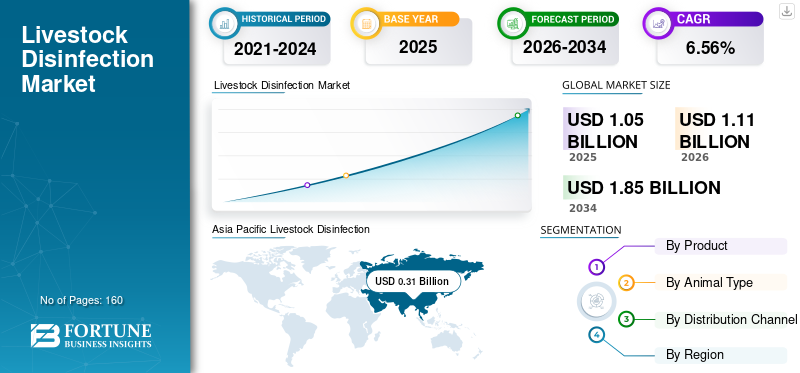
The global livestock disinfection (topical) market size was valued at USD 1.05 billion in 2025. The market is projected to grow from USD 1.11 billion in 2026 to USD 1.85 billion by 2034, exhibiting a CAGR of 6.56% during the forecast period. Asia Pacific dominated the livestock disinfection (topical) market with a market share of 29.52% in 2025.
The global market comprises ready to use or concentrated products that are directly applied to animals’ skins, teats, hooves, or navels to reduce the bacterial/yeast load and to lower the chances of infections that lead to productivity loss. The global market is estimated to grow at a moderately steady growth rate due to increasing awareness and demand for teat hygiene in bovine animals as teat disinfection is the highest-frequency on-animal disinfection routine undertaken in livestock animals. Furthermore, in recent years, there has been a surge in the adoption of premium livestock disinfection products, with an increasing number of farms purchasing high cost products that improve compliance such as with sprayability, dosing consistency and stable foam. Moreover, factors such as protocolization, automation/modernization, and biosecurity tightening after occurrence of disease events and to prevent disease outbreaks are anticipated to drive market growth.
- For instance, according to Agriculture and Agri-Food Canada (AAFC), a government agency of Canada, the number of dairy farms declined from 12,007 in 2014 to 9,256 in 2024. This reflects a trend of consolidation in the Canadian dairy sector and is expected to eventually shift toward a protocolized hygiene purchasing.
Furthermore, several companies such as DeLaval, KERSIA GROUP, Ecolab Inc., and others, comprise the key players in the market. Some of the reasons for the dominance of these companies include an innovative product base, strong presence in large animal farming establishments, and robust revenue generation from product sales.
Download Free sample to learn more about this report.
Livestock Disinfection (Topical) Market Key Takeways
 Global Market Size & Forecast
- 2025 Market Size: USD 1.05 billion
- 2026 Market Size: USD 1.11 billion
- 2034 Forecast Market Size: USD 1.85 billion
- CAGR: 6.56% from 2026–2034
 Market Share
- Asia Pacific dominated the livestock disinfection (topical) market with a 29.52% share in 2025.
- The bovine/cattle segment accounted for the largest market share in 2025.
- The animal farms segment is projected to hold a 38.27% market share in 2026.
 Key Regional Highlights
Asia Pacific
Asia Pacific led the global market with a valuation of USD 0.31 billion in 2025, supported by its strong livestock industry.
North America
North America maintained a significant market presence, reaching USD 0.30 billion in 2025.
Europe
Europe is projected to grow at a 5.52% CAGR and reach USD 0.30 billion by 2026.
U.S.
U.S. The market is estimated to reach approximately USD 0.29 billion in 2026.
Japan
Japan The livestock disinfection (topical) market was valued at approximately USD 0.24 billion in 2025.
Read More

LIVESTOCK DISINFECTION (TOPICAL) MARKET TRENDS
Greater Shift toward Premium, Skin Friendly Alternatives
A notable trend witnessed in the global market is the rising adoption of premium products that are non-staining and promote greater hydration, among other benefits. These products have a greater success rate of adoption as they lead to increased comfort for animals and user compliance. From the perspective of dairy farms, these products possess greater importance as teat skin condition influences pathogen entry risk and the willingness of workers to maintain consistent routines. Moreover, the usage of these products eventually raises the average selling price (ASP) of products even when the animal numbers are stable in farms, as they lead to the farms’ greater profitability.
- For instance, in September 2025, KERSIA GROUP introduced Glycolac Hydra+, a non-staining, next generation teat dip, developed to provide softening and hydrating properties along with advanced care for teat skin conditions.
MARKET DYNAMICS
MARKET DRIVERS
Download Free sample to learn more about this report.
Need for Elimination of Farm Losses Coupled with Increased Farm Modernization to Drive Market Growth
The most critical driving factor that will contribute to a stronger market growth is the need to reduce or eliminate farm losses, in terms of animals and monetary gains. This is especially relevant in the case of bovine animals such as cows that are prone to mastitis leading to discarded milk, reduced yield, treatment costs, and higher labor. Hence, farms prioritize disease prevention routines including the adoption of livestock topical disinfection routines as they are cheaper in comparison to losses. Furthermore, in highly regulated markets such as Europe, where livestock products are required to be of significantly higher quality, these products support a large revenue stream such as saleable milk. Such factors are likely to collectively support the livestock disinfection (topical) market growth during the forecast period.
- For instance, in August 2025, the National Mastitis Council released an updated, ‘Recommended Mastitis Control Program’, that reinforced structured udder health practices that included routine teat hygiene.
MARKET RESTRAINTS
Sensitivities to Higher Farm Costs to Hinder Market Growth
In several emerging countries, a key restraint is that the small and mid-sized farms often are sensitive to the higher costs of such topical products. When livestock product margins are limited, these farms often choose to postpone the procurement of these products or reduce their frequency. This impacts the product adoption rates leading to uneven growth rates across the forecast period. This impact is the strongest in case of farms who engage in the fragmented procurement of these products and where quality based incentives are absent or minimal. These farms prioritize immediate cash cost over longer-term performance return on investment ROI. This significantly limits the growth potential of this market.
- According to the ‘Pan American Health Organization (PAHO) in November 2024, 13 outbreaks of avian influenza in wild and domestic birds in Mexico were reported to the World Organization for Animal Health (WOAH). These outbreaks impacted both the domestic (poultry) and the wild birds. These outbreaks occurred across 8 states. Such events cause pressures in terms of biosecurity and also the topical antisepsis use rises during such outbreaks. These events limit the greater adoption of livestock disinfection products.
MARKET OPPORTUNITIES
Increased Automation and Market Consolidation to Provide Market Growth Prospects
Some of the critical opportunities of growth associated with the market are the increased prospects of farm automation, leading to rising demand for such products. As the adoption of automated spray systems expand, the products developed for sprayability, adhesion, and barrier formation can potentially gain market share. These products often justify higher pricing as they reduce mastitis risk and improve teat condition in high-performance environments. Furthermore, the market consolidation amongst the key players also support market growth as they market their products into existing farm relationships and increase the distribution reach of their products.
- In December 2023, DeLaval announced the rollout of the DeLaval teat spray robot TSR2, their new, re-designed automated teat sprayer. This automated teat sprayer optimizes the pre- and post-teat spray application task for rotary milking systems leading to enhanced cow health.
MARKET CHALLENGES
Adoption Gap between Large and Small Livestock Farms to Slow Market Growth Prospects
A major growth challenge associated with this market is the limited capabilities of the smaller farms to adopt these advanced products as compared to the larger, enterprise farms. This has been observed as larger farms lack the lead times, training and cash flow for the consistent use of these products. This leads to an uneven penetration of these products in emerging regions especially and makes scaling demand difficult in these markets. This significantly reduces the potential for higher growth prospects.
- For instance, in May 2025, Tetra Pak announced the launch of the Dairy Hub Handbook, a detailed guide to the Tetra Pak’s Dairy Hub model. Tetra Pak reported the Kenya level outcomes such as higher amounts of milk sold at farm level and big production uplifts tied to linking farmers to processors/co-ops and strengthening practices. Once farmers sell into formal channels, milk quality requirements (clean milking routine, udder prep, post-milking teat disinfection) tend to become non-negotiable.
Segmentation Analysis
By Product
Greater Utilization of Teat & Udder Disinfectants for Disease Prevention to Boost Segmental Dominance
On the basis of product, the market is segmented into teat & udder disinfectants, wound & skin disinfectants, hoof & foot disinfectants, and others.
In terms of products, the teat & udder disinfectants segment is estimated to dominate the global livestock disinfection (topical) market share. The dominance of this segment is primarily due to the standard practice of teat disinfection in the commercial dairies across the regions of North America and the Europe. The growth of this segment is driven by repeated protocol compliance, rising demand for consistent and better udder health outcomes, and innovative product launches by major players.
- In October 2024, DeLaval announced the introduction of Titan, a teat disinfectant developed for automated spray systems that combines the ease of a spray application with film-forming protection.
The hoof & foot disinfectants segment is anticipated to rise at a CAGR of 8.00% over the forecast period.
To know how our report can help streamline your business, Speak to Analyst
By Animal Type
Bovine/Cattle Segment Led the Market Due to Routine Disinfection Protocols
On the basis of animal type, the market is segmented into bovine/cattle, swine/porcine, poultry, and others.
In 2025, the bovine/cattle segment accounted for the largest share of the global market. Prominent factors contributing to this segment’s dominance include the presence of routine, high-frequency protocols for teat and hoof disinfection, and other factors. Furthermore, an approach toward better hygiene protocols in terms of bovine animals was highlighted in the ‘Strategy Document on the Prevention and Control of Mastitis’, published by the Ministry of Fisheries, Animal Husbandry & Dairying, Government of India.
- In December 2023, Punjnad Pharma Pvt. Ltd. announced the availability of their product DERMO HERBALBAR, a lactic-acid teat dip with film barrier.
The swine/porcine segment is projected to grow at a CAGR of 9.16% over the forecast period.
By Distribution Channel
Significant Volume Purchases by Animal Farms to Propel Segmental Dominance
In terms of distribution channel, the market is segmented into animal farms, veterinary clinics & hospitals, retail channels, online channels, and others.
The animal farms segment accounted for the largest market share in 2025 as integrators and large farms account for a significant proportion of the procured product offerings. They also have the ability to negotiate direct contracts for key livestock disinfection products including teat disinfectants. Moreover, the segment is set to hold a market share of 38.27% in 2026.
- For instance, in several animal health guidelines published by key organizations such as the National Mastitis Council and the Dairy Farmers of Canada, teat disinfection procedure is considered as a core on-farm control step, driven through repeated purchases through farms.
Moreover, the online channels segment is projected to grow at a CAGR of 12.32% over the forecast period.
Livestock Disinfection (Topical) Market Regional Outlook
On the basis of region, the market is categorized into North America, Europe, Asia Pacific, South America, and the Middle East and Africa.
Asia Pacific
Asia Pacific Livestock Disinfection (Topical) Market Size, 2025 (USD Billion)
To get more information on the regional analysis of this market, Download Free sample
The Asia Pacific market reached USD 0.31 billion in 2025 and secured the position of the largest region in the market. The Asia Pacific is the fastest-growing regional market. The reason for this substantial growth is the transition from the concept of smallholder style farms to large, protocol-driven commercial systems. This is particularly relevant for countries with substantial volume driven sales such as China and Indonesia. In the Asia region, as the trend of formalization increases, it is expected to result in a large share accounted by the region in the global market. This trend of formalization is expected to increase the spend per animal through more routine dips, structured hoof programs, and administration of procedural antisepsis products.
Japan Livestock Disinfection (Topical) Market
The Japan market reached around USD 0.24 billion in 2025, accounting for roughly 2.0% of global revenues. Japan has a steady share in the global market due to a highly structured dairy culture and demand for operational efficiency, rather than herd growth.
China Livestock Disinfection (Topical) Market
China’s market is projected to be one of the largest worldwide, with 2025 revenues reaching around USD 0.08 billion, representing roughly 6.9% of global sales.
India Livestock Disinfection (Topical) Market
The India market reached around USD 0.04 billion in 2025, accounting for roughly 3.5% of global revenues.
North America
North America held a significant value in 2024, valuing at USD 0.28 billion, and also maintained a considerable value in 2025, with USD 0.30 billion. The regional market is driven by the presence of highly scaled farms and dairies where disinfection measures such as teat disinfection is highly embedded in the standard operating procedures (SOPs). For instance, in the U.S., the dairy base remains considerable with the annual milk production in 2024 being estimated at 226B lbs. of milk. Hence, livestock producers in the region want to protect their margins via proper mastitis prevention routines.
U.S. Livestock Disinfection (Topical) Market
Based on North America’s regional dominance and the U.S.’ largest share within the region, the U.S. market can be analytically approximated at around USD 0.29 billion in 2026, accounting for roughly 25.6% of global sales.
Europe
Europe is on track to record a growth rate of 5.52% over the forecast period and reach a valuation of USD 0.30 billion by 2026. The European market is a high compliance market with strong expectations regarding livestock products such as milk quality, reinforcing the consistent disinfection SOPs. The regional growth is more innovation-focused rather than volume-led, with manufacturers emphasizing on better formulations, conditioning, consistency and environmental considerations. Such policies are key drivers that enable the adoption of premium livestock disinfection (topical) products in the region.
U.K. Livestock Disinfection (Topical) Market
In 2025, the U.K. market reached a value of around USD 0.03 billion, representing roughly 2.3% of global revenues.
Germany Livestock Disinfection (Topical) Market
Germany’s market reached approximately USD 0.04 billion in 2025, equivalent to around 2.3% of global sales.
South America, Middle East, and Africa
The South America, Middle East, and the Africa regions are expected to witness significant growth rates in this market during the forecast period. The South America market reached a valuation of USD 0.09 billion in 2025. This market, in particular Brazil, is expanding at a considerable growth rate, owing to its strong livestock population. The biggest demand accelerator in the region is the key countries’ strong livestock numbers along with greater protocol adoption such as more consistent udder preparation and mastitis prevention routines. In the Middle East, Saudi Arabia reached a value of USD 0.01 billion in 2025.
COMPETITIVE LANDSCAPE
Key Industry Players
Innovative Product Portfolio Offerings and Diverse Geographical Presence to Drive Dominance of Major Companies
The global livestock disinfection (topical) market comprises a semi-fragmented competition structure, including major companies such DeLaval, KERSIA GROUP, Ecolab Inc., and others. The considerable revenue share of these companies is owing to their diverse product portfolio, presence in large animal farms, and emphasis on expanding market presence through the opening of high tech animal farms. Furthermore, these players are engaged in major strategic initiatives such as acquisitions to boost their market share over the forecast period.
- For instance, in November 2022, DeLaval announced the launch of new teat dip with a formic acid active called the FormaShield. The product is a concentrated liquid teat disinfectant that can be diluted and administered to lactating cows before and after milking.
Other major companies present in the global market include Deosan, GEA Group Aktiengesellschaft, BouMatic, IBA Dairy Supplies, and others. These companies have major offerings in their product portfolio comprising a wide range of livestock disinfectants and diverse geographical presence which support their strong market share across the forecast period.
LIST OF KEY LIVESTOCK DISINFECTION (TOPICAL) COMPANIES PROFILED
- DeLaval (Sweden)
- KERSIA GROUP (France)
- Ecolab Inc. (U.S.)
- Deosan (Solenis LLC) (U.S.)
- GEA Group Aktiengesellschaft (Germany)
- BouMatic (U.S.)
- IBA Dairy Supplies (U.S.)
- Delmer Group (India)
KEY INDUSTRY DEVELOPMENTS
- April 2025: Neogen Corporation announced a definitive agreement to sell its global cleaners and disinfectants business to the Kersia Group.
- October 2024: DeLaval announced the launched of Titan, a film-forming barrier teat disinfectant designed for automated spray systems. The company explicitly frames it under the Europe, Middle East & Africa (EMEA) udder health solutions leadership.
- August 2024: DeLaval announced the opening of a high-tech dairy farm in Poland called the Fortune Cieszymowo. This site would include the presence of the world’s largest VMS batch milking installation of 25 robots. Such developments further lead to the recurrent use of disinfectant products.
- September 2023: DeLaval announced the expansion of its udder health portfolio with the rollout of three new glycolic acid-based teat disinfectants, including the OceanBlu spray, OceanBlu pro and the OceanBlu barrier, in the European market.
- April 2023: KERSIA Group continued its international expansion by concluding a joint venture with a large player in the Chinese food and beverage hygiene market, Klenzan.
REPORT COVERAGE
The global livestock disinfection (topical) market analysis includes a comprehensive analysis of the market size & forecast by all the market segments included in the report. It comprises an analysis on the market dynamics and market trends expected to determine the market growth rate over the forecast period. It also includes data on major aspects, including an overview of livestock animals and their population by key regions, the guidelines scenario, and innovative product launches. Moreover, it includes partnerships, mergers, and acquisitions, as well as key industry developments in the market. The global market forecast report also provides a depth competitive landscape with information on the market share and profiles of key operating players.
Request for Customization to gain extensive market insights.
Report Scope & Segmentation
| ATTRIBUTE | DETAILS |
| Study Period | 2021-2034 |
| Base Year | 2025 |
| Estimated Year | 2026 |
| Forecast Period | 2026-2034 |
| Historical Period | 2019-2024 |
| Growth Rate | CAGR of 6.56% from 2026-2034 |
| Unit | Value (USD Billion) |
| Segmentation | By Product, Animal Type, Distribution Channel, and Region |
| By Product |
|
| By Animal Type |
|
| By Distribution Channel |
|
| By Region |
|
Frequently Asked Questions
According to Fortune Business Insights, the global market value stood at USD 1.05 billion in 2025 and is projected to reach USD 1.85 billion by 2034.
In 2025, the Asia Pacific market value stood at USD 0.31 billion.
The market is expected to exhibit a CAGR of 6.56% during the forecast period of 2026-2034.
By product, the teat & udder disinfectants segment is expected to lead the market.
Increased need for strong and safe livestock disinfection products and adoption of premium offerings with technologically superior product launches are key factors driving the market expansion.
DeLaval, KERSIA GROUP, and Ecolab Inc., are the major companies in the global market.
Asia Pacific dominated the market in 2025.



- 2021-2034
- 2025
- 2021-2024
- 160
Get 30-60 hrs Free Customization
Expand Regional and Country Coverage, Segments Analysis, Company Profiles, Competitive Benchmarking, and End-user Insights.













.webp)






Related Reports
-
US +1 833 909 2966 ( Toll Free )
-
Get In Touch With Us