LNG Liquefaction Technology Market Size, Share & Industry Analysis, By Type (APCI C3MR, Dual Mixed Refrigerant (DMR), Cascade Process, Single Mixed Refrigerant (SMR), Nitrogen Expander, and Others), By Plant Capacity (Large-scale LNG (>5 MTPA), Mid-scale LNG (1–5 MTPA), and Small-scale LNG (<1 MTPA)), By Deployment (Onshore LNG, Floating LNG (FLNG), and Modular/Mobile LNG), Regional Forecast, 2026-2034
 Download Free Sample
LNG Liquefaction Technology Market Size and Future Outlook
 Listen to Audio Version
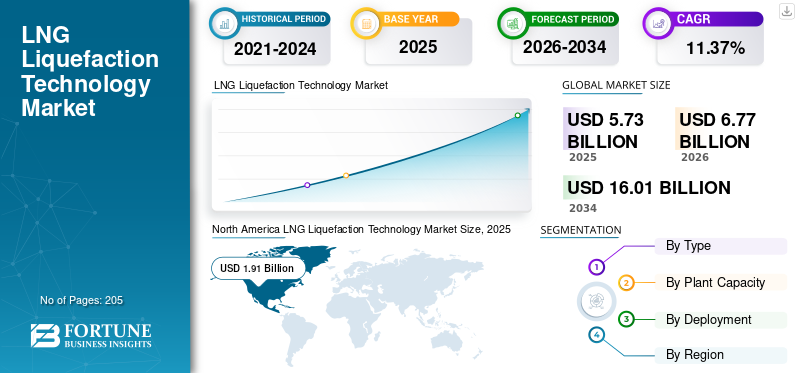
The global LNG liquefaction technology market size was valued at USD 5.73 billion in 2025. The market is projected to grow from USD 6.77 billion in 2026 to USD 16.01 billion by 2034, exhibiting a CAGR of 11.37% during the forecast period. North America dominated the LNG liquefaction technology market with a market share of 33.33% in 2025.
LNG liquefaction technology refers to the set of cryogenic process technologies, refrigeration systems, and engineering solutions used to convert natural gas into liquefied natural gas (LNG) by cooling it to approximately -162°C. This process reduces the gas volume by nearly 600 times, enabling cost-effective storage and long-distance transportation through LNG carriers.
The market is primarily driven by rising global LNG demand, increasing energy security concerns, and the rapid expansion of LNG export infrastructure. Countries in Europe and the Asia Pacific are increasingly adopting LNG to diversify energy supply and reduce dependence on coal and pipeline gas imports. Large LNG capacity additions in the U.S., Qatar, Canada, and Africa are significantly increasing demand for advanced liquefaction technologies and cryogenic systems.
- For instance, in February 2024, Microsoft signed a long-term agreement with carbon removal developer Vaulted Deep to purchase permanent carbon removal credits as part of its carbon negativity and neutrality strategy. The agreement supports the deployment of waste-based carbon sequestration technologies designed to permanently store carbon underground. This development highlights the growing corporate preference for high-integrity and durable carbon removal solutions over traditional avoidance offsets.
Some of the leading companies operating in the global industry include Schneider Electric, Salesforce, SAP, and Microsoft. Salesforce is a leading U.S.-based cloud software company actively involved in the market through its sustainability and ESG solutions portfolio. The company offers Net Zero Cloud, a carbon management platform that helps organizations track, analyze, and reduce Scope 1, Scope 2, and Scope 3 emissions.
Download Free sample to learn more about this report.
LNG Liquefaction Technology Market KEY TAKEAWAYS
 Global Market Size & Forecast
- 2025 Market Size: USD 5.73 billion
- 2026 Market Size: USD 6.77 billion
- 2034 Forecast Market Size: USD 16.01 billion
- CAGR: 11.37% during 2026–2034
 Market Share
- North America held the dominant market share of 33.33% in 2025.
- APCI C3MR accounted for the largest technology share of 35.59% in 2025.
- Large-scale LNG (>5 MTPA) held the largest segment share of 52.21% in 2025.
 Key Regional Highlights
North America
The market was valued at USD 1.91 billion in 2025 and is projected to reach USD 2.24 billion in 2026.
Europe
The market reached USD 0.41 billion in 2025 and is projected to grow at a 6.49% rate during the forecast period.
Asia Pacific
The market reached USD 1.70 billion in 2025, with Australia and Malaysia valued at USD 0.62 billion and USD 0.30 billion.
U.S.
The market stood at approximately USD 1.63 billion in 2025.
Japan
Japan is expected to contribute to the growth of the Asia Pacific LNG liquefaction technology market
Read More

LNG LIQUEFACTION TECHNOLOGY MARKET TRENDS
Increasing Adoption of Electrified Liquefaction Trains is the Key Market Trend
The LNG liquefaction technology market growth is driven by the increasing adoption of electrified liquefaction trains to reduce carbon emissions and improve energy efficiency across LNG production facilities. Traditionally, LNG plants have relied on gas turbine-driven compressors for refrigeration and liquefaction processes.
However, LNG developers are increasingly shifting toward electric motor-driven systems powered by grid electricity or renewable energy sources to lower Scope 1 emissions and support decarbonization goals. This trend is particularly visible in projects such as LNG Canada, where hydroelectric power is being integrated into liquefaction operations to reduce overall carbon intensity. Electrified LNG systems also improve operational efficiency, reduce maintenance requirements, and support compliance with tightening environmental regulations and methane reduction initiatives.
MARKET DYNAMICS
MARKET DRIVERS
Download Free sample to learn more about this report.
Expansion of Offshore Gas Monetization to Drive Market Development
The increasing development of offshore natural gas reserves is emerging as a major driver for the market. Many gas discoveries are located in remote deepwater regions where pipeline transportation infrastructure is economically unfeasible or geographically challenging. As a result, energy companies are increasingly investing in floating LNG (FLNG) facilities and offshore liquefaction systems to monetize stranded gas reserves directly at offshore production sites. This trend is accelerating demand for compact, modular, and highly efficient liquefaction technologies capable of operating under offshore and harsh environmental conditions.
MARKET RESTRAINTS
Complexity Linked to High Cryogenic Infrastructure to Hamper Market Demand
The market faces significant restraints due to the high engineering complexity associated with cryogenic infrastructure development. LNG liquefaction facilities require advanced refrigeration systems, specialized cryogenic materials, precision heat exchangers, and highly integrated process control systems capable of operating at extremely low temperatures near -162°C. Designing and maintaining these systems involves substantial technical expertise, long construction timelines, and strict operational safety requirements.
MARKET OPPORTUNITIES
Development of Arctic LNG Infrastructure to Provide Several Growth Opportunities
The expansion of Arctic LNG infrastructure presents a significant growth opportunity for the LNG liquefaction technology market. Large undeveloped natural gas reserves located in Arctic regions, particularly in Russia, Alaska, and northern Canada, are driving interest in advanced liquefaction technologies capable of operating efficiently under extreme cold-weather conditions. Arctic LNG projects require specialized cryogenic process systems, winterized liquefaction equipment, ice-resistant FLNG structures, and highly efficient refrigeration technologies optimized for sub-zero environments. These projects also create demand for compact modular LNG systems that can be transported and deployed in remote locations with limited infrastructure access.
MARKET CHALLENGES
Volatility in Global Natural Gas Prices to Deter Industry Development
Fluctuations in global natural gas prices remain a major challenge for the LNG liquefaction technology market as LNG project economics are highly sensitive to feed gas costs and long-term price stability. Sudden changes in gas prices can impact investment decisions, project financing, and final investment approvals for new liquefaction facilities. During periods of low gas prices, LNG export margins may decline, reducing incentives for new infrastructure development and technology deployment. Conversely, extremely high gas prices can increase operational costs and create uncertainty in long-term LNG supply agreements.
Segmentation Analysis
By Type
APCI C3MR Segment Dominated Due to Its Ability to Maintain Stable Refrigeration Performance
Based on type, the market is classified into APCI C3MR, dual mixed refrigerant (DMR), cascade process, single mixed refrigerant (SMR), nitrogen expander, and others.
In 2025, APCI C3MR dominated the market, accounting for 35.59% share of the global market. The process is widely preferred for mega LNG trains exceeding 5-8 MTPA due to its ability to maintain stable refrigeration performance under continuous long-duration operations. The technology integrates propane pre-cooling with mixed refrigerant cycles, enabling efficient thermal management across large cryogenic systems. In addition, APCI has developed a highly standardized technology ecosystem around C3MR, including proprietary main cryogenic heat exchangers and integrated process optimization systems.
The nitrogen expander segment is experiencing the highest growth and is expected to grow at a CAGR of 14.84% during the forecast period.
To know how our report can help streamline your business, Speak to Analyst
By Plant Capacity
Large-scale LNG (>5 MTPA) Dominated owing to Its Ability to Offer Superior Operational Efficiency
Based on plant capacity, the market is classified into Large-scale LNG (>5 MTPA), Mid-scale LNG (1–5 MTPA), and Small-scale LNG (<1 MTPA).
In 2025, the Large-scale LNG (>5 MTPA) segment dominated the global market, accounting for 52.21% share, as they offer superior operational efficiency and lower unit liquefaction costs across multi-train export facilities. These projects maximize economies of scale by spreading infrastructure, storage, utilities, and marine loading costs across significantly higher production volumes. Large LNG trains also support long-term supply contracts with major importing countries in Asia and Europe, making them financially attractive for national oil companies and global LNG exporters.
The small-scale LNG (<1 MTPA) segment is expected to grow at a CAGR of 13.41% during the forecast period.
By Deployment
Onshore LNG Segment Led as it Provides Easier Access to Maintenance
On the basis of deployment, the market is classified into onshore LNG, floating LNG (FLNG), and modular/mobile LNG.
In 2025, the onshore LNG segment dominated the global market, accounting for 79.30% share. Onshore facilities can accommodate multiple liquefaction trains, larger cryogenic storage tanks, and high-capacity marine loading terminals more efficiently than offshore systems. These projects also provide easier access to maintenance, workforce availability, and long-term infrastructure expansion, which improves operational reliability over multi-decade project lifecycles. In addition, onshore LNG plants are typically connected directly to major gas-producing basins through dedicated pipeline systems, enabling a stable feed gas supply for large export volumes.
The floating LNG (FLNG) segment is expected to grow at a CAGR of 13.63% during the forecast period.
LNG Liquefaction Technology Market Regional Outlook
By geography, the market is categorized into North America, Europe, Asia Pacific, Latin America, and the Middle East & Africa.
North America
North America LNG Liquefaction Technology Market Size, 2025 (USD Billion)
To get more information on the regional analysis of this market, Download Free sample
The North America market accounted for a dominant market share in 2025 and was valued at USD 1.91 billion. The region is expected to maintained its dominant share in 2026 with USD 2.24 billion.
The segment’s growth is due to the rapid expansion of Gulf Coast LNG export terminals supported by abundant shale gas production from the Permian, Haynesville, and Marcellus basins. The region is witnessing large-scale deployment of APCI C3MR liquefaction systems across projects such as Plaquemines LNG, Golden Pass LNG, and Corpus Christi Stage III. In addition, Canada is emerging as a key growth hub with electrified LNG projects such as LNG Canada and Cedar LNG, driving adoption of low-carbon liquefaction technologies and electric-drive refrigeration systems.
U.S. LNG Liquefaction Technology Market
Based on North America’s strong contribution and the U.S. dominance within the region, the U.S. market stood at around USD 1.63 billion in 2025, accounting for roughly 28.45% of the global sales.
Europe
Europe is projected to record a growth rate of 6.49% during the forecast period. The market reached a valuation of USD 0.41 billion in 2025. Europe’s market is primarily driven by Norway’s Snøhvit LNG operations and the region’s growing focus on small-scale LNG and LNG bunkering infrastructure. Countries such as the Netherlands and Spain are expanding modular LNG systems and marine LNG fueling networks to support shipping decarbonization and energy diversification strategies. Additionally, Eastern Europe’s market is gradually expanding through LNG infrastructure diversification initiatives, cross-border gas connectivity projects, and increasing investments in small-scale LNG and regional energy security programs.
Norway LNG Liquefaction Technology Market
The Norwegian market in 2025 stood at around USD 0.14 billion in 2025 and is estimated to reach around USD 0.16 billion in 2026, representing roughly 2.45% of the global revenues. Norway’s LNG liquefaction sector benefits from direct access to Barents Sea gas resources, enabling efficient integration between offshore production systems and onshore liquefaction infrastructure. The country is also investing in digitalized LNG operations and advanced subsea gas processing technologies to improve reliability and operational efficiency in harsh Arctic environments.
Asia Pacific
Asia Pacific accounted for a significant LNG liquefaction technology market share, reaching USD 1.70 billion in 2025. In the region, Australia and Malaysia reached USD 0.62 billion and USD 0.30 billion, respectively, in 2025.
Asia Pacific’s market is characterized by strong FLNG deployment in Australia and Malaysia, where offshore gas monetization projects are driving demand for compact mixed refrigerant systems and floating cryogenic infrastructure. The region is also witnessing rapid growth in distributed LNG networks in China and Southeast Asia, supporting increased adoption of modular liquefaction technologies for industrial fuel supply, LNG trucking, and LNG-to-power applications.
Australia LNG Liquefaction Technology Market
The market in Australia accounted for roughly 10.79% of global revenues in 2025. The market is supported by large offshore gas reserves in the Carnarvon and Browse basins, driving continued investment in high-capacity LNG trains and FLNG infrastructure.
Malaysia LNG Liquefaction Technology Market
Malaysia’s market represents roughly 5.15% of the global market.
China LNG Liquefaction Technology Market
The Chinese market in 2025 stood at around USD 0.23 billion, accounting for roughly 3.93% of global revenues.
Latin America
Latin America is expected to witness moderate growth in this market in the long term. The market reached a valuation of USD 0.27 billion in 2025. The region’s market is increasingly influenced by Pacific Coast LNG export developments in Mexico and offshore gas monetization initiatives in Brazil and Argentina.
Brazil LNG Liquefaction Technology Market
Brazil's market reached around USD 0.11 billion in 2025, representing roughly 1.99% of the market.
Middle East & Africa
The Middle East & Africa are expected to witness significant growth in this market during the forecast period. The Middle East & Africa market reached a valuation of USD 1.44 billion in 2025. The market in the region is driven by Qatar’s large-scale North Field expansion and increasing offshore LNG developments across Mozambique, Senegal, and Mauritania.
GCC LNG Liquefaction Technology Market
The GCC market reached around USD 0.96 billion in 2025, representing roughly 16.77% of the global market.
COMPETITIVE LANDSCAPE
Key Industry Players
Major players are Actively Expanding their Market Share Via Partnerships and New Product Launches
The global LNG liquefaction technology market holds a consolidated market structure, constituting prominent players such as Air Products and Chemicals, Inc., Shell plc, Linde plc, and others. Companies operating in the market are adopting targeted growth strategies focused on strengthening their product portfolio, technical capability, expanding manufacturing presence, and other areas.
- For instance, in April 2024, Air Products announced continued involvement in QatarEnergy’s North Field Expansion project by supplying proprietary APCI LNG liquefaction technology and main cryogenic heat exchangers for new mega LNG trains. The project strengthened the company’s position in large-scale LNG liquefaction technology deployment. Air Products’ AP-X and C3MR technologies are being used to improve liquefaction efficiency and support large LNG export capacities in one of the world’s largest LNG infrastructure expansion programs.
Other key players in the global market include Technip Energies N.V., Baker Hughes, Chart Industries, and Air Liquide. These companies are expected to prioritize new product launches and collaborations to increase their global market share.
LIST OF KEY LNG LIQUEFACTION TECHNOLOGY COMPANIES PROFILED
- Air Products and Chemicals, Inc. (U.S.)
- Shell plc (U.K.)
- Linde plc (Ireland)
- ConocoPhillips (U.S.)
- Technip Energies N.V. (France)
- Baker Hughes (U.S.)
- Chart Industries (U.S.)
- Air Liquide (France)
- Honeywell International Inc. (U.S.)
- Black & Veatch (U.S.)
KEY INDUSTRY DEVELOPMENTS
- March 2024: Baker Hughes announced additional supply agreements for LNG turbomachinery and compressor technologies supporting multiple LNG export projects in North America and the Middle East. The company continued expanding its portfolio of electric-drive compression systems and high-efficiency refrigeration technologies used in large LNG liquefaction trains.
- February 2024: Technip Energies secured major engineering activities related to QatarEnergy’s LNG expansion program, supporting liquefaction train integration and cryogenic infrastructure deployment. The company continued strengthening its position in modular LNG and large-scale liquefaction engineering through the deployment of advanced LNG processing systems.
- October 2023: Honeywell expanded the deployment of gas pretreatment and process optimization technologies used in LNG liquefaction facilities across the Asia Pacific and North America. The company continued supplying LNG pretreatment systems designed for the removal of CO2, sulfur compounds, and impurities before cryogenic liquefaction.
- September 2023: Linde announced the expansion of its cryogenic engineering capabilities supporting LNG liquefaction projects in North America and the Middle East. The company continued supplying advanced cryogenic heat exchangers, refrigeration technologies, and process engineering solutions for large LNG export terminals. Linde’s involvement in energy-efficient refrigeration systems and low-carbon LNG infrastructure projects strengthened its role in supporting next-generation liquefaction technologies aimed at improving operational efficiency and reducing LNG plant emissions.
- July 2023: Shell advanced operational optimization activities at the Prelude FLNG facility in Australia to improve floating LNG production reliability and offshore liquefaction efficiency. The company continued deploying compact liquefaction systems and offshore cryogenic technologies designed for deepwater gas monetization.
REPORT COVERAGE
The global LNG liquefaction technology market analysis provides an in-depth study of the market size & forecast by all the market segments included in the report. It includes details on the market dynamics and the market trends expected to drive the market in the forecast period. It offers information on the technological advancements, new product launches, key industry developments, and details on partnerships, mergers & acquisitions. The market research report also encompasses a detailed competitive landscape with information on the market share and profiles of key operating players.
Request for Customization to gain extensive market insights.
Report Scope & Market Segmentation
| ATTRIBUTE | DETAILS |
| Study Period | 2021-2034 |
| Base Year | 2025 |
| Estimated Year | 2026 |
| Forecast Period | 2026-2034 |
| Historical Period | 2021-2024 |
| Growth Rate | CAGR of 11.37% from 2026 to 2034 |
| Unit | Value (USD Billion) |
| Segmentation | By Type, Plant Capacity, Deployment, and Region |
| By Type |
|
| By Plant Capacity |
|
| By Deployment |
|
| By Geography |
|
Frequently Asked Questions
Fortune Business Insights says that the global market value stood at USD 5.73 billion in 2025 and is projected to reach USD 16.01 billion by 2034.
In 2025, the market value stood at USD 1.91 billion.
The market is expected to exhibit a CAGR of 11.37% during the forecast period.
The APCI C3MR segment led the market by type.
Rising global LNG demand, expansion of LNG export infrastructure, and offshore gas monetization are some of the key factors driving the market.
Air Products and Chemicals, Inc., Shell plc, and Linde plc are some of the top players in the market.
North America dominated the market in 2025.



- 2021-2034
- 2025
- 2021-2024
- 205
Get 30-60 hrs Free Customization
Expand Regional and Country Coverage, Segments Analysis, Company Profiles, Competitive Benchmarking, and End-user Insights.



















Related Reports
-
US +1 833 909 2966 ( Toll Free )
-
Get In Touch With Us