Luxury Electric Vehicle Market Size, Share & Industry Analysis, By Propulsion Type (BEVs and HEVs), By Vehicle Type (Sedans, SUVs, Hatchbacks, and Others), By Price Range (Entry Luxury, Mid Luxury, and Ultra Luxury), By Component (Battery Pack, Electric Powertrain, Charging System, Infotainment & Connectivity Systems, ADAS & Autonomous Driving Systems, and Others), and Regional Forecast, 2026–2034
 Download Free Sample
(Offer valid till 15th Oct 2026)

LUXURY ELECTRIC VEHICLE MARKET SIZE AND FUTURE OUTLOOK
 Listen to Audio Version
The global luxury electric vehicle market size was valued at USD 187.19 billion in 2025 and is projected to grow from USD 208.25 billion in 2026 to USD 531.36 billion by 2034, exhibiting a CAGR of 12.4% during the forecast period. Europe dominated the luxury electric vehicle market with a market share of 37.68% in 2025.
A luxury electric vehicle is a premium electric vehicle offering advanced features, superior comfort, high performance, extended driving range, and cutting-edge technology tailored for enhanced user experience. The market growth is driven by the rising adoption of electric vehicles, technological advancements, government incentives, expanding charging infrastructure, and increasing consumer demand for sustainable luxury mobility.
Major players in the market include Tesla Inc., BMW Group, Mercedes-Benz Group AG, Audi AG, Porsche AG, Lucid Motors, Rivian Automotive, Jaguar Land Rover, Volvo Cars, and Lexus. These participants compete through technologically advanced innovations, extended driving range, premium design, and enhanced digital connectivity solutions.
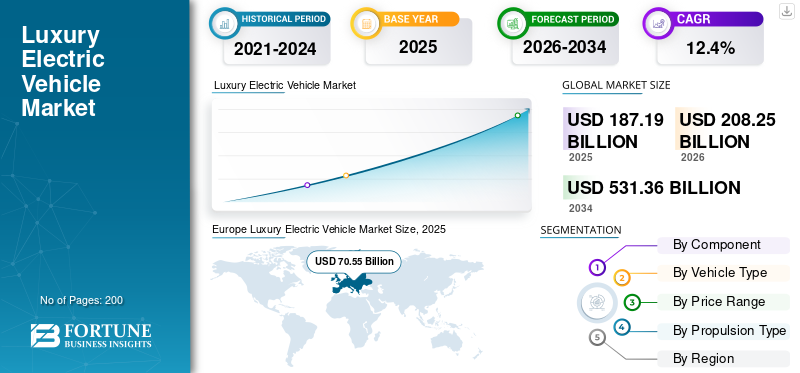
Download Free sample to learn more about this report.
Luxury Electric Vehicle Market KEY TAKEAWAYS
 Market Size & Forecast
- 2025 Market Size: USD 187.19 Billion
- 2026 Market Size: USD 208.25 Billion
- 2034 Forecast Market Size: USD 531.36 Billion
- CAGR: 12.4% from 2026–2034
 Market Share
- Europe dominated the luxury electric vehicle market with a 37.68% share in 2025.
- Infotainment & connectivity systems is the fastest-growing component segment.
- Mid luxury held the second-largest market share in 2025.
 Key Regional Highlights
Europe
Europe led the market due to strong EV regulations, premium vehicle demand, and advanced charging infrastructure.
Europe
North America ranked second, supported by technological innovation and rising luxury EV adoption.
Asia Pacific
Asia Pacific held the third-largest market share, driven by urbanization and government support for electric mobility.
U.S.
U.S. The market is estimated to reach USD 56.66 billion in 2026, accounting for around 27.2% of global revenue.
Japan
Japan The market is estimated to reach USD 5.58 billion in 2026, contributing approximately 2.7% of global revenue.
Read More

LUXURY ELECTRIC VEHICLE MARKET TRENDS
Expansion of Charging Infrastructure to Support Market Penetration
The rapid development of charging infrastructure across key regions such as North America, Europe, and the Asia Pacific is playing a critical role in boosting the adoption of electric vehicles. Governments and private players are investing in ultra-fast charging networks, improving accessibility and convenience for users. This expansion is reducing range anxiety and increasing consumer confidence in electric mobility. As infrastructure continues to improve, it is expected to positively impact market growth, market analysis, and long-term adoption trends in the luxury EV segment.
- In March 2026, Charge_iN by Mahindra partnered with HPCL to deploy EV charging stations across fuel outlets in India, leveraging HPCL’s network to expand infrastructure, enhance user convenience, and accelerate the adoption of electric vehicles nationwide.
Increasing Popularity of Luxury Electric SUVs is a Significant Market Trend
Luxury electric SUVs are emerging as a dominant trend in the global market, driven by their versatility, spacious interiors, and strong performance capabilities. Consumers are increasingly favoring SUVs over sedans due to their practicality and elevated driving experience. Automakers are responding by launching a wide range of electric SUVs across different price points, which is reshaping the vehicle type landscape. This trend is expected to significantly influence market demand and contribute to the expansion of the fastest-growing market segments.
- In November 2024, Mahindra announced the launch of two new luxury electric SUVs, featuring advanced battery technology, over 400 km driving range, and sustainable materials. The move is aimed at strengthening the company’s position in India’s rapidly growing electric vehicles market.
MARKET DYNAMICS
MARKET DRIVERS
Download Free sample to learn more about this report.
Rising Demand for Premium Sustainable Mobility to Accelerate Market Growth
The growing preference for environmentally friendly yet premium transportation solutions is significantly boosting the luxury electric vehicle market growth. High-income consumers are increasingly prioritizing sustainability without compromising on comfort, performance, or brand value. This shift is further supported by favorable government policies, tax incentives, and stricter emission regulations globally. As a result, luxury automakers are expanding their electric portfolios to meet the rising market demand while aligning with sustainability goals, thereby strengthening their market share during the forecast period.
- In July 2025, Li Auto launched its premium electric SUV i8 in China, featuring ultra-fast charging, up to 720 km driving range, and advanced AI systems, aiming to compete with Tesla and Nio in the market.
Technological Advancements in Battery and Connectivity to Enhance Vehicle Appeal
Continuous innovations in battery technology, including higher energy density and faster charging capabilities, are enhancing the driving range and overall performance of luxury electric vehicles. Additionally, the integration of AI, advanced driver assistance systems (ADAS), and connected infotainment features is transforming vehicles into technologically advanced mobility solutions. These advancements are attracting tech-savvy consumers and strengthening the value proposition of luxury EVs. Electric vehicle manufacturers are investing heavily in R&D, which is further fueling market growth and shaping long-term market trends.
- In March 2026, Lexus launched its first battery electric vehicle, ES500e, in India, featuring a 74.68 kWh battery, 580 km driving range, fast-charging capability, and an 8-year warranty.
MARKET RESTRAINTS
High Cost of Luxury Electric Vehicles May Limit Mass Adoption
Despite strong demand, the high upfront cost of luxury EVs remains a significant barrier to wider adoption. Advanced battery systems, premium materials, and cutting-edge technologies contribute to elevated prices compared to conventional vehicles. This limits accessibility to a niche consumer base and restricts market expansion in price-sensitive regions. Additionally, fluctuations in raw material prices for batteries further increase production costs. These factors collectively pose challenges to achieving broader market penetration during the forecast period.
MARKET OPPORTUNITIES
Growing Demand in Emerging Markets Creates Expansion Opportunities
Emerging economies in the Asia Pacific, Latin America, and the Middle East are presenting lucrative opportunities for the market. Rising disposable incomes, urbanization, and increasing awareness of sustainable mobility are driving the demand for premium electric vehicles. Governments in these regions are also introducing supportive policies and incentives to promote electric mobility. As a result, electric vehicle manufacturers are expanding their presence and distribution networks in these markets, making them key contributors to future growth over forecast period.
- In April 2026, Cadillac expanded its EV dealer network across Australia and New Zealand by partnering with local experts, increasing customer access, and supporting the launch of new luxury electric SUVs. The move intended to strengthen the company’s presence in the market.
Integration of Autonomous and Connected Technologies Unlocks New Value
The integration of autonomous driving capabilities and connected technologies is opening new avenues for innovation in the market. Features such as self-driving capabilities, real-time vehicle monitoring, and personalized user experiences are enhancing the appeal of luxury EVs. These advancements are improving safety and convenience and redefining the overall driving experience. As technology continues to evolve, it is expected to create new revenue streams and strengthen the competitive landscape within the electric vehicles industry.
- In February 2022, Jaguar Land Rover partnered with Nvidia to develop AI-powered and autonomous driving technologies. The deal focuses on integrating software-defined platforms, advanced driver assistance systems, and intelligent cockpit features into these technologies.
MARKET CHALLENGES
Supply Chain Constraints and Battery Material Dependency to Create Challenges for Market Expansion
The market faces significant challenges due to dependency on critical raw materials such as lithium, cobalt, and nickel for battery production. Supply chain disruptions, geopolitical tensions, and price volatility can impact production timelines and cost structures. Additionally, the limited availability of these materials may hinder the scalability of manufacturing operations. Electric vehicle manufacturers must address these challenges through strategic sourcing, recycling initiatives, and alternative battery technologies to ensure sustainable market growth and stability.
Segmentation Analysis
By Component
Battery Pack Segment Led the Market, fostered by its Vital Role in Vehicle Performance
Based on component, the market is segmented into battery pack, electric powertrain, charging system, infotainment & connectivity systems, ADAS & autonomous driving systems, and others.
The battery pack segment dominated the luxury electric vehicle market in 2025 due to its critical role in determining vehicle performance, driving range, and overall efficiency. High cost contribution and continuous innovation in energy density and fast-charging capabilities drive strong market demand. Electric vehicle manufacturers prioritize battery advancements, ensuring consistent investment, upgrades, and replacement demand across the global market.
- In April 2026, Hyundai launched an updated IONIQ 5 in India with an 84 kWh battery pack, offering up to 690 km driving range, enhanced safety features, and improved technology.
The infotainment & connectivity systems segment is the fastest-growing segment, projected to expand at a CAGR of 15.1% during the forecast period. The rising demand for technologically advanced, connected, and personalized in-car experiences is accelerating component adoption, especially by premium luxury vehicle buyers globally.
By Vehicle Type
Strong Consumer Preference for Premium Space and Performance to Boost SUVs Segment Growth
Based on vehicle type, the market is segmented into sedans, SUVs, hatchbacks, and others.
The SUVs segment dominates the market due to the strong consumer preference for spacious interiors, elevated driving position, and superior performance. Luxury electric SUVs offer enhanced driving range, advanced safety features, and versatility, making them highly attractive among high-income buyers. The increasing product launches and strong demand across North America and the Asia Pacific further sustain their market growth and expand their market share.
- In April 2026, BYD patented the design of its Leopard 8 plug-in hybrid luxury SUV in India, featuring advanced ADAS, hybrid powertrain, and up to 1,200 km combined range.
The sedans segment accounts for the second-largest market share and is projected to grow at a CAGR of 11.2% during the forecast period. The continued demand for premium comfort, aerodynamic efficiency, and executive mobility supports steady adoption in urban markets globally.
To know how our report can help streamline your business, Speak to Analyst
By Price Range
Affordability and Expanding Consumer Base to Spur Entry Luxury Segment Growth
Based on price range, the market is segmented into entry luxury, mid luxury, and ultra luxury.
The entry luxury segment dominates the market and is also the fastest growing segment due to its relatively accessible pricing and expanding consumer base. The increasing adoption of electric vehicles among upper-middle-income buyers, along with improved driving range and technologically advanced features, is driving strong demand. Electric vehicle manufacturers are focusing on this segment to scale volumes and strengthen their luxury electric vehicle market share.
- In April 2026, XPeng unveiled the GX flagship SUV with up to 750 km range, 800V platform, 5C supercharging, and L4-ready autonomous hardware, priced at approximately USD 58,000 with dual powertrain options.
The mid luxury segment holds the second-largest share and is projected to grow at a CAGR of 12.1% during the forecast period. Strong demand for balanced performance, premium features, and brand value continues to support steady adoption across developed markets.
By Propulsion Type
Zero-Emission Mobility Demand and Advancements in Battery Technology to Bolster BEVs Segment Growth
Based on propulsion type, the market is segmented into BEVs and HEVs.
The BEVs segment dominates the market and is also the fastest growing segment due to the rising demand for zero-emission mobility and continuous improvements in battery technology. Enhanced driving range, expanding charging infrastructure, and strong regulatory support are accelerating adoption. Electric vehicle manufacturers are prioritizing BEVs to strengthen market share and align with long-term sustainability goals across the global market.
- In April 2026, Mercedes-Benz launched the all-electric CLA BEV in India, targeting younger luxury buyers with advanced technology, premium design, and enhanced driving range.
The HEVs segment is projected to grow at a CAGR of 11.9% during the forecast period. Their dual powertrain capability offers flexibility and reduced range anxiety, supporting the steady demand for plug in hybrid electric vehicles (PHEV) and later in future fuel cell electric vehicle (FCEV), among consumers transitioning toward full electrification.
Luxury Electric Vehicle Market Regional Outlook
By geography, the market is categorized into Europe, North America, Asia Pacific, South America and the Middle East & Africa.
Europe
Europe Luxury Electric Vehicle Market Size, 2025 (USD Billion)
To get more information on the regional analysis of this market, Download Free sample
Europe dominates the global market share due to strong regulatory frameworks, early adoption of sustainable mobility, and the presence of leading electric vehicle manufacturers. Stringent emission norms and government incentives are accelerating the adoption of electric vehicles across premium segments. Countries such as Germany, the U.K., and France are witnessing high demand for battery electric vehicle models. Additionally, well-developed charging infrastructure and rising demand for technologically advanced luxury vehicle solutions are supporting sustained market growth and long-term market trends.
- In August 2025, Mercedes-Benz advanced the launch of its electric E-Class to 2027, introducing improved platform architecture, enhanced performance, and refined design.
Germany Luxury Electric Vehicle Market
The Germany market is estimated to reach around USD 18.69 billion in 2026, accounting for roughly 9.0% of the global market revenues. Strong OEM presence, strict emission norms, and innovation in battery electric vehicle technologies support growth.
U.K. Luxury Electric Vehicle Market
The U.K. market is estimated to touch around USD 15.23 billion in 2026, accounting for roughly 7.3% of the global market revenues. Government incentives, charging expansion, and increasing adoption of electric vehicles drive steady demand.
North America
North America holds the second largest position in the market, driven by strong consumer demand for high-performance luxury electric vehicles and rapid technological advancements. The region benefits from the presence of key electric vehicle manufacturers and continuous innovation in driving range and connectivity features. Increasing investments in charging infrastructure and favorable government policies are further boosting the electric vehicle industry. The growing popularity of plug-in hybrid electric vehicle (PHEV) and battery electric vehicle (BEV) models is also contributing to steady market demand and expansion.
- In April 2026, Lotus Technology expanded into Canada with the launch of its all-electric Eletre SUV, priced at USD 87,588, and unveiled a limited-edition model. The move would strengthen its presence in the market.
U.S. Luxury Electric Vehicle Market
The U.S. market is estimated to reach around USD 56.66 billion in 2026, accounting for roughly 27.2% of the global market revenues. Strong consumer demand, innovation, and the presence of leading electric vehicle manufacturers accelerate market growth.
Asia Pacific
Asia Pacific represents the third largest market share, supported by rapid urbanization, increasing disposable incomes, and strong government initiatives promoting electric mobility. Countries such as China, Japan, and India are witnessing the growing demand for electric vehicle adoption, particularly in premium categories. The region is emerging as a key manufacturing hub for electric vehicle manufacturers, driving cost efficiencies and innovation. Rising awareness regarding sustainability and improvements in charging infrastructure are further strengthening market growth and shaping regional market analysis.
- In October 2025, Hyundai announced plans to launch its Genesis luxury EV brand in India by 2027. The move is focused on locally assembled electric vehicles, advanced technology, and premium mobility solutions.
China Luxury Electric Vehicle Market
The China market is estimated to reach around USD 29.04 billion in 2026, accounting for roughly 13.9% of the global market revenues. Strong government support, domestic electric vehicle manufacturers, and high adoption of electric vehicles drive sustained growth.
Japan Luxury Electric Vehicle Market
The Japan market is estimated to touch around USD 5.58 billion in 2026, accounting for roughly 2.7% of the global market revenues. Growth is supported by hybrid transition strategies, innovation, and demand for technologically advanced premium vehicles.
India Luxury Electric Vehicle Market
In 2026, the India market is estimated to reach a valuation of around USD 1.73 billion, accounting for roughly 0.8% of the global market revenues. Rapid urbanization, policy incentives, and rising premium demand make it the fastest growing market.
South America
South America is projected to be the fastest-growing market, expanding at a CAGR of 18.0% during the forecast period. Increasing environmental awareness, supportive government initiatives, and gradual expansion of charging infrastructure are driving the adoption of electric vehicles. Growing interest in premium mobility and improving economic conditions are also contributing to the rising demand for the market. As infrastructure develops, the region is expected to create new opportunities for global players and enhance overall market growth.
- In March 2026, Cadillac entered the Brazilian market with three all-electric SUVs OPTIQ, LYRIQ, and VISTIQ, marking its expansion into South America and strengthening its presence in the global market.
Middle East & Africa
The Middle East & Africa represents a developing market with steady growth potential driven by rising investments in smart mobility and sustainable transportation. The increasing focus of oil-based economies on diversification and adoption of technologically advanced transportation solutions are supporting the electric vehicles industry. Premium consumers in countries such as the UAE and Saudi Arabia are showing growing interest in luxury EVs. However, infrastructure limitations remain a challenge, influencing the gradual yet consistent market demand across the region.
- In April 2026, Li Auto expanded globally through partnerships in the UAE and Saudi Arabia and announced entry into Asia Pacific markets. The move aimed at strengthening its position and presence with extended-range and premium electric vehicle offerings.
COMPETITIVE LANDSCAPE
Key Industry Players
Companies to Invest in Battery Innovation to Secure an Edge over Rivals
The market is moderately consolidated, with a mix of established luxury automakers and emerging electric vehicle manufacturers competing globally. Key players such as Tesla Inc., BMW Group, Mercedes-Benz Group AG, Audi AG, and Porsche AG focus on technologically advanced platforms, extended driving range, and premium design differentiation. Companies are investing in battery innovation, software-defined vehicles, and autonomous capabilities to gain a competitive edge. Strategic partnerships, platform sharing, and expansion into Asia Pacific and North America help strengthen market presence. Continuous product launches and innovation influence competition across the global market.
- In April 2026, BMW announced that its Munich plant would produce only all-electric vehicles from 2027, backed by major investments to improve efficiency and reduce costs.
LIST OF KEY LUXURY ELECTRIC VEHICLE COMPANIES PROFILED
- Tesla Inc. (U.S.)
- BMW Group (Germany)
- Mercedes-Benz Group AG (Germany)
- Audi AG (Germany)
- Porsche AG (Germany)
- Lucid Motors (U.S.)
- Rivian Automotive (U.S.)
- Jaguar Land Rover (U.K.)
- Volvo Cars (Sweden)
- Lexus (Japan)
- BYD Company Ltd. (China)
- NIO Inc. (China)
- XPeng Inc. (China)
- Polestar Automotive (Sweden)
- Genesis Motor (South Korea)
KEY INDUSTRY DEVELOPMENTS
- April 2026: Audi confirmed that the updated 2027 Q4 e-tron will continue in the U.S. lineup with a refreshed design and feature upgrades, despite declining sales. The move is centered on maintaining its offering in the compact luxury electric crossover segment.
- April 2026: Porsche unveiled the all-electric Cayenne Coupé Electric featuring up to 669 km WLTP range, 800V architecture, and up to 850 kW output, with fast-charging speeds reaching 390 kW for high-performance luxury SUV buyers.
- April 2026: Jaguar revealed its upcoming 4-door electric GT with over 700 km range, more than 1,000 hp output, and fast charging, adding 321 km in 15 minutes, with global debut scheduled for September 2026.
- April 2026: Volvo began the production of the EX60 electric SUV in Sweden, offering up to 810 km WLTP range and 10-80% charging in 16 minutes. The production is supported by a SEK 10 billion (USD 1.08 billion) investment in next-generation EV manufacturing.
- April 2026: Lucid unveiled the 2027 Gravity lineup, featuring enhanced standard features, advanced driver assistance systems, and premium customization options, with the Gravity Touring priced from USD 79,900.
- April 2026: Audi revealed the E7X electric SUV with up to 751 km driving range, 900V architecture, and ultra-fast charging enabling 429 km range in 10 minutes. The move aimed at targeting China’s premium EV segment with advanced performance and in-car technology.
- February 2026: Audi announced plans to launch an entry-level EV, likely the A2 e-tron, priced around USD 41,000, with 58-79 kWh battery options and up to 369 miles WLTP range, targeting the affordable luxury EV segment.
- February 2026: Polestar announced a four-model EV rollout from 2026 to 2028, including the Polestar 5 with 884 hp and 800V architecture, and the Polestar 7 SUV priced around USD 50,000, targeting multiple premium segments.
REPORT COVERAGE
The global luxury electric vehicle market analysis provides an in-depth study of the market size & forecast by all the market segments included in the market report. It includes details on the market dynamics and trends expected to drive the market over the forecast period. It offers information on technological advancements, new product launches, key automotive industry developments, and details on partnerships, mergers, and acquisitions. The market report scope also encompasses a detailed competitive landscape with information on the market share and profiles of key operating players.
Request for Customization to gain extensive market insights.
Report Scope & Segmentation
| ATTRIBUTE | DETAILS |
| Study Period | 2021-2034 |
| Base Year | 2025 |
| Estimated Year | 2026 |
| Forecast Period | 2026-2034 |
| Historical Period | 2021-2024 |
| Growth Rate | CAGR of 12.4% from 2026-2034 |
| Unit | Value (USD Billion) |
| Segmentation | By Component, By Vehicle Type, By Price Range, By Propulsion Type, and By Region |
| By Component |
|
| By Vehicle Type |
|
| By Price Range |
|
| By Propulsion Type |
|
| By Region |
|
Frequently Asked Questions
Fortune Business Insights says that the global market value stood at USD 187.19 billion in 2025 and is projected to reach USD 531.36 billion by 2034.
In 2025, the Europe market value stood at USD 70.55 billion.
The market is expected to exhibit a CAGR of 12.4% during the forecast period of 2026-2034.
The SUVs segment leads the market by vehicle type.
The rising demand for premium sustainable mobility is a key factor accelerating market growth.
Major players in the market include Tesla Inc., BMW Group, Mercedes-Benz Group AG, Audi AG, Porsche AG, Lucid Motors, Rivian Automotive, Jaguar Land Rover, Volvo Cars, and Lexus.
Europe holds the largest share of the market.



- 2021-2034
- 2025
- 2021-2024
- 200
-
(Offer valid till 15th Oct 2026)
Get 30-60 hrs Free Customization
Expand Regional and Country Coverage, Segments Analysis, Company Profiles, Competitive Benchmarking, and End-user Insights.




















Related Reports
-
US +1 833 909 2966 ( Toll Free )
-
Get In Touch With Us