Marine Battery Market Size, Share & Industry Analysis, By Battery (Lithium-ion, Fuel Cell, Lead-Acid Battery, Nickel-Cadmium, and Sodium-based), By Capacity (Less than 100Ah, 100-250Ah, and Greater than 250 Ah), By Design (Solid-state Battery and Flow Battery), By Application (Defense and Commercial), and Regional Forecast, 2026-2034
 Download Free Sample
KEY MARKET INSIGHTS
 Listen to Audio Version
The global marine battery market size was USD 1.67 billion in 2025 and is projected to grow from USD 2.10 billion in 2026 to USD 6.11 billion by 2034 at a CAGR of 16.50% during 2026-2034. Europe dominated the marine battery market with a market share of 40.40% in 2025.
Rising seaborne emissions, environmental hazards, particulates released from conventional fuel consumption, and climate change have pressured to evaluate and curb these emissions and pollution. International intergovernmental bodies such as United Nations on Climate Change and International Maritime Organization (IMO) on Sulphur Dioxides Emissions have formalized the regulations to curb these emissions.
The advancement in marine battery technology has increased the adoption rate of alternative propulsion and power sources. Adoption of this type of battery technology for fully electric and hybrid propulsion by commercial passenger vessels, leisure boat operators, ferries operators, and submarines has increased its operational efficiency. With the dwindling sources of lithium and geopolitics over lithium sources, the market players are pressurized to look for other power sources such as sodium-ion batteries that work on similar working principles as that of a lithium-ion marine battery. Sodium is abundantly available globally, which allows it to grow its market share in the market.
The ongoing COVID-19 pandemic strongly affected the marine industry, but market research has indicated moderate growth in 2020 and growth is expected over the forecast period.
•As new ship orders declined in 2018-2019, the ongoing COVID-19 pandemic impacted the global supply chain and a potential global economic slowdown, affecting cargo ship availability and supply chain disruptions. However, the growth in the need for battery technology for ships will increase during the forecast period.
• Due to the ongoing pandemic in the world, the growth of global markets and the growth of turnover of market participants have been significantly reduced due to delays in production and deliveries. It has also been affected by production shutdowns due to global shutdowns or limited capacity.
• Government or commercial market operator's budget for shipbuilding and industry development has decreased due to ongoing pandemic and associated spread of infrastructure costs.
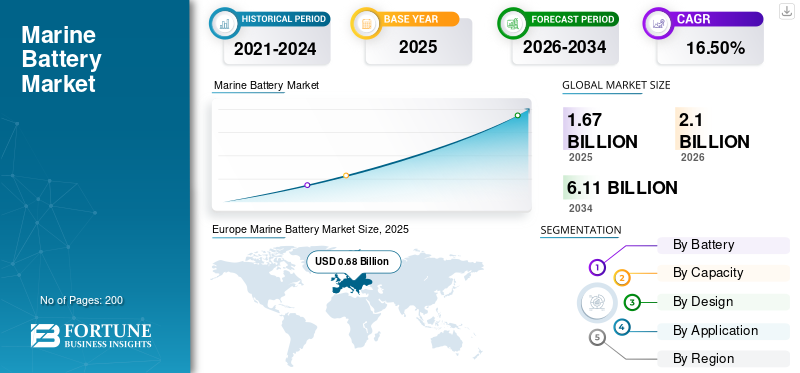
Download Free sample to learn more about this report.
MARINE BATTERY Market KEY TAKEAWAYS
 Global Market Size & Forecast
- 2025 Market Size: USD 1.67 billion
- 2026 Market Size: USD 2.10 billion
- 2034 Forecast Market Size: USD 6.11 billion
- CAGR: 16.50% from 2026–2034
 Market Share
- Europe dominated the marine battery market with a 40.40% share in 2025.
- Lithium-ion batteries are projected to hold a 35.95% share in 2026.
- Commercial applications are expected to account for 62.87% of the market in 2026.
 Key Regional Highlights
Europe
Europe reached USD 0.68 billion in 2025, accounting for 40.40% of the market.
Asia Pacific
Asia Pacific reached USD 0.43 billion in 2025, representing a 25.40% share.
North America
North America reached USD 0.37 billion in 2025, holding a 22.10% share.
U.S.
Market projected to reach USD 0.341 billion in 2026.
Japan
Market projected to reach USD 0.127 billion in 2026.
Read More

Marine Battery Market Trends
Implementation of IMO (International Maritime Organization) 2020 Sulfur Regulation to Boost Market Growth
Since January 2020, International Maritime Organization (IMO) has implemented a regulation to curb the growing sulfur dioxide emissions from Marine Vessels. IMO has implemented stringent regulation in four ECAS (Emission Control Areas) such as the Baltic Sea area, the North Sea area, the North American area, and the U.S. Caribbean Sea area. In these ECAS, the market is anticipated to experience demand for alternative marine power technologies and the high adoption rate of marine battery and relevant technologies. These factors are expected to propel the marine battery market growth.
Download Free sample to learn more about this report.
Marine Battery Market Growth Factors
Growing Maritime Trade due to High Demand for Alternative Supply Chain to Drive Market Growth
According to a Maritime Supply Chain Optimization study, world trade is highly dependent on maritime transport. Around 90% of products are traded through sea trade routes. Seaborne trade has been highly impacted, owing to the ongoing COVID-19 pandemic, the U.S.-China trade war, and the palpable churning of geoeconomics and geopolitics. These factors are forcing governments worldwide to evaluate and reconfigure the global supply chain and implement alternative marine power and propulsion systems during 2024-2032. An alternative global supply chain is anticipated to increase the number of vessels operating worldwide and modernize the existing fleet of vessels.
Rising Maritime Tourism and Need for Better Marine Infrastructure and Connectivity to Propel Market Growth
High demand for maritime tourism and the need for better marine infrastructure and connectivity are the major factors for the growth of marine industries, which is anticipated to generate significant revenues for developing and developed countries, mainly depending upon marine and coastal tourism. Better infrastructure and connectivity are crucial factors for increasing maritime and coastal tourism. Governments worldwide optimize their seaborne economy policies to provide environment-friendly marine tourism and better connectivity to different ports. These factors are anticipated to generate the market growth during 2024-2032.
RESTRAINING FACTORS
High Initial Cost and Limitation of Capacity and Range by Battery Powered Vessels to Restrain Market Growth
Electric propulsion systems involve higher initial costs than conventional propulsion systems due to the installation of relevant storage capacity and size of the battery storage, which limits the range of the electric propelled vessels. The battery technology has a long way to mature in the marine market due to the higher range and capacity of conventional marine fuels and propulsion systems. Also, electronic components are highly prone to failures due to corrosion which requires specialized coating and treatment and highly skilled human resources to operate. The cost factor has restricted more widespread adoption of electric propulsion technology.
Marine Battery Market Segmentation Analysis
By Battery Analysis
Lithium-ion Segment to Lead Market During Forecast Period Owing to its Proven Capacity and Reliable Technology
Based on battery, the market is divided into lithium-ion, fuel cell, lead-acid battery, nickel-cadmium, and sodium-based.
The lead-acid battery segment is anticipated to drive the market remarkably, with the largest market share in 2025. The growth is due to the high demand for electric propulsions for numerous commercial vessels by the commercial market players and commercial marine fleet operators. Increased demand for electric propulsion and the advent of maritime tourism drive the market growth.
The lithium-ion segment will witness significant growth due to growing demand for commercial vessels with electric propulsion across regions, especially IMO 2020's four ECAS. The rise in demand for lithium-ion battery-powered vessels across the industries also yields an eco-friendly, efficient, and reliable solution for their maritime operations. The lithium-ion segment is anticipated to hold a dominant market share of 35.95% in 2026.
The fuel cell segment is estimated to grow significantly during the forecast period due to the marine shipbuilders' adoption of fuel cell technology in their ships, such as Hyundai Heavy Industries and Toshiba Corporation, involved in developing reliable fuel cell technology.
The sodium-based segment is anticipated to grow at a significant CAGR during the forecast period due to highly abundant sources of sodium worldwide. Still, it has limited manufacturers, which are anticipated to grow. Lithium-ion and Sodium-based (Sodium-ion) batteries were developed simultaneously, but lithium-ion batteries had more commercial utilities than sodium-based batteries. With a dwindling supply of lithium over the next few decades, the battery manufacturers are adopting and advancing the sodium-based batteries that work on the same working process as lithium-ion batteries.
To know how our report can help streamline your business, Speak to Analyst
By Capacity Analysis
Greater than 250 Ah Segment to Lead Market Owing to High Demand for High Capacity Marine Batteries
Based on capacity, the market is divided into less than 100 Ah, 100-250 Ah, and greater than 250 Ah.
The greater than 250 Ah segment is anticipated to hold a dominant market share of 43.94% in 2026 due to the high demand for large-capacity batteries for electrically-propelled commercial vessels. With the advent of stringent governmental and international environmental policies on carbon and hazardous gaseous emissions, the utility of electric propulsion in marine vessels, passenger ships, and ferries increases.
The less than 100Ah segment is anticipated to be the second-largest segment during the forecast period due to leisure boats' high demand for these batteries and the high adoption rate of marine batteries due to the shift from conventional marine fuel-based propulsion. The 100-250Ah segment is anticipated to grow significantly during the forecast period due to the need for better maritime connectivity and demand for maritime passenger ships and ferries worldwide.
By Design Analysis
Flow Battery Segment to Propel Market During Forecast Period due to High Demand for Electric Propulsion for Various Marine Applications
Based on design, the market is segmented into the solid-state and flow battery.
The flow battery segment is anticipated to hold a dominant market share of 43.94% in 2026, owing to the rise in utility of electric propulsion for various applications, increase in the number of commercial vessels, and rise in maritime tourism worldwide. Though electric propulsion involves a higher initial cost, commercial marine vessel fleet operators have emphasized the utility of electric propulsion.
The solid-state battery segment has shown a significant market growth rate. It is the fastest-growing segment during the forecast period due to high demand for its marine applications, more extended range, low risk than flow batteries. Solid-state batteries such as sodium-based, lithium-ion batteries, and others have been reliable for many commercial vessel fleet operators worldwide. They have been the primary revenue-generating factors for market players.
By Application Analysis
Commercial Segment to Lead the Market During the Forecast Period due to High Adoption Rate of Marine Battery Technology
The global market is bifurcated into commercial and defense by application.
The commercial segment is anticipated to hold a dominant market share of 62.87% in 2026. The market growth is attributed to the rise in maritime tourism, changes in the governmental policies to optimize the seaborne economy, conversion of the propulsion system in the existing fleet with electric propulsion in IMO 2020's ECAS, rise in demand for marine services across commercial industries such as deep-sea mining, energy, and infrastructure, oil, and gas. Also, the utility of battery technology in the commercial sector has shown significant growth and is anticipated to grow during the forecast period.
The defense segment is anticipated to grow at a significant growth rate due to the rising number of defense shipping building programs, rise in the utility of the marine batteries in naval vessels by government and commercial naval shipyards, and rise in the defense budgets in China, India, the U.S., and the UAE despite the ongoing pandemic. The increase in utility of marine type of batteries in the submarines by defense organizations and forces is anticipated to grow the segment's market share during the forecast period.
REGIONAL INSIGHTS
This market is segmented into North America, Europe, Asia Pacific, and the Rest of the World.
Europe
Europe Marine Battery Market Size, 2025 (USD Billion)
To get more information on the regional analysis of this market, Download Free sample
Europe contributed approximately USD 0.68 billion to the global market in 2025, accounting for 40.40% share, and is expected to reach USD 0.85 billion in 2026. The growth is attributed to the high number of commercial marine vessels operators and market players and the vast supply chain network in Europe. The procurement of advanced electric propulsions for future marine vessels by the market players such as Wartsila, Akasol AG, Echandia AB, Siemens, Leclanche SA, and others. The rise in maritime tourism and adoption of electric propulsion in various marine applications drive the market growth. The UK market is projected to reach USD 0.19 billion by 2026, and the Germany market is projected to reach USD 0.126 billion by 2026.
North America
The market in North America reached USD 0.37 billion in 2025, representing 22.10% of total market revenue, and is projected to reach USD 0.46 billion in 2026. Increasing adoption of electric propulsion by government agencies such as NOAA, rising battery-powered marine vessels for commercial and governmental, and defense utilities, and high demand for these batteries across North America for leisure boats and recreational applications to drive the development of the market. The U.S. market is projected to reach USD 0.341 billion by 2026.
Asia Pacific
The Asia Pacific market is projected to grow at a moderate pace, owing to the presence of marine battery manufacturers such as Toshiba Corporation, Exide Industries Ltd., Korea Special Battery, Furukawa Battery Solutions, and others. These players drive the growth of the market in the Asia Pacific. The rest of the world, which encompasses Latin America and, the Middle East & Africa, will witness moderate growth due to the rise in the number of commercial marine vessels during the forecast period. The Japan market is projected to reach USD 0.127 billion by 2026, the China market is projected to reach USD 0.144 billion by 2026, and the India market is projected to reach USD 0.089 billion by 2026. In 2025, the Asia Pacific market stood at USD 0.43 billion, representing 25.40% of global demand, and is projected to grow to USD 0.53 billion in 2026.
Rest of the World
Rest of the World recorded a market size of USD 0.16 billion in 2025, capturing 12.00% of the global market share, and is projected to reach USD 0.2 billion in 2026.
KEY INDUSTRY PLAYERS
Advent of Advanced Battery Technologies for Next-Generation Electric Propulsion Development by Key Market Players to Propel Market Growth
The development of marine battery, technological advancements in marine batteries, and others are the upcoming trends in the market. A robust product portfolio, increment in R&D investments, and emphasis on mergers & acquisitions are the primary factors responsible for the dominance and high market share of key market players such as Wärtsilä Oyj Abp Siemens, Akasol AG, Leclanche S.A., and others.
List of Top Marine Battery Companies:
- Akasol AG (Germany)
- EnerSys (U.S.)
- Exide Industries Ltd. (India)
- Furukawa Battery Solutions Co. Ltd. (Japan)
- G.S. Yuasa Corporation (Japan)
- HBL Power Systems Ltd. (India)
- Johnson Controls International (Ireland)
- Leclanché SA (Switzerland)
- Saft Groupe S.A. (France)
- Siemens AG (Germany)
- Systems Sunlight SA (Greece)
- Toshiba Corporation (Japan)
- Wärtsilä Oyj Abp (Finland)
KEY INDUSTRY DEVELOPMENTS:
- September 2021 – Wartsila was awarded a contract by Zero Emissions Services BV (ZES) to deliver Warsila's mobile battery container solution to enable the Netherland's inland waterway vessels.
- May 2021 – Wartsila was selected by Maersk Supply Service to facilitate its Wartsila HY Module, a containerized hybrid battery solution and battery energy storage system for its fleet modernization.
REPORT COVERAGE
The global marine battery market report offers qualitative and quantitative insights on this market. It provides a detailed analysis of the market size & growth rate for all possible segments in the market. Along with this, the report provides an elaborative analysis of dynamics, COVID-19 effect, emerging trends, and competitive landscape in the market.
Key insights offered in the report are the adoption the marine battery market trends by individual segments, recent industry developments such as mergers & acquisitions, partnerships, consolidated SWOT analysis of key players, Porter's five forces analysis, business strategies of leading market players, micro and macroeconomic indicators, and the leading industry trends.
Request for Customization to gain extensive market insights.
Report Scope & Segmentation
|
ATTRIBUTE |
DETAILS |
|
Study Period |
2021-2034 |
|
Base Year |
2025 |
|
Estimated Year |
2026 |
|
Forecast Period |
2026-2034 |
|
Historical Period |
2021-2024 |
|
Growth Rate |
CAGR of 16.50% from 2026 to 2034 |
|
Unit |
Value (USD Billion) |
|
Segmentation |
By Battery
|
|
By Capacity
|
|
|
By Design
|
|
|
By Application
|
|
|
By Region
|
Frequently Asked Questions
Fortune Business Insights says that the market value stood at USD 2.10 billion in 2026 and is projected to reach USD 6.11 billion by 2034.
With a CAGR of 16.50%, the market will exhibit steady growth over the forecast period (2026-2034).
The lithium-ion segment is estimated to be the leading segment in this market during the forecast period.
The key factors driving the market are rise in maritime trade due to alternative seaborne supply chain policy-making, increase in maritime tourism and passenger transportation, and IMO 2020 sulfur regulations.
Siemens AG, Akasol AG, and Leclanche S.A. are the top players.
Europe dominated the marine battery market with a market share of 40.40% in 2025.
Rise in maritime trade due to alternative supply chain networks is the latest trend.



- 2021-2034
- 2025
- 2021-2024
- 200
Get 30-60 hrs Free Customization
Expand Regional and Country Coverage, Segments Analysis, Company Profiles, Competitive Benchmarking, and End-user Insights.




















Related Reports
-
US +1 833 909 2966 ( Toll Free )
-
Get In Touch With Us