Microserver Market Size, Share & Industry Analysis, By Component (Hardware and Services), By Form Factor (Rack-mounted, Blade, Tower, and Modular), By Enterprise Type (Large Enterprises and SMEs), By Application (Data Center, Cloud Computing, Media/Content Storage, and Others), and Regional Forecast, 2026-2034
 Download Free Sample
Microserver Market Overview
 Listen to Audio Version
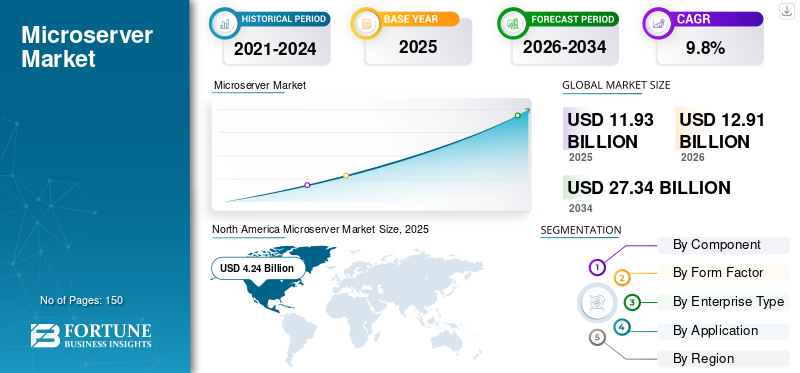
The global microserver market size was valued at USD 11.93 billion in 2025. The market is projected to grow from USD 12.91 billion in 2026 to USD 27.34 billion by 2034, exhibiting a CAGR of 9.8% during the forecast period. North America dominated the microserver market with a market share of 35.54% in 2025.
Microservers are small, energy-efficient server systems built to perform functions, such as hosting websites, edge computing, or processing data in small-scale situations where power consumption and space are at a premium. In comparison to traditional server systems, microservers have a lower price point than traditional server systems while meeting less demanding performance levels. Therefore, they are perfect for distributed computing environments and for use by small businesses. The growth of the market is fueled by an increasing demand for low-power and low-cost scalable computing solutions for both edge computing and cloud-based services, as well as the need for an economical means of processing data at the edge of the internet. This factor plays an important role in fueling the market growth.
Furthermore, many key market players, such as Hewlett Packard Enterprise (HPE), Dell Technologies, Intel Corporation, Advanced Micro Devices, Inc., and Lenovo Group Limited, operating in the market, are focusing on developing energy-efficient, high-performance microserver solutions tailored for edge computing and cloud infrastructure, while leveraging scalability and cost-effectiveness to meet the growing demand for distributed computing.
Download Free sample to learn more about this report.
Microserver Market KEY TAKEAWAYS
 Market Size & Forecast
- 2025 Market Size: USD 11.93 billion
- 2026 Market Size: USD 12.91 billion
- 2034 Forecast Market Size: USD 27.34 billion
- CAGR: 9.8% from 2026–2034
 Market Share
- North America dominated the microserver market with a 35.54% share in 2025.
- The services segment is anticipated to grow at the highest CAGR of 11.8% over the forecast period.
- The modular segment is anticipated to grow at the highest CAGR of 12.1% over the forecast period.
 Key Regional Highlights
North America
North America is estimated to reach approximately USD 4.59 billion in 2026, maintaining its leadership position in the global microserver market.
Europe
Europe is projected to reach USD 3.66 billion in 2026, driven by increasing enterprise digitalization and cloud deployment.
Asia Pacific
Asia Pacific is estimated to reach USD 3.17 billion in 2026 and is expected to register the highest CAGR during the forecast period.
U.S.
U.S. The market is analytically approximated at around USD 3.63 billion in 2026, accounting for roughly 28.1% of global sales.
Japan
Japan The microserver market is estimated at around USD 0.60 billion in 2026, supported by growing demand for energy-efficient computing solutions.
Read More

IMPACT OF GENERATIVE AI
Rising Demand for Generative AI in Edge Computing Driving Innovations in Market
Generative AI is significantly influencing the market by increasing demand for local AI inference and real-time data processing at the edge, where microservers are deployed for their energy efficiency and compact size. Therefore, as AI technology and applications such as Personal Digital Assistants (PDA), autonomous vehicles, and smart cities continue to increase in popularity, microservers will become an essential device for generating and processing large amounts of information using AI, thus reducing the amount of reliance on cloud-based services.
As a result, we are beginning to see a rapid increase in the need for AI-based hardware platform devices and edge computing solutions, causing manufacturers to develop new microservers with additional capabilities that contain built-in AI processing capabilities such as GPUs and TPUs. The need for faster processing with decreased latency are also driving the deployment of microservers into other industries such as healthcare, retail, and auto manufacturing. Therefore, the overall market for generative AI continues to grow, we will see that microservers will become more important in providing low-cost, low-power solutions for processing all types of AI-related activity at the edge of the network. For instance,
- In June 2023, Hewlett Packard Enterprise (HPE) launched the Apollo 4200 Gen10 Plus, a scalable, energy-efficient microserver designed to meet the increasing demand for edge computing and AI-powered workloads.
MICROSERVER MARKET TRENDS
Increasing Shift toward Edge Computing is Fueling Market Growth
Rising shift toward edge computing is accelerating the microserver market growth. More and more companies want to process data at the edge of their networks instead of sending it to a central location for processing in the Cloud. As a result, there is a growing demand for microservers that can provide low-latency and real-time data processing capabilities. Edge computing helps to solve bandwidth and latency problems when sending data to the Cloud. This is important for applications such as IoT, autonomous systems, and smart cities. Due to their small size and energy efficiency, microservers are well-suited for edge computing; therefore, they provide efficient and scalable solutions for processing AI-based workloads and sensor data locally. As companies in automotive, healthcare, and manufacturing continue to adopt edge computing technologies, demand for microservers will increase significantly in the future. For instance,
- In May 2025, SealingTech introduced the AegisEdge MicroServer, designed to provide cybersecurity and AI-driven edge computing for critical infrastructure. This product launch targets the increasing need for secure, low-latency data processing at the edge.
MARKET DYNAMICS
MARKET DRIVERS
Download Free sample to learn more about this report.
Proliferation of IoT and Smart Devices Drives Market Growth
The growth of Internet of Things (IoT) devices and smart devices is key in supporting the development of a growing market for cloud computing products. These smart devices generate vast amounts of data that must be processed at the source of the data; this is where microservers play their role in providing edge computing functionality by allowing the processing of this data in close proximity to its source. This allows for reduced latency and bandwidth use due to the need to transfer data to centralized cloud services.
With the growth of smart cities, smart homes, and industrial IoT applications, the need for compact and energy-efficient computing solutions, such as microservers, to support near real-time decision-making. In addition, localized processing of data is necessary for the functioning of autonomous systems and the execution of AI applications within the IoT ecosystem. Consequently, the scalable as well as cost effective nature of microservers continue to make them crucial for the ever-increasing number of connected devices globally. For instance,
- In February 2025, Supermicro announced a significant investment in expanding its microserver offerings focused on AI, IoT, and edge computing. This move aligns with the increasing need for cost-effective, high-performance solutions for processing IoT data locally.
MARKET RESTRAINTS
Compatibility and Integration Issues May Hinder Market Growth
The market faces the challenges of compatibility and integration when businesses shift from traditional servers to microserving. This often involves difficulty in integrating microserves into the legacy IT ecosystem as they may require specialized hardware or architecture that is not wholly compatible with existing systems and therefore, may incur additional cost due to required software changes and upgrades to existing hardware. These potential additional costs may grow even larger for companies needing to deploy large-scale/hybrid environments in order for microservers to work interactively between cloud and on-premises infrastructures.
MARKET OPPORTUNITIES
Rising Popularity of Miniaturization and Cost-Effectiveness Creating New Opportunities for Market Growth
By miniaturizing microservers, there is an opportunity for the market as it is possible to have a smaller size (i.e., overall footprint) with no reduction in performance, so that the server can fit into tight spaces. The costs associated with microservers are also appealing for those looking to expand their information technology infrastructure, given that traditional server deployments often involve substantial expense. Both factors will be especially attractive to small and medium sized enterprises (SMEs) and to distributed systems, where stability and efficient use of resources are primary considerations. Due to the increasing energy efficiency and cost of microservers, demand should grow across industries such as retail, healthcare, and education where small servers must be used for local processing of data. For instance,
- In May 2025, Supermicro announced its MicroCloud multi‑node server solutions built with AMD EPYC 4005 series processors, emphasizing performance density, scalability, and cost efficiency in a compact form factor suitable for cloud and edge deployments.
Segmentation Analysis
By Component
Efficiency and Cost-Effectiveness Driving Hardware Segment’s Dominance in Market
Based on component, the market is bifurcated into hardware and services.
Hardware segment is expected to account for the largest market share as it forms the foundation of microserver functionality, providing the essential processing power, storage, and networking capabilities. Businesses are looking for cost-effective and energy-efficient solutions to process their data at the edge and need compact pieces of hardware to effectively process workloads at the edge. This factor increases the demand for the hardware.
Services segment are anticipated to grow at the highest CAGR of 11.8% over the forecast period. This is owing to the increasing demand for managed services, cloud integration, and support for edge computing infrastructure, as businesses seek expert solutions for optimizing and managing their microserver deployments.
By Form Factor
Rack-Mounted Segment to Lead Market Owing to Scalability and High-Density Computing
Based on form factor, the market is divided into rack-mounted, blade, tower, and modular.
Rack-mounted segment is anticipated to account for the largest market share. This is owing to their ability to provide scalable, high-density computing in a compact footprint compared to other types of mounting systems. Ideal for data center environments, they represent an economical way for companies to use the space available in their data centers, increasing energy efficiency while supporting applications ranging from cloud computing to edge computing.
Modular segment is anticipated to grow at the highest CAGR of 12.1% over the forecast period. This is owing to their flexibility, allowing businesses to easily scale and customize their computing infrastructure to meet the growing demands of edge computing and cloud-based applications.
By Enterprise Type
Extensive IT Infrastructure and Investment in Scalable Solutions Driving Large Enterprises’ Dominance in Market
Based on enterprise type, the market is categorized into large enterprises and SMEs.
Large enterprises witnessed a dominating market share in 2025. This is due to their extensive IT infrastructure needs and ability to adopt scalable, high-performance microservers to handle large-scale data processing and cloud-based workloads. The combination of being able to invest in high-quality products and use advanced features will continue to give them a competitive edge over the other segments of this market.
SMEs are projected to grow at the highest CAGR of 11.7% over the forecast period. This is due to their increasing adoption of cost-effective, scalable microserver solutions that enable them to efficiently handle data processing and cloud-based workloads without the need for large, complex IT infrastructures.
By Application
To know how our report can help streamline your business, Speak to Analyst
Data Center Segment Dominated Due to Expansion of Digital Infrastructure
Based on application, the market is classified into data center, cloud computing, media/content storage, and others (industrial edge, etc.).
Data center segment held a dominating market share in 2025 as they operate highly connected digital economy spanning reservations, flight operations, maintenance systems, crew management, and passenger services, all of which require continuous cybersecurity protection. The rising frequency of ransomware and data breach incidents targeting airline IT infrastructure has further accelerated investment in network security, identity management, and real-time threat monitoring.
Cloud computing segment is anticipated to grow at the highest CAGR of 11.4% during the forecast period. This is owing to the increasing shift toward digital transformation, with businesses adopting cloud-based microservers to enhance flexibility, scalability, and cost-efficiency in their IT infrastructure.
Microserver Market Regional Outlook
By geography, the market is categorized into North America, South America, Europe, the Middle East & Africa, and Asia Pacific.
North America
North America Microserver Market Size, 2025 (USD Billion)
To get more information on the regional analysis of this market, Download Free sample
North America held the largest microserver market share in 2024, valuing at USD 3.98 billion, and also maintained the leading share in 2025, with USD 4.24 billion. The market in North America is expected to increase, owing to its excellent IT infrastructure, adoption rates of cloud computing, and large data center expansion investments. North America has dominated the market as a result of the demand for high-performance, energy-efficient microservers needed for large-scale digital transformation efforts. For instance,
- In January 2026, The U.S. Air Force awarded General Dynamics Information Technology (GDIT) a contract to deploy a zero-trust security solution across nearly 200 bases, reinforcing sustained cyber modernization spend tied to defense aviation infrastructure.
U.S. Microserver Market
Based on North America’s strong contribution and the U.S. dominance within the region, the U.S. market can be analytically approximated at around USD 3.63 billion in 2026, accounting for roughly 28.1% of global sales.
To know how our report can help streamline your business, Speak to Analyst
Europe
Europe is projected to record a growth rate of 9.0% in the coming years, which is the second highest among all regions, and reach a valuation of USD 3.66 billion by 2026. The market in Europe is experiencing growth, owing to the use of energy efficient computing solutions, driven by both sustainability goals and the desire for green IT. Similarly, the expansion of data centers due to cloud computing and edge applications is creating a strong demand for affordable, scalable microserver solutions throughout the region. For instance,
- In June 2025, Supermicro launched its MicroCloud multi-node server solutions in France, focusing on AI and edge computing, further strengthening its position in the Europe region.
U.K. Microserver Market
The U.K. market is estimated at around USD 0.72 billion in 2026, representing roughly 5.6% of global revenues.
Germany Microserver Market
Germany’s market is projected to reach approximately USD 0.68 billion in 2026, equivalent to around 5.3% of global sales.
Asia Pacific
Asia Pacific region is estimated to reach USD 3.17 billion in 2026 and expected to grow at the highest CAGR during the forecast period. This is owing to rapid growth in cloud computing and the increasing need for energy-efficient solutions in datacenters around China, India, and Japan. In addition, as automotive industry and smart cities continue to develop edge computing applications, there is greater demand for cost effective and scalable microservers to enable localized data processing. For instance,
- In September 2025, Delaplex Limited and BSNL signed an MoU to roll out a nationwide edge micro data center network in India, leveraging compact server infrastructure to expand low‑latency digital services, supporting MSMEs and regional compute needs.
Japan Microserver Market
The Japan market is estimated at around USD 0.60 billion in 2026, accounting for roughly 4.6% of global revenues. This is owing to the country's strong focus on advanced technology adoption, including cloud computing, AI, and IoT, which requires efficient, scalable, and low-power server solutions. Furthermore, with Japan's rapid technological change, there are many different government initiatives that support edge computing and smart cities, which is further increasing the need for micro servers in both business/enterprise and industrial settings.
China Microserver Market
China’s market is projected to be one of the largest globally, with 2026 revenues estimated at around USD 0.74 billion, representing roughly 5.7% of global sales.
India Microserver Market
The Indian market is estimated at around USD 0.43 billion in 2026, accounting for roughly 3.3% of global revenues.
South America
South America is expected to witness moderate growth in this market during the forecast period. The South America market is set to reach a valuation of USD 0.67 billion in 2026. This is owing to increasing investments in cloud computing, data centers, and edge computing applications, driven by the region's demand for cost-effective and scalable computing solutions to support digital transformation.
Brazil Microserver Market
The Brazil market is estimated at around USD 0.31 Billion in 2026, accounting for roughly 2.4% of global sales.
Middle East & Africa
The Middle East & Africa is estimated to reach USD 0.87 billion in 2026 and expected to grow at a prominent growth rate in the coming years. This is owing to increasing investments in digital infrastructure and cloud services, particularly in the Gulf Cooperation Council (GCC) countries, which are driving demand for scalable, energy-efficient computing solutions. Moreover, the rise of smart cities and IoT applications are creating plenty of opportunities for need of edge Compute; where micro serve plays a critical role in allowing localized processing of data.
- In May 2025, Saudi Arabia allocated USD 5 billion for cybersecurity enhancements in the defense sector, part of its Vision 2030 plan, to ensure the protection of aerospace systems and infrastructure.
GCC Microserver Market
The GCC is set to reach a value of USD 0.26 billion in 2026.
COMPETITIVE LANDSCAPE
Key Industry Players
Focus on Expanding Product Portfolio by Key Players to Propel Market Growth
The global microserver market holds a semi-consolidated market structure, with prominent players such as Hewlett Packard Enterprise (HPE), Dell Technologies, Intel Corporation, Advanced Micro Devices, Inc., and Lenovo Group Limited holding significant positions. These companies are driving market growth through continuous strategic initiatives, including the integration of AI-powered microserver solutions, expansion of edge computing applications, and the development of energy-efficient computing platforms. Partnerships with cloud service providers, telecom operators, and edge infrastructure developers are crucial in this expansion, particularly for enabling cost-effective, low-latency data processing solutions.
Other notable players in the global market include Fujitsu Ltd., Supermicro, Tyan Computer Corporation, Oracle Corporation, and ASRock Rack. These companies are expected to increase focus on next-generation microserver technologies, particularly ARM-based solutions, AI accelerators, and edge data center solutions, to reinforce their market positioning and expand their global presence throughout the forecast period.
LIST OF KEY MICROSERVER COMPANIES PROFILED IN REPORT
- Hewlett Packard Enterprise (HPE) (U.S.)
- Dell Technologies (U.S.)
- Intel Corporation (U.S.)
- Advanced Micro Devices, Inc. (U.S.)
- Lenovo Group Limited (China)
- Fujitsu Ltd. (Japan)
- Supermicro (U.S.)
- Tyan Computer Corporation (Taiwan)
- Oracle Corporation (U.S.)
- ASRock Rack(Taiwan)
KEY INDUSTRY DEVELOPMENTS
- November 2025: Supermicro launched AI-optimized microserver solutions in China, aiming to support the region’s expanding cloud infrastructure and AI-driven workloads at the edge.
- May 2025: Supermicro announced a USD 20 billion partnership with DataVolt to supply GPU platforms and rack systems for AI‑centric data campuses in Saudi Arabia and the U.S., reflecting large‑scale investment in server infrastructure aligned with growing edge and cloud workload.
- May 2025: SealingTech launched its AegisEdge MicroServer and expanded its reach through a collaboration with MAW Telecom International in Poland to strengthen critical infrastructure defenses in Eastern Europe.
- April 2025: Fujitsu Ltd. expanded its strategic collaboration with Supermicro to launch the PRIMERGY GX2570 M8s, featuring high‑performance GPU servers and integrated management tools for enterprise generative AI infrastructure, helping customers deploy scalable compute without owning hardware.
- April 2025: Intel announced a strategic partnership with Alibaba Cloud to enhance edge computing and microserver capabilities across Asia Pacific, focusing on AI-driven deployments for the region’s expanding cloud and IoT infrastructure.
- January 2025: At Consumer Electronics Show (CES 2025), Intel Corporation unveiled a new processor platforms with advanced AI performance and efficiency that support enterprise and edge computing, aligning with trends in microserver adoption for localized workloads.
- June 2024: ASRock Rack unveiled several AI‑optimized server platforms leveraging NVIDIA Blackwell architecture at COMPUTEX 2024, including liquid‑cooled GPU server systems designed for high‑performance inference and low TCO in data processing and edge computing environments.
REPORT COVERAGE
The global microserver market analysis includes a comprehensive study of the market size & forecast by all the market segments included in the report. It includes details on the market dynamics and market trends expected to drive the market over the forecast period. It provides information on key aspects, including an overview of technological advancements, pipeline candidates, the regulatory environment, and product launches. Additionally, it details partnerships, mergers & acquisitions, as well as key industry developments and prevalence by key regions. The global market research report also provides a detailed competitive landscape with information on the market share and profiles of key operating players.
Request for Customization to gain extensive market insights.
Report Scope & Segmentation
| ATTRIBUTE | DETAILS |
| Study Period | 2021-2034 |
| Base Year | 2025 |
| Estimated Year | 2026 |
| Forecast Period | 2026-2034 |
| Historical Period | 2021-2024 |
| Growth Rate | CAGR of 9.8% from 2026-2034 |
| Unit | Value (USD Billion) |
| Segmentation | By Component, Form Factor, Enterprise Type, Application, and Region |
| By Component |
|
| By Form Factor |
|
| By Enterprise Type |
|
| By Application |
|
| By Region |
|
Frequently Asked Questions
According to Fortune Business Insights, the global market value stood at USD 11.93 billion in 2025 and is projected to reach USD 27.34 billion by 2034.
In 2025, the North Americas market value stood at USD 4.24 billion.
The market is growing at a CAGR of 9.8% during the forecast period of 2026-2034.
By application, the data center segment is expected to lead the market.
Proliferation of IoT and smart devices drive the market growth.
Hewlett Packard Enterprise (HPE), Dell Technologies, Intel Corporation, Advanced Micro Devices, Inc., and Lenovo Group Limited are the major players in the global market.
North America held the largest market share in 2025.



- 2021-2034
- 2025
- 2021-2024
- 150
Get 30-60 hrs Free Customization
Expand Regional and Country Coverage, Segments Analysis, Company Profiles, Competitive Benchmarking, and End-user Insights.




















Related Reports
-
US +1 833 909 2966 ( Toll Free )
-
Get In Touch With Us