Mini Dresses Market Size, Share & Industry Analysis, By Product Design (Bodycon, A-line/Fit & Flare, Shift Mini Dresses, and Others), By Fabric (Polyester & Synthetic Blends, Cotton & Cotton Blends, Satin & Silk, and Others), By Age Group (Teenagers, Young Adults, Adults, and Above 45 Years), By Occasion (Casual Wear, Party & Club Wear, Vacation/Resort Wear, and Others), By Price Range (Economy, Mid-Range, and Premium/Luxury), By Distribution Channel (Specialty Apparel Stores, Department Stores, Online Retail, and Others), and Regional Forecast, 2026-2034
 Download Free Sample
(Offer valid till 31st Oct 2026)

Mini Dresses Market Size and Future Outlook
 Listen to Audio Version
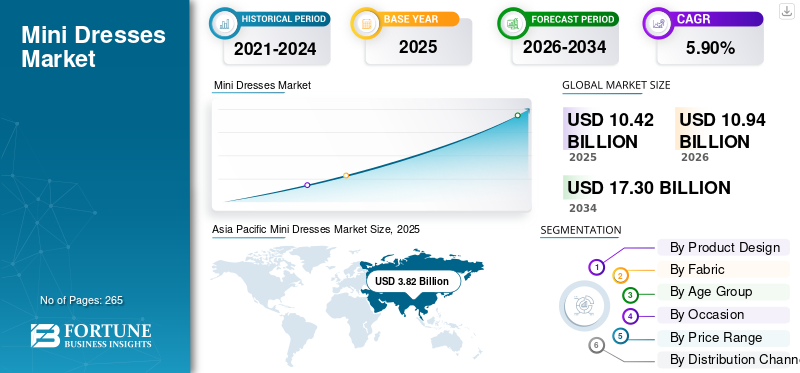
The global mini dresses market size was valued at USD 10.42 billion in 2025 and is projected to grow from USD 10.94 billion in 2026 to USD 17.30 billion by 2034, exhibiting a CAGR of 5.90% during the forecast period. Asia Pacific dominated the mini dresses market with a market share of 36.66% in 2025.
The global market is growing exponentially, driven by increasing demand for fashionable and adaptable clothes for everyday wear, parties, vacations, and other events. This growth is triggered by contemporary fashion trends and style cues from celebrities and influencers, increasing e-commerce penetration, and a growing preference for affordable yet fashionable items. Mini dress manufacturers offer varied sizes and shapes of trendy short dresses, including different materials and prints, in order to cater to the needs of young consumers and stylish working women. The seasonal demand for summer dress collection and spring dress collection remains high, but there is also the potential of using such dresses as an opportunity category for luxury brands.
Players dominating the market include Industria de Diseño Textil, S.A., H&M Hennes & Mauritz AB, ASOS plc, Mango Fashion Group, and SHEIN Group. The growth is attributed to effective digital presence along with stylish and luxury women’s clothing lineups. One of the key strategies employed by the aforementioned competitors is the constant introduction of new products via omnichannel retailing, involving collection refreshment, enhancing digital channels, and leveraging digital styling to address dynamic consumer needs. The fashion offering, along with store/online experience, stands out as a competitive advantage of Inditex, while ASOS and Mango focus on innovation and a multi-channel ecosystem.
Download Free sample to learn more about this report.
Mini Dresses Market Key Takeaways
 Global Market Size & Forecast
- 2025 Market Size: USD 10.42 billion
- 2026 Market Size: USD 10.94 billion
- 2034 Forecast Market Size: USD 17.30 billion
- CAGR: 5.90% from 2026–2034
 Market Share
- Asia Pacific dominated the mini dresses market with a 36.66% share in 2025.
- The bodycon segment dominated the market by product design in 2025.
- The polyester & synthetic blends segment led the market by fabric in 2025.
 Key Regional Highlights
Asia Pacific
Asia Pacific led the market with USD 3.82 billion in 2025 and is projected to grow at a 7.19% CAGR during the forecast period.
North America led the global market with a 49.53% share in 2025.
North America ranked second, reaching USD 2.78 billion in 2025 and is expected to expand at a 5.20% CAGR.
Europe
Europe accounted for USD 2.61 billion, representing 25.06% of the global market in 2025.
U.S.
The market reached USD 1.81 billion in 2025, accounting for 17.41% of global market revenues.
Japan
The market was valued at USD 0.33 billion in 2025, representing approximately 3.15% of global market revenues.
Read More

MINI DRESSES MARKET TRENDS
Social Media-Led Fast Fashion Emerges as Key Trend Among Gen Z and Millennial Consumers
The introduction of social media and celebrity styling has ensured that mini dress fashion is increasingly demanded by making viral looks turn into instant shopping decisions. In light of younger generations looking for more economical and on-trend pieces that are ready to wear for occasions, there has been a response from the brands in the form of constant collection drops, collaborations with influencers and virtual releases.
MARKET DYNAMICS
MARKET DRIVERS
Download Free sample to learn more about this report.
Rising Demand for Occasional and Social Wear to Boost Market Growth
An increased interest in attending parties, going on holidays, having a night out, and other informal celebrations is one of the primary factors that fuel the high demand for mini dresses, leading to market growth. With today's young women looking to purchase fashionable and photogenic clothes that can be easily styled, sleeveless mini dresses become an obvious choice for any event. Therefore, clothing brands regularly introduce new trends in different materials and styles of mini dresses at different price points. As a result, higher rates of changing wardrobes, more purchases via the Internet, and impulse buying behavior of consumers favor market expansion.
MARKET RESTRAINTS
Limited Versatility across Seasons and Settings to Hamper Market Growth
Growing consumer demand for practical and comfort-oriented clothing stands as a restraint to the adoption of mini dresses, especially in conservative work environments and mature markets. Consumers’ growing interest in midi and maxi dresses, which are more versatile and provide greater coverage, could translate into longer clearance times, deeper seasonal discounts, and lower follow-on purchases for retailers, hampering overall market growth.
MARKET OPPORTUNITIES
Expansion of Inclusive and Sustainable Collections to Generate Growth Opportunities
The increasing need for clothing that caters to diverse sizes and sustainable practices provides an excellent opportunity for the mini dresses market growth. Brands could capitalize on their potential by offering extended sizes, using recycled material, and having transparent supply chain practices. This will foster consumer trust, appeal to the younger generation, and justify high prices. In turn, sustainable and inclusive offerings could continuously grow the consumer base, decrease hesitation about purchases, and build strong consumer loyalty.
MARKET CHALLENGES
Intense Competition and Margin Pressure to Pose a Market Challenge
The intense rivalry from fast-fashion businesses, private labels, and pure-play Internet retailers constitutes a significant barrier to the operations of mini dress companies. Given that consumers consider pricing, discount, design, and shipment among other things from a host of websites, western wear apparel companies have to continually engage in price cuts and heavy expenditure on marketing in order to stay competitive.
Segmentation Analysis
By Product Design
Strong Partywear and Social Media Demand Attributed to Growth of Bodycon Segment
By product design, the market is segmented into bodycon, A-line/fit & flare, shift mini dresses, and others.
The bodycon segment dominated the mini dresses market share in 2025, as they are mostly favored for occasions such as partywear, clubwear, evening wear, and fashionable looks on social media. The fitted nature of these dresses ensures that they create an audacious and fashionable appearance. Consumers are motivated to buy them through the promotion of bodycon dress styles by influencers and celebrities owing to their tendency to often update their fashion sense with new purchases.
To know how our report can help streamline your business, Speak to Analyst
The A-line/fit & flare segment is anticipated to rise at the second-fastest CAGR of 6.01% over the forecast period.
By Fabric
Affordability and Design Flexibility Led to Dominance of Polyester & Synthetic Blends Segment
Based on fabric, the market is divided into polyester & synthetic blends, cotton & cotton blends, satin & silk, and others.
The polyester & synthetic blends segment dominated the market in 2025 in terms of revenue since they provide the advantage of being cheap to manufacture, durable, wrinkle-free, and adaptable for color printing purposes. This enables fashion designers to make mini dresses in line with the latest trends that are affordable for consumers. Since the fast fashion industry extensively utilizes synthetic materials to launch new collections frequently, consumers gain access to trendy and affordable designer mini dresses.
The satin & silk segment is anticipated to rise at the fastest CAGR of 7.00% over the forecast period.
By Age Group
High Fashion Engagement and Exposure to Social Trends Fueled Young Adults Segment Growth
Based on age group, the market is divided into teenagers, young adults, adults, and above 45 years.
The young adults segment captured the dominant market share in 2025 due to their strong inclination toward social media trends, celebrity looks, nightclub fashion, and holiday outfits. This is owing to young adults having greater financial capacity compared to teenagers and an increased tendency to change clothes for events more often. With brands focusing on marketing products to this age bracket through fast fashion releases and influencer marketing, there will be increased product visibility and impulse buys.
The teenagers segment is anticipated to rise at the second-fastest CAGR of 5.87% over the forecast period.
By Occasion
Everyday Styling and Higher Purchase Frequency Boosted Growth of Casual Wear Segment
Based on occasion, the market is divided into casual wear, party & club wear, vacations/resort wear, and others.
Casual wear segment captured the dominant market share in 2025 in terms of value share, driven by the growing consumer preference for dresses that can be easily styled for everyday use, such as going out, shopping, having brunch, going to college, and informal parties. Since casual mini dresses can be worn for a variety of occasions compared to party wear dresses, club wear, and resort wear dresses, there is increased repeat purchase, thus making them revenue leaders.
The party & club wear segment is anticipated to rise at the fastest CAGR of 6.65% over the forecast period.
By Price Range
Value-driven Fashion Demand Boosted Growth of Mid-Range Segment
By price range, the market is segmented into economy, mid-range, and premium/luxury.
The mid-range segment dominated the market in terms of revenue share in 2025, as customers tend to favor stylish and high-quality dresses that are relatively cheaper compared to luxury or premium brands. The category targets young adults as well as working women who buy mini dresses regularly for casual, party, vacation, and seasonal wear. With the launch of trendier products made from high-quality fabrics and frequent launches at affordable prices, consumers keep buying repeatedly.
The premium/luxury segment is anticipated to rise at the fastest CAGR of 6.64% over the forecast period.
By Distribution Channel
Convenience and Digital Fashion Discovery Led to Growth of Online Retail Segment
Based on distribution channel, the market is segmented into specialty apparel stores, department stores, online retail, and others.
Online retail segment held the dominant share of revenue in 2025, due to changing preferences of consumers who favor online shopping of fashion wear through e-commerce sites, brand sites, and shopping apps. There are more product varieties and discounts available, size variations are greater, the latest trends are easily accessible, and pricing is more easily comparable on online channels than in most physical retail stores. The sales on social media through direct promotion and influencer-style drives traffic to convert into sales.
The others segment is projected to grow at the second-fastest CAGR of 5.34% during the forecast period.
Mini Dresses Market Regional Outlook
By geography, the market is categorized into Europe, North America, Asia Pacific, South America, and the Middle East & Africa.
Asia Pacific
Asia Pacific Mini Dresses Market Size, 2025 (USD Billion)
To get more information on the regional analysis of this market, Download Free sample
Asia Pacific dominated the global mini dresses market, reaching USD 3.82 billion in 2025 and growing at a CAGR of 7.19% during the forecast period. Rising youth population, increasing disposable income of consumers, a growing strong sense of fashion influenced by social media trends, and strong demand for affordable trend-led apparel in China, India, Japan, and South Korea drive regional market expansion. China remained the world’s largest online retail market in 2024, with online retail sales reaching about USD 2.16 trillion, supporting wider digital fashion purchases.
Japan Mini Dresses Market
The Japanese market was valued at USD 0.33 billion in 2025, accounting for roughly 3.15% of global market revenues. Growth in Japan’s market for mini dresses can be attributed to strong urban fashion culture, youth-focused trend adoption, and rising digital apparel purchases through mature e-commerce channels. Furthermore, the growth is supplemented by tourism-led fashion retail demand in cities such as Osaka, Kyoto, and Tokyo, as the country logged around 36.9 billion international tourists in 2024, increasing shopping and occasion wear purchases.
China Mini Dresses Market
The market was valued at USD 1.06 billion in revenues in 2025, representing roughly 10.18% of global market sales.
India Mini Dresses Market
The market size was valued at USD 1.22 billion in 2025, accounting for roughly 11.70% of global market revenues.
North America
North America ranked second in the global market, valued at USD 2.78 billion in 2025 and is projected to grow at a CAGR of 5.20% in the coming years. The region’s growth can be attributed to the high impact of social media, robust expenditure on fashion, and increasing demand for occasion-appropriate clothing. American consumers are opting for mini dresses for casual outings, attending parties or vacations, and seasonal outings. The presence of fast-fashion retailers, luxury brands, and e-commerce sites ensures easy access to such products.
U.S. Mini Dresses Market
With North America’s strong contribution and the U.S. dominance in the region, the U.S. market reached USD 1.81 billion in 2025, accounting for roughly 17.41% of global market sales. The strong online fashion spending, influencer-led styling trends, and rising demand for versatile casual, partywear, and vacation-ready apparel among consumers drive U.S. market growth.
Europe
Europe held the third-largest share in 2025, valued at USD 2.61 billion, accounting for 25.06% of the global market. The strong online fashion adoption and high fashion consciousness across France, Italy, Spain, and the U.K., where consumers frequently purchase trend-led casual, partywear, and vacation outfits, drives the European market growth. For instance, Eurostat reported that clothing, shoes, and accessories were the most frequently purchased online goods in the European Union in 2024, supporting the online fashion adoption driver.
U.K. Mini Dresses Market
The U.K. market reached USD 0.40 billion in 2025, representing roughly 3.84% of global market revenues.
Germany Mini Dresses Market
The market reached USD 0.52 billion in 2025, equivalent to around 5.00% of global market sales.
South America and Middle East & Africa
The South America and the Middle East & Africa markets are expected to witness moderate growth during the forecast period. The South American market reached USD 0.70 billion in 2025. The expanding youth population, coupled with rising fashion consciousness, growing e-commerce penetration, and strong social media influence, particularly in Brazil and Argentina, where young consumers increasingly purchase affordable, trend-led casual and partywear apparel, drives market development in the region.
UAE Mini Dresses Market
The UAE market reached USD 0.06 billion in 2025.
South Africa Mini Dresses Market
The market reached USD 0.09 billion in 2025, representing roughly 0.91% of global market revenues.
COMPETITIVE LANDSCAPE
Key Industry Players
Key Players to Focus on Product Innovation and Social Commerce to Shape Market Expansion
Some notable companies, including Industria de Diseño Textil, S.A. (Zara/Inditex), H&M, ASOS, Mango, SHEIN, and Boohoo Group plc, attempt to establish their leadership in the market with a wide variety of fashionable items at low costs. The key features stressed by market leaders include continuous release of fresh product lines, marketing efforts using social influencers, omnichannel selling, and fast time-to-market processes when trying to respond to ever-evolving fashion tastes. Sustainability of products, provision of sizes suitable for different body shapes, possibilities of customizing products, as well as efficient logistics and return policies, may contribute toward securing customer loyalty. With more people relying on social media when deciding what to purchase, the organizations that will pay special attention to innovations in social commerce, mobile applications, and merchandise management based on data will be able to hold major share in the market.
LIST OF KEY MINI DRESSES COMPANIES PROFILED IN REPORT
- Industria de Diseño Textil, S.A. (Inditex/Zara) (Spain)
- H&M Hennes & Mauritz AB (Sweden)
- Mango Fashion Group (Spain)
- ASOS plc (U.K.)
- SHEIN Group (Singapore)
- Debenhams Group / Boohoo Group plc (U.K.)
- Fast Retailing Co., Ltd (Japan)
- Urban Outfitters, Inc. (U.S.)
- Revolve Group, Inc. (U.S.)
- Abercrombie & Fitch Co. (U.S.)
KEY INDUSTRY DEVELOPMENTS
- June 2026: Marks & Spencer offers a cotton-rich striped knitted mini dress under its Autograph collection, positioning the style around breathable fabric, slim fit, playful ruffled details, and casual summer dressing. This reflects the brand’s focus on travel-friendly and easy-to-wear premium casual mini dresses.
- May 2026: Mango partnered with Hailey Bieber for its Summer 2026 campaign, launching an exclusive collection available across selected stores and online channels, including effortless mini dresses inspired by Los Angeles street style. The initiative supports Mango’s 2024–2026 4E Strategic Plan by strengthening brand elevation and celebrity-led consumer engagement.
- October 2025: ASOS strengthened its Arrange party wear line with statement dresses, including a red bandeau mini dress. The initiative supported ASOS’s strategy of building exclusive in-house fashion labels with inclusive sizing and occasion-led designs to improve differentiation in online apparel retail.
- October 2025: Mango launched Kaia Gerber’s third Mango party collection, featuring after-dark essentials including a black mini dress styled for holiday-season occasions. The collaboration used celebrity-led storytelling and party wear styling to strengthen Mango’s visibility in premium, accessible occasion wear.
- April 2025: Zara reintroduced its viral pink mini dress in a refreshed floral version for summer 2025. The move allowed Zara to capitalize on proven consumer demand, social media recall, and affordable vacation wear styling, strengthening its fast-response product strategy.
REPORT COVERAGE
The global mini dresses market analysis includes a comprehensive study of the market & forecast by all the market segments included in the report. This qualitative and quantitative report includes details on the market dynamics and trends that are expected to drive the market over the forecast period. It provides information on key aspects, including product launches. Additionally, it details partnerships, mergers & acquisitions, and key industry developments. The global research report combines the outlook for the market with a detailed competitive landscape, including market share and profiles of key players.
Request for Customization to gain extensive market insights.
Report Scope & Segmentation
| ATTRIBUTE | DETAILS |
| Study Period | 2021-2034 |
| Base Year | 2025 |
| Estimated Year | 2026 |
| Forecast Period | 2026-2034 |
| Historical Period | 2021-2024 |
| Growth Rate | CAGR of 5.90% from 2026 to 2034 |
| Unit | Value (USD Billion) |
| Segmentation | By Product Design, Fabric, Age Group, Occasion, Price Range, Distribution Channel, and Region |
| By Product Design |
|
| By Fabric |
|
| By Age Group |
|
| By Occasion |
|
| By Price Range |
|
| By Distribution Channel |
|
| By Region |
|
Frequently Asked Questions
According to Fortune Business Insights, the global market value stood at USD 10.42 billion in 2025 and is projected to reach USD 17.30 billion by 2034.
In 2025, the North America’s market value stood at USD 2.78 billion.
The market is expected to grow at a CAGR of 5.90% during the forecast period.
By product design, the bodycon segment led the market.
Rising demand for trend-led casual, partywear, and vacation-ready apparel, supported by social media influence, fast-fashion launches, and expanding online retail accessibility, drives the growth of the market.
Industria de Diseño Textil, S.A. (Zara/Inditex), H&M, ASOS, Mango, and SHEIN are the top players in the global market.
Asia Pacific held the largest market share.



- 2021-2034
- 2025
- 2021-2024
- 265
-
(Offer valid till 31st Oct 2026)
Get 30-60 hrs Free Customization
Expand Regional and Country Coverage, Segments Analysis, Company Profiles, Competitive Benchmarking, and End-user Insights.
















Related Reports
-
US +1 833 909 2966 ( Toll Free )
-
Get In Touch With Us