Molecular Breeding Market Size, Share & Industry Analysis, By Breeding Process (Marker-Assisted Selection (MAS), Marker-Assisted Backcrossing (MABC), Genomic Selection (GS), QTL Mapping, and Others), By Marker Type (Single Nucleotide Polymorphism (SNP), Simple Sequence Repeats (SSR), Amplified Fragment Length Polymorphism (AFLP), Restriction Fragment Length Polymorphism (RFLP), Random Amplified Polymorphic DNA (RAPD), and Others), By Application (Crop Based and Livestock Based), By End User, and Regional Forecast, 2026-2034
 Download Free Sample
(Offer valid till 15th Oct 2026)

KEY MARKET INSIGHTS
 Listen to Audio Version
The global molecular breeding market size was valued at USD 4.02 billion in 2025. The market is projected to grow from USD 4.52 billion in 2026 to USD 13.27 billion by 2034, exhibiting a CAGR of 14.43% during the forecast period. The North America dominated global market with a share of 36.07% in 2025.
Molecular breeding is a scientific method that is used to improve the traits of plants and animals using advanced molecular biology tools. Such a method is used to identify and select desirable traits and implant them in plants and animals with more accuracy and efficiency. As this method is faster than other traditional molecular breeding technologies, the market is expected to grow significantly in the future.
Companies such as Thermo Fisher Scientific Inc., Illumina, and Bayer AG are some of the key players operating in this market. Companies are investing in the research and development of and expanding their in-house capability to innovate and differentiate their products.
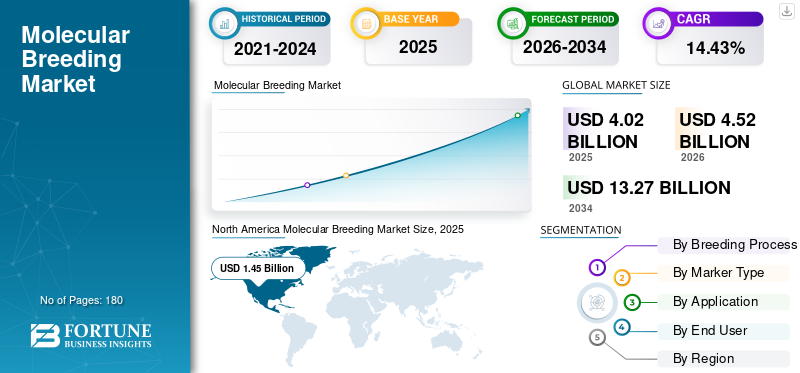
Download Free sample to learn more about this report.
Molecular Breeding Market Key Takeaways
 Global Market Size & Forecast
- 2025 Market Size: USD 4.02 billion
- 2026 Market Size: USD 4.52 billion
- 2034 Forecast Market Size: USD 13.27 billion
- CAGR: 14.43% from 2026–2034
 Market Share
- North America dominated the molecular breeding market with a 36.07% share in 2025.
- The Genomic Selection (GS) segment is projected to grow at a 14.93% CAGR during the forecast period.
- The Simple Sequence Repeat (SSR) segment is expected to grow at a 14.40% CAGR during the forecast period.
 Key Regional Highlights
North America
North America is projected to reach USD 1.62 billion in 2026, maintaining its leading position.
Europe
Europe is estimated to reach USD 1.39 billion in 2026, ranking as the second-largest regional market.
Asia Pacific
Asia Pacific was valued at USD 1.10 billion in 2025, supported by rising agricultural biotechnology adoption.
U.S.
The market is estimated to reach USD 1.36 billion by 2026.
Japan
The market was valued at USD 0.16 billion in 2025.
Read More

MARKET DYNAMICS
MARKET DRIVERS
Growing Demand for High Yield Stress Resistance Crops Supports Market Growth
Climate change is one of the crucial factors expected to impact crop yields and food availability in the future. Climate fluctuations are causing frequent droughts, increasing the impact of pests on crops, and reducing the quality of seeds. Extreme weather conditions, which may include prolong dry spells or floods, can significantly impact crop yield, resulting in food scarcity. Molecular breeding can help farmers as this method helps to develop advanced seeds with improved traits such as drought tolerance and pest resistance, higher yield with limited agricultural inputs, and enhanced food safety and security.
MARKET RESTRAINTS
High Production Cost to Impede Market Growth
The molecular breeding process is costly and research-intensive. High quality specialized laboratory is required for conducting such research and development, and such methods also require high trained professionals who have in-depth knowledge in this area. This acts as one of the major constraints that deters many small startups from entering the market, as their initial investment costs are quite high. This is expected to hinder the molecular breeding market growth in the coming years.
MARKET OPPORTUNITIES
Growing interest in Emerging Economies Creates Opportunity to Explore Untapped Application Areas
Government funding is playing a crucial role in the adoption of molecular breeding for crop and livestock production. In India, the departed of Biotechnology is funded by the government of India to conduct research on crop improvement programs using advanced molecular breeding technology such as genomics, transgenics, and gene editing. The Indian government has launched some key initiatives, such as the Agriculture Biotechnology Programme, Mission Mode Programme on "Characterization of Genetic Resources", and others to develop new crops with advanced traits. Similarly, other emerging economies such as Brazil, Southeast Asia, and others are also launching such initiatives that support the adoption of this technology in the food and agriculture field. This creates an opportunity for innovation, growth, and increased demand for such products in the market.
MOLECULAR BREEDING MARKET TRENDS
Integration of Artificial Intelligence (AI) and Machine Learning (ML) in Breeding Programs is the Key Market Trend
In recent years, artificial intelligence and related tools have advanced significantly, and with the launch of platforms such as OpenAI, Claude, Gemini, and others, the adoption of such tools across different industries is rising. Companies involved in molecular sequencing are also adopting and integration such technology in their research platforms to generate fast, accurate, and reliable results that can be used to develop innovative methods for developing advanced traits in crops and animals. Companies such as Corteva Agriscience, Bayer, and others are integrating such methods to improve their breeding programs.
Download Free sample to learn more about this report.
Segmentation Analysis
By Breeding Process
Marker-Assisted Selection Leads Market Share Due to Low Cost and Infrastructure Requirements
The market is divided by breeding process into Marker-Assisted Selection (MAS), Marker-Assisted Backcrossing (MABC), Genomic Selection (GS), QTL mapping, and others.
The Marker-Assisted Selection (MAS) segment accounts for the largest molecular breeding market share. This process is the earliest and most studied process used in crop and livestock applications. Moreover, it is low-cost and low-risk and can be easily integrated into traditional breeding methods.
The Genomic Selection (GS) segment is expected to grow at a Compound Annual Growth Rate (CAGR) of 14.93% over the forecast period. Genomic sequencing provides a detailed analysis of genetic variations in an organism, and this information helps in the precise selection of complex traits in crops.
To know how our report can help streamline your business, Speak to Analyst
By Marker Type
Single Nucleotide Polymorphism Led Market Share Due to High Data Consistency and Data Quality
The market is segmented by form into Single Nucleotide Polymorphism (SNP), Simple Sequence Repeat (SSR), Amplified Fragment Length Polymorphism (AFLP), Restriction Fragment Length Polymorphism (RFLP), Random Amplified Polymorphic DNA (RAPD), and others.
The Single Nucleotide Polymorphism (SNP) segment accounted for the largest market share in 2024. This form is suitable for dense genetic mapping, QTL analysis, and genomic selection (GS). It is suitable across different labs and provides data consistency and quality.
Simple Sequence Repeat (SSR) is another major segment that is expected to grow by 14.40% during the forecast period. This method provides accuracy, polymorphism, cost-effectiveness, and ease of use, and hence can be used for a wide range of studies, parentage testing, and trait mapping.
By Application
Crops Dominated Market Due to Growing Demand for Maintaining Food Security Globally
The market is segmented by application into crop based and livestock based. Crop based can be further segmented into cereals & grains, oilseeds & pulses, fruits & vegetables, and other crop. Livestock based can also be further segmented into cattle, poultry, swine, and others.
The crop based segment held the largest market share in 2024. This method is widely adopted in manufacturing seed for different crops, such as improving yield, stress tolerance, and traits such as disease resistance, to ensure food and nutritional security.
The livestock based segment is another major segment that is expected to grow by 13.96% during the forecast period. The use of such sequencing methods enables fast genetic improvement, supports disease control, and increases meat, milk, and egg productivity.
By End User
Increased R&D Investments to Improve Yield, Pest Resistance Fueled Seed Companies Segment Growth
The market segmentation by end user includes seed companies, livestock companies, academic & government institutions, and independent breeding service providers.
Seed companies held the largest market share in 2024. Seed manufacturing companies such as Bayer CropScience, Corteva Agriscience, Syngenta, BASF, and KWS Saat invest heavily in R&D, using genomic sequencing and trait mapping to improve yield, pest resistance, and stress tolerance.
Livestock companies are expected to rise at a CAGR of 14.51% during the forecast period. Major breeding companies use genomic sequencing as an indispensable tool for gene mapping and improving traits in cattle, poultry, and swine.
Molecular Breeding Market Regional Outlook
By geography, the market is categorized into Europe, North America, Asia Pacific, South America, and the Middle East & Africa.
North America
North America Molecular Breeding Market Size, 2025 (USD Billion) To get more information on the regional analysis of this market, Download Free sample
The market in North America is estimated to reach USD 1.62 billion in 2026. There are multiple research and development programs conducted across the U.S. and Canada, which are aimed at developing advanced crops for farmers. Public and private institutions are collaborating with each other to develop crops with advanced traits that help to improve disease and climate resistance. In 2026, the U.S. market is estimated to reach USD 1.36 billion. The country has undertaken several initiatives, which include USDA Agricultural Research Service (ARS) and National Institute of Food and Agriculture (NIFA), National Plant Genome Initiative (NPGI), and Breeding Insight Program aimed at improving seed and livestock breeding programs.
Europe
The market in Europe is estimated to reach USD 1.39 billion in 2026 and secure the position of the second-largest region in the market. Several agriculture and livestock companies with global presence have research and development facilities in this region, which receive significant funding for developing new breeds of seeds with advanced traits. The region is also widely using artificial intelligence, genomic selection, and other advanced methods to develop data-driven breeding programs for crops such as maize, wheat, barley, and other similar crops. During the forecast period, the European region is projected to record a growth rate of 14.14%. Backed by these factors, countries such as Germany are expected to record valuations of USD 0.29 billion, France USD 0.16 billion, and the U.K. USD 0.22 billion in 2025.
Asia Pacific
The Asia Pacific market was valued at USD 0.87 billion in 2024, and is also one of the fastest-growing markets global. The market in Asia Pacific is estimated to reach USD 1.1 billion in 2025. The region is one of the populous areas in the world, and maintaining food safety and security in the region is one of the primary areas where the government invests heavily. As climate change is becoming more frequent, the adoption of advanced technology has increased significantly in recent years. Research institutions in Asian countries are actively integrating this technology into their food programs to advance and develop climate and disease-resistant crops. In this region, China and Japan are estimated to reach USD 0.52 billion and USD 0.16 billion, each, in 2025.
South America
Over the forecast period, South America will witness a high growth in this market. The South America market in 2026 is set to record USD 0.3 billion. The government is adopting several practices to ensure that the crops are disease-resistant, herbicide-tolerant, and generate high yields. Countries such as Brazil, Chile, and others are adopting molecular breeding programs to develop high-quality export-oriented crops for the market.
Middle East & Africa
In the Middle East & Africa, South Africa's market forecast is set to grow at a CAGR of 13.77% during the forecast period. Countries such as Saudi Arabia, UAE, and others are aggressively investing in molecular breeding adoption to strengthen food security and boost local agricultural productivity.
COMPETITIVE LANDSCAPE
Key Industry Players
Integration of Advanced Technology Innovation is the Key Strategy Used by Companies to Differentiate Their Products
The global molecular breeding market exhibits a fragmented structure, with intense competition among market players operating in this segment. Thermo Fisher Scientific Inc., Illumina, Bayer AG, and others are a few of the dominating players in the global market. Several companies operate their own in-house genome sequencing labs to innovate and develop improved crop and livestock in the market. Companies are scaling up their genome sequencing infrastructure and establishing outsourcing stations in areas where required. Some companies are also integrating advanced technology such as Artificial intelligence to differentiate their product offerings from other market players.
LIST OF KEY MOLECULAR BREEDING COMPANIES PROFILED
- Illumina, Inc. (U.S.)
- Thermo Fisher Scientific, Inc. (U.S.)
- Bayer AG (Germany)
- Corteva Agriscience (U.S.)
- Syngenta AG (Switzerland)
- KWS SAAT SE & Co. KGaA (Germany)
- LGC Genomics (U.K.)
- Zoetis Inc. (U.S.)
- Genus PLC (U.K.)
- SGS S.A. (Société Générale de Surveillance) (Switzerland)
KEY INDUSTRY DEVELOPMENTS
- September 2024 – Corteva Agriscience launched the Genlytix ecosystem, which integrates gene editing capabilities, data analytics, and strategic partnerships. This platform includes data on 350 granted patents along with 140,000 edited plants.
- May 2024: Zoetis expanded its genomic testing platform, which enables dairy and beef producers to make profitable genetic selection and management decisions that help to focus on wellness traits, production, fertility, and sustainability.
- January 2024 – Ohalo Genetics launched the Boosted Breeding platform, a novel plant breeding technology to develop high-yielding crop varieties.
Request for Customization to gain extensive market insights.
Report Scope & Segmentation
|
ATTRIBUTE |
DETAILS |
|
Study Period |
2021-2034 |
|
Base Year |
2025 |
|
Estimated Year |
2026 |
|
Forecast Period |
2026-2034 |
|
Historical Period |
2021-2024 |
|
Growth Rate |
CAGR of 14.43% from 2026-2034 |
|
Unit |
Value (USD Billion) |
|
Segmentation |
By Breeding Process, Marker Type, Application, End User, and Region |
|
By Breeding Process |
|
|
By Marker Type |
|
|
By Application |
|
|
By End User |
|
|
By Region |
North America (By Breeding Process, Marker Type, Application, End User, and Country)
Europe (By Breeding Process, Marker Type, Application, End User, and Country)
Asia Pacific (By Breeding Process, Marker Type, Application, End User, and Country)
South America (By Breeding Process, Marker Type, Application, End User, and Country)
Middle East & Africa (By Breeding Process, Marker Type, Application, End User, and Country)
Rest of the Middle East & Africa (By End User) |
Frequently Asked Questions
Fortune Business Insights says that the global market value stood at USD 4.02 billion in 2025 and is projected to reach USD 13.27 billion by 2034.
In 2025, the market value stood at USD 1.45 billion.
The market is expected to exhibit a CAGR of 14.43% during the forecast period of 2026-2034.
By end user, the seed companies segment led the global market in 2024.
Growing demand for high yield stress resistance crops supports market growth.
Thermo Fisher Scientific Inc., Illumina, and Bayer AG are a few of the players in the market.
North America held the largest market share in 2024.
Integration of Artificial Intelligence (AI) and Machine Learning (ML) in breeding programs is the key trend influencing the market.



- 2021-2034
- 2025
- 2021-2024
- 180
-
(Offer valid till 15th Oct 2026)
Get 30-60 hrs Free Customization
Expand Regional and Country Coverage, Segments Analysis, Company Profiles, Competitive Benchmarking, and End-user Insights.














Related Reports
-
US +1 833 909 2966 ( Toll Free )
-
Get In Touch With Us