Natural Carotenoids Market Size, Share & Industry Analysis, By Type (Astaxanthin, Beta-Carotene, Lutein, Zeaxanthin, Lycopene, Canthaxanthin, and Others), By Source (Plants and Microorganisms), By Application (Food & Beverages, Dietary Supplements, Personal Care & Cosmetics, Animal Feed, and Pharmaceuticals), and Regional Forecast, 2026-2034
 Download Free Sample
(Offer valid till 30th Sep 2026)

Natural Carotenoids Market Size and Industrty Overview
 Listen to Audio Version
The global natural carotenoids market size was valued at USD 478.20 million in 2025 and is projected to grow from USD 495.95 million in 2026 to USD 685.46 million by 2034, exhibiting a CAGR of 4.13% during the forecast period. Europe dominated the natural carotenoids market with a market share of 32.00% in 2025.
Natural carotenoids are a group/class of fat-soluble pigments primarily found in photosynthetic bacteria, algae, and plants. These pigments impart red, yellow, and orange hues in various vegetables and fruits. Over 750 carotenoids have been identified, of which astaxanthin, lycopene, and lutein are the most popular. Concerning advantages, these ingredients offer anti-inflammatory and cancer prevention properties. Also, it aids in strengthening cognitive function, skin, and heart health.
Along with the food sector, it is a key ingredient in the animal feed, cosmetics, and supplements sectors. Predominantly, Europe and North America are recognized as the biggest consumers of natural carotenoids. This consumption rate is mainly driven by increased awareness about the health benefits and the expanding use of natural ingredients in processed foods.
A few key players in the market include Cyanotech Corporation, Allied Biotech Corporation, and Fuji Chemicals & Co., Ltd., among others.
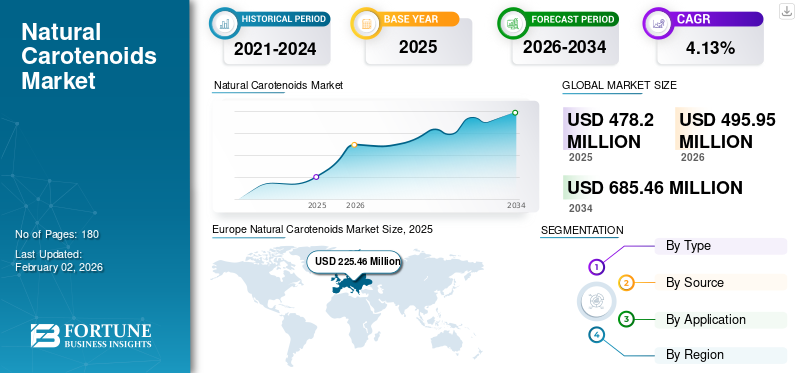
Download Free sample to learn more about this report.
Natural Carotenoids Market KEY TAKEAWAYS
 Global Market Size & Forecast
- 2025 Market Size: USD 478.20 Million
- 2026 Market Size: USD 495.95 Million
- 2034 Forecast Market Size: USD 685.46 Million
- CAGR: 4.13% from 2026–2034
 Market Share
- Europe dominated with a 32.00% market share in 2025, driven by clean-label demand.
- Astaxanthin held the largest market share, supported by its high antioxidant benefits.
- Plant-based sources led the market due to sustainable and natural extraction.
 Key Regional Highlights
Asia Pacific
Asia Pacific to reach USD 94.79 million in 2026, fueled by rising health awareness.
North America
North America to reach USD 127.42 million in 2026, supported by functional food adoption.
Europe
Europe to reach USD 234.19 million in 2026, driven by clean-label ingredient demand.
U.S.
U.S. expected to witness steady growth, driven by demand for natural food and cosmetic ingredients.
Japan
Japan expected to witness steady growth during the forecast period, supported by increasing demand for natural and functional ingredients.
Read More

MARKET DYNAMICS
Market Drivers
Growing Animal Feed Industry Increases Usage of Natural Pigments
The flourishing animal feed industry is a critical driver for the market's growth. Natural carotenoids are extensively utilized in the animal feed sector, particularly due to their coloring properties. These ingredients are majorly added to feed to strengthen the visual appeal of animal products such as egg yolks, chicken skin, and salmon flesh. Popular carotenoids used in feed include beta-carotene (for poultry), astaxanthin (for salmon), and lutein (for yellow coloration in fish). Besides color, these ingredients enhance the feed's nutritive value and contribute to their overall well-being, fueling the global natural carotenoids market growth.
Market Restraints
Stability and Shelf-Life Challenges and High Extraction Costs Impede Market Growth
One key difficulty carotenoid producers face is the shelf life and stability challenges. Carotenoids are naturally produced and prone to degradation due to light, heat, pH changes, and oxidation, which may hamper their nutritional value, bioavailability, and color. Moreover, a few carotenoids have low water solubility, making them difficult to incorporate into numerous beverages and food items. Additionally, these carotenoids have low bioavailability, which means they are not easily utilized and absorbed by the body. As a result, such factors hinder the market's potential.
Another obstacle in the global market is the high cost of purification and extraction of natural carotenoids. Compared to synthetic extraction, natural extraction of carotenoids is expensive, mainly due to the prices linked with specialized equipment and the degradation potential during processing. Thus, the factors mentioned above impede the global natural carotenoids market share.
Market Opportunities
Advancements in Production Technologies to Create Growth Opportunities
The increasing advancements in manufacturing technologies unlock growth possibilities in the global industry. Natural carotenoid producers should adopt advanced technology to enhance the extraction method. Traditional solvent extraction methods can be supplemented with greener substitutes such as ultrasound-assisted extraction, supercritical fluid extraction, and microwave-assisted extraction for improved extraction. Moreover, biofortification and encapsulation techniques are being developed to preserve carotenoids from degradation during storage and processing. Additionally, the firms can use ionic liquids and deep eutectic solvents as they are efficient and eco-friendly solvents for carotenoid extraction.
Natural Carotenoids Market Trends
Expanding Use of Carotenoids in Cosmetics Sector is a Current Key Trend
Natural carotenoids play a remarkable role in the personal care & cosmetics industry. These ingredients are used as natural colorants, providing a range of shades, and are considered a valuable option to synthetic colors. Such natural ingredients align with the ongoing trend of natural/clean-label products, and lutein and beta carotene are a few common carotenoids that can be utilized in moisturizers and powders. Incorporation of natural carotenoids in cosmetic items protects skin from oxidative damage and minimizes premature aging. Moreover, some carotenoids strengthen skin elasticity and improve skin tone. As a result, the advantages of carotenoids in personal care products bolster their utilization rate.
SEGMENTATION ANALYSIS
By Type
Astaxanthin Dominated Market Due to Its Popularity in Skin and Physical Health
Based on type, the market is distributed into astaxanthin, beta-carotene, lutein, zeaxanthin, lycopene, canthaxanthin, and others.
The astaxanthin segment held the highest market share in 2024. Astaxanthin is one of the most common types and offers a higher antioxidant capacity than other types. Also, this ingredient can be utilized in various functional foods and cosmetics, as it promotes skin and physical health. Also, it can ease recovery after exercise and protect individuals from neurodegenerative diseases. Thus, the benefits mentioned above augment the segment's growth.
Beta-carotene emerged as the fastest-growing segment and is anticipated to soar at the same pace during the forecast period. Likewise, other carotenoids, beta carotene, also act as an antioxidant and are crucial for improved immune function and vision.
By Source
Plants Led Market Due to Their Ample Advantages in Food Edibles
Based on the source, the market is segmented into plants and microorganisms.
Among all, the plants segment dominated the global marketplace and holds the largest market share. Plant-based extraction aids in promoting sustainable practices and is a safer alternative. Compared to other sources, plants are widely available and recognized as a sustainable carotenoid source. These naturally extracted pigment has a strong potential to improve the nutritional profile and color of various food edibles, augmenting the growth.
Microorganisms have a high CAGR and are expected to maintain the same during the forecast period. These organisms have higher stability, yield, and are cost-effective. Also, compared to other sources, using bacteria or algae leads to rapid production.
By Application
Food & Beverages Dominated Market Owing to High Usage of Carotenoids
Based on the application, the market is distributed into food & beverages, dietary supplements, personal care & cosmetics, animal feed, and pharmaceuticals.
The food & beverages segment led the global market in 2024. These pigments are mainly used as food additives and natural colorants in beverages, dairy items, cheese, and edible fats. Moreover, these ingredients can be used for fortification to address Vitamin A deficiency. Thus, the factors mentioned above facilitate the market's potential.
Animal feed emerged as the fastest-growing segment during the forecast period. Adding such ingredients to animal feed assists in fulfiling their daily nutrient intake and improving the quality of their products (eggs and meat).
Natural Carotenoids Market Regional Outlook
Based on region, the market is segmented into North America, Europe, Asia Pacific, South America, and the Middle East & Africa.
Europe
Europe Natural Carotenoids Market Size, 2025 (USD Million)
To get more information on the regional analysis of this market, Download Free sample
Europe dominated the global market and held the largest market share. The Europe region captured 32.00% of the global market in 2025, generating USD 225.46 million in revenue, and is projected to reach USD 234.19 million in 2026. Europeans are increasingly looking for natural substitutes for artificial additives in pharmaceuticals, cosmetics, and food & beverages. This trend of clean-label items escalates the usage of carotenoids. Innovations in production and extraction technologies further support the market's growth. Using advanced technology enhances the efficiency of the production of such ingredients. Moreover, favorable government policies and frameworks promote the use of natural components in various applications. Following this, the expanding animal feed sector further stimulates the market's potential. As a result, improved awareness of natural pigments propels the regional growth.
Download Free sample to learn more about this report.
North America
In 2025, the North America market stood at USD 122.93 million, representing 28.65% of global demand, and is projected to grow to USD 127.42 million in 2026. North America secured the second position in the global industry. The growth is backed by rising awareness of health advantages and the trend of functional food ingredients. Predominantly, in North America, most consumers rely on packaged and convenient food items. To stay healthy, a few individuals gravitate toward ready-to-eat products comprising functional ingredients such as lutein, astaxanthin, and others. Moreover, the increasing emphasis on organic and sustainable sourcing of ingredients fuels the usage of natural pigments. Also, over time, Americans are switching toward plant-centric diets to curb the risk of chronic ailments. Thus, such instances drive the growth of the industry.
The U.S. is the leading country in the region, followed by Canada and Mexico. The rising consumer demand for clean-label ingredients and the growing use of natural components in the cosmetics sector propel market growth in the U.S.
Asia Pacific
Asia Pacific maintained a strong presence in the global market, reaching USD 91.36 million in 2025, accounting for 24.22% share, and is expected to reach USD 94.79 million in 2026. Asia Pacific ranked third in the market and is anticipated to maintain the same growth trajectory in the coming years. Likewise, other developed regions, Asia Pacific, also witness a health & wellness trend where Asians mostly focus on the ingredients used in the end product. The Asian region is highly burdened with numerous health challenges, increasing the necessity of safer solutions. This situation triggers the adoption of natural ingredients in food & beverages. Moreover, the thriving organic personal care industry in Asian countries such as China, India, and others adds to the market's growing momentum.
South America
South America is at its nascent stage and is predicted to grow faster over the forecast period. The growing presence of established regional players and increasing demand for healthy products attract growth opportunities.
Middle East & Africa
The Middle East & Africa market accounted for USD 11.02 million in 2025, representing 16.08% of the global industry, and is expected to reach USD 11.32 million in 2026. The Middle East & Africa region is in its developing stage and is expected to maintain the same pace in the upcoming years. The increasing prevalence of malnutrition and growing awareness of health consciousness collectively enhance the market's growth.
Latin America
In 2025, Latin America represented USD 27.43 million, accounting for 19.70% of the worldwide market, and is projected to grow to USD 28.23 million in 2026.
COMPETITIVE LANDSCAPE
KEY INDUSTRY PLAYERS
Major Players Are Aiming at Expanding Their Base to Facilitate Market Growth
Dominating players in the market include Cyanotech Corporation, Fuji Chemicals & Co., Ltd., and Valensa Corporation, among others. All the enterprises operating in the market are introducing new natural ingredients for the food & beverage and animal feed sectors. Moreover, top producers of natural carotenoids are entering into partnerships to improve their product portfolio.
List of Key Natural Carotenoid Companies Profiled
- Fuji Chemical Industries Co., Ltd. (Japan)
- BASF SE (Germany)
- Valensa International (U.S.)
- Cyanotech Corporation (U.S.)
- Allied Biotech Corporation (Taiwan)
- Solabia-Algatech Nutrition (Israel)
- Divi's Nutraceuticals (U.S.)
- ORYZA OIL & FAT CHEMICAL CO., LTD. (Japan)
- Algalif (Iceland)
- RAHN AG (Switzerland)
KEY INDUSTRY DEVELOPMENTS
- March 2024: Kuenhle AgroSystem, a biotechnology firm in the U.S., secured USD 3 million in funding from S2G Ventures, a financial service firm in the U.S. This funding helped elevate the production of natural microalgae-derived astaxanthin powder to an industrial level.
- March 2024: AstaReal, a subsidiary of Fuji Chemical Industries Co., Ltd., a chemicals company in Japan, showcased its latest formulation, which combines two algal-derived ingredients, omega-3 fatty acids and astaxanthin. This item was displayed at Vitafoods, a nutraceutical event held in Europe.
- July 2021: AstaReal AB, a Swedish firm and a subsidiary of the Japanese chemicals company, Fuji Chemical Industries Co., Ltd., introduced natural astaxanthin for the European animal feed and pet food sectors. This ingredient was marketed under Novasta and can be mixed with soft chews, wet and dry food, and extruded snacks.
- February 2021: Solabia-Algatech Nutrition, an Israeli company, released a new astaxanthin cold water dispersible and microencapsulated powder. This powder contains 2.5% natural astaxanthin, ideal for sports drinks and dietary supplements.
- October 2020: Cyanotech Corporation, a U.S.-based microalgae-centric products manufacturer, announced the launch of natural BioAstin Hawaiian Astaxanthin, a water-dispersible powder. This ingredient is available across the U.S. market and is safe for fruit juices, teas, and ready-to-drink beverages.
REPORT COVERAGE
The market research report includes quantitative and qualitative insights into the market. It also offers a detailed market analysis of the market size and growth rate for all market segments. Key insights in the global natural carotenoids market report include an overview of related markets, a competitive landscape, recent industry developments such as mergers & acquisitions, the regulatory environment in critical countries, and current global market trends.
Request for Customization to gain extensive market insights.
Report Scope & Segmentation
|
ATTRIBUTE |
DETAILS |
|
Study Period |
2021-2034 |
|
Base Year |
2025 |
|
Estimated Year |
2026 |
|
Forecast Period |
2026-2034 |
|
Historical Period |
2021-2024 |
|
Unit |
Value (USD Million) |
|
Growth Rate |
CAGR of 4.13% from 2026 to 2034 |
|
Segmentation |
By Type
|
|
By Source
|
|
|
By Application
|
|
|
By Region
|
Frequently Asked Questions
Fortune Business Insights says that the global market size was valued at USD 478.20 million in 2025.
The market is expected to grow at a CAGR of 4.13% during the forecast period (2026-2034).
By application, the food & beverage segment led the market.
The growing animal feed industry increases the usage of natural pigments.
Cyanotech Corporation, Allied Biotech Corporation, and Fuji Chemicals & Co., Ltd., are a few of the top players in the market.
Europe held the highest share of the market.
Advancements in production technologies create growth opportunities.



- 2021-2034
- 2025
- 2021-2024
- 180
-
(Offer valid till 30th Sep 2026)
Get 30-60 hrs Free Customization
Expand Regional and Country Coverage, Segments Analysis, Company Profiles, Competitive Benchmarking, and End-user Insights.




















Related Reports
-
US +1 833 909 2966 ( Toll Free )
-
Get In Touch With Us