Neuromorphic Memory Modules Market Size, Share & Industry Analysis, By Product Type (Memory Chips, Memory Modules, Neuromorphic SoC Solutions, FPGA-based Systems, and ASIC-based Systems), By Application (Image & Video Processing, Autonomous Systems, Language & Speech, Signal Processing, Pattern Recognition, and Others), By End-user (Automotive, Industrial Automation & Robotics, IT & Telecom, Consumer Electronics, Aerospace & Defense, Healthcare, and Others), and Regional Forecast, 2026 – 2034
 Download Free Sample
NEUROMORPHIC MEMORY MODULES MARKET SIZE AND FUTURE OUTLOOK
 Listen to Audio Version
The neuromorphic memory modules market size was valued at USD 1.60 billion in 2025. The market is projected to grow from USD 1.88 billion in 2026 to USD 7.48 billion by 2034, exhibiting a CAGR of 18.9% during the forecast period. North America dominated the neuromorphic memory modules market with a market share of 38.75% in 2025.
Neuromorphic memory modules are advanced memory solutions designed to emulate the neural structure of the human brain, enabling high-speed and energy-efficient computing for AI and edge computing applications. These modules encompass memory chips, memory modules, FPGA- and ASIC-based systems, and neuromorphic SoCs, supporting applications such as image and video processing, autonomous systems, language and speech, signal processing, and pattern recognition. Key end-users include automotive, industrial automation, IT and telecom, consumer electronics, aerospace, defense, and healthcare. Market growth is driven by rising demand for energy-efficient AI computing, autonomous systems, and advanced memory technologies.
Intel Corporation, IBM Corporation, Samsung Electronics Co., Ltd., and Micron Technology, Inc. are the top players in the market.
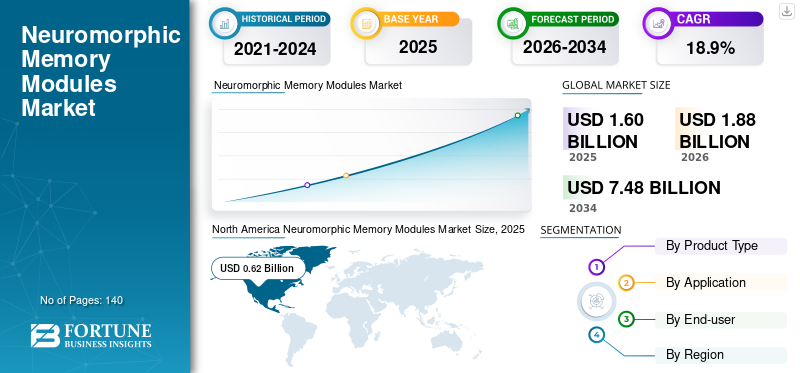
Download Free sample to learn more about this report.
NEUROMORPHIC MEMORY MODULES MARKET TRENDS
Growth of Integrated Memory-Compute Architectures for Edge AI is a Key Market Trend
Market growth is increasingly driven by integrated memory-compute architectures in neuromorphic SoCs and ASICs, which combine memory and processing within a single chip. This market trend is focused on brain inspired computing and computing systems that mimic the human brain through spiking neural networks, enabling faster interpretation of sensory data in real-time AI environments. This integration reduces latency and energy consumption, enabling high-performance AI processing for autonomous systems, robotics, industrial automation, edge computing, and edge devices. Integrated designs address the limitations of separate memory and processor units while supporting event-driven workloads. As demand for real-time AI inference grows across industries, integrated memory-compute modules are increasingly deployed to enhance speed, reliability, and energy efficiency, positioning them as a critical innovation for both consumer and enterprise edge AI applications.
- According to IEEE Xplore, in-memory computing can reduce energy use by up to 90%, accelerating adoption in edge AI devices.
MARKET DYNAMICS
MARKET DRIVERS
Download Free sample to learn more about this report.
Rising Demand for Energy-Efficient AI and Edge Computing is Driving Market Growth
The neuromorphic memory modules market growth is driven by the increasing need for energy-efficient AI solutions in edge and real-time applications. Traditional memory and processor architectures consume significant power and introduce latency, limiting performance in battery-constrained and latency-sensitive environments. Neuromorphic memory modules reduce data transfer overhead and integrate computation with memory, enabling faster, low-power AI chips and low-power processing. These computing solutions also support in-memory AI computing, Compute-In-Memory (CIM), Neural Processing Units (NPUs), and AI memory modules for advanced edge intelligence. Industries such as automotive, industrial automation, IT & telecom, consumer electronics, aerospace, and healthcare are increasingly adopting these modules to improve performance while reducing energy consumption, creating strong market momentum for vendors providing integrated, high-efficiency memory solutions.
- According to McKinsey & Company, low-power AI chip designs can improve energy efficiency by up to 10×. This efficiency boost is increasing adoption in edge computing.
|
Rank |
Market Drivers |
Overall Impact Rank |
CAGR Contribution (2026-2034) |
Impact 2026-2028 |
Impact 2029-2031 |
Impact 2032-2034 |
|
1 |
Growing AI implementation across industries is increasing demand for energy-efficient, high-speed neuromorphic memory modules. |
High |
+4.9% |
High |
High |
Medium |
|
2 |
Expansion of AI at the edge requires low-latency, low-power memory solutions, driving adoption of neuromorphic architectures. |
High |
+3.9% |
High |
Medium |
Medium |
|
3 |
Increased deployment of autonomous vehicles, drones, and robotics is creating demand for real-time, event-driven processing. |
High |
+5.5% |
High |
High |
High |
|
4 |
MRAM, ReRAM, PCM, and memristor innovations enhance performance and energy efficiency, supporting next-generation AI applications. |
Medium |
+3.5% |
High |
Medium |
Medium |
|
5 |
Growing AI-driven automation in manufacturing increases the need for fast and reliable neuromorphic memory modules. |
Medium |
+3.0% |
Medium |
Medium |
Medium |
|
6 |
Others (Adoption in medical devices, smart electronics, wearables, industrial IoT, robotics, and smart sensors, creating new growth opportunities) |
Low |
+2.1% |
Medium |
Medium |
Low |
|
|
Total Positive Growth Contribution |
|
+22.9% |
|
|
|
MARKET RESTRAINTS
High Manufacturing Complexity and Limited Standardization Hinder Market Growth
The market faces challenges due to complex manufacturing processes and a lack of standardized design frameworks. Developing MRAM, Resistive RAM (ReRAM), Phase-Change Memory (PCM), Ferroelectric RAM (FeRAM), and memristors-based modules requires advanced fabrication techniques and precise integration with neuromorphic hardware, neuromorphic computing platforms, neuromorphic SoCs, and ASICs, which increases production costs and limits scalability. Additionally, the absence of universally accepted design and testing standards across vendors slows down interoperability and adoption in new applications. These factors create entry barriers for smaller players. They may constrain rapid deployment, particularly in cost-sensitive sectors such as consumer electronics and edge devices, despite the growing demand for low-power AI memory solutions.
|
Rank |
Market Restraints |
Overall Impact Rank |
Negative CAGR Contribution (2026-2034) |
Impact 2026-2028 |
Impact 2029-2031 |
Impact 2032-2034 |
|
1 |
High manufacturing complexity and integration challenges |
High |
-0.8% |
High |
High |
Medium |
|
2 |
Lack of standardization across neuromorphic memory designs |
High |
-0.5% |
High |
Medium |
Medium |
|
3 |
High cost of advanced memory technologies (MRAM, ReRAM, memristors) |
Medium |
-1.2% |
High |
Medium |
Low |
|
4 |
Others (limited skilled workforce, R&D constraints, supply chain issues) |
Low |
-1.5% |
Medium |
Medium |
Low |
|
|
Total Negative Growth Impact |
|
-4.0% |
|
|
|
MARKET OPPORTUNITIES
Expansion of Edge AI and Autonomous Systems Deployment is Creating Market Growth Opportunities
The growing adoption of AI at the edge and in autonomous systems represents a significant opportunity for neuromorphic memory modules. These modules enable low-latency, energy-efficient, and event-driven processing, which is critical for applications in autonomous vehicles, industrial automation, robotics, smart sensors, and wearable devices. As enterprises and technology providers shift workloads from cloud to edge inference, the demand for memory modules that combine processing and storage increases. This trend offers revenue growth potential for suppliers. It encourages innovation in memory technologies, helping the market move toward commercial scale adoption across sectors such as automotive, healthcare, consumer electronics, and industrial AI platforms.
- According to the Association for Computing Machinery (ACM), neuromorphic architectures provide substantial energy savings over conventional hardware, supporting wider edge AI deployment.
SEGMENTATION ANALYSIS
By Product Type
Memory Chips Led Market Due to Their Fundamental Role in Neuromorphic Architectures
Based on product type, the market is divided into memory chips, memory modules, neuromorphic SoC solutions, FGPA-based systems, and ASIC-based systems.
In 2025, memory chips dominated the neuromorphic memory modules market share with 51.6% as they form the fundamental building blocks of neuromorphic architectures and are compatible with a wide range of AI workloads. Their maturity, availability, and reliability make them essential for high-speed data storage and retrieval across applications.
Neuromorphic SoC solutions are expected to grow at the highest CAGR of 23.0% over the forecast period, as they integrate memory and computation on a single chip. This reduces latency and energy consumption, enabling efficient edge AI and autonomous systems processing.
By Application
Image & Video Processing Held Largest Share Due to High Memory Demands
Based on application, the market is segmented into image & video processing, autonomous systems, language & speech, signal processing, pattern recognition, and others.
In 2025, image & video processing held the largest share of 32.9%, as these workloads are highly memory-intensive and are widely deployed across consumer electronics, surveillance, and industrial imaging applications. They demand high throughput and rapid access to large datasets, which neuromorphic memory modules efficiently provide.
Autonomous systems are projected to grow at the highest CAGR of 23.3% over the forecast period, as real-time AI decision-making becomes critical for vehicles, drones, and robotics. Neuromorphic memory modules provide energy-efficient, low-latency processing, supporting rapid adoption in this emerging segment.
By End-user
To know how our report can help streamline your business, Speak to Analyst
Automotive Segment Dominated Market Due to Growing AI Integration in Vehicles
Based on end-user, the market is divided into automotive, industrial automation & robotics, IT & telecom, consumer electronics, aerospace & defense, healthcare, and others.
In 2025, the automotive segment held the largest share of 22.5%. It is expected to grow at the highest CAGR of 22.1% over the forecast period due to increasing AI integration for autonomous driving, driver assistance, and in-vehicle intelligence systems. Neuromorphic memory modules support these applications with fast, energy-efficient processing in resource-constrained environments.
Consumer electronics hold the second-largest share of 22.2% as smart devices, wearables, and imaging equipment widely implement AI workloads. These devices require rapid, efficient memory solutions, sustaining strong adoption and continuous demand in this sector.
Neuromorphic Memory Modules Market Regional Outlook
By geography, the market is categorized into North America, South America, Asia Pacific, Europe, and the Middle East & Africa.
North America
North America Neuromorphic Memory Modules Market Size, 2025 (USD Billion)
To get more information on the regional analysis of this market, Download Free sample
North America holds the largest market share due to its mature semiconductor ecosystem, strong AI and edge computing adoption, and established R&D infrastructure. High demand from automotive, industrial, and consumer electronics sectors drives widespread deployment. Well-developed supply chains, advanced technology capabilities, and early adoption of neuromorphic architectures ensure sustained market leadership in this region.
To know how our report can help streamline your business, Speak to Analyst
U.S. Neuromorphic Memory Modules Market
The U.S. market was valued at around USD 0.51 billion in 2025, accounting for roughly 31.9% of sales.
Asia Pacific
Asia Pacific is expected to record the highest CAGR during the forecast period due to rapid industrialization, large-scale AI adoption, and government-backed smart infrastructure projects. Countries such as China, India, and South Korea are investing heavily in automotive, consumer electronics, and industrial automation applications. The growing need for energy-efficient, low-latency AI processing accelerates the deployment of neuromorphic memory modules, driving rapid market growth.
Japan Neuromorphic Memory Modules Market
The Japanese market was valued at around USD 0.06 billion in 2025, accounting for roughly 3.6% of global revenues.
China Neuromorphic Memory Modules Market
China’s market is projected to be one of the largest globally, with 2025 revenues valued at USD 0.13 billion, roughly 8.2% of global sales.
India Neuromorphic Memory Modules Market
The Indian market was valued at USD 0.06 billion in 2025, accounting for roughly 3.4% of global revenues.
Europe
Europe holds a significant share due to its advanced research initiatives, established automotive and industrial sectors, and early adoption of energy-efficient AI solutions. Government support for AI and smart infrastructure encourages the deployment of neuromorphic memory modules across automotive, aerospace, and manufacturing applications. The region’s strong technological ecosystem maintains steady demand for high-performance memory solutions.
U.K. Neuromorphic Memory Modules Market
The U.K. market was valued at approximately USD 0.06 billion in 2025, accounting for roughly 3.7% of global revenues.
Germany Neuromorphic Memory Modules Market
Germany’s market reached USD 0.07 billion in 2025, equivalent to around 4.5% of global sales.
Middle East & Africa
The Middle East & Africa is expected to grow more slowly than other regions due to fragmented infrastructure, lower R&D investment, and slower AI adoption. High costs and limited industrial deployment constrain market expansion. While demand is emerging in smart city and defense applications, overall adoption of neuromorphic memory modules remains limited compared with mature and fast-growing regions.
GCC Neuromorphic Memory Modules Market
The GCC market reached USD 0.03 billion in 2025, accounting for roughly 2.1% of global revenues.
South America
South America is expected to grow at the second-highest CAGR due to emerging industrial automation, gradual AI integration, and smart device adoption. Countries are investing in localized edge computing and energy-efficient memory solutions to support automotive, manufacturing, and industrial applications. This trend boosts demand for neuromorphic memory modules and drives market expansion despite infrastructure limitations.
Brazil Neuromorphic Memory Modules Market
The Brazilian market was valued at USD 0.10 billion in 2025, accounting for roughly 6.4% of global revenues.
COMPETITIVE LANDSCAPE
Key Industry Players
Key Players Launch New Solutions to Strengthen Their Market Positioning
Key players are strengthening their positions by launching advanced neuromorphic memory solutions, enhancing system integration, and addressing rising demands for AI-driven low-power computing. They focus on innovations in MRAM, ReRAM, memristor-based memory, and neuromorphic SoC and ASIC architectures. Portfolio expansion, strategic partnerships, acquisitions, and ecosystem development enable companies, device manufacturers, and enterprises to reinforce their presence across the global market.
LIST OF KEY NEUROMORPHIC MEMORY MODULE COMPANIES PROFILED
- Intel Corporation (U.S.)
- IBM Corporation (U.S.)
- Samsung Electronics Co., Ltd. (South Korea)
- Micron Technology, Inc. (U.S.)
- SK Hynix Inc. (South Korea)
- Taiwan Semiconductor Manufacturing Company Limited (Taiwan)
- BrainChip Holdings Ltd. (Australia)
- Syntiant Corp. (U.S.)
- Crossbar Inc. (U.S.)
- Weebit Nano Ltd. (Australia)
KEY INDUSTRY DEVELOPMENTS
- March 2026: IBM revealed its NorthPole neuromorphic inference chip prototype focused on integrated memory and inference. It targets low‑power AI tasks with on‑chip memory acceleration.
- February 2026: TSMC expanded production of advanced process nodes (5 nm/4 nm) used in neuromorphic and AI chips. These foundry services underpin leading neuromorphic processors from partners such as Intel and BrainChip.
- January 2026: Intel launched the Loihi 3 neuromorphic processor for energy‑efficient AI workloads. It delivers brain‑inspired spike processing designed for edge and autonomous applications.
- December 2025: BrainChip released the Akida 2.0 neuromorphic processor for low‑power edge AI inference. It enhances spiking neural network performance for always‑on intelligent devices.
- June 2025: Micron announced HBM4/HBM4E memory stacks with industry‑leading bandwidth for AI accelerators. These products improve performance for memory‑intensive neuromorphic applications.
- May 2025: SK Hynix completed development of HBM4 memory with a 2,048‑bit interface for advanced AI hardware. It boosts data throughput essential for high‑performance neuromorphic systems.
- March 2025: Samsung introduced HBM4 high‑bandwidth memory modules for next‑generation AI systems. These modules support high throughput, critical for AI and neuromorphic compute platforms.
REPORT COVERAGE
The neuromorphic memory modules market report provides a comprehensive overview of market size, forecasts, and key segments. It analyzes market dynamics, emerging trends, technological advancements, and growing demand for AI-enabled low-power memory solutions, driving market growth. The report highlights major developments, including partnerships, mergers, acquisitions, and strategic initiatives by leading market players. It also presents a competitive landscape, market share analysis, and detailed profiles of top companies operating in the market.
Request for Customization to gain extensive market insights.
REPORT SCOPE & SEGMENTATION
| ATTRIBUTE | DETAILS |
| Study Period | 2021-2034 |
| Base Year | 2025 |
| Estimated Year | 2026 |
| Forecast Period | 2026-2034 |
| Historical Period | 2021-2024 |
| Growth Rate | CAGR of 18.9% from 2026 to 2034 |
| Unit | Value (USD Billion) |
| Segmentation | By Product Type, By Application, By End-user, and By Region |
| By Product Type |
|
| By Application |
|
| By End-user |
|
| By Region |
|
Frequently Asked Questions
Fortune Business Insights says that the global market value stood at USD 1.60 billion in 2025 and is projected to reach USD 7.48 billion by 2034.
In 2025, the North America market value stood at USD 0.62 billion.
The market is expected to grow at a CAGR of 18.9% over the forecast period.
By end-user, the automotive segment led the market.
Key market drivers include growing AI adoption, autonomous systems, and demand for energy-efficient memory.
Intel Corporation, IBM Corporation, and Samsung Electronics Co., Ltd. are among the top players in the market.
North America held the largest market share in 2025.
Rising AI, edge computing, and low-power memory needs are expected to drive product adoption.


- 2021-2034
- 2025
- 2021-2024
- 140
Get 30-60 hrs Free Customization
Expand Regional and Country Coverage, Segments Analysis, Company Profiles, Competitive Benchmarking, and End-user Insights.




















Related Reports
-
US +1 833 909 2966 ( Toll Free )
-
Get In Touch With Us