North America Pharmaceuticals Market Size, Share & Industry Analysis, By Type (Drugs {Oncology, Diabetes, Infectious Diseases, Cardiology, Neurology, Respiratory, Hypertension, Anti-Obesity, Dermatology, Ophthalmology, and Others} and Vaccines {Viral Diseases and Bacterial Diseases}), By Distribution Channel (Hospital Pharmacies, Retail Pharmacies, and Online Pharmacies), and Regional Forecast, 2025-2032
 Download Free Sample
KEY MARKET INSIGHTS
 Listen to Audio Version
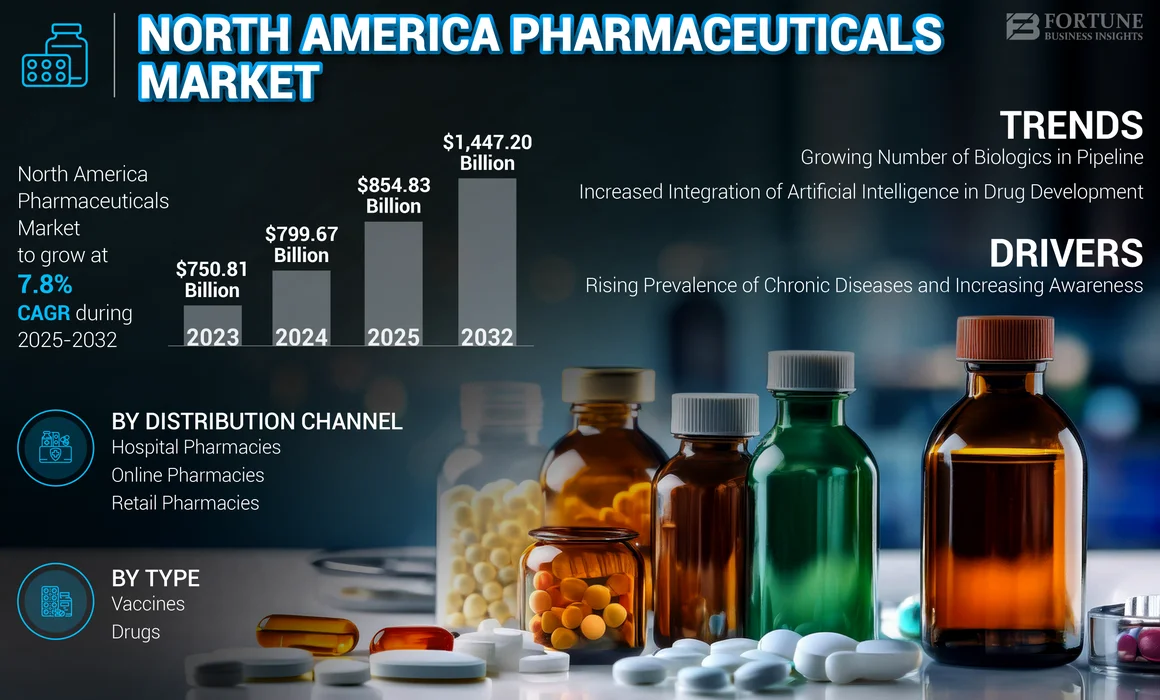
The North America pharmaceuticals market size was valued at USD 799.67 billion in 2024. The market is projected to be worth USD 854.83 billion in 2025 and reach USD 1,447.20 billion by 2032, exhibiting a CAGR of 7.8% during the forecast period.
Pharmaceuticals refers to the drugs and vaccines that are utilized for the treatment, management and the prevention of various diseases. The North American pharmaceutical market, which encompasses U.S and Canada, stands as a pivotal segment of the global healthcare industry. This market is characterized by its substantial size, dynamic growth, and significant influence on global pharmaceutical trends.
A number of factors are expected to propel the demand for diverse pharmaceuticals in the North America market. Some of the most critical reasons include a strong and sustained prevalence of chronic diseases, the aging population, and a robust research & development (R&D) environment leading to launches of innovative drugs supported by the presence of numerous key companies. Furthermore, there is a strong opportunity for growth and innovation in this market as some of the key trends witnessed include a positive growth trajectory for the specialty drugs and with a number of small molecule drugs and biologics losing exclusivity.
- For instance, according to the data released by Statistics Canada in September 2023, an estimated 45.1% of Canadians suffered from at least one chronic disease in 2021.
Some of the key pharmaceutical companies present in the North America market includes Pfizer Inc., Johnson & Johnson Services, Inc., Merck & Co., Inc., AbbVie Inc., and Bristol-Myers Squibb Company. The reasons attributable to these companies’ established presence includes the presence of offerings across a wide range of clinical indications, promising product pipeline, and strong sales revenue in these markets.
- In January 2025, Johnson & Johnson Services, Inc. announced the acquisition of Intra-Cellular Therapies, Inc., in order to further boost the company’s portfolio for neurosciences.
MARKET DYNAMICS
MARKET DRIVERS
Rising Prevalence of Chronic Diseases and Increasing Awareness to Boost Demand for Pharmaceuticals
The surge in the number of cases of chronic diseases in the U.S. and Canada is one of the most critical factors that is expected to significantly impact the market growth. As the number of patients continues to grow, the rise in the awareness regarding the various illnesses is expected to lead to the demand for innovative drugs. The demand for innovative drugs is especially fostered by the need for improved patient outcomes. Such drivers are expected to lead to the market growth during the forecast period.
- The U.S. Department of Health and Human Services (HHS) 2025 Annual Performance Plan and Report stated plans to launch supportive programs to improve the health, safety, and well-being of Americans with a focus on increasing access to and utilization of prevention, crisis intervention, treatment, and recovery services.
MARKET RESTRAINTS
Increasing Number of Biosimilars and Generic Drug to Result in Pricing Pressure
This increasing number of biosimilars and generics in the North American pharmaceuticals market is expected to exert significant pricing pressure on branded medications. Generics do not require extensive testing, manufacturing, and development investments. The active ingredients in biosimilars have already been proven safe and effective, so their R&D costs are typically 15 to 20 times lower than those of their reference drugs. These factors make it affordable and increases the uptake of generics and biosimilars and enabling patients to better adhere to their therapies.
- For instance, in January 2023, the introduction of biosimilars such as Amgen Inc's Amjevita, which is a biosimilar to AbbVie Inc's Humira, has already begun to impact the pricing strategies in the rheumatoid arthritis medication sector. Such influx of multiple biosimilars for a single biologic can lead to price competition, which often results in reduced profit margins for pharmaceutical companies.
MARKET OPPORTUNITIES
Development of Glucagon-like peptide-1 (GLP-1) Agonists to Provide Impetus for Future Market Growth
The rising use of GLP-1 agonists in North America represents a significant opportunity in the management of type 2 diabetes and obesity. This opportunity is further supported by clinical evidence that demonstrate the effectiveness of these drugs in managing weight and improving metabolic health. Moreover, the growing awareness of lifestyle modifications in conjunction with pharmacotherapy is driving patients to seek out these innovative treatments.
- As per the article published in American Medical Association in June 2024, about 1 in 8 (roughly 12%) of the U.S. adults have used a GLP-1 drug
- Similarly, a report published in March 2024, in Canada, approximately 10.0% of the adult population uses a GLP-1 type drug, such as Ozempic. This equates to an estimated 900,000 to 1.4 million Canadians currently using a GLP-1 drug.
MARKET CHALLENGES
Supply Chain Reliance for API and Finished Drugs on International Countries Can Hamper Growth Prospects
An important challenge for the North America market is their reliance on the international sources for the procurement of raw materials such as the active pharmaceutical ingredients and also for the finished drug products. This dependency particularly exposes the market to various vulnerabilities and potential disruptions. In particular, the market is dependent on China and India, for its pharmaceutical supply chains.
- As per the report by the International Journal of Drug Regulatory Affairs in September 2020, around 80.0% of the active pharmaceutical ingredients and 40% of the finished drug product are imported into the U.S. from overseas from India and China. The U.S. has increased its import of Chinese pharmaceutical products by over 600% since 2016.
For instance, during the pandemic, many pharmaceutical companies faced severe shortages of essential medicines and APIs due to factory shutdowns in countries such as China and India, which are the major suppliers of these components.
Other Challenges
Regulatory Hurdles May Further Pose Additional Market Challenges
The stringent regulatory policy exhibited by the key regulatory agencies in the region such as the U.S. Food and Drug Administration, may lead to a lower number of drugs being approved. Furthermore, other associated challenges such as heightened recalls of approved drugs, and a lengthy and an uncertain approval process may also hinder the growth potential.
Increased Pricing Pressures May Limit Market Growth Potential
Another critical challenge that the pharmaceutical industry faces is the consistent pressure to considerably reduce the prices of their products, especially of the innovative drugs that were developed with multiple phases of clinical trials and regulatory processes.
These pricing pressures may lead to the pharmaceutical companies to be unable to recover the costs of their innovations, leading to lesser incentives for further R&D initiatives.
NORTH AMERICA PHARMACEUTICALS MARKET TRENDS
Growing Number of Biologics in Pipeline of Key Players
In terms of the type of products being developed, the pharmaceuticals market is undergoing a transformative change with the increase in the development of biologics. Biologics refer to a wide range of products such as monoclonal antibodies, vaccines, and gene therapies that are derived from living organisms and offer targeted therapies for various diseases, including cancer, auto-immune disorders, and rare genetic conditions. As an increasing number of patients demand treatments with fewer adverse effects, biologics are a good alternative. Hence, the development of these product types is eventually expected to positively impact the overall North America Pharmaceuticals market growth.
- In April 2024, Eli Lilly and Company initiated the phase III clinical trial for the monoclonal antibody Lebrikizumab (LY3650150) in adult participants with chronic rhinosinusitis and nasal polyps treated with intranasal corticosteroids.
Increased Integration of Artificial Intelligence in Drug Development:
In particular, one notable insight that is witnessed in terms of the pharma industry is the increasing amount of investments committed to the implementation of artificial intelligence (AI) in these markets. Increased utilization of artificial intelligence has several advantages in the drug discovery and manufacturing process. Some of the advantages includes a significant reduction to the drug development timelines and a limited or elimination of the utilization of animals for pharmaceutical testing.
- In January 2025, Pfizer Inc. collaborated with PostEra to use AI for generative chemistry to accelerate the drug discovery process. PostEra announced an expansion to USD 610 million in their collaboration with Pfizer.
Download Free sample to learn more about this report.
IMPACT OF COVID-19
The outbreak of the COVID-19 pandemic had a mixed impact on the growth of the North America pharmaceuticals market. In terms of the impact of the pandemic, the COVID-19 had a varied impact on the different segments of the market such as the drugs and the vaccines.
- For instance, the sales of key pharmaceuticals such as respiratory drugs and vaccines for the bacterial diseases underwent a decline in 2020, as compared to 2019.
However, certain pandemic related factors led to disruptions in the overall market such as the patients’ fears and preferences, safety precautions implemented by healthcare providers, disruption of supply chains and distribution channels, as well as logistical challenges.
Trade Protectionism
The scenario related to the trade protectionism in the North America pharmaceuticals market has undergone a significant transition after the election of the new administration in the U.S. This imposition of tariffs on the China market by the U.S., creates additional pressures on the U.S. supply chains for pharmaceuticals, and several pharmaceutical companies predict drug shortages and increased prices, unless these products are exempt under the list of tariffs. Similarly, the imposition of tariffs on the Canadian market by the U.S. is expected to result in a similar scenario.
Segmentation Analysis
By Type
High Demand for These Products Led to Dominance of Drugs Segment in 2024
On the basis of the type segment, the market is segmented into the drugs and vaccines segments.
The drugs segment can be further sub-segmented into oncology, diabetes, infectious diseases, cardiology, neurology, respiratory, hypertension, anti-obesity, dermatology, ophthalmology, and others. In 2024, the drugs segment dominated the market with the highest North America pharmaceuticals market share. The segment is projected to maintain its dominance during the forecast period. It owing to the presence of a substantial number of products present under this segment, their ability to treat, manage or cure chronic diseases such as diabetes, and the strong sales revenue attributed to this segment.
- For instance, in November 2022, Bristol-Myers Squibb Company announced the Health Canada’s approval of Camzyos (mavacamten capsules) for the treatment of adults with symptomatic obstructive hypertrophic cardiomyopathy. This medication is the first approved allosteric and selective cardiac myosin inhibitor in Canada.
On the other hand, the vaccines segment is projected to witness a faster market growth trajectory. The vaccines segment can be further divided into bacterial diseases and viral diseases. The increased number of outbreaks of infectious diseases such as COVID-19 and the growing demand for preventive healthcare is expected to support the segmental growth.
- For instance, in October 2024, Pfizer Inc, received the U.S. FDA approval for ABRYSVO, a recombinant vaccine for individuals of ages 18 through 59 years of age who are at an increased risk for lower respiratory tract disease caused by respiratory syncytial virus (RSV).
To know how our report can help streamline your business, Speak to Analyst
By Distribution Channel
Large Number of Hospital Pharmacies in the Region to Boost Segmental Dominance
In terms of the distribution channel, the market is segmented into hospital pharmacies, retail pharmacies, and online pharmacies.
The hospital pharmacies segment held the largest market share in 2024. The dominance of this segment is due to a strong volume of patient visits in the hospitals, the significant demand for prescription drugs, and the presence of healthcare professionals who can prescribe and distribute these drugs in the hospital pharmacies.
- For instance, in December 2024, Cenora announced the launch of Accelerate Pharmacy Solutions to allow and help the hospital and health systems’ customers in terms of the optimization of their operations and improvement of financial performance.
On the other hand, in 2024, the retail pharmacies segment also accounted for a prominent market share. Some of the reasons for the segment’s notable market share is the large number of retail pharmacies present across the U.S., and Canada and their collaborations with the other major companies.
- For instance, in September 2024, Canada’s Pharmaprix announced the launch of more care clinics in retail pharmacy stores to accelerate the provision of primary care in the retail pharmacies.
The online pharmacies are projected to grow at the highest CAGR during the forecast period as an increasing number of customers are opting to utilize this mode of distribution channel. Some of the advantages associated with online pharmacies includes their cost effectiveness and easy accessibility to critical medications.
NORTH AMERICA PHARMACEUTICALS MARKET REGIONAL OUTLOOK
In terms of the country analysis, the market is divided into the U.S., and Canada.
U.S.
In 2024, the U.S. accounted as the largest market share in the North America pharmaceuticals market. The market dominance of U.S. in the market is fueled by the country’s substantial healthcare expenditure, strong access to reimbursement through Medicare and Medicaid, an enormous patient burden, and the presence of notable players in the pharmaceutical industry.
- For instance, according to the data by the Centers for Disease Control and Prevention (CDC) in October 2024, approximately 6 in 10 adults in U.S, currently live with a chronic disease, such as cancer, heart disease, or diabetes.
Furthermore, an overwhelming number of product launches are directed at the U.S. market due to its strong demand and product adoption trends.
- For instance, according to the data published by the Center for Drug Evaluation and Research (CDER) in January 2025, in 2024, the U.S. FDA approved 50 new drugs.
Canada
The Canadian market is considerably smaller than the U.S. market, however, the country is projected to witness strong growth trends. Canada has witnessed a positive trend in terms of population growth, has robust healthcare expenditure trends, and a strong prevalence of chronic diseases. This factors are expected to contribute to the country’s growth across the forecast period.
- As per the data published by the Canadian Digestive Health Foundation in 2024, Canada has one of the highest rates of irritable bowel syndrome (IBS) in the world, with an estimated prevalence of 18%, as compared to the prevalence of 11% globally.
Competitive Landscape
Key Market Players
Diverse Portfolio of Pfizer Inc., AbbVie Inc., and Bristol-Myers Squibb Company Enables Them to Occupy Commanding Positions
In terms of competitive landscape, the North America pharmaceuticals market reflects a fragmented competition with the presence of several notable players. While no player single handedly dominates the North America market, some of the key players includes Pfizer Inc., AbbVie Inc., and Bristol-Myers Squibb Company. These players account for a prominent proportion of the market owing to their strong product portfolio with the presence of several blockbuster drugs, their established market presence in North America, and a promising pipeline of upcoming drugs.
AbbVie Inc. is one of leading companies present in the market in 2024. The company boasts a strong product portfolio comprising of oncology and immunology drugs, has an influential presence in the U.S. market, and also has several innovative pipeline candidates undergoing the clinical trials.
- In December 2024, AbbVie Inc. initiated the Phase 1 clinical trial for the pipeline candidate of ABBV-969, for the treatment of metastatic castration-resistant prostate cancer (mCRPC).
Some other key players of the North America market includes Pfizer Inc., Bristol-Myers Squibb Company, Merck & Co., Inc., Novartis AG, Johnson & Johnson Services, Inc., and others. Coupled with these companies, the market also includes the presence of several other established and emerging players with innovative pharmaceutical products in their portfolio or research pipelines.
- For instance, in September 2024, Sanofi signed an exclusive licensing agreement with U.S. based RadioMedix, Inc., to address unmet medical needs in cancer.
LIST OF KEY NORTH AMERICA PHARMACEUTICALS COMPANIES PROFILED
- Pfizer Inc. (U.S.)
- Sanofi (France)
- Novartis AG (Switzerland)
- GSK plc (U.K.)
- Merck & Co., Inc. (U.S.)
- AstraZeneca (U.K.)
- F. Hoffmann-La Roche Ltd. (Switzerland)
- Johnson & Johnson Services, Inc. (U.S.)
- AbbVie Inc. (U.S.)
- Bristol-Myers Squibb Company (U.S.)
KEY INDUSTRY DEVELOPMENTS
- January 2025: AstraZeneca received the U.S. FDA for Enhertu (fam-trastuzumab deruxtecan-nxki) as the first HER2-directed therapy for patients with HR-positive, HER2-low metastatic breast cancer following disease progression after one or more endocrine therapy.
- December 2024: Pfizer Inc. received U.S. FDA Approval for RAFTOVI combination regimen as first-line treatment of BRAF V600E-Mutant metastatic colorectal cancer.
- December 2024: Bristol-Myers Squibb Company announced the U.S. FDA's approval of a subcutaneous formulation of Opdivo (called Opdivo Qvantig) (nivolumab and hyaluronidase-nvhy) for multiple solid tumors.
- December 2024: Novartis AG announced the positive topline results from the Phase III STEER study. This pivotal study assessed the efficacy and safety of investigational intrathecal onasemnogene abeparvovec (OAV101 IT) for spinal muscular atrophy (SMA) Type 2.
- December 2024: AbbVie Inc. acquired Aliada Therapeutics to accelerate the drug development for the treatment of patients with Alzheimer's disease.
REPORT COVERAGE
The North America pharmaceuticals market report covers an exhaustive analysis of the market. The market research report covers key aspects such as the detailed analysis of the type and distribution channel segments, the comprehensive company profiles, and the market share analysis of the key companies present in the market. Furthermore, the North America pharmaceuticals market forecast also considers the impact of the loss of patent protection on the major products present in the market and also the scenario after the launches of innovative products. In addition, it also includes the detailed insights into the key industry developments such as mergers, partnerships, & acquisitions, pipeline analysis, new product launches, the key challenges in the industry, the promising therapeutic areas and also the detailed overviews of the trend in investment funding, mergers and acquisitions, and IPO in the key countries.
Request for Customization to gain extensive market insights.
Report Scope & Segmentation
|
ATTRIBUTE |
DETAILS |
|
Study Period |
2019-2032 |
|
Base Year |
2024 |
|
Estimated Year |
2025 |
|
Forecast Period |
2025-2032 |
|
Historical Period |
2019-2023 |
|
Growth Rate |
CAGR of 7.8% from 2025-2032 |
|
Unit |
Value (USD billion) |
|
Segmentation |
By Type
By Distribution Channel
By Region
|
Frequently Asked Questions
Fortune Business Insights says that the market stood at USD 799.67 billion in 2024 and is projected to reach USD 1,447.20 billion by 2032.
The market is expected to exhibit steady growth at a CAGR of 7.8% during the forecast period.
By type segment, the drugs segment dominated the market in 2024.
The surging prevalence of acute and chronic diseases in the region, increased awareness, rise in strategic initiatives such as acquisitions, and innovative product launches are boosting the North American market growth.
Pfizer, Inc., AbbVie Inc., Bristol-Myers Squibb Company, and Merck & Co., Inc. are some of the major players in the market.
The U.S. dominated the market in 2024.



- 2019-2032
- 2024
- 2019-2023
- 148
Get 30-60 hrs Free Customization
Expand Regional and Country Coverage, Segments Analysis, Company Profiles, Competitive Benchmarking, and End-user Insights.













.webp)






Related Reports
-
US +1 833 909 2966 ( Toll Free )
-
Get In Touch With Us