Osseointegration Implants Market Size, Share & Industry Analysis, By Product Type (Dental Implants, Bone-Anchored Prosthetic Implants, Bone-Anchored Hearing Implants, Orthopedic Osseointegration Implants, and Others), By Material Type (Titanium & Titanium Alloys, Zirconia/Ceramic Implants, and Others), By End-user (Hospitals, Dental Clinics, Specialty Clinics, and Others), and Regional Forecast, 2026-2034
 Download Free Sample
Osseointegration Implants Market Size and Future Outlook
 Listen to Audio Version
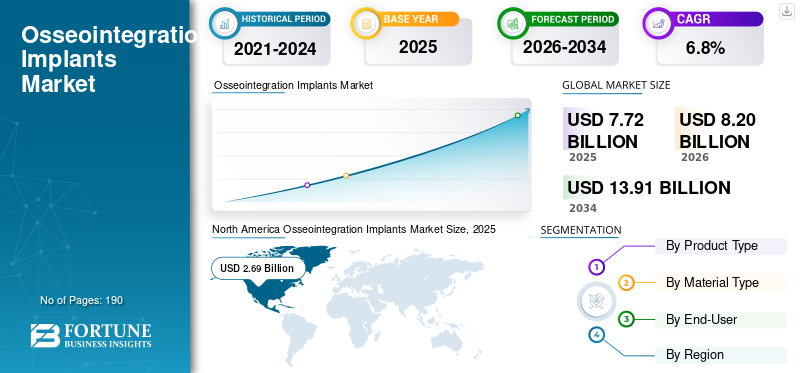
The global osseointegration implants market size was valued at USD 7.72 billion in 2025 and is projected to grow from USD 8.20 billion in 2026 to USD 13.91 billion by 2034, exhibiting a CAGR of 6.8% during the forecast period. North America dominated the osseointegration implants market with a market share of 34.84% in 2025.
Osseointegration implants are medical implants designed to form a direct structural and functional bond with living bone, allowing stable fixation without soft-tissue interference. These implants are widely used in orthopedics, dental implants, limb prosthetics, craniofacial reconstruction, and spinal fusion procedures. Market growth is attributed to the rising burden of arthritis, trauma injuries, amputations, tooth loss, and demand for long-lasting implant fixation. In addition, an increasing number of technologically advanced cementless implants is also projected to have a positive impact on the market growth. Growth is also supported by 3D printing, robotic surgery, digital planning, and a rising preference for implants with better mobility and long-term stability.
- For instance, in July 2021, the AO Foundation and American Academy of Periodontology conducted a global consensus conference focused on peri-implant health and implant maintenance.
Key players in the market include Institut Straumann AG, Envista Holdings Corporation, Dentsply Sirona Inc., and Zimmer Biomet Holdings, Inc. They are focusing on developing various innovative technologies to offer better products with improved accuracy and efficiency.
Download Free sample to learn more about this report.
OSSEOINTEGRATION IMPLANTS MARKET TRENDS
Rising Preference for 3D-printed Porous Titanium Implants is a Key Market Trend
A major trend shaping the market is the increasing use of 3D printing technology for manufacturing osseointegration implants. Additive manufacturing enables the creation of highly porous structures that mimic natural bone architecture and enhance biological fixation. Moreover, the technology also facilitates patient-specific implant designs for complex anatomical requirements. Such developments demonstrate the growing industry focus on improving implant integration, reducing surgical complications, and enhancing long-term clinical outcomes through next-generation manufacturing technologies.
- For instance, in September 2024, Exactech completed the first total ankle replacement surgeries using its Vantage Ankle 3D and 3D+ tibial implants featuring 3D-printed porous titanium technology.
MARKET DYNAMICS
MARKET DRIVERS
Download Free sample to learn more about this report.
Growing Adoption of Cementless Implant Technologies to Accelerate Market Growth
The increasing shift toward cementless orthopedic and dental implants is a key driver for the global osseointegration implants market growth. Modern implant designs incorporate porous structures and bioactive surfaces that encourage natural bone ingrowth, improving implant stability and reducing revision rates. Moreover, rising demand from a younger and more active patient population is supporting the transition toward biologically fixed implants with longer functional life.
MARKET RESTRAINTS
High Procedure and Implant Costs to Restrain Market Growth
The high cost associated with osseointegration procedures remains a significant restraint for market expansion. Advanced titanium implants, customized prosthetic systems, robotic-assisted surgeries, and specialized rehabilitation programs increase the overall treatment expense. In addition, several osseointegration procedures require highly trained surgical teams and long-term patient monitoring, further elevating healthcare costs. Reimbursement limitations in several countries continue to restrict patient access to advanced implant technologies.
MARKET OPPORTUNITIES
Expansion of Bone-Anchored Prosthetic Systems to Offer Lucrative Market Opportunities
Growing acceptance of bone-anchored prosthetic solutions among amputees presents a significant opportunity for market participants. Osseointegration implants eliminate the need for traditional socket-based prostheses, improving mobility, comfort, and quality of life. Increasing clinical evidence supporting these systems is encouraging broader adoption among healthcare providers. Furthermore, advancements in personalized implant manufacturing and digital surgical planning are creating new growth opportunities in orthopedic reconstruction and complex trauma management.
MARKET CHALLENGES
Risk of Infection and Long-Term Complications Pose a Critical Challenge to Market Growth
Despite technological advancements, infection risk and implant-related complications remain major challenges for the market. Procedures involving skin-penetrating components, particularly limb osseointegration systems, require extensive post-operative monitoring to prevent infections and mechanical failures. Implant loosening, peri-implant fractures, and rehabilitation complexities can also affect patient outcomes. Additionally, successful implementation requires specialized surgical expertise and multidisciplinary care teams, limiting adoption in facilities with inadequate infrastructure.
Segmentation Analysis
By Product Type
Substantial Number of Knee and Hip Implants Boosted Orthopedic Osseointegration Implants Segment Growth
Based on product type, the market is divided into dental implants, bone-anchored prosthetic implants, bone-anchored hearing implants, orthopedic osseointegration implants, and others.
In 2025, orthopedic osseointegration implants accounted for the largest market share due to their widespread use in hip, knee, shoulder, ankle, trauma, and limb reconstruction procedures. The increasing prevalence of osteoarthritis, osteoporosis, sports injuries, and traumatic fractures has significantly increased demand for advanced orthopedic implants. In addition, growing preference for cementless fixation and improved implant survivorship is further supporting segment growth. The orthopedic sector has also benefited from substantial investments in robotic-assisted surgery and implant innovation.
- For instance, in December 2022, NYU Langone Health launched an osseointegration program using Integrum's FDA-approved OPRA Implant System for amputee rehabilitation. The development highlights the increasing adoption of bone-anchored prosthetic technologies designed to improve prosthetic attachment, mobility, and patient outcomes, while supporting the expansion of osseointegration procedures across specialized orthopedic centers.
The bone-anchored prosthetic implants segment is anticipated to rise with a CAGR of 10.1% over the forecast period.
To know how our report can help streamline your business, Speak to Analyst
By Material Type
Considerable Biocompatibility Offered by Titanium and Titanium Alloys Accelerated Segment Growth
Based on material type, the market is segmented into titanium & titanium alloys, zirconia/ceramic implants, and others.
In 2025, the titanium & titanium alloys segment dominated the global market, owing to their superior biocompatibility, corrosion resistance, mechanical strength, and proven ability to promote bone integration. These materials exhibit excellent osseointegration characteristics, making them the preferred choice for orthopedic, dental, spinal, and prosthetic implants. Their compatibility with additive manufacturing technologies has further increased adoption, enabling the development of highly porous structures that facilitate bone ingrowth.
- For instance, in July 2025, Overture Orthopaedics commercially launched the OvertureTi Knee Resurfacing System for patients with early osteoarthritis and cartilage defects. The development reflects the growing demand for bone-preserving implant solutions that support biological fixation, improve joint function, and offer an alternative to traditional knee replacement procedures, thereby expanding opportunities within the orthopedic osseointegration implants market.
The zirconia/ceramic implants segment is anticipated to rise with a CAGR of 6.9% over the forecast period.
By End-User
Significant Number of Implant Procedures in Hospitals Accelerated Segment Growth
Based on end-user, the market is segmented into hospitals, dental clinics, specialty clinics, and others.
In 2025, hospitals held the highest osseointegration implants market share due to the high volume of orthopedic, dental, trauma, and reconstructive procedures performed in these settings. Most osseointegration surgeries require advanced imaging systems, specialized operating rooms, multidisciplinary surgical teams, and post-operative rehabilitation facilities that are readily available in hospitals. In addition, the increasing adoption of robotic-assisted surgical platforms and digital planning technologies has further strengthened hospital demand for advanced implants. Additionally, hospitals are typically the first healthcare facilities to adopt innovative implant technologies and participate in clinical research programs. Furthermore, the segment is set to hold 48.3% share in 2026.
The specialty clinics segment is projected to grow at a CAGR of 7.9% during the forecast period.
Osseointegration Implants Market Regional Outlook
By geography, the market is categorized into Europe, North America, Asia Pacific, Latin America, and the Middle East & Africa.
North America
North America Osseointegration Implants Market Size, 2025 (USD Billion)
To get more information on the regional analysis of this market, Download Free sample
North America held the dominant share in 2024, valued at USD 2.54 billion, and also maintained the leading share in 2025, with USD 2.69 billion. The market in North America is expected to increase due to the high prevalence of osteoarthritis, traumatic injuries, limb amputations, and age-related musculoskeletal disorders.
U.S. Osseointegration Implants Market
Based on North America’s strong contribution and the U.S. dominance within the region, the U.S. market can be analytically approximated at around USD 2.43 billion in 2026, accounting for roughly 29.7% of global sales.
Europe
Europe is projected to record a growth rate of 6.3% in the coming years, which is the second highest among all regions, and reach a valuation of USD 2.46 billion in 2026. The region is estimated to witness considerable market growth due to an increasing aging population, rising incidence of degenerative bone disorders, and strong demand for advanced joint replacement procedures.
U.K. Osseointegration Implants Market
The U.K. market in 2026 is estimated at around USD 0.41 billion, representing roughly 6.3% of global revenues.
Germany Osseointegration Implants Market
Germany’s market is projected to reach approximately USD 0.56 billion in 2026, equivalent to around 6.7% of global sales.
Asia Pacific
Asia Pacific is estimated to reach USD 2.03 billion in 2026 and secure the position of the third-largest region in the market. The market growth is attributed to its large patient population, rapidly expanding healthcare infrastructure, and increasing healthcare expenditure.
Japan Osseointegration Implants Market
The Japanese market in 2026 is estimated at around USD 0.35 billion, accounting for roughly 4.3% of global revenues.
China Osseointegration Implants Market
China’s market is projected to reach USD 0.68 billion in 2026, representing roughly 8.2% of global sales.
India Osseointegration Implants Market
The Indian market in 2026 is estimated at around USD 0.45 billion, accounting for roughly 5.5% of global revenues.
Latin America and Middle East & Africa
The Latin America and Middle East & Africa regions are expected to witness moderate growth in this market during the forecast period. The Latin America market is set to reach a valuation of USD 0.48 billion in 2026.
GCC Osseointegration Implants Market
The GCC market is set to reach a value of USD 0.14 billion in 2026.
South Africa Osseointegration Implants Market
The South African market is projected to reach around USD 0.06 billion in 2026, representing roughly 0.71% of global revenues. Growing investments by market players, along with a growing emphasis on biocompatible implants, are accelerating market growth.
COMPETITIVE LANDSCAPE
Key Industry Players
Rising Number of Collaborations Coupled with Higher Quality of Services by Key Players to Boost Market Progress
The global osseointegration implants market holds a semi-consolidated market structure, constituting prominent players such as Institut Straumann AG, Envista Holdings Corporation, Dentsply Sirona Inc., and Zimmer Biomet Holdings, Inc. The significant global market share of these companies is attributed to numerous strategic activities, including distribution collaborations and the implementation of new programs.
- For instance, in July 2025, Dentsply Sirona launched a new Implant Product Selection Guide on its U.S. e-commerce platform to improve implant product identification and purchasing efficiency for dental professionals. The initiative highlights the increasing adoption of digital tools in implant dentistry aimed at streamlining clinical workflows, supporting treatment planning, and facilitating broader utilization of osseointegration-based dental implant
Other notable players in the global market include Johnson & Johnson MedTech, Neobiotech Co., Ltd., Cochlear Limited, and Permedica S.p.A. These companies are expected to prioritize collaborations to increase their global market share during the forecast period.
LIST OF KEY OSSEOINTERATION IMPLANT COMPANIES PROFILED
- Institut Straumann AG (Switzerland)
- Envista Holdings Corporation (U.S.)
- Dentsply Sirona Inc. (U.S.)
- Zimmer Biomet Holdings, Inc. (U.S.)
- BioHorizons Implant Systems, Inc. (U.S.)
- Johnson & Johnson MedTech (U.S.)
- Neobiotech Co., Ltd. (South Korea)
- Cochlear Limited (Australia)
- Permedica S.p.A. (Italy)
- Integrum AB (Sweden)
KEY INDUSTRY DEVELOPMENTS
- December 2024: Zimmer Biomet received FDA clearance for its Persona Revision SoluTion PPS Femur, strengthening the company's position in cementless revision knee implants and supporting the broader adoption of biologic fixation technologies in orthopedic reconstruction.
- October 2024: Exactech obtained FDA clearance for the Truliant Porous 3D Tibial Implant, expanding the availability of 3D-printed porous implant solutions designed to enhance osseointegration and long-term implant stability.
- September 2024: Exactech completed the first commercial surgeries using its Vantage Ankle 3D and 3D+ implants, highlighting increasing clinical acceptance of additive manufacturing technologies in lower-extremity reconstruction.
- March 2022: OssDsign entered into a long-term supply agreement with Assistance Publique–Hôpitaux de Paris, strengthening the adoption of customized cranial implants across major healthcare institutions in Europe.
- October 2021: Nobel Biocare launched the Xeal and TiUltra implant surface technologies to improve soft tissue attachment and bone integration. The development reflects the growing industry focus on advanced implant surface engineering to enhance osseointegration, improve clinical outcomes, and support long-term implant stability in dental applications.
REPORT COVERAGE
The global osseointegration implants market analysis includes a comprehensive study of the market size & forecast by all the market segments included in the report. It includes details on the market dynamics and market trends expected to drive the market over the forecast period. It provides information on key aspects, including an overview of technological advancements, the regulatory environment, and product launches. Additionally, it details partnerships, mergers & acquisitions, as well as key industry developments and investments by key regions. The global market research report also provides a detailed competitive landscape with information on the market share and profiles of key operating players.
Request for Customization to gain extensive market insights.
Report Scope & Segmentation
| ATTRIBUTE | DETAILS |
| Study Period | 2021-2034 |
| Base Year | 2025 |
| Estimated Year | 2026 |
| Forecast Period | 2026-2034 |
| Historical Period | 2021-2024 |
| Growth Rate | CAGR of 6.8% from 2026 to 2034 |
| Unit | Value (USD Billion) |
| Segmentation | By Product Type, Material Type, End-User, and Region |
| By Product Type |
|
| By Material Type |
|
| By End-User |
|
| By Region |
|
Frequently Asked Questions
According to Fortune Business Insights, the global market value stood at USD 7.72 billion in 2025 and is projected to reach USD 13.91 billion by 2034.
In 2025, the market value in North America stood at USD 2.69 billion.
The market is expected to exhibit a CAGR of 6.8% during the forecast period of 2026-2034.
By product type, the orthopedic osseointegration implants segment led the market.
Growing adoption of cementless implant technologies is driving market expansion.
Institut Straumann AG, Envista Holdings Corporation, Dentsply Sirona Inc., and Zimmer Biomet Holdings, Inc are the major players in the global market.
North America dominated the market in 2025.



- 2021-2034
- 2025
- 2021-2024
- 190
Get 30-60 hrs Free Customization
Expand Regional and Country Coverage, Segments Analysis, Company Profiles, Competitive Benchmarking, and End-user Insights.













.webp)






Related Reports
-
US +1 833 909 2966 ( Toll Free )
-
Get In Touch With Us