Oxygen Scavengers Market Size, Share & Industry Analysis, By Product Type (Inorganic and Organic), By Application (Power Generation & Boilers, Oil & Gas, Food & Beverage Packaging, Water Treatment (Non-boiler), and Others) and Regional Forecast, 2026-2034
 Download Free Sample
OXYGEN SCAVENGERS MARKET SIZE AND FUTURE OUTLOOK
 Listen to Audio Version
The global oxygen scavengers market size was USD 2.35 billion in 2025i and is projected to grow from USD 2.48 billion in 2026 to USD 3.84 billion by 2034 at a CAGR of 5.6% during the forecast period. Asia Pacific dominated the oxygen scavengers market with a market share of 37.87% in 2025.
Oxygen scavengers are chemical compounds added to liquids, gases, or sealed environments to remove dissolved or residual oxygen and prevent oxidative degradation, corrosion, and product spoilage. They are widely used in boiler feed water systems, oil & gas injection streams, industrial process water, and active food products packaging to protect equipment integrity and extend shelf life. The primary market driver is the global installed base of steam boilers and industrial water systems, where continuous oxygen control is essential to prevent corrosion-related failures, unplanned shutdowns, and efficiency losses, making oxygen scavengers a recurring and mission-critical maintenance chemical across industries. Ecolab Inc., Solenis, Arkema, Veolia, and Clariant are few key players operating in the market.
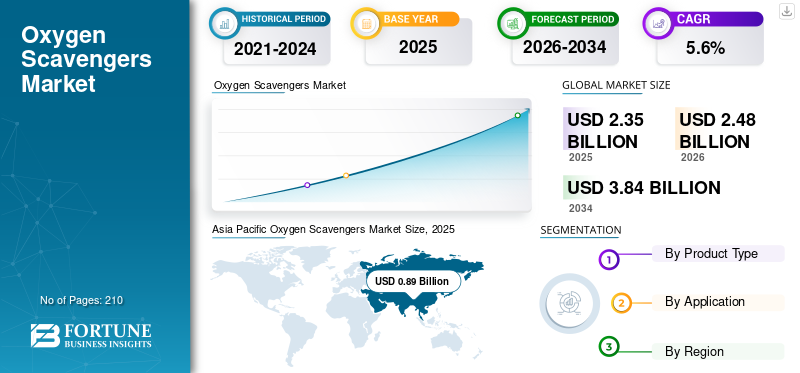
Download Free sample to learn more about this report.
Oxygen Scavengers Market Key Takeaways
 Market Size & Forecast
- 2025 Market Size: USD 2.35 billion
- 2026 Market Size: USD 2.48 billion
- 2034 Forecast Market Size: USD 3.84 billion
- CAGR: 5.6% from 2026-2034
 Market Share
- Asia Pacific dominated the oxygen scavengers market with a 37.87% share in 2025.
- The inorganic segment held the largest market share in 2025.
- The power generation & boilers segment accounted for the largest market share in 2025.
 Key Regional Highlights
Asia Pacific
Asia Pacific dominated the global oxygen scavengers market in 2025.
North America
North America's demand is primarily driven by the oil & gas sector and water injection systems.
Europe
Europe's market growth is supported by power generation and industrial boiler applications.
U.S.
The market reached USD 0.48 billion in 2025, accounting for around 20.4% of global sales.
Japan
The market reached USD 0.13 billion in 2025, representing approximately 5.5% of global sales.
Read More

OXYGEN SCAVENGERS MARKET TRENDS
Accelerating Shift Toward High-Performance Organic Formulations is Key Market Trend
A key industry trend includes the global shift from hydrazine-based scavengers to safer organic alternatives such as DEHA and carbohydrazide. Regulatory pressure in Europe and North America, combined with workplace safety standards, is reshaping product portfolios. This shift is increasing the share of specialty organic chemistries, raising technical differentiation and pricing power. Simultaneously, packaging applications are adopting advanced oxygen absorbing systems integrated into films and closures. The industry is gradually moving from commodity driven volume toward performance driven formulations, supporting margin improvement and innovation across developed markets.
MARKET DYNAMICS
MARKET DRIVERS
Download Free sample to learn more about this report.
Industrial Infrastructure Expansion Fuels Product Demand
A major driver of the oxygen scavengers market growth is the expanding global installed base of industrial boilers, steam systems, desalination plants and water infrastructure. Rapid industrialization in Asia Pacific and infrastructure upgrades in the Middle East are increasing demand for corrosion control solutions. Steam driven manufacturing, power generation and refining operations require continuous oxygen removal to prevent pitting and tube failure. Since oxygen scavengers are low-cost yet mission-critical maintenance chemicals, they benefit from recurring demand tied to asset protection and operational continuity, ensuring stable long-term consumption across both developed and emerging economies.
MARKET RESTRAINTS
Energy Transition and Boiler Efficiency Restrains Market Growth
A structural restraint for the market is the global shift toward renewable energy and improved steam system efficiency. As coal-fired power generation declines in Europe and parts of North America, the installed base of large thermal boilers stabilizes or contracts. Additionally, improved mechanical deaeration systems and optimized dosing technologies reduce chemical intensity per unit of steam generated. These efficiency improvements, while positive for sustainability, limits volume acceleration in mature markets. Consequently, demand growth increasingly depends on emerging economies rather than legacy industrial regions.
MARKET OPPORTUNITIES
Active Packaging Adoption Creates High Value Growth Avenue beyond Industrial Applications
A major opportunity lies in the expansion of active food and pharmaceutical packaging. Rising global consumption of packaged and convenience foods, combined with longer distribution chains and e-commerce growth, is increasing the demand for oxygen-absorbing sachets and polymer integrated scavenging films. Unlike boiler chemicals, packaging scavengers command significantly higher unit pricing and technical margins. As food safety regulations tighten and shelf-life extension becomes a competitive advantage, this segment offers structural growth beyond traditional industrial water treatment applications, positioning oxygen scavengers within higher value specialty chemical ecosystems.
MARKET CHALLENGES
Commodity Price Volatility and Competitive Intensity Pressure Margin Stability to Limit Market Growth
A critical challenge facing the industry is raw material and energy price volatility, particularly for sulfur derivatives, amines, and iron powders. Commodity inorganic scavengers operate in highly competitive environments with limited pricing power, especially in Asia Pacific. At the same time, customers often procure through long term industrial contracts, limiting pass-through flexibility. Increasing regulatory compliance costs further strain margins. As a result, producers must balance cost optimization with portfolio upgrading toward specialty formulations to maintain profitability in a market where volume growth is steady but not explosive.
SEGMENTATION ANALYSIS
By Product Type
Industrial Boiler Installed Base Sustains High-Volume Demand for Inorganic Segment
Based on the product type, the market is segmented into inorganic and organic.
The inorganic segment is anticipated to hold the dominant oxygen scavengers market share during the forecast period. The primary demand driver for inorganic oxygen scavengers is the vast global installed base of industrial and utility boilers requiring continuous corrosion control. Sodium sulfite and related inorganic chemistries remain cost-effective, reliable, and well-established solutions for low to medium pressure steam systems. In emerging markets across Asia Pacific and the Middle East, ongoing expansion of power generation, refining and manufacturing infrastructure continues to anchor large volume consumption. Their affordability, ease of handling, and compatibility with conventional boiler treatment programs sustains inorganic scavengers as the dominant segment globally.
The major growth driver for organic oxygen scavengers is the global transition away from hydrazine and toward safer, high-performance alternatives. Regulatory tightening in Europe and North America, combined with stricter workplace safety standards, is accelerating adoption of DEHA, carbohydrazide and other organic formulations. These products offer superior passivation properties, improved high-pressure boiler performance, and lower environmental risk. Additionally, expanding oil & gas specialty applications and active packaging systems further boost demand, positioning organic scavengers as the fastest-growing segment within the market. The organic segment is anticipated to rise with a CAGR of 6.4% over the forecast period.
By Application
To know how our report can help streamline your business, Speak to Analyst
Expanding Steam Infrastructure to Drive Recurring Demand in Power Generation & Boilers Segment
Based on the application, the market is segmented into power generation & boilers, oil & gas, food & beverage packaging, water treatment (non-boiler) and others.
The power generation & boilers segment is anticipated to hold the dominant market share during the forecast period. The primary demand driver for oxygen scavengers in power generation and industrial boilers is the critical need to prevent corrosion in high-pressure steam systems. Thermal power plants, refineries, chemical facilities and manufacturing units rely on continuous oxygen removal to avoid pitting, tube failure and costly downtime. As emerging economies expand electricity generation and industrial steam capacity, the installed boiler base continues to grow. As oxygen scavengers are low-cost yet essential maintenance chemicals, they benefit from recurring, non-discretionary demand tied directly to asset protection and operational reliability.
The driver for food and beverage packaging segment is the need for extended shelf life and improved food safety across increasingly complex global supply chains. Oxygen-absorbing sachets and active packaging films help prevent oxidation, spoilage, and microbial growth, particularly in ready-to-eat and processed foods. Rising e-commerce distribution, longer transit times, and stricter food safety regulations are accelerating adoption. As consumer preference shifts toward convenience foods and export-oriented supply chains expand, oxygen scavengers are becoming integral to packaging innovation and product quality preservation.
The food & beverage packaging segment is anticipated to rise with a CAGR of 6.8% over the forecast period.
OXYGEN SCAVENGERS MARKET REGIONAL OUTLOOK
By region, the market is segmented into North America, Europe, Asia Pacific, Latin America, and Middle East & Africa.
Asia Pacific
Asia Pacific Oxygen Scavengers Market Size, 2025 (USD Billion)
To get more information on the regional analysis of this market, Download Free sample
Asia Pacific region dominated the market in 2025. Asia Pacific’s demand is fundamentally driven by the expansion of power generation and industrial boiler infrastructure across China, India, and Southeast Asia. Rapid industrialization, rising electricity demand and manufacturing growth require continuous oxygen control in steam systems. This large and growing installed base makes boilers the dominant application by volume. Supporting momentum comes from increasing packaged food consumption and urban water infrastructure expansion. Additionally, the structural progress of thermal power and industrial steam capacity remains the central force shaping regional market growth.
Japan Oxygen Scavengers Market
Japan’s market reached USD 0.13 billion in 2025, equivalent to around 5.5% of global sales.
China Oxygen Scavengers Market
China’s market is projected to be one of the largest worldwide and held revenues at USD 0.38 billion in 2025, representing roughly 16.2% of global sales.
India Oxygen Scavengers Market
India’s market reached USD 0.16 billion in 2025, equivalent to around 6.8% of global sales.
North America
In North America, the primary driver of product demand is the oil & gas sector, particularly upstream shale production and water injection systems requiring continuous corrosion control. Oxygen removal is critical in maintaining pipeline integrity, storage systems, and enhanced oil recovery operations. While power generation and industrial boilers provide a stable baseline of recurring demand, the technical intensity and higher treatment volumes in oilfield applications exert a stronger growth influence. Additionally, expanding active food packaging adoption supports incremental demand, but oil & gas remains the dominant structural driver.
U.S. Oxygen Scavengers Market
The U.S. market was at USD 0.48 billion in 2025, accounting for roughly 20.4% of global sales.
Europe
In Europe, rising demand is primarily driven by power generation and industrial boiler systems, where strict environmental and workplace regulations are accelerating the transition toward safer, high-performance oxygen scavengers. Corrosion prevention in district heating networks, manufacturing steam systems, and energy infrastructure sustains steady consumption. While food and beverage packaging solutions is a fast-growing supporting segment due to advanced food safety standards, the installed base of regulated boiler infrastructure remains the most significant volume anchor. Long-term demand stability is closely tied to industrial asset protection and regulatory compliance requirements.
U.K. Oxygen Scavengers Market
U.K.’s market reached at USD 0.08 billion in 2025, equivalent to around 3.4% of global sales.
Germany Oxygen Scavengers Market
Germany’s market was valued at USD 0.12 billion in 2025, equivalent to around 5.1% of global sales.
Latin America
In Latin America, oxygen scavenger demand is primarily supported by power generation and industrial boiler systems tied to refining, pulp & paper, and manufacturing activities. Brazil and Mexico anchor regional consumption through established industrial infrastructure and steam-intensive operations. Oil & gas applications provide meaningful secondary support, particularly in refining and pipeline corrosion management. While food packaging demand is gradually rising, boiler and steam system protection remains the core volume driver. Future growth is linked to industrial modernization and incremental energy infrastructure investment across the region.
Brazil Oxygen Scavengers Market
Brazil’s market was at USD 0.10 billion in 2025, equivalent to around 4.3% of global sales.
Middle East & Africa
In the Middle East & Africa, oil & gas production and associated water injection systems represent the dominant driver for the market. Corrosion prevention in upstream facilities, pipelines, and refining operations requires continuous chemical treatment. Additionally, large-scale desalination and thermal power facilities in Gulf countries reinforce steady consumption in boiler applications. While food packaging and general water treatment contribute marginally, hydrocarbon infrastructure and water-intensive energy systems remain the principal structural forces sustaining regional demand growth.
Saudi Arabia Oxygen Scavengers Market
Saudi Arabia’s market reached USD 0.06 billion in 2025, equivalent to around 2.6% of global sales.
COMPETITIVE LANDSCAPE
Key Industry Players
Fragmented Specialty Mix and Infrastructure-Linked Demand Intensify Competitive Positioning in Market
The market competitive landscape is moderately fragmented, characterized by a mix of large integrated water treatment companies and regional specialty chemical producers. Competition is driven by formulation performance, regulatory compliance, technical service capability, and long-term industrial contracts rather than pure price alone. Bulk inorganic scavengers remain volume-driven and cost-competitive, while organic and oilfield formulations offer higher margins and differentiation. The market increasingly favors suppliers with integrated corrosion management solutions and global distribution networks. Key leading producers include Ecolab, Solenis, Arkema, Veolia and Clariant.
LIST OF KEY OXYGEN SCAVENGERS COMPANIES PROFILED
- MITSUBISHI GAS CHEMICAL COMPANY, INC. (Japan)
- Accepta Water Treatment (U.K.)
- Adipro Chemicals (U.S.)
- Arkema (France)
- Clariant (Switzerland)
- Desiccare Inc. (U.S.)
- Ecolab Inc. (U.S)
- Multisorb (U.S.)
- Solenis (U.S)
- Veolia (France)
REPORT COVERAGE
The global market report provides a detailed analysis of the market. It focuses on key aspects such as profiles of leading companies, product types, and leading applications of the product. Besides this, it offers insights into the analysis of key market trends and highlights key industry developments. In addition to the aforementioned factors, it encompasses several factors that have contributed to the growth of the market over recent years.
Request for Customization to gain extensive market insights.
Report Scope & Segmentation
| ATTRIBUTE | DETAILS |
| Study Period | 2021-2034 |
| Historical Period | 2021-2024 |
| Base Year | 2025 |
| Estimated Year | 2026 |
| Forecast Period | 2026-2034 |
| Unit | Volume (Kiloton); Value (USD Billion) |
| Growth Rate | CAGR of 5.6% during 2026-2034 |
| Segmentation | By Product Type, By Application and By Region |
| By Product Type |
|
| By Application |
|
| By Region |
|
Frequently Asked Questions
Fortune Business Insights says that the global market size was USD 2.35 billion in 2025 and is projected to record a valuation of USD 3.84 billion by 2034.
In 2025, Asia Pacific stood at USD 0.89 billion.
Registering a CAGR of 5.6%, the market will exhibit steady growth during the forecast period of 2026-2034.
The power generation & boilers application is expected to lead this market during the forecast period.
Industrial infrastructure expansion to fuel steady oxygen scavenger demand, driving market growth
Ecolab, Solenis, Arkema, Veolia, and Clariant are the major players operating in the market.
Asia Pacific dominated the market in terms of share in 2025.
Active packaging adoption to create high value growth avenue beyond industrial applications.



- 2021-2034
- 2025
- 2021-2024
- 210
Get 30-60 hrs Free Customization
Expand Regional and Country Coverage, Segments Analysis, Company Profiles, Competitive Benchmarking, and End-user Insights.


















Related Reports
-
US +1 833 909 2966 ( Toll Free )
-
Get In Touch With Us