Peppermint Oil Market Size, Share & Industry Analysis, By Product Type (Natural and Conventional), By Form (Liquid, Concentrates, and Encapsulated Peppermint Oil), By Application (Food & Beverages, Dietary Supplements, Pharmaceuticals, Personal Care & Cosmetics, Aromatherapy & Wellness, and Others), and Regional Forecast, 2026-2034
 Download Free Sample
(Offer valid till 15th Oct 2026)

Peppermint Oil Market Size and Future Outlook
 Listen to Audio Version
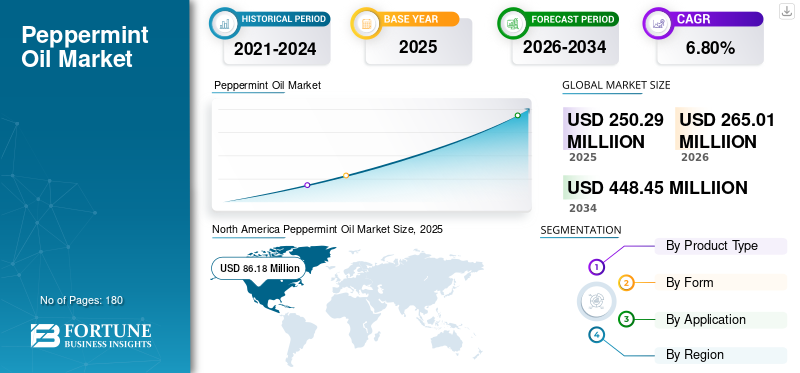
The global peppermint oil market size was valued at USD 250.29 million in 2025 and is projected to grow from USD 265.01 million in 2026 to USD 448.45 million by 2034, exhibiting a CAGR of 6.80% during the forecast period. North America dominated the peppermint oil market with a market share of 34.43% in 2025.
Peppermint oil is a naturally-sourced essential oil extracted from the flowering tops and leaves of the peppermint plant via steam distillation. It is recognized for its high menthol content, which imparts a distinctive minty flavor and cooling sensation. A few of the common types of oil include encapsulated oil, oil blends, and pure oil. With respect to target applications, it is widely used in the food and beverage industry (chewing gums, beverages), pharmaceuticals, aromatherapy & wellness, and other industrial applications. Geographically, North America and Europe are considered the major consumers in the global market. The growing awareness of the therapeutic benefits of oil and the expanding supplements sector are key drivers in the market.
Companies such as Givaudan SA, Symrise AG, and DSM-Firmenich are prominent players in the market. New product launches are a pivotal strategy adopted by key players to improve their position.
Download Free sample to learn more about this report.
Peppermint Oil Market Key Takeaways
 Market Size & Forecast
- 2025 Market Size: USD 250.29 million
- 2026 Market Size: USD 265.01 million
- 2034 Forecast Market Size: USD 448.45 million
- CAGR: 6.80% from 2026–2034
 Market Share
- North America dominated the peppermint oil market with a 34.43% share in 2025.
- The concentrates segment is projected to grow at a CAGR of 6.47% over the forecast period.
- The aromatherapy & wellness segment is projected to grow at a high CAGR of 7.47% over the forecast period.
 Key Regional Highlights
North America
North America held 34.43% share in 2025, valued at USD 86.18 million.
Asia Pacific
Asia Pacific market valued at USD 63.36 million in 2025.
Europe
Europe market valued at USD 71.22 million in 2025.
U.S.
Market valued at USD 74.46 million in 2025.
Japan
Market valued at USD 8.47 million in 2025.
Read More

PEPPERMINT OIL MARKET TRENDS
Rising Use of Peppermint Oil in Oral Hygiene and Personal Care Products is Key Trend
Peppermint oil is witnessing high adoption across oral hygiene and personal care applications, owing to its multifunctional properties, which combine both functional advantages and sensory appeal. In the oral care sector, this oil is widely utilized in mouthwashes, breath fresheners, and toothpastes, mainly due to its antimicrobial properties and strong cooling sensation. Simultaneously, it is being highly utilized in the haircare and skincare segment for its scalp-stimulating and soothing properties. It is mostly used in massage oil, face washes, and face cleansers, where it offers a cooling effect. Moreover, it minimizes the risk of acne and acts as a natural astringent. By seeing such advantages, the players in the beauty space are aiming to launch new products infused with peppermint oil.
MARKET DYNAMICS
MARKET DRIVERS
Download Free sample to learn more about this report.
Surging Demand for Natural Ingredients Drives Use of Peppermint Oil
The increasing shift toward clean-label/natural ingredients is a main driver strengthening the use of peppermint oil. Today, the majority of the population is becoming health-conscious about component’s transparency and avoiding the use of artificial flavors and synthetic additives. This transition is specifically strong in food and beverage, and cosmetics, where purchasers mostly link natural components with long-term health benefits and safety. Peppermint oil, being minimally processed and naturally derived, fits well in this trend, allowing producers to replace synthetic flavors with naturally occurring components. When used in food products, it improves the freshness and supports food preservation, whereas in cosmetics, it is used to enhance product efficacy and offers antimicrobial properties.
MARKET RESTRAINTS
Sensitivity to Storage Conditions and Shelf-Life Restrictions Inhibit Market’s Growth
One of the pivotal hurdles in the global market is limited shelf life and storage sensitivity. Peppermint, although highly stable than other citrus-based oils, is still prone to degradation when subjected to poor storage environments. Its main components, which include menthone and menthol, are easily affected by oxygen, light, and heat, which can lead to chemical degradation and oxidation over a period of time. Extended exposure can hamper the oil’s aroma profile and minimize its therapeutic efficacy, making it less ideal for conditions that need consistent functional/sensory performance. Moreover, in regions with inadequate warehouse infrastructure and elevated temperature conditions, preserving oil becomes highly difficult, further fueling the risk of value loss or spoilage during storage and transportation.
MARKET OPPORTUNITIES
Utilization of Modern Technologies in Oil Sector Opens Growth Opportunities
The adoption of advanced technologies in the oil industry unlocks numerous growth possibilities. To improve the efficiency of extraction, the producers are adopting steam distillation technology. Along with enhancing efficiency, it also strengthens the quality of oil. Supercritical CO₂ extraction is another popular method explored by companies to produce a high-purity solvent-free extract. Moreover, mass spectrometry and gas chromatography are utilized by manufacturers as they help in detecting adulteration and maintaining the quality of end products. Additionally, to strengthen the stability of oil, the businesses are using encapsulation technologies. Through this technique, the producers can protect the oil from oxidation and also strengthen its shelf life.
Segmentation Analysis
By Product Type
Conventional Segment Dominated Market Due to Cost-Effectiveness
Based on product type, the market is segmented into conventional and natural.
The conventional segment led the market in 2025. The conventional peppermint farming allows the use of crop protection chemicals and fertilizers, which substantially enhances crop yield. Owing to limited restrictions on inputs and higher yield, regular peppermint is economical to produce. Moreover, lower compliance and certification costs are other key factors boosting the global peppermint oil market growth.
The natural segment is projected to grow at a high CAGR of % over the forecast period.
By Form
Liquid Form Led in Market Owing to Higher Formulation Flexibility
Depending on form, the market is sub-divided into liquid, concentrates, and encapsulated peppermint oil.
In 2025, the liquid category led the global market. Compared with encapsulated or concentrates, the liquid form provides greater flexibility in aromatherapy, cosmetics, and food, as it can be easily blended into various formulation systems. Moreover, it has minimal processing steps and offers immediate aroma and flavor release, further adding to the growth. Additionally, wider commercial availability and easy blending with other oils such as eucalyptus, lavender, and rosemary bolster the segment’s potential.
The concentrates segment is projected to grow at a CAGR of 6.47% over the forecast period.
To know how our report can help streamline your business, Speak to Analyst
By Application
Food & Beverages Segment Led Industry Owing to High Use of Oil in Culinary Applications
Based on application, the market is distributed into food & beverages, dietary supplements, pharmaceuticals, personal care & cosmetics, aromatherapy & wellness, and others.
Food & beverages segment led the global market in 2025. Compared to other applications, peppermint oil is utilized in large volumes in food and beverages such as dairy items, confectionery, and beverages. This component, when incorporated in food items, provides an immediate sensory impact that enhances the consumer’s experience. Moreover, it has a minimal entry barrier in the food sector and can be easily adopted by consumers in their daily routine. Additionally, the increasing awareness of health advantages and faster product innovation further propel the global peppermint oil market share.
The aromatherapy & wellness segment is projected to grow at a high CAGR of 7.47% over the forecast period.
Peppermint Oil Market Regional Outlook
By geography, the market is categorized into Europe, North America, Asia Pacific, South America, and the Middle East & Africa.
North America
North America Peppermint Oil Market Size, 2025 (USD Million)
To get more information on the regional analysis of this market, Download Free sample
The North America region dominates the market, reaching a valuation of USD 86.18 million in 2025. The market in North America is expected to grow due to rising demand for natural oils including peppermint oil and the flourishing supplements industry.
U.S. Peppermint Oil Market
Based on North America's strong contribution and the U.S. dominance within the region, the U.S. market was approximated at around USD 74.46 million in 2025, accounting for roughly 29.75% of global sales.
Europe
Europe reached a valuation of USD 71.22 million in 2025, recording a growth rate of 6.49% during the forecast period and securing second position. The growing essential oil market and surging use of clean-label oils in personal care products are boosting the regional potential.
Germany Peppermint Oil Market
The German market was valued at around USD 15.65 million in 2025, representing roughly 6.25% of the global revenues.
U.K. Peppermint Oil Market
The U.K. market reached approximately USD 11.91 million in 2025, equivalent to around 4.76% of the global sales.
Asia Pacific
The Asia Pacific region reached USD 63.36 million in 2025 and held the third position. The adoption of advanced method of extraction and surging awareness of aromatherapy are propelling the region's potential.
India Peppermint Oil Market
The Indian market was valued at around USD 16.06 million in 2025, accounting for roughly 6.42% of the global revenues.
China Peppermint Oil Market
China's market is projected to be one of the largest globally, with revenues valued at around USD 18.04 million in 2025, accounting for roughly 7.21% of global market sales.
Japan Peppermint Oil Market
The Japanese market was valued at around USD 8.47 million in 2025, accounting for approximately 3.38% of the global revenues.
South America and Middle East & Africa
The South America and Middle East & Africa regions are expected to witness moderate growth in this market during the forecast period. The South America market reached a valuation of USD 18.47 million in 2025. The high demand for peppermint oil in products including chocolates and candies, and the rising number of producers, are expected to drive demand. The Middle East and Africa market reached USD 11.07 million in 2025.
Egypt Peppermint Oil Market
The Egypt market reached around USD 3.15 million in 2025, representing roughly 1.26% of global revenues.
COMPETITIVE LANDSCAPE
Key Industry Players
New Launches of Products by Key Players to Aid in Market Expansion
The peppermint oil market comprises a blend of well-known essential oil producers and niche players competing for market share. All the companies operating in the global space are focusing on new product developments and base expansion to strengthen their share in the market. Moreover, the firms should try to seek collaborations and promotions to improve their market reach.
LIST OF KEY PEPPERMINT OIL COMPANIES PROFILED IN REPORT
- doTERRA International LLC (U.S.)
- Symrise AG (Germany)
- Givaudan SA (Switzerland)
- International Flavors & Fragrances Inc. (IFF) (U.S.)
- DSM-Firmenich (Switzerland)
- AOS Products Pvt. Ltd. (India)
- Ultra International B.V. (Netherlands)
- Berjé Inc. (U.S.)
- Kancor Ingredients Limited (India)
- Young Living Essential Oils (U.S.)
KEY INDUSTRY DEVELOPMENTS
- November 2025: DSM-Firmenich, a Swiss-based chemical enterprise, announced the opening of a new plant in Kerala, India.
- October 2020: doTERRA International LLC, an American health & wellness company, introduced new diffusers and essential oil products, along with three wellness programs which help individuals to concentrate on their particular health goals.
REPORT COVERAGE
The global peppermint oil market provides an in-depth study of the market size & forecast by all the market segments included in the market reports. The market forecast analysis includes details on the market dynamics and global market trends expected to drive the market during the forecast period. The global market analysis offers information on the new product launches, key industry developments, and details on partnerships, mergers & acquisitions. The peppermint oil industry forecast also encompasses a detailed competitive landscape with information on the market share and profiles of key operating players.
Request for Customization to gain extensive market insights.
Report Scope & Segmentation
| ATTRIBUTE | DETAILS |
| Study Period | 2021-2034 |
| Base Year | 2025 |
| Estimated Year | 2026 |
| Forecast Period | 2026-2034 |
| Historical Period | 2021-2024 |
| Growth Rate | CAGR of 6.80% from 2026-2034 |
| Unit | Value (USD Million) |
| Segmentation | By Product Type, Form, Application, Region |
| By Product Type |
|
| By Form |
|
| By Application |
|
| By Region |
|
Frequently Asked Questions
Fortune Business Insights says that the global market value stood at USD 250.29 million in 2025 and is projected to reach USD 448.45 million by 2034.
In 2025, North Americas market value stood at USD 86.18 million.
The market is expected to exhibit a CAGR of 6.80% during the forecast period of 2026-2034.
By product type, the conventional segment led the global market.
Surging demand for natural ingredients drives the use of peppermint oil.
Givaudan SA, Symrise AG, and DSM-Firmenich are the top players in the market.
North America held the largest market share in 2025.
Rising use of peppermint oil in oral hygiene and personal care products is the key trend.



- 2021-2034
- 2025
- 2021-2024
- 180
-
(Offer valid till 15th Oct 2026)
Get 30-60 hrs Free Customization
Expand Regional and Country Coverage, Segments Analysis, Company Profiles, Competitive Benchmarking, and End-user Insights.




















Related Reports
-
US +1 833 909 2966 ( Toll Free )
-
Get In Touch With Us