Polyurethane Additives Market Size, Share & Industry Analysis, By Additive Type (Catalysts, Surfactants, Blowing Agents, Flame Retardants, and Others), By End-Use Industry (Building and Construction, Automotive and Transportation, Furniture and Bedding, Electrical and Electronics, and Others), and Regional Forecast, 2026-2034
 Download Free Sample
Polyurethane Additives Market Size and Future Outlook
 Listen to Audio Version
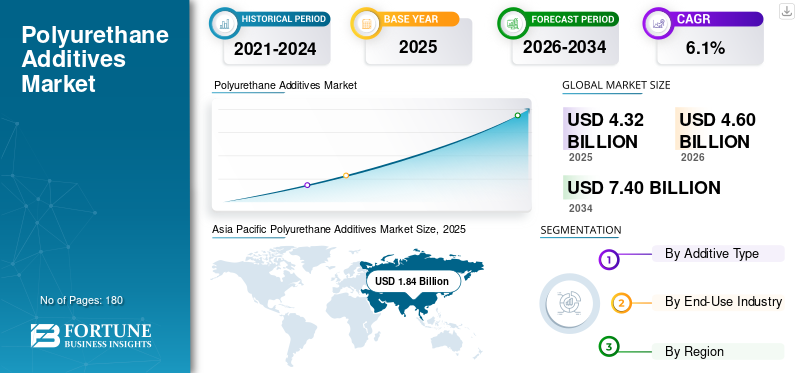
The global polyurethane additives market size was valued at USD 4.32 billion in 2025. The market is projected to grow from USD 4.60 billion in 2026 to USD 7.40 billion by 2034, exhibiting a CAGR of 6.1% during the forecast period. Asia Pacific dominated the polyurethane additives market with a market share of 40.59% in 2025
Polyurethane additives are crucial materials used to improve the processing, strength, stability, durability, and overall performance of polyurethane products. The demand for these additives is closely connected to polyurethane consumption in construction insulation, furniture and bedding, automotive components, footwear, coatings, adhesives, sealants, and other industrial applications. These additives help manufacturers achieve better foam structure, product consistency, thermal efficiency, flexibility, and longer service life. Globally, the market is supported by steady polyurethane demand, growing performance requirements, stricter environmental regulations, and increasing adoption of specialized additive solutions across major end-use industries and regional manufacturing markets globally.
The market is dominated by a small group of integrated chemical producers with broad product portfolios and established formulation technologies. Major players such as Evonik Industries AG, Momentive Performance Materials Inc., Dow Inc., BASF SE, Huntsman Corporation, and regional producers focus on product innovation, application-specific additive solutions, regulatory compliance, and consistent technical support, resulting in a moderately consolidated market characterized by steady demand, high switching costs, and strong customer relationships.
Download Free sample to learn more about this report.
POLYURETHANE ADDITIVES MARKET TRENDS
Growing Use of Customized Additive Packages Is Reshaping the Market
A key trend in the market is the increasing use of customized additive packages developed for specific foam types and processing needs. Instead of using separate catalysts, surfactants, stabilizers, and modifiers, manufacturers are adopting combined solutions that simplify formulation and improve product consistency. From a business perspective, this trend supports closer cooperation between suppliers and customers, reduces production complexity, and helps manufacturers achieve better foam quality, processing efficiency, and overall product performance.
- According to the U.S. Department of Energy, an automated spray polyurethane foam project targeted a 10% increase in insulation yield and a 20% reduction in overall cost, highlighting the growing focus on consistent foam quality, processing efficiency, and optimized polyurethane formulations.
MARKET DYNAMICS
MARKET DRIVERS
Download Free sample to learn more about this report.
Rising Demand for Polyurethane Foams in Building Insulation Sustains Additive Consumption
Polyurethane additives market growth is primarily driven by the growing use of rigid polyurethane foams in building insulation applications. These additives are essential for controlling foam formation, improving cell structure, enhancing thermal performance, and ensuring processing consistency. As energy-efficiency standards become stricter and demand for insulated buildings increases, manufacturers are adopting advanced catalysts, surfactants, flame retardants, and stabilizers in rigid foam formulations. This expansion in construction insulation creates a clear demand-side pull, as higher rigid polyurethane foam production directly increases the consumption of polyurethane additives.
- According to the European Commission, buildings account for around 40% of total energy consumption in the European Union, highlighting the need for effective insulation materials such as rigid polyurethane foam and the additives used in their production.
|
Rank |
Market Drivers |
Overall Impact Rank |
CAGR Contribution (2026-2034) |
Impact 2026-2028 |
Impact 2029-2031 |
Impact 2032-2034 |
|
1 |
Rising Demand for Polyurethane Foams in Building Insulation Sustains Additive Consumption |
High |
+2.20% |
High |
High |
High |
|
2 |
Growing use of polyurethane in automotive interiors and lightweight components |
High |
+1.80% |
Medium |
High |
High |
|
3 |
Expansion of furniture, mattress, and bedding production |
Medium |
+1.60% |
High |
Medium |
Medium |
|
4 |
Increasing adoption of low-emission and high-performance polyurethane formulations |
Medium |
+1.40% |
Medium |
High |
High |
|
5 |
Rising polyurethane consumption in appliances, electrical, and electronics applications |
Medium |
+1.20% |
Medium |
Medium |
High |
|
6 |
Others (growth in footwear, coatings, adhesives, sealants, elastomers, medical products, and regional polyurethane manufacturing) |
Low |
+0.90% |
Low |
Low |
Low |
|
Total Positive Growth Contribution |
+ 9.10% |
MARKET RESTRAINTS
High Exposure to Cyclical Construction Activity Creates Demand Volatility in the Market
Polyurethane additives demand is constrained by its strong reliance on construction activity, particularly in rigid foam insulation, sealants, coatings, and related building materials. Slowdowns in residential and commercial construction, reduced renovation spending, or delayed infrastructure projects can quickly lower polyurethane production and additive consumption. Unlike essential bulk chemicals with wider end-use diversity, many polyurethane additives are closely tied to project-based demand and building investment cycles. This dependence makes the market vulnerable during periods of high interest rates, weak property development, and broader macroeconomic uncertainty.
|
Rank |
Market Restraints |
Overall Impact Rank |
Negative CAGR Contribution (2026-2034) |
Impact 2026-2028 |
Impact 2029-2031 |
Impact 2032-2034 |
|
1 |
High Exposure to Cyclical Construction Activity Creates Demand Volatility for Polyurethane Additives |
High |
-1.10% |
High |
Medium |
Medium |
|
2 |
Volatility in silicone, amine, flame-retardant, and specialty chemical input costs |
High |
-0.90% |
High |
High |
Medium |
|
3 |
Regulatory pressure and costs associated with reformulating restricted additives |
Medium |
-0.70% |
Medium |
High |
High |
|
4 |
Others (supply-chain disruptions, technical compatibility issues, limited formulation expertise, and substitution by alternative materials) |
Low |
-0.30% |
Low |
Low |
Low |
|
Total Negative Growth Impact |
-3.00% |
MARKET OPPORTUNITIES
Growing Demand for Low-Emission Polyurethane Products Creates New Opportunities
Polyurethane additive manufacturers can benefit from the rising demand for low-emission and environmentally safer polyurethane products. Stricter rules on hazardous catalysts, volatile organic compounds, and traditional flame retardants are encouraging manufacturers to use safer and more sustainable alternatives. This creates opportunities for low-odor catalysts, reactive silicone surfactants, halogen-free flame retardants, and bio-based additives. Companies are offering compliant additives without affecting foam quality, processing efficiency, or product durability are improving their market position across major polyurethane applications.
- According to the U.S. Environmental Protection Agency (EPA), concentrations of several common organic pollutants can be 2 to 5 times higher indoors than outdoors, encouraging the demand for low-emission polyurethane materials and safer additive formulations.
MARKET CHALLENGES
Complex Formulation Requirements to Increase Development and Support Costs, Hampering Market Growth
Polyurethane additive producers face a major challenge as formulations often need to be adjusted as per different foam systems, raw materials, processing conditions, and performance needs. An additive that works well in one application may not provide the same result in another application. This requires continuous testing, product modification, and close technical support for customers. As a result, companies are required to invest in laboratories, technical experts, and application development, thereby increasing costs and potentially delaying the launch of new additive solutions.
Segmentation Analysis
By Additive Type
Strong Demand and Broad Use Across Polyurethane Systems Supports Dominance of Catalysts
Based on additive type, the market is segmented into catalysts, surfactants, blowing agents, flame retardants, and others.
The catalysts segment accounted for leading share of the global market in 2025. Catalysts lead in additive consumption as they control reaction speed, curing time, foam formation, and overall processing efficiency across rigid foams, flexible foams, coatings, adhesives, sealants, and elastomers. Their use is essential for maintaining production consistency and achieving required balance between processing time and final product performance. As polyurethane manufacturers continue to improve productivity, reduce processing time, and develop application-specific formulations, demand for amine and metal-based catalysts remains strongly supported across major polyurethane systems.
The flame retardants segment is expected to grow at a CAGR of 7.5% over the forecast period.
By End-Use Industry
To know how our report can help streamline your business, Speak to Analyst
High Demand for Polyurethane Insulation Positions Building and Construction Industry as the Leading End-user Industry
In terms of end-use industry, the market is categorized into building and construction, automotive and transportation, furniture and bedding, electrical and electronics, and others.
The building and construction segment accounted for the largest market share in 2025. This segment leads polyurethane additives demand as rigid polyurethane foams require catalysts, surfactants, flame retardants, and stabilizers to achieve consistent cell structure, thermal performance, dimensional stability, and processing efficiency. Growing use of polyurethane insulation in walls, roofs, panels, and refrigeration systems supports steady additive consumption. As energy-efficiency requirements and renovation activity increase, building and construction remains the strongest end-use segment.
The electrical and electronics segment is expected to grow at a CAGR of 7.3% over the forecast period.
Polyurethane Additives Market Regional Outlook
By geography, the market is categorized into North America, Europe, Asia Pacific, Latin America, and the Middle East & Africa.
Asia Pacific
Asia Pacific Polyurethane Additives Market Size, 2025 (USD Billion)
To get more information on the regional analysis of this market, Download Free sample
Asia Pacific held the dominant polyurethane additives market share in 2025, valued at USD 1.84 billion, and is expected to retain its leading role in 2026, reaching USD 1.97 billion. The region’s leadership is driven by its large polyurethane production base, strong construction activity, and high-volume manufacturing of furniture, automotive components, electronics, and consumer goods. Growing demand for performance additives supports sustained regional market growth, particularly across China, India, Japan, and South Korea.
China Polyurethane Additives Market
Based on Asia Pacific’s strong contribution and China’s large polyurethane manufacturing base, the China market reached approximately USD 0.96 billion in 2025, accounting for approximately 52.2% of regional revenues. Demand is supported by extensive production of rigid and flexible polyurethane foams for construction, furniture, bedding, industrial, and automotive industry applications. The demand is also supported by a well-developed chemical industry and rising use of advanced performance additives across manufacturing sectors.
To know how our report can help streamline your business, Speak to Analyst
India Polyurethane Additives Market
The India market in 2025 was valued at around USD 0.26 billion. Growth is supported by expanding construction activity, rising furniture and bedding production, increasing automotive sector and appliance manufacturing, and gradual expansion of domestic polyurethane processing capacity, strengthening demand for performance additives.
North America
North America remains a significant regional market and reached USD 0.94 billion in 2025. Demand is supported by established polyurethane consumption across construction insulation, automotive interiors, appliances, furniture, coatings, and industrial applications. The region benefits from advanced manufacturing capabilities, strong technical expertise, developed distribution networks, and steady replacement demand. However, overall regional market growth remains moderate due to mature end-use industries and relatively stable polyurethane production levels across the region.
U.S. Polyurethane Additives Market
The U.S. market in 2025 touched USD 0.84 billion, representing approximately 88.5% of regional revenues. Consumption is driven by demand for additives used in rigid insulation foams, flexible furniture and bedding foams, automotive interiors, appliances, coatings, adhesives, and industrial polyurethane systems nationwide across major end-use industries.
Europe
Europe is projected to record modest growth over the forecast period, reaching a valuation of USD 1.11 billion by 2025. Strict environmental regulations, high operating costs, and growing demand for low-emission additive technologies characterize the growth of the region. Continued consumption across building insulation, automotive components, furniture, coatings, adhesives, and industrial polyurethane applications supports steady demand for advanced performance additives.
Germany Polyurethane Additives Market
Germany’s market is projected touched approximately USD 0.31 billion by 2025, representing around 28.2% of regional revenues. Demand is supported by automotive production, industrial manufacturing, advanced polyurethane processing, and the use of performance additives.
U.K. Polyurethane Additives Market
The U.K. market in 2025 reached USD 0.26 billion, accounting for roughly 23.1% of regional revenues. Consumption is concentrated as polyurethane additives are used across building insulation, furniture and bedding, automotive components, coatings, adhesives, and selective industrial applications requiring consistent processing and product performance.
Latin America and Middle East & Africa
The Latin America and Middle East & Africa regions are expected to record moderate growth during the forecast period. The Latin America market reached USD 0.26 billion in 2025, supported by construction activity, furniture production, appliance manufacturing, and expanding polyurethane processing capacity. Demand for additives is gradually increasing across these applications. In the Middle East & Africa, market growth is supported by building insulation, industrial uses, infrastructure development, and the expansion of downstream polyurethane manufacturing. The MEA market is expected to reach USD 0.18 billion in 2026.
GCC Polyurethane Additives Market
The GCC market accounted for around USD 0.08 billion in 2025, representing approximately 48.9% of regional revenues. Demand is supported by construction, infrastructure development, polyurethane insulation use, industrial activity, and the region’s role in chemical production, polymer processing, and distribution.
COMPETITIVE LANDSCAPE
Key Industry Players
Development of Application-Specific Solutions by Prominent Players is Defining the Market Competition
The polyurethane additives market is relatively consolidated and technically specialized, as complex formulation requirements, high research and development needs, and strict regulatory compliance create significant barriers to entry. These factors limit new participation and concentrates supply among a small group of global chemical producers with broad product portfolios and established application expertise.
Leading players such as Evonik Industries AG, Momentive, Dow, BASF, and Huntsman focus primarily on developing application-specific additive solutions and strengthening technical support rather than pursuing aggressive capacity expansion. Recent activities across these companies highlight a strategic emphasis on product performance, formulation efficiency, regulatory compliance, and gradual adoption of low-emission additive technologies to support long-term market positioning.
LIST OF KEY POLYURETHANE ADDITIVES COMPANIES PROFILED
- Evonik Industries AG (Germany)
- Momentive (U.S.)
- Dow (U.S.)
- BASF (Germany)
- Huntsman (U.S.)
- Tosoh Corporation (Japan)
- LANXESS (Germany)
- Kao Corporation (Japan)
- PCC Group (Germany)
- Ferline S.A. (Switzerland)
KEY INDUSTRY DEVELOPMENTS
- October 2024: Momentive expanded its distribution partnership with Safic-Alcan for Niax polyurethane additives across additional Eastern European countries, improving regional product availability, supply flexibility, and customer support for slabstock foam manufacturers.
- March 2023: Evonik partnered with Chemours to combine DABCO PM 301 polyurethane additive with low-global-warming-potential blowing agents, improving thermal performance and processing efficiency in spray polyurethane foam systems.
- February 2023: Momentive installed a pilot-scale machine at its Leverkusen laboratory in Germany for testing small batches of Niax polyurethane additive formulations, improving product-development speed, formulation testing, and technical support for customers.
- September 2022: Momentive completed the expansion of its Termoli manufacturing facility in Italy to increase production of Niax polyurethane additives, strengthening regional supply capabilities and supporting sustainable rigid and flexible foam
- November 2021: Evonik opened an innovation center in Essen, Germany for developing specialty polyurethane additives, shortening product-development timelines and strengthening formulation capabilities for emerging applications such as artificial leather and electric mobility.
- August 2021: LANXESS completed the acquisition of Emerald Kalama Chemical for approximately USD 1.04 billion, adding polymer modifiers and specialty additives used in polyurethane formulations and expanding its performance-additives portfolio.
REPORT COVERAGE
The global polyurethane additives market analysis provides an in-depth study of the market size & forecast by all the market segments included in the report. It includes details on market dynamics and trends expected to drive the market during the forecast period. It offers information on technological advancements, new product launches, key industry developments, and partnerships, mergers & acquisitions. The market research report also includes a detailed competitive landscape, including market share and profiles of key players.
Request for Customization to gain extensive market insights.
Report Scope & Segmentation
| ATTRIBUTE | DETAILS |
| Study Period | 2021-2034 |
| Base Year | 2025 |
| Estimated Year | 2026 |
| Forecast Period | 2026-2034 |
| Historical Period | 2021-2024 |
| Growth Rate | CAGR of 6.1% from 2026-2034 |
| Unit | Value (USD Billion) Volume (Kiloton) |
| Segmentation | By Additive Type, End-Use Industry, and Region |
| By Additive Type |
|
| By End-Use Industry |
|
| By Geography |
|
Frequently Asked Questions
Fortune Business Insights says that the global market size was valued at USD 4.32 billion in 2025 and is projected to reach USD 7.40 billion by 2034.
Recording a CAGR of 6.1%, the market is slated to exhibit steady growth during the forecast period.
Building and construction segment led in 2025.
Asia Pacific held the highest market share in 2025.
Growing use of high-performance polyurethane products across construction, automotive, and furniture applications is increasing demand for catalysts, surfactants, flame retardants, and stabilizers.



- 2021-2034
- 2025
- 2021-2024
- 180
Get 30-60 hrs Free Customization
Expand Regional and Country Coverage, Segments Analysis, Company Profiles, Competitive Benchmarking, and End-user Insights.


















Related Reports
-
US +1 833 909 2966 ( Toll Free )
-
Get In Touch With Us