Probiotic Cosmetics Market Size, Share & Industry Analysis, By Type (Skincare, Hair Care, and Others) By End User (Men and Women), By Distribution Channel (Hypermarket/Supermarket, Convenience Stores, E-commerce/Online, and Others), and Regional Forecast, 2026-2034
 Download Free Sample
(Offer valid till 15th Oct 2026)

KEY MARKET INSIGHTS
 Listen to Audio Version
The global probiotic cosmetics market size was valued at USD 480 million in 2025 and is projected to grow from USD 510 million in 2026 to USD 880 million by 2034, exhibiting a CAGR of 7.08% during the forecast period. North America dominated the probiotic cosmetics market with a market share of 35.87% in 2025.
Probiotic cosmetics are skincare and personal care products infused with live beneficial microorganisms or fermented ingredients that support the skin’s microbiome. These products aim to balance skin flora, enhance natural immunity, reduce inflammation, and improve conditions such as acne, eczema, and sensitivity. The market for probiotic cosmetics is growing rapidly due to rising consumer awareness about skin microbiome health and a strong shift toward natural and functional skincare solutions. Increased prevalence of acne or skin issues caused by pollution, stress, and overuse of harsh chemicals further support demand. Additionally, the clean beauty trend and growing preference for personalized skincare fuel product innovation. In addition, supportive research and endorsements by dermatologists also drive consumer trust and market adoption. For instance, a report published by Nosto in 2021 cited that 59% of people are influenced by products that are mentioned as “natural and organic” and 68% of consumers are looking for products described as “clean”.
Key players operating in the market include Esse Skincare, Tula Skincare, Gallinee, Aurelia London, LaFlore Probiotic Skincare, and Eminence Organic Skin Care. Global giants such as L’Oreal, Unilever, and Johnson & Johnson are also entering this niche through acquisitions or in-house innovation. These players are undertaking multiple growth strategies such as product innovation and merger & acquisition, along with a focus on clean beauty, which further results in boosting the overall cosmetic products market size.
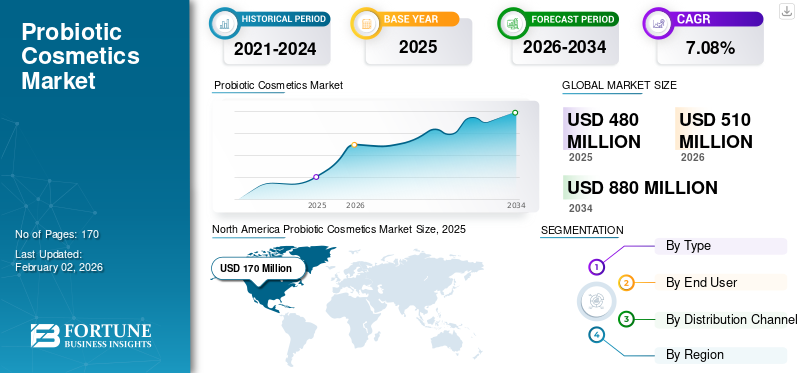
Download Free sample to learn more about this report.
Probiotic Cosmetics Market Key Takeaways
 Global Market Size & Forecast
- 2025 Market Size: USD 480 million
- 2026 Market Size: USD 510 million
- 2034 Forecast Market Size: USD 880 million
- CAGR: 7.08% from 2026–2034
 Market Share
- North America dominated the probiotic cosmetics market with a market share of 35.87% in 2025.
- The skincare segment is projected to dominate the market with a share of 54.90% in 2026.
- The women segment is projected to dominate the market with a share of 62.75% in 2026.
 Key Regional Highlights
North America
North America recorded a market size of USD 170 million in 2025, capturing 35.87% of the global market share, and is projected to reach USD 180 million in 2026.
Europe
Europe is projected to grow at a CAGR of 7.00% during the forecast period, driven by increasing working population, rising disposable income, changing lifestyle, and surge in hectic lifestyle.
Asia Pacific
Asia Pacific generated USD 110 million in 2025, representing 22.36% of the global market landscape, and is expected to reach USD 110 million in 2026.
U.S.
The U.S. market is projected to reach USD 148.47 million by 2026. Increasing number of retail stores in the U.S. is the key factor boosting the market growth.
Japan
The probiotic cosmetics market is projected to reach USD 14.66 million by 2026, driven by growing consumer preference for advanced skincare and microbiome-friendly cosmetic products.
Read More

MARKET DYNAMICS
MARKET DRIVERS
Rising Consumer Awareness of Skin Microbiome Health to Spur Market Growth
Consumers are becoming increasingly informed about the role of the skin microbiome in maintaining healthy skin. With growing awareness of home imbalances in the skin flora can lead to acne, sensitivity, and inflammation, people are seeking gentle, effective alternatives to chemical-laden products. Probiotic cosmetics offer a natural approach by restoring microbial balance, which aligns with the rising demand for science-backed, holistic skincare. This shift is driving the adoption among health-conscious and wellness-oriented consumers.
Surge in Demand for Clean and Natural Beauty Products to Drive Market Expansion
The clean beauty movement has significantly influenced the demand for probiotic beauty products such as cosmetics. Consumers now prefer products that are free from parabens, sulfates, and synthetic fragrances. Probiotic skincare fits this demand by offering natural, non-toxic formulations that promote skin health without harsh chemicals. This demand for transparency, sustainability, and minimalism in beauty products is pushing brands to innovate with probiotic and fermented ingredient-based solutions.
MARKET RESTRAINTS
Lack of Consumer Awareness and Education to Hamper Market Growth
One of the key factors hampering market growth across several emerging industries is the lack of consumer awareness and proper education about the product or service. In many regions, especially in Tier II and Tier III cities or rural areas, potential buyers remain unaware of the benefits, usage, or value proposition of newer offerings. This gap in understanding leads to hesitation in adoption and slows overall market penetration. Additionally, misinformation or preconceived notions can create resistance to change, especially in sectors such as health tech, organic products, or digital finance. Companies struggle to build trust and drive demand without targeted awareness campaigns and educational efforts, limiting market expansion and long-term growth potential.
MARKET OPPORTUNITY
Expansion of E-commerce in Tire II and Tier III Cities to Offer Potential Growth Opportunities
The rapid digital penetration and improved internet infrastructure in Tier II and Tier III cities present a strong probiotic cosmetics market growth opportunity for businesses across sectors. As smartphone usage and digital literacy rise in these regions, consumers are increasingly turning to online platforms for shopping, entertainment, education, and financial services. This shift is further accelerated by affordable data plans and government initiatives promoting digital inclusion. E-commerce players are recognizing the untapped potential and customizing offerings, language support, and logistics to cater to these semi-urban and rural markets. Brands that localize their approach and ensure seamless delivery experiences can gain early mover advantage, foster customer trust, and significantly boost sales in these high-growth potential, previously untapped markets.
Download Free sample to learn more about this report.
MARKET CHALLENGE
Regulatory Uncertainty and Lack of Standardization to Stand as a Market Challenge
A major challenge faced by businesses today is lack of clear regulatory guidelines and standardization, ensuring their stability, safety, and efficacy in cosmetic formulations is complex. Regulatory bodies across regions have different definitions and classifications for probiotics in non-food products, leading to confusion and inconsistent product approvals. Additionally, there is no universal benchmark to validate the potency or functionality of probiotic strains used in skincare, which raises concerns over product claims and consumer trust. This regulatory ambiguity restricts innovation, increases compliance costs, and slows down market entry for new players, ultimately hindering the overall growth and credibility of the global probiotic cosmetics industry.
Probiotic Cosmetics Market Trends
Rise of Multifunctional Probiotic-Infused Skincare
The market is witnessing a surge in demand for multifunctional formulations that blend probiotic benefits with anti-ageing, hydration, and sun protection properties. Consumers now demand compact, efficient routine products such as serums and creams that soothe inflammation, combat wrinkles, brighten the complexion, and offer SPF are rapidly gaining traction. This shift reflects growing awareness of skin microbiome wellness and the appeal of natural, clean-label beauty solutions. It also aligns with sustainability goals by reducing the need for multiple products and minimizing packaging waste. Brands integrating probiotics alongside actives, including peptides, retinol, hyaluronic acid, and sunscreen, are best positioned to meet the evolving needs of consumers of all age groups, driving the global market growth.
Impact of COVID-19
The COVID-19 disrupted the probiotic cosmetic products industry by causing raw material shortages, production halts, and store closures, resulting in lower sales as consumers prioritized essentials. However, growing focus on skin health and hygiene practices fueled rebound interest in microbiome-friendly products, boosting product sales through e-commerce platforms while prompting new launches. Overall, the pandemic temporarily hampered market growth yet showed digital acceleration and wellness-driven demand.
SEGMENTATION ANALYSIS
By Type
Skin Care Segment Dominates Owing to Rising Consumer Awareness Regarding Maintaining Healthy Skin
Based on type, the market is divided into skincare, hair care, and others.
The skincare segment is projected to dominate the market with a share of 54.90% in 2026. Increasing consumer awareness regarding maintaining healthy skin, changing lifestyles, increasing concerns about aging, and rising innovation in skincare technologies drive the segment's growth. Furthermore, rising skincare concerns such as acne, inflammation, eczema, and rosacea among individuals across the globe boost the demand for the market.
The hair care segment is expected to record the highest CAGR over the forecast period. The increasing consumer awareness regarding healthy scalp microbiome for strong and healthy hair drives the product demand. The rising shift of consumers from chemical products to clean, natural, and non-toxic alternatives for enhancing hair's appearance, promoting hair growth, improving scalp health, and increasing shine in hair boosts the segment's growth. Furthermore, probiotic hair care prevents damage from styling, and environmental factors lead to healthier and shinier hair.
To know how our report can help streamline your business, Speak to Analyst
By End User
Women Segment Dominated Due to Increasing Awareness Regarding Chemical-Free Beauty Products
Based on end user, the market is segmented into men and women.
The women segment is projected to dominate the market with a share of 62.75% in 2026. The demand for probiotic skincare products amongst women is increasing owing to rising awareness towards natural and chemical-free beauty products. The increasing availability of a variety of probiotic skincare products, such as moisturizers, cleansers, serums, and masks specifically for women, drives the segment's growth. Moreover, these products help nourish beneficial bacteria and restore skin health, which makes them attractive to health-conscious female consumers.
The men's segment is projected to record the highest CAGR over the forecast period. Increasing men's consumer awareness regarding personal grooming and skin maintenance for personal and professional reasons boosts product demand. The increasing influence of social media and rising promotion of cosmetics products by actors, male influencers, and athletes encourages male consumers, which further accelerates the growth of the segment.
By Distribution Channel
Hypermarket/Supermarket Segment Leads Owing to Increasing Number of Physical Stores
Based on distribution channels, the market is segmented into hypermarkets/supermarkets, convenience stores, e-commerce/online, and others.
The hypermarket/supermarket segment is projected to dominate the market with a share of 39.22% in 2026, owing to the increasing number of hypermarkets/supermarkets in both developed and developing countries such as India, China, Thailand, and Vietnam drives global market growth. For instance, in May 2025, DMart, an India-based supermarket chain, announced the addition of 28 stores in Q4FY25.
The e-commerce/online segment is projected to record the highest CAGR during the forecast period. The increasing trend of online shopping owing to rising internet penetration and growing adoption of smartphones globally drives the market growth. Furthermore, e-commerce/online shopping offers diversified discounts, additional coupons, wider product selection, convenience, and competitive pricing, which further fuels product demand.
PROBIOTIC COSMETICS MARKET REGIONAL OUTLOOK
Regionally, the global market is segmented into North America, Europe, Asia Pacific, South America, and the Middle East & Africa.
North America
North America Probiotic Cosmetics Market Size, 2025 (USD Million)
To get more information on the regional analysis of this market, Download Free sample
North America recorded a market size of USD 170 million in 2025, capturing 35.87% of the global market share, and is projected to reach USD 180 million in 2026. Increasing consumer awareness regarding the probiotic skincare and haircare products benefits, such as strengthening the skin barrier, reducing inflammation, slowing down aging, and balancing skin microbiome boosts the product demand in the region. Furthermore, the increasing wellness trend in beauty is enhancing the demand for products that promote both overall well-being and skin health in the region. The U.S. market is projected to reach USD 148.47 million by 2026.
Increasing number of retail stores in the U.S. is the key factor boosting the market growth. For instance, in January 2024, Walmart, a U.S.-based omnichannel retailer, announced to open more than 150 large format stores in the next five years in the U.S.
Europe
Europe region is projected to grow at a CAGR of 7.00% during the forecast period. Increasing working population, rising disposable income, changing lifestyle, and surge in hectic lifestyle are the factors fueling the Europe market growth. For instance, in November 2023, according to the European Union in 2022, the highest gross saving rates amongst the European countries were recorded in Germany (19.9%), Luxembourg (18.1%), and Netherlands (19.4%). The UK market is projected to reach USD 22.86 million by 2026, while the Germany market is projected to reach USD 29.11 million by 2026.
Asia Pacific
The Asia Pacific market generated USD 110 million in 2025, representing 22.36% of the global market landscape, and is expected to reach USD 110 million in 2026. Asia Pacific region is anticipated to grow with the highest CAGR over the forecast period. Rising urbanization, growing population, and increasing consumer inclination towards adopting organic and natural cosmetic products drive market growth in the region. According to Worldometer, the Indian population is rising approximately by 0.89% annually. Consumer awareness towards personal grooming in the region is significantly growing owing to its impact on social interactions, self-confidence, and personal & professional success, which further results in enhancing the product demand. The Japan market is projected to reach USD 14.66 million by 2026, the China market is projected to reach USD 39.59 million by 2026, and the India market is projected to reach USD 30.05 million by 2026.
South America
South America region is projected to rise with a substantial CAGR over the forecast period. The easy availability of probiotic cosmetic products in online sales channels such as Amazon, Mercado Livre, and Magazine Luiza fuels the product demand. According to the International Trade Administration, U.S. Department of Commerce, in April 2023, Brazil experienced quick e-commerce growth of 14.3%, and it is projected that it will reach USD 200 billion by 2026.
Middle East & Africa
Middle East & Africa accounted for USD 19.15 million in 2025, representing 4.00% of the global market share, and is projected to reach USD 20.15 million in 2026. The Middle East & Africa region is proposed to raise a substantial CAGR over the forecast period. Rising adoption of social media advertisement by manufacturers such as LOREAL GROUPE, Aurelia London, and Bo International for enhancing brand awareness, lead generation, and attracting potential consumers boosts the market growth. The rising consumer awareness towards personal grooming and self-hygiene in the region accelerates the product demand.
COMPETITIVE LANDSCAPE
Key Industry Players
Key Players Are Focusing On Geographic Expansion to Strengthen Presence
Growing competition among prominent players such as LOREAL GROUPE, Aurelia London, and Esse Skincare encourages them to leverage their strong brand loyalty and increase product awareness & presence to stay competitive. The prominent players in the market aim to launch new product offerings and enhance their product reach across the countries by increasing offline stores and digital presence to remain competitive in the global market.
LIST OF KEY COMPANIES PROFILED IN THIS REPORTS
- LOREAL GROUPE (France)
- GALLINÉE (U.K.)
- Aurelia London (U.K.)
- Esse Skincare (South Africa)
- Dakota Biotech (LaFlore Probiotic Skincare) (U.S.)
- Bo International (India)
- Eminence Organic Skin Care (Canada)
- KHEONI (India)
- Procter & Gamble (TULA Life, Inc.) (U.S.)
- HeiQ Materials AG (Switzerland)
KEY INDUSTRY DEVELOPMENTS
- December 2023 – LOREAL GROUPE, a France-based cosmetic products manufacturing company, has announced the acquisition of Lactobio. According to the company the acquisition will help in developing innovative cosmetic solutions involving live bacteria.
- March 2023 – BioGaia, a Sweden-based manufacturing company, launches probiotic skin ointments for infants and children. This launch will likely enhance the company’s product portfolio.
- August 2022: S-BIOMEDIC, a Belgium-based manufacturing company launched skincare active probiotic. The launch will likely help the company enhance its product category.
- January 2022: Procter & Gamble, a U.S.-based manufacturing company, has announced the acquisition of TULA Life, Inc., which deals in manufacturing probiotic cosmetic products.
REPORT COVERAGE
The probiotic cosmetics report provides a detailed market overview and focuses on key aspects, such as competitive landscape, companies’ market share, market dynamics, regional analysis, type, end user, and distribution channel. Besides this, it offers insights into various market trends and highlights key industry developments. In addition to the above-mentioned factors, the market report encompasses several other factors that have contributed to the growth of the market in recent years.
Request for Customization to gain extensive market insights.
Report Scope & Segmentation
|
ATTRIBUTE |
DETAILS |
|
Study Period |
2021-2034 |
|
Base Year |
2025 |
|
Forecast Period |
2026-2034 |
|
Historical Period |
2021-2024 |
|
Growth Rate |
CAGR of 7.08% from 2026 to 2034 |
|
Unit |
Value (USD Million) |
|
Segmentation
|
By Type
|
|
By End User
|
|
|
By Distribution Channel
|
|
|
By Region
|
Frequently Asked Questions
Fortune Business Insights says that the market size was valued at USD 510 million in 2026 and is projected to reach USD 880 million by 2034.
In 2025, the North America market value stood at USD 170 million.
Recording a CAGR of 7.08%, the market will exhibit steady growth over the forecast period.
Based on type, the skincare segment is leading the market.
Rising consumer awareness of skin microbiome health is the key factor driving the market.
LOREAL GROUPE, Aurelia London, and Esse Skincare, and Others are the major players in the market.
North America dominated global market in 2025.
Surge in demand for clean and natural beauty products to drive the adoption of this product.



- 2021-2034
- 2025
- 2021-2024
- 170
-
(Offer valid till 15th Oct 2026)
Get 30-60 hrs Free Customization
Expand Regional and Country Coverage, Segments Analysis, Company Profiles, Competitive Benchmarking, and End-user Insights.



















Related Reports
-
US +1 833 909 2966 ( Toll Free )
-
Get In Touch With Us