Pulp Processing Chemicals Market Size, Share & Industry Analysis, By Application (Bleaching Chemicals, Pulping Make-Up Chemicals, Deinking Chemicals, Defoamers/Process Aids, and Others), and Regional Forecast, 2026-2034
 Download Free Sample
PULP PROCESSING CHEMICALS MARKET SIZE AND FUTURE OUTLOOK
 Listen to Audio Version
The global pulp processing chemicals market size was USD 8.37 billion in 2025. The market is projected to grow from USD 8.64 billion in 2026 to USD 11.30 billion by 2034, exhibiting a CAGR of 3.4% during the forecast period. Asia Pacific dominated the pulp processing chemicals market with a market share of 37.27% in 2025.
Pulp processing chemicals are used from raw fiber preparation through pulping, bleaching, deinking, washing, conditioning, and pulp-line process control to convert wood, recycled paper, or non-wood fiber into usable pulp for high-quality paper, tissue, packaging, board, and market pulp. They include bleaching chemicals, pulping makeup chemicals, deinking chemicals, defoamers, process aids, enzymes, chelants, biocides, and pitch/deposit control agents. A major demand driver is growth in bleached chemical pulp and recycled-fiber processing, especially for packaging and tissue, which increases the need for bleaching efficiency, contaminant control, deinking performance, water-loop stability, and mill productivity.
Solenis, Kemira, Nouryon, SNF Group, and Arkema are among the major players in the market.
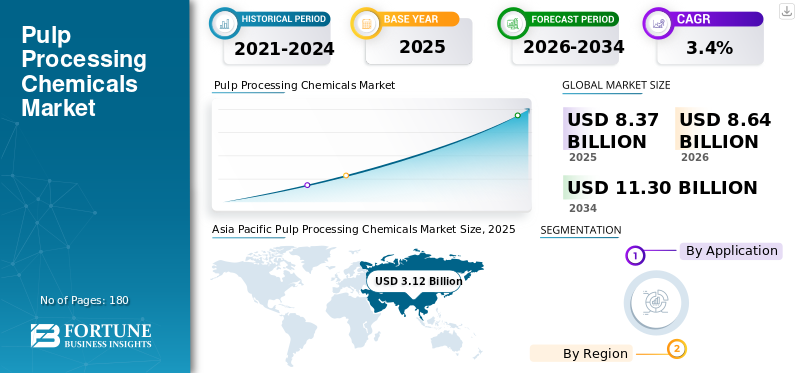
Download Free sample to learn more about this report.
Pulp Processing Chemicals Market Key Takeways
 Global Market Size & Forecast
- 2025 Market Size: USD 8.37 billion
- 2026 Market Size: USD 8.64 billion
- 2034 Forecast Market Size: USD 11.30 billion
- CAGR: 3.4% from 2026–2034
 Market Share
- Asia Pacific dominated the pulp processing chemicals market with a 37.27% share in 2025.
- The bleaching chemicals segment held the largest market share in 2025.
- The deinking chemicals segment is projected to grow at the fastest CAGR of 3.9% during the forecast period.
 Key Regional Highlights
Asia Pacific
Asia Pacific is expected to remain the leading regional market, driven by expanding packaging, tissue, and recycled fiber processing.
North America
North America's market growth is supported by mill optimization, operational efficiency, and process reliability improvements.
Europe
Europe is witnessing steady demand due to sustainability-focused mill modernization and stricter environmental regulations.
U.S.
U.S. The market was valued at approximately USD 1.32 billion in 2025, supported by investments in pulp mill efficiency and advanced processing chemicals.
Japan
Japan The market was valued at approximately USD 0.35 billion in 2025, driven by demand for high-quality pulp production and sustainable manufacturing practices.
Read More

PULP PROCESSING CHEMICALS MARKET TRENDS
Fiber Mix Diversification Forces Mills to Adopt Smarter Process Chemistry
A major global trend is the shift from uniform virgin wood fiber toward a more complex mix of hardwood, softwood, plantation fiber, recycled pulp, non-wood fiber, and imported pulp. This is changing how mills use pulp processing chemicals, as each fiber type behaves differently during pulping, bleaching, washing, deinking, and deposit control. Mills increasingly need customized chemical programs rather than standard formulations. This trend favors suppliers that can combine chemistry, application know-how, monitoring systems, and mill-level troubleshooting to improve yield, brightness, and overall operating efficiency.
MARKET DYNAMICS
MARKET DRIVERS
Download Free sample to learn more about this report.
Rise in Packaging and Tissue Demand to Boost Market Expansion
The key demand driver is growth in packaging, tissue, and hygiene paper, supported by e-commerce, urbanization, food delivery, healthcare use, and rising consumption in emerging markets. These grades require reliable pulp quality, strong fiber cleanliness, and stable mill operations, which increases demand for pulp processing chemicals. Even in mature markets, mills are investing in productivity, grade flexibility, and process efficiency. As operating rates improve, chemical usage rises by volume and through higher-value additives that improve performance and reduce downtime.
MARKET RESTRAINTS
Cost Pressure Intensification Limits Mills’ Willingness to Increase Chemical Spend
A prominent restraint in the pulp processing chemicals market growth is persistent pressure on pulp and paper mill margins from energy, fiber, logistics, water, labor and compliance costs. As a result, mills are cautious about increasing chemical spend unless suppliers can prove measurable cost savings or productivity gains. Commodity chemicals are price-sensitive, while specialty chemicals must justify their premium through lower dosage, fewer deposits, better washing, reduced effluent, improved brightness, or higher machine uptime. Environmental restrictions also limit some legacy chemistries and require reformulation. This restrains broad-based volume growth and pushes the market toward performance-based, efficiency-led chemical programs.
MARKET OPPORTUNITIES
Growing Focus on Sustainability Fuels Demand for Low-Impact and Digital Chemistry
The major opportunity lies in a sustainable and digitally optimized pulping process. Mills are seeking solutions that reduce bleaching load, cut water and energy consumption, lower effluent impact, improve fiber yield, and support closed-loop operations. This creates attractive growth for enzymes, advanced chelants, peroxide stabilizers, bio-based additives, optimized biocides, low-foam process aids, and deposit-control technologies. Suppliers can move beyond selling chemicals by offering monitoring, diagnostics, automation, and outcome-based service models. Companies that help mills meet sustainability targets while improving productivity can capture higher margins and become strategic operating partners rather than transactional chemical vendors.
MARKET CHALLENGES
Increase in Fiber Variability is Raising Technical Burden on Chemical Suppliers
The biggest challenge is managing inconsistent fiber quality and increasingly complex mill operating conditions. Recycled fiber may contain ink, adhesives, ash, and microbial load, while plantation and imported fibers vary in pitch, metals, lignin, and bleaching response. These variations can disrupt deinking, foam control, bleaching efficiency, deposit prevention, and water-loop stability. Mills expects chemical suppliers to resolve problems quickly through site-specific testing, dosage optimization, and technical support. Suppliers lacking strong application expertise, local support, and digital monitoring capabilities may struggle, as customers increasingly prefer integrated solution providers that can improve process reliability rather than supply chemicals.
SEGMENTATION ANALYSIS
By Application
To know how our report can help streamline your business, Speak to Analyst
High-Brightness Pulp Demand Bolstered Bleaching Chemicals Segment Growth
Based on the application, the market is segmented into bleaching chemicals, pulping make-up chemicals, deinking chemicals, defoamers/process aids, and others.
The bleaching chemicals segment accounted for a dominant pulp processing chemicals market share in 2025. A major factor driving demand for bleaching chemicals is the growth of high-brightness pulp used in premium packaging, tissue, printing grades, and export-oriented market pulp. Producers are under pressure to deliver consistent brightness, low residual lignin, and cleaner pulp while meeting environmental requirements. This increases the use of chlorine dioxide, hydrogen peroxide, oxygen, ozone, caustic soda, chelants, and peroxide stabilizers. Demand is particularly supported by the expansion of bleached kraft pulp production in fiber-rich regions and by stricter quality expectations from downstream paper producers.
The deinking chemicals segment is anticipated to rise with a CAGR of 3.9% over the forecast period. A major factor driving demand for deinking chemicals is the rising use of recycled fiber in packaging materials, tissue, and graphic paper production. Mills processing recovered paper must remove inks, adhesives, coatings, fillers, and other contaminants to achieve acceptable brightness, cleanliness, and smoothness. This supports demand for caustic soda, hydrogen peroxide, sodium silicate, surfactants, dispersants, collectors, and defoamers. Growth is strongest where sustainability targets, recycled-content mandates, and cost pressure are pushing mills to substitute virgin fiber with recovered fiber.
PULP PROCESSING CHEMICALS MARKET REGIONAL OUTLOOK
By region, the market is segmented into North America, Europe, Asia Pacific, and the Rest of the World.
Asia Pacific
Asia Pacific Pulp Processing Chemicals Market Size, 2025 (USD Billion)
To get more information on the regional analysis of this market, Download Free sample
The Asia Pacific region is expected to dominate the market during the forecast period. The major regional demand driver is expanding packaging, tissue, and recycled-fiber processing demand. Rapid growth in consumer goods, e-commerce, hygiene products, and urban consumption is pushing mills to process larger volumes of virgin and recovered fiber. This increases the need for deinking, bleaching, defoaming, biocidal, and process-aid chemicals. Future growth will be supported by mill capacity additions, quality upgrades, and higher demand for cleaner recycled fiber, especially as producers shift from low-grade paper output toward stronger packaging, tissue, and specialty paper grades.
Japan Pulp Processing Chemicals Market
Japan’s market was valued at approximately USD 0.35 billion in 2025, equivalent to around 4.2% of global sales.
China Pulp Processing Chemicals Market
China’s market is projected to be one of the largest globally, with 2025 revenues valued at around USD 1.40 billion, representing roughly 16.7% of global sales.
India Pulp Processing Chemicals Market
India’s market was valued at approximately USD 0.34 billion in 2025, equivalent to around 4.1% of global revenues.
North America
In North America, the major driver of demand is the need to improve efficiency and reliability in mature pulp and paper mills. Producers are focused on reducing downtime, improving fiber yield, maintaining pulp brightness, and controlling deposits, foam, microbial growth, and process variability. This supports demand for bleaching chemicals, defoamers, biocides, pitch-control agents, chelants, and process aids. Market growth is anticipated to be driven less by new mill capacity and more by optimization programs that help mills lower operating costs, improve environmental performance, and extend the productivity of existing assets.
U.S. Pulp Processing Chemicals Market
The U.S. market was valued at around USD 1.32 billion in 2025, accounting for roughly 15.8% of global sales.
Europe
Europe’s demand is mainly driven by sustainability-led mill modernization and stricter expectations around resource efficiency, water use, emissions, and circularity. Pulp producers and recycled-fiber mills are increasingly adopting chemicals that reduce bleaching load, improve deinking performance, stabilize closed water systems, and support cleaner production. Future demand is likely to come from solutions that help mills maintain quality while using mixed fiber streams, reduce environmental impact, and improve cost competitiveness in a mature yet regulation-sensitive market.
Sweden Pulp Processing Chemicals Market
Sweden’s market was valued at approximately USD 0.31 billion in 2025, equivalent to around 3.7% of global revenues.
Germany Pulp Processing Chemicals Market
Germany’s market was valued at approximately USD 0.07 billion in 2025, equivalent to around 0.8% of global sales.
Rest of the World
In the rest of the world, especially in Latin American countries, the major demand driver is export-oriented bleached market pulp production, especially from large-scale hardwood pulp mills. Producers must achieve consistent brightness, cleanliness, yield, and operating efficiency to serve global tissue and packaging applications. This supports strong demand for pulp processing chemicals and drives market growth.
Brazil Pulp Processing Chemicals Market
Brazil’s market was valued at approximately USD 1.21 billion in 2025, equivalent to around 14.5% of global sales.
COMPETITIVE LANDSCAPE
Key Industry Players
Key Players Emphasize Specialty Solutions and Technical Service to Maintain Their Dominance
The global pulp processing chemicals industry is moderately consolidated, with large multinational suppliers competing on product breadth, mill technical services, regional manufacturing footprints, and the ability to deliver performance-based solutions. Top key players include Solenis, Kemira, Nouryon, SNF Group, and Arkema. Commodity producers compete on scale and cost, while specialty suppliers differentiate through application expertise, digital monitoring, sustainability claims, and customized mill programs. Strategic advantage increasingly comes from helping mills reduce chemical dosage, improve yield, stabilize fiber quality, lower effluent, and reduce downtime.
LIST OF KEY PULP PROCESSING CHEMICAL COMPANIES PROFILED
- Solenis (U.S.)
- Kemira(Finland)
- Nouryon (Netherlands)
- SNF (France)
- Arkema (France)
- ERCO Worldwide (Canada)
- Solvay (Belgium)
- Evonik (Germany)
- Esteem Industries Pvt. Ltd. (India)
- Aries Chemical, Inc. (U.S.)
KEY INDUSTRY DEVELOPMENTS
- April 2026: Solenis has begun construction of a USD 35 million production facility in Beihai, Guangxi, China. Set to start operations in Q2 2027, the 60,000-tonne plant will supply papermaking chemicals, strengthen regional supply chains, cut customer distances, and support fast-growing pulp and paper markets in Western China and Southeast Asia.
- August 2025: Nouryon signed a long-term deal with Arauco to supply sodium chlorate and chlorine dioxide solutions for its USD 4.6 billion pulp mill in Mato Grosso do Sul, Brazil. Nouryon will build and operate integrated facilities, boosting South American sodium chlorate capacity by 20%. Mill production is expected to begin in late 2027.
- March 2025: Nouryon launched Eka HP Puroxide, a low-carbon hydrogen peroxide product, in the Nordics for the pulp and paper, mining, and water treatment markets. Produced in Sweden using fossil-free hydrogen and renewable electricity, it can cut carbon footprint by up to 90%, helping customers reduce Scope 3 greenhouse gas emissions.
- July 2024: Kemira announced to expand sodium chlorate production at its Ortigueira, Brazil, facility by over 10%. The investment supports rising South American demand for bleached pulp and strengthens Kemira’s Pulp & Paper business. Using renewable energy and proprietary technology, Kemira aims to serve pulp producers and growing molded fiber packaging markets.
- February 2023: Solenis acquired Kolb Distribution Ltd.’s paper process chemicals business, strengthening its pulp and paper offerings in Europe, the Middle East & Africa. The deal includes a long-term exclusive supply agreement with KLK Kolb Group, expanding Solenis’ access to deposit control, cleaning, and foam control technologies while supporting customer supply security and future growth.
REPORT COVERAGE
The global pulp processing chemicals market report provides a detailed analysis of the market. It focuses on key aspects such as profiles of leading companies, product types, and leading applications of the product. Besides this, it offers insights into the analysis of key market trends and highlights key industry developments. In addition to the aforementioned factors, it encompasses several factors that have contributed to the growth of the market over recent years.
Request for Customization to gain extensive market insights.
Report Scope & Segmentation
| ATTRIBUTE | DETAILS |
| Study Period | 2021-2034 |
| Historical Period | 2021-2024 |
| Base Year | 2025 |
| Estimated Year | 2026 |
| Forecast Period | 2026-2034 |
| Unit | Value (USD Billion) |
| Growth Rate | CAGR of 3.4% during 2026-2034 |
| Segmentation | By Application and By Region |
| By Application |
|
| By Region |
|
Frequently Asked Questions
Fortune Business Insights says that the global market size was USD 8.37 billion in 2025 and is projected to record a valuation of USD 11.30 billion by 2034.
In 2025, the market in Asia Pacific stood at USD 3.12 billion.
Registering a CAGR of 3.4%, the market will exhibit steady growth during the forecast period of 2026-2034.
By application, the bleaching chemicals segment led the market in 2025.
Rise in packaging and tissue demand is driving market growth.
Solenis, Kemira, Nouryon, SNF Group, and Arkema are the major players operating in the market.
Asia Pacific dominated the market in terms of share in 2025.
Expansion of recycled fiber use to drive the product adoption in the coming years.



- 2021-2034
- 2025
- 2021-2024
- 180
Get 30-60 hrs Free Customization
Expand Regional and Country Coverage, Segments Analysis, Company Profiles, Competitive Benchmarking, and End-user Insights.


















Related Reports
-
US +1 833 909 2966 ( Toll Free )
-
Get In Touch With Us