Pushback Tractor Market Size, Share & Industry Analysis, By Aircraft Type (Narrow-Body Aircraft, Wide-Body Aircraft, Regional Aircraft, Cargo Aircraft), By Product Type (Conventional Towbar Tractor and Towbarless Pushback Tractor), By Propulsion (Diesel/ICE, Electric/Battery, Hybrid), By Towing Capacity (Below 50 Tons, 50–150 Tons, and Above 300 Tons), By Operation Type (Manual/Operator-Driven and Autonomous/Robotic Pushback), By Application (Commercial Airport Operations and Cargo & Freighter Operations), By End User (Airlines and Airport Operators), and Regional Forecast, 2026-2034
 Download Free Sample
Pushback Tractor Market Size and Future Outlook
 Listen to Audio Version
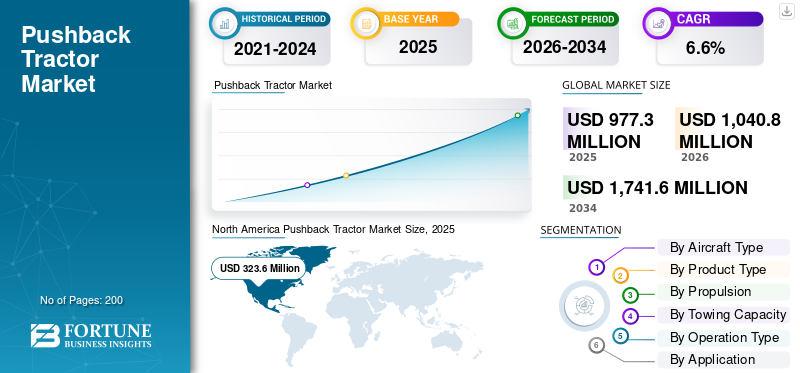
The pushback tractor market size was valued at USD 977.3 million in 2025 and is projected to grow from USD 1,040.8 million in 2026 to USD 1,741.6 million by 2034, exhibiting a CAGR of 6.6% during the forecast period. North America dominated the global market with a market share of 33.11% in 2025.
The pushback tractor market comprises aircraft pushback equipment used to safely move aircraft over gates, hangars, and apron areas. As a core part of airport ground support equipment (GSE), these vehicles support faster aircraft ground handling and smoother airport ramp operations. Market growth is driven by increased aircraft movements, airport expansion, fleet modernization, and increased adoption of electric pushback tractor and towbarless pushback tractor systems.
Major companies include TLD Group SAS, Goldhofer Aktiengesellschaft, Textron Specialized Vehicles Inc., Oshkosh AeroTech, LLC, Mototok International GmbH, Kalmar Motor AB, MULAG Fahrzeugwerk Heinz Wössner GmbH u. Co. KG, Eagle Industrial Truck Manufacturing, L.L.C., TREPEL Airport Equipment GmbH, and Weihai Guangtai Airport Equipment Co., Ltd. The market is being driven by advanced aircraft towing vehicles, electric aircraft towing vehicles, remote-controlled tugs, and heavy-duty aircraft movement solutions.
Download Free sample to learn more about this report.
PUSHBACK TRACTOR MARKET TRENDS
Growing Focus on Reducing Airport Emissions Accelerates Product Demand
Airports and ground handling services are increasingly replacing diesel-powered aircraft pushback equipment with electric and low-emission models to reduce apron emissions, noise, and fuel dependence. This trend is mainly visible at large international airports where airport ramp operations are under pressure to become cleaner without slowing aircraft turnaround times. As a result, demand for electric pushback tractor and towbarless pushback tractor platforms is rising across commercial airports and MRO facilities.
MARKET DYNAMICS
MARKET DRIVERS
Download Free sample to learn more about this report.
Rising Aircraft Traffic Drives Market Growth
Growing air traffic is increasing the need for reliable aircraft towing vehicles, as each additional aircraft movement requires gate pushback, towing, repositioning, and hangar transfers. Busy airport hubs operate with tighter turnaround windows, making efficient aircraft ground handling equipment more important for airlines, airport operators, and ground handling companies.
For instance, in April 2026, ACI World reported that global airport passengers reached an estimated 9.8 billion in 2025, while aircraft movements reached around 101.5 million, showing continued recovery and higher operational intensity at airports.
MARKET RESTRAINTS
High Cost Pressure and Charging Infrastructure Requirements to Restrain Product Adoption
Although electric models lower operating emissions, many airports continue to face cost pressure as the transition requires the purchase of electric pushback tractor itself and chargers, grid upgrades, parking layouts, and maintenance capabilities. These requirements slow adoption among smaller airports and cost-sensitive operators, especially where diesel Airport Ground Support Equipment (GSE) fleets are still serviceable.
MARKET OPPORTUNITIES
Mega Airport Expansion Projects Create Opportunity for Advanced Aircraft Movement Solutions
Major airport expansion projects are opening new opportunities for modern aircraft movement solutions, particularly heavy-duty, towbarless, and electric pushback systems. One of the strongest opportunity areas for the market is greenfield and mega-hub projects, as the need for new runways, additional gates, cargo zones, and MRO facilities requires larger fleets of airport logistics equipment.
For instance, in April 2024, Dubai announced plans to move Dubai International Airport operations to the new Al Maktoum International Airport project as part of a USD 35 billion expansion project. The airport is designed with five parallel runways and 400 aircraft gates, creating long-term demand for airport movement solutions.
MARKET CHALLENGES
Increasing Operational Complexity to Challenge Industry Expansion
With increasing airport activity, pushback operations must be managed within tight turnaround windows, while accounting for aircraft stand availability, taxiway congestion, safety clearances, and the movement of multiple ground vehicles around the same aircraft. This increases the complexity of airport ramp operations and heightens the need for trained operators, efficient fleet dispatching, and reliable availability of aircraft pushback equipment.
Impact of Tariff War
Tariff-Driven Cost Pressure and Self-Reliant Supply Chain to Have a Mixed Impact on Market Growth
Tariff escalation is having a mixed impact on the pushback tractor market. Increased duties on steel, aluminum, lithium-ion batteries, electrical components, and China-linked clean mobility parts are increasing manufacturing costs for aircraft pushback equipment, particularly electric and towbarless types. This may slow price-sensitive airport purchases and cause smaller ground handlers to defer fleet replacement. The tariff war, on the other hand, is forcing OEMs and suppliers to localize sourcing, expand regional assembly operations, and reduce dependence on single-country battery, electric motors, and metal supply chains. This trend is expected to drive regional manufacturing of Airport Ground Support Equipment (GSE) while strengthening long-term supply chain resilience across key airport markets.
For instance, in May 2024, the U.S. announced higher tariffs on Chinese electric vehicles, lithium-ion batteries, steel, aluminum, semiconductors, and critical minerals, increasing cost pressure across clean mobility and industrial equipment supply chains.
Segmentation Analysis
By Aircraft Type
Narrow-Body Aircraft Segment Dominated the Market Due to High Frequency of Flight Operations
By aircraft type, the market is categorized into narrow-body aircraft, wide-body aircraft, regional aircraft, business jets & general aviation aircraft, military aircraft, and cargo aircraft.
Narrow-body aircraft held the largest global pushback tractor market share in 2025, as Airbus A320 and Boeing B737 families represented the highest share of global departures, gate turnarounds, and short-to-medium-haul flight operations. These aircraft generate frequent pushback cycles across domestic and regional routes, creating steady demand for aircraft pushback equipment and mid-capacity aircraft towing vehicles at commercial airports.
For instance, in January 2026, Boeing stated that nearly 90% of projected aircraft deliveries for India and South Asia through 2044 would be single-aisle aircraft, reflecting the continued importance of narrow-body fleets in supporting high-frequency airport operations.
The wide-body aircraft segment is expected to grow at the highest CAGR of 8.1% over the forecast period.
To know how our report can help streamline your business, Speak to Analyst
By Product Type
Conventional Towbar Tractor Segment Dominated the Market Due to Operational Familiarity and Ease of Maintenance
On the basis of product type, the market is classified into conventional towbar tractor, towbarless pushback tractor, compact/remote-controlled aircraft tug, and heavy-duty aircraft tow tractor.
Conventional towbar tractor held the largest market share in 2025, as they remain the most widely used aircraft pushback equipment across commercial airports, regional airports, cargo terminals, and MRO facilities. Conventional towbar tractors are easier to maintain and more familiar to ramp crews than towbarless systems. When combined with aircraft-specific towbars, they also provide flexibility for mixed aircraft fleets. As a result, they continue to be the preferred choice for cost-conscious Airport Ground Support Equipment (GSE) procurement.
The towbarless pushback tractor segment is expected to grow at a CAGR of 9.1% over the forecast period.
By Propulsion
Diesel/ICE Segment Dominated the Market Due to Established Infrastructure and Heavy-Duty Reliability
By propulsion, the market is classified into diesel/ICE, electric/battery, hybrid/alternative, and hydrogen/fuel cell.
The diesel/ICE segment held the largest global market share in 2025, as many existing airport fleets continue to rely on diesel-powered tractors for continuous ramp operations, heavy aircraft towing, and long operating shifts. Although the electric pushback tractor segment is growing quickly, diesel-powered models remain dominant in airport ramp operations due to proven torque output, lower infrastructure dependency, and established maintenance capabilities.
The hydrogen/fuel cell segment is expected to register a CAGR of 14.8% over the forecast period.
By Towing Capacity
50–150 Tons Segment Dominated the Market Due to its Broad Use Across Narrow-Body and Regional Aircraft Operations
On the basis of towing capacity, the market is classified into below 50 tons, 50–150 tons, 150–300 tons, and above 300 tons.
50–150 tons held the largest global market share in 2025, as this capacity range supports the largest operational base of narrow-body, regional, and smaller cargo aircraft. It represents the highest-volume category for aircraft movement solutions, as airports need tractors in this class for frequent gate pushbacks, short-distance towing, and daily aircraft ground handling operations.
The above 300 tons segment is expected to grow at a CAGR of 8.0% over the forecast period.
By Operation Type
Manual/Operator-Driven Segment Dominated the Market Due to Safety-Critical Nature of Aircraft Pushback
On the basis of operation type, the market is classified into manual/operator-driven, remote-controlled, semi-autonomous, and autonomous/robotic pushback.
The manual/operator-driven segment held the largest global market share in 2025, as aircraft pushback remains a safety-sensitive activity involving pilots, tug drivers, ramp agents, headset communication, airport ground control clearance, and stand-specific operating procedures. Although remote-controlled and semi-autonomous tractors are gaining attention, the majority of airports continue to rely on trained operators to ensure safe and accurate aircraft ground handling and controlled airport ramp operations.
The autonomous/robotic pushback segment is expected to grow at the highest CAGR of 11.8% over the forecast period.
By Application
Commercial Airport Operations Segment Led the Market, Driven by High Aircraft Movements Volume
By application, the market is divided into commercial airport operations, cargo & freighter operations, MRO & hangar movement, military airbase operations, aircraft manufacturing & final assembly, and others.
Commercial airport operations held the largest market share in 2025, as passenger airports handle the highest number of daily pushback events, gate movements, and aircraft repositioning jobs. The main demand center for pushback tractors is commercial operations, with both major hub airports and secondary airports requiring the continuous availability of airport logistics equipment to support efficient ground operations.
The cargo & freighter operations segment is expected to register a CAGR of 7.5% over the forecast period.
By End User
Ground Handling Companies Segment Led the Market, Driven by Outsourced Ramp Operations and Fleet Ownership
Based on end user, the market is segmented into airlines, airport operators, ground handling companies, MRO providers, defense forces, and aircraft OEMs.
Ground handling companies dominated the market as airlines increasingly outsource ramp services, including pushback, towing, baggage handling, cargo support, and aircraft turnaround activities. These handlers operate multi-airline contracts at airports and therefore maintain larger fleets of aircraft pushback equipment, aircraft towing vehicles, and other airport ground support equipment (GSE) than many individual airlines.
The airport operators segment is expected to register a CAGR of 7.4% over the forecast period.
Pushback Tractor Market Regional Outlook
By geography, the market is categorized into North America, Europe, Asia Pacific, and Rest of the World.
North America
North America Pushback Tractor Market Size, 2025 (USD Million)
To get more information on the regional analysis of this market, Download Free sample
North America holds the largest market share and is anticipated to grow at a CAGR of 6.0% during the forecast period. The region benefits from one of the world’s densest airport networks and a high concentration of large commercial hubs, cargo airports, MRO bases, and airline-owned operating facilities. The region’s high aircraft movement volume creates consistent replacement and modernization demand for aircraft pushback equipment, towbarless pushback tractor systems, and conventional airport ground support equipment (GSE).
U.S. Pushback Tractor Market
Based on the strong contribution of North America to the market and the dominance of the U.S. within the region, the U.S. market stood at around USD 271.8 million in 2025, and is projected to grow at a CAGR of 5.7% during the forecast period.
Europe
The market in Europe is anticipated to grow at a CAGR of 6.3% during the forecast period, due to its dense airport network, mature airline operations, strong MRO base, and high focus on airport decarbonization. Major hubs such as London Heathrow Airport, Amsterdam Schiphol Airport, Paris Charles de Gaulle Airport, Frankfurt Airport, Madrid Airport, and Istanbul Airport create regular replacement demand for airport ground support equipment (GSE) and advanced aircraft movement solutions.
France Pushback Tractor Market
The market in France reached approximately USD 39.6 million in 2025, equivalent to around 16.08% of Europe revenues.
Asia Pacific
Asia Pacific is anticipated to grow at the highest CAGR of 8.1% over the forecast period, due to the strong airport expansion, increasing domestic air travel, and increasing fleet activity in China, India, Japan, South Korea, Southeast Asia, and Australia. The region is defined by a high density of narrow-body aircraft operations, which creates continuous demand for conventional aircraft pushback equipment. Large international hubs such as Incheon, Singapore, Hong Kong, Shanghai, and Tokyo are creating demand for towbarless pushback tractors and heavy-duty aircraft towing vehicles.
China Pushback Tractor Market
In China, the market stood at around USD 90.7 million in 2025, representing roughly 33.30% of Asia Pacific sales.
India Pushback Tractor Market
The Indian market stood at around USD 39.1 million in 2025, growing at a CAGR of 11.1% during the forecast period.
Rest of the World
The Rest of the World (Middle East & Africa and Latin America) holds a comparatively smaller market share but is expected to grow at a CAGR of 5.8% during the forecast period. Pushback tractor market growth is driven primarily by the Middle East & Africa, while Latin America provides consistent replacement demand from Brazil, Mexico, Colombia, Chile, and major tourism-driven airports across the region. High-capacity aircraft pushback equipment is required at large international hubs in the UAE, Saudi Arabia, Qatar, and Türkiye to support wide-body, cargo, and long-haul operations.
Latin America Pushback Tractor Market
The market in Latin America reached around USD 50.7 million in 2025, growing at a CAGR of 4.9% during the forecast period.
COMPETITIVE LANDSCAPE
Key Industry Players
Key Players Focus on Efficient Aircraft Movement Solutions to Support Cleaner Airport Ramp Operations
The global pushback tractor market is moderately consolidated, with major players such as TLD Group, Goldhofer Aktiengesellschaft, Textron Specialized Vehicles Inc., Oshkosh AeroTech, LLC, MOTOTOK International GmbH, and Kalmar Motor AB competing on towing capacity, reliability, product range, and aftersales support. Companies are expanding their product portfolios across conventional tractors, towbarless pushback tractor systems, and heavy-duty aircraft towing vehicles for commercial airports, cargo terminals, MROs, and defense airbases.
Leading players are increasingly investing in electric pushback tractor models, remote-controlled tugs, and efficient aircraft movement solutions to support cleaner airport ramp operations. In addition, strong service networks, spare-parts availability, and proven performance at high-traffic airports are becoming key competitive differentiators, as customers increasingly prioritize uptime, operational safety, and total lifecycle cost.
LIST OF KEY PUSHBACK TRACTOR COMPANIES PROFILED
- TLD Group SAS (France)
- Goldhofer Aktiengesellschaft (Germany)
- Textron Ground Support Equipment Inc. (U.S.)
- Oshkosh AeroTech, LLC (U.S.)
- Mototok International GmbH (Germany)
- Kalmar Motor AB (Sweden)
- MULAG Fahrzeugwerk Heinz Wössner GmbH u. Co. KG (Germany)
- TREPEL Airport Equipment GmbH (Germany)
- Weihai Guangtai Airport Equipment Co., Ltd. (China)
- Charlatte Manutention SAS (France)
- Eagle Tugs / Tronair Inc. (U.S.)
- TowFLEXX GmbH (Germany)
- Nandan GSE Pvt. Ltd. (India)
- Aviogei Airport Equipment S.r.l. (Italy)
- Bliss-Fox Ground Support Equipment Pty Ltd. (Australia)
- Taxibot International Ltd. (Israel)
- Lektro Inc./Oshkosh AeroTech (U.S.)
- Aero Specialties Inc. (U.S.)
KEY INDUSTRY DEVELOPMENTS
- April 2026: Airports Council International (ACI) released its preliminary 2025 airport traffic rankings, estimating global passenger traffic at 9.8 billion passengers, up 3.6% from 2024, while air cargo volumes reached nearly 128.9 million metric tons.
- March 2026: The Federal Aviation Authority (FAA updated guidance for its Airport Zero Emissions Vehicle and Infrastructure Pilot Program material, under which eligible airports can use Airport Improvement Program funding to purchase zero-emission vehicles and construct or modify required infrastructure.
- March 2026: The FAA updated its Voluntary Airport Low Emissions Program information, confirming that VALE allows airport sponsors to use AIP funds and Passenger Facility Charges to finance low-emission vehicles, refueling/recharging stations, and gate electrification.
- September 2025: BKJ Airports placed a landmark order with TLD and ASARA for next-generation green Airport Ground Support Equipment (GSE), including pushback tractors, electric coaches, electric ramp vehicles, electric baggage freight loaders, ground power units, electric tugs, ramps, and related equipment.
- August 2025: Menzies Aviation completed the acquisition of G2 Secure Staff for USD 305.00 million, doubling its U.S. footprint and expanding its global network to 350 airports across 65 countries.
- January 2025: Dubai International Airport reported a record 92.3 million passengers in 2024 and confirmed that authorities plan to move operations to Al Maktoum International Airport following the airport’s USD 35.00 billion expansion project.
- May 2024: WheelTug reported that its electric nose-wheel taxiing system had 26 airlines and around 2,700 aircraft lined up for installation, while the company’s FAA certification process was about two-thirds complete.
- April 2024: Dubai announced a nearly USD 35.00 billion Al Maktoum International Airport expansion plan, under which Dubai International Airport operations planned to shift to the new facility within ten years.
REPORT COVERAGE
The global pushback tractor market analysis provides an in-depth study of market size, market segmentation, and company profiling & forecast. It includes details on the market dynamics and trends that are expected to drive the market during the forecast period. It offers information on the technological advancements, new product launches, key industry experts’ developments, and details on strategic partnerships, mergers & acquisitions. The market research report also encompasses a detailed competitive landscape with information on the market share and profiles of key players.
Request for Customization to gain extensive market insights.
Report Scope & Segmentation
| ATTRIBUTE | DETAILS |
| Study Period | 2021-2034 |
| Base Year | 2025 |
| Estimated Year | 2026 |
| Forecast Period | 2026-2034 |
| Historical Period | 2021-2024 |
| Growth Rate | CAGR of 6.6% from 2026 to 2034 |
| Unit | Value (USD Million) |
|
Segmentation |
By Aircraft Type
|
|
By Product Type
|
|
|
By Propulsion
|
|
|
By Towing Capacity
|
|
|
By Operation Type
|
|
|
By Application
|
|
|
By End User
|
|
|
By Region
|
Frequently Asked Questions
Fortune Business Insights says that the global market value stood at USD 977.3 million in 2025 and is projected to reach USD 1,741.6 million by 2034.
In 2025, the market value stood at USD 290.4 million.
The market is expected to exhibit a CAGR of 6.6% during the forecast period.
By product type, the conventional towbar tractor segment led the market.
Rising aircraft movements are the key factor driving the market.
Key players in the market include TLD Group SAS, Goldhofer Aktiengesellschaft, Textron Ground Support Equipment Inc., Oshkosh AeroTech, LLC, and Mototok International GmbH.
North America dominates the market.



- 2021-2034
- 2025
- 2021-2024
- 200
Get 30-60 hrs Free Customization
Expand Regional and Country Coverage, Segments Analysis, Company Profiles, Competitive Benchmarking, and End-user Insights.




















Related Reports
-
US +1 833 909 2966 ( Toll Free )
-
Get In Touch With Us