QR Code Labels Market Size, Share & Industry Analysis, By Material (Paper, Plastic, and Others), By Label Type (Sleeve Labels, Pressure-Sensitive Labels, Glue-Applied Labels, and Others), By Application (Food & Beverages, Retail & E-commerce, Personal Care & Cosmetics, Healthcare, Agriculture, and Others), and Regional Forecast, 2026-2034
 Download Free Sample
(Offer valid till 31st Oct 2026)

QR Code Labels Market Size and Future Outlook
 Listen to Audio Version
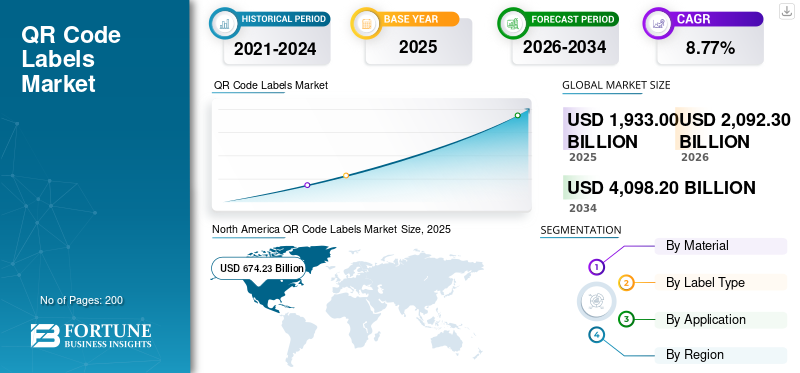
The global QR code labels market size was valued at USD 1,933.00 billion in 2025 and is projected to grow from USD 2,092.30 billion in 2026 to USD 4,098.20 billion by 2034, exhibiting a CAGR of 8.77% during the forecast period. North America dominated the QR code labels market with a market share of 34.88% in 2025.
The market includes creation, distribution, and utilization of labels that feature Quick Response (QR) codes, which facilitate digital access to product details, authentication, traceability, inventory oversight, marketing materials, and customer interaction via smartphone or scanner reading.
The rising need for product traceability, anti-counterfeiting strategies, and consumer access to comprehensive product information is propelling the adoption of QR code labels. Additionally, the increasing digitalization of supply chains and the growing prevalence of smartphones are further enhancing their application across sectors such as manufacturing, retail, healthcare, and logistics.
Many key industry players, such as CCL Industries Inc., SML Group, and HERMA GmbH, operating in the market, are focusing on developing innovative products and conducting R&D.
Download Free sample to learn more about this report.
QR code labels market KEY TAKEAWAYS
 Global Market Size & Forecast
- 2025 Market Size: USD 1,933.00 Billion
- 2026 Market Size: USD 2,092.30 Billion
- 2034 Forecast Market Size: USD 4,098.20 Billion
- CAGR: 8.77% from 2026-2034
 Market Share
- North America dominated the market with a revenue share of 34.88% in 2025.
- Paper held the largest market share by material in 2025.
- Sleeve labels held the largest market share by label type in 2025.
 Key Regional Highlights
North America
North America dominated the market with revenue of USD 674.23 billion in 2025.
Europe
Europe accounted for USD 328.42 billion in 2025 and is projected to grow at a CAGR of 8.28%.
Asia Pacific
Asia Pacific reached USD 502.83 billion in 2025, securing the second position.
U.S.
The market was valued at around USD 500.35 billion in 2025, accounting for roughly 25.88% of global sales.
Japan
The market reached USD 91.06 billion in 2025, accounting for roughly 4.71% of global revenues.
Read More

QR code labels market TRENDS
Integration of QR Code Labels with Smart Packaging and Consumer Engagement
The global market for QR code labels is experiencing a significant shift toward the integration of smart packaging solutions that connect physical products with digital platforms. Brand owners are increasingly incorporating dynamic QR codes into labels, allowing consumers immediate access to information regarding product origin, ingredient details, sustainability credentials, promotional offers, and personalized experiences via smartphones. This trend is rapidly gaining traction across various sectors, including food and beverages, cosmetics, pharmaceuticals, and consumer goods, as companies strive to improve customer engagement and enhance brand transparency. Dynamic QR codes also facilitate real-time updates to content without the need to alter printed labels, rendering them highly valuable for marketing initiatives and post-sale communications. As the pace of digital transformation quickens, QR code labels are becoming a vital element of connected packaging strategies.
MARKET DYNAMICS
MARKET DRIVERS
Download Free sample to learn more about this report.
Rising Adoption of GS1 Sunrise 2027 and Transition From 1D to 2D Barcodes is Driving Market Growth
The increasing implementation of GS1 Sunrise 2027 and the shift from 1D to 2D barcodes is anticipated to be the primary catalyst for change. The GS1 Sunrise 2027 initiative promotes the transition of retailers, manufacturers, and brand owners globally from conventional linear barcodes to sophisticated 2D codes like QR codes, which offer enhanced data capacity and improved product identification. QR code labels facilitate real-time traceability, inventory management, product authentication, regulatory compliance, and direct consumer interaction via smartphones. As companies modernize their packaging and supply chain processes to align with global standards, the demand for QR code labels is projected to rise significantly across the food, beverage, pharmaceuticals, personal care, and industrial sectors, positioning this transition as a key factor in sustained market growth.
|
Rank |
Market Drivers |
Overall Impact Rank |
CAGR Contribution (2026-2034) |
Impact: 2026-2028 |
Impact: 2029-2031 |
Impact: 2032-2034 |
|
1 |
Rising adoption of GS1 Sunrise 2027 and transition from 1D to 2D barcodes |
High |
+3.8% |
High |
High |
High |
|
2 |
Increasing demand for product traceability and supply chain transparency across industries |
High |
+3.2% |
High |
High |
High |
|
3 |
Growing adoption of smart packaging and consumer engagement through connected packaging solutions |
Medium-High |
+2.8% |
Medium |
High |
High |
|
4 |
Expansion of digital printing and variable data labeling technologies |
Medium |
+2.4% |
Medium |
Medium |
High |
|
5 |
Rising need for anti-counterfeiting, product authentication, and brand protection |
Medium-Low |
+2.0% |
Medium |
Medium |
Medium |
|
6 |
Others (growth of omnichannel retail, inventory automation, digital product passports, sustainability initiatives, logistics digitization, etc.) |
Low |
+1.97% |
Low |
Medium |
Medium |
|
Total Positive Growth Contribution |
+16.17% |
MARKET RESTRAINTS
High Initial Investment in QR Code Printing, Serialization, and Scanning Infrastructure Hinder Market Growth
The significant initial investment required for QR code printing, serialization, and scanning infrastructure continues to be the main obstacle impacting the Global QR code labels market throughout the forecast period. The implementation of QR code labeling necessitates substantial investments in high-resolution digital printing systems, variable data printing software, serialization platforms, inspection equipment, and compatible scanning technologies across manufacturing and distribution processes. Moreover, companies frequently need to integrate these solutions with enterprise resource planning (ERP), warehouse management, and traceability systems, which adds to the complexity and costs of implementation. Small and medium-sized enterprises are particularly impacted due to their limited financial resources and technical expertise, which hinders their adoption despite the long-term operational advantages. These initial capital requirements can impede market penetration, especially in developing economies where digital labeling infrastructure is still in the process of development.
|
Rank |
Market Restraint |
Overall Impact Rank |
Negative CAGR Contribution (2026-2034) |
Impact: 2026-2028 |
Impact: 2029-2031 |
Impact: 2032-2034 |
|
1 |
High initial investment in QR code printing, serialization, and scanning infrastructure |
High |
-2.9% |
High |
Medium |
Low |
|
2 |
Data security, privacy concerns, and risks associated with connected QR code platforms |
Medium-High |
-2.2% |
Medium |
High |
Medium |
|
3 |
Limited adoption among small and medium-sized enterprises due to implementation costs and technical barriers |
Medium |
-1.6% |
High |
Medium |
Low |
|
4 |
Others (regional standardization gaps, scanner compatibility issues, integration challenges, low consumer awareness in developing regions, etc.) |
Low |
-0.7% |
Low |
Low |
Low |
|
Total Negative Growth Impact |
-7.40% |
MARKET OPPORTUNITIES
Expansion of Digital Product Passports and Sustainability Initiatives Offers Potential Growth Opportunities
The increasing implementation of digital product passports and sustainability-oriented labeling initiatives offers a considerable opportunity for the global QR code label market. Governments, regulatory agencies, and manufacturers are progressively advocating for digital product information to enhance transparency concerning material composition, recyclability, carbon footprint, and product lifecycle. QR code labels serve as a scalable and economical solution of conveying information without cluttering physical packaging. As circular economy initiatives become more significant, manufacturers in electronics, textiles, packaging, and consumer goods are anticipated to incorporate QR codes into their products to facilitate compliance and raise consumer awareness. This shifting regulatory and sustainability environment is projected to generate substantial long-term demand for sophisticated QR code labeling.
MARKET CHALLENGES
Ensuring Data Security and Consumer Trust Poses a Critical Challenge to Market Growth
Ensuring data security concerns and maintaining consumer trust continues to be a significant challenge for the market. As QR codes link users to digital platforms, it is imperative for businesses to safeguard the associated information against cyber threats, unauthorized alterations, and fraudulent redirects. Counterfeit QR codes or malicious substitutes can lead consumers to phishing sites or provide misleading product information, which could harm brand reputation. Consequently, organizations must implement secure code generation, utilize encrypted databases, establish authentication mechanisms, and engage in continuous monitoring to uphold system integrity. Furthermore, adherence to evolving data privacy regulations necessitates meticulous management of consumer interactions and the data collected, thereby complicating the implementation process for businesses scaling QR code label solutions.
Segmentation Analysis
By Material
Cost Efficiency, Print Compatibility, and Sustainability Makes Paper the Preferred Material
Based on material, the market is divided into paper, plastic, and others.
Paper material leads the global market for QR code labels owing to its affordability, superior print quality, and versatility across numerous labeling applications. These labels are widely utilized in sectors such as retail, food and beverages, logistics, pharmaceuticals, and consumer goods for purposes including product identification, pricing, inventory management, and promotional labeling. Moreover, the increasing focus from consumers and regulatory bodies on sustainable packaging has spurred the shift toward recyclable and responsibly sourced paper labels, moving away from traditional plastic options in various non-durable applications. The ability of paper labels to work with different printing technologies, such as digital, flexographic, and thermal printing, further boosts operational efficiency and facilitates their broad adoption across various industries.
The plastic segment is expected to grow at a CAGR of 8.56% over the forecast period.
By Label Type
360-Degree Branding, Product Protection, and Versatile Application Drive Dominance of Sleeve Labels
Based on label type, the market is segmented into sleeve labels, pressure-sensitive labels, glue-applied labels, and others.
In 2025, the sleeve labels segment dominated the global market as it delivers comprehensive branding, superior product visibility, and improved functionality across various packaging formats. Their remarkable adaptability allows them to conform to containers of different shapes and sizes, resulting in their widespread application in beverages, personal care items, household goods, pharmaceuticals, and food packaging. Moreover, shrink sleeve labels can function as tamper-evident seals, thereby enhancing product security and boosting consumer trust. Their compatibility with advanced printing technologies guarantees long-lasting, scannable QR codes while facilitating attractive packaging, making sleeve labels the preferred option for manufacturers aiming for both operational effectiveness and heightened consumer interaction.
The pressure-sensitive labels segment is projected to grow at a CAGR of 8.84% over the forecast period.
By Application
To know how our report can help streamline your business, Speak to Analyst
Food & Beverages Application Leads with Growing Demand for Product Transparency, Traceability, and Consumer Engagement
Based on application, the market is segmented into food & beverages, retail & e-commerce, personal care & cosmetics, healthcare, agriculture, and others.
The food & beverages segment is expected to hold the largest QR code labels market share over the forecast period driven by the industry's heightened emphasis on product transparency, traceability, and improved consumer interaction. Manufacturers extensively utilize QR code labels to offer immediate access to ingredient lists, nutritional data, allergen information, sourcing details, expiration dates, and sustainability credentials, all while adhering to changing food labeling regulations. The sector's substantial production volumes, regular smart labeling needs, and increasing integration of smart packaging technologies further solidify the segment's dominant position.
The retail & e-commerce segment is projected to grow at a CAGR of 7.48% over the forecast period.
QR code labels market Regional Outlook
By geography, the market is categorized into Europe, North America, Asia Pacific, Latin America, and the Middle East & Africa.
North America
North America QR Code Labels Market Size, 2025 (USD Billion)
To get more information on the regional analysis of this market, Download Free sample
North America held the dominant share in 2024 and 2025 at USD 619.90 billion and USD 674.23 billion respectively. North America is propelled by rigorous product traceability standards, enhanced retail digitization, and the extensive use of smart packaging technologies. The high penetration of smartphones and the implementation of omnichannel retail strategies further boost adoption across the region.
U.S QR code labels market
Based on North America's strong contribution and the U.S.’ dominance within the region, the U.S. market is analytically approximated at around USD 500.35 billion for 2025, accounting for roughly 25.88% of global sales. The U.S. market is largely influenced by the digitization of brands, the consumer's desire for transparency in products, and the need for regulatory compliance within the food and pharmaceutical sectors. Manufacturers are progressively incorporating dynamic QR codes into their packaging to enhance marketing initiatives, loyalty programs, product authentication, and supply chain transparency.
Europe
Europe is projected to grow at 8.28% over the forecast period, the third-highest growth rate. In 2025, the region’s market accounted for USD 328.42 billion driven by sustainability efforts, circular economy regulations, and changing demands for digital product information. Producers are increasingly utilizing QR-enabled labels to convey details such as recycling guidelines, product origins, environmental certifications, and lifecycle data.
U.K QR Code Labels Market
The U.K. market in 2025 captured USD 57.08 billion, representing approximately 2.95% of global revenues.
Germany QR Code Labels Market
Germany accounted for USD 81.41 billion in 2025, equivalent to around 4.21% of global sales.
Asia Pacific
Asia Pacific reached USD 502.83 billion in 2025 and secured the second position. The region is witnessing fastest-growth driven by the expansion of manufacturing operations, a surge in e-commerce packaging, and a rise in smartphone adoption. China, India, and South Korea are implementing QR code labels to boost supply chain efficiency, fight against counterfeiting, and improve customer interaction.
Japan QR Code Labels Market
In 2025, Japan hit USD 91.06 billion, accounting for roughly 4.71% of global revenues. Japan's market is propelled by its sophisticated manufacturing industry, elevated consumer demands for product quality, and the early integration of smart packaging technologies. The nation's significant emphasis on precision manufacturing and digital transformation fosters continuous market growth.
China QR Code Labels Market
China's market is projected to be one of the largest worldwide, with 2025 revenues hitting USD 157.34 billion, representing roughly 8.14% of global sales.
India QR Code Labels Market
India captured USD 131.24 billion, accounting for roughly 6.79% of global high-revenue markets.
Latin America
Latin America gained USD 234.09 billion in 2025 and is expected to witness moderate growth during the forecast period. The region is experiencing a rise in the use of QR code labels as manufacturers enhance their supply chains and improve product traceability. The expansion of organized retail, food exports, pharmaceutical manufacturing, and e-commerce is prompting companies to adopt QR-enabled labeling to ensure regulatory compliance, prevent counterfeiting, and facilitate better communication with consumers, even amidst differing levels of digital infrastructure. This trend reflects a significant shift toward modernization in the region's manufacturing practices.
Middle East & Africa
In the Middle East & Africa, South Africa reached USD 56.46 billion in 2025. The regional market is propelled by increasing investments in logistics, healthcare, food processing, and the modernization of retail. Additionally, the growing penetration of smartphones and the expansion of organized retail networks are further facilitating the adoption of QR code labels throughout the region.
Saudi Arabia QR Code Labels Market
Saudi Arabia approximately accounted for USD 66.21 billion in 2025, accounting for roughly 3.43% of global revenues.
COMPETITIVE LANDSCAPE
Key Industry Players
Focus on Expanding Product Launch and Acquisitions by Key Players to Propel Market Progress
The global market has a semi-consolidated structure, with prominent players including CCL Industries Inc., SML Group, and HERMA GmbH. The significant market shares of these packaging companies is due to numerous strategic initiatives, including collaborations among operating entities to advance research.
- For instance, in February 2026, CCL Industries broadened its digital label offerings by incorporating sophisticated QR code and NFC-enabled label solutions tailored for consumer goods, pharmaceuticals, and food packaging applications. This enhanced portfolio allows brands to deliver dynamic product information, authentication, traceability, sustainability data, and consumer engagement through a single printed label.
Other notable players include Packtica Sdn. Bhd., Maverick Label, and Coast Label Company. They are expected to prioritize new product launches, strategic partnerships, and collaborations to increase their global market shares during the forecast period.
LIST OF KEY QR CODE LABELS COMPANIES PROFILED
- CCL Industries Inc. (Canada)
- SML Group (Hong Kong)
- HERMA GmbH (Germany)
- Packtica Sdn. Bhd. (Malaysia)
- Maverick Label (U.S.)
- Coast Label Company (U.S.)
- Data Label Co. (U.S.)
- PPG Industries Inc. (U.S.)
- Consolidated Label Co. (U.S.)
- Fastroll Labels Sdn. Bhd. (Malaysia)
- Multi-Color Corporation (U.S.)
- MPI Label Systems Inc. (U.S.)
- Certags LLC (U.S.)
- RH Technical Industries (India)
- Custom Labels Ltd. (U.K.)
KEY INDUSTRY DEVELOPMENTS
- October 2025: HERMA introduced new sustainable self-adhesive label materials specifically designed for digital printing applications, which include high resolution QR code printing. These materials offer exceptional print quality, durability, and recyclability, while also meeting the labeling needs of food, pharmaceuticals, logistics, and industrial sectors.
- June 2025: Multi-Color Corporation bolstered its smart packaging capabilities by increasing investments in digital label production technologies that can accommodate serialized QR codes and variable data printing. This expansion allows manufacturers of consumer packaged goods to enhance supply chain visibility, execute interactive marketing campaigns, and adhere to emerging product transparency regulations.
- March 2025: PPG Industries has unveiled advanced coating technologies intended for pressure-sensitive labels and packaging applications. These coatings enhance print durability, moisture resistance, and compatibility with digitally printed QR codes, while also supporting recyclable packaging structures.
- September 2024: CCL Industries declared further investments aimed at expanding its specialty label manufacturing capabilities across key production facilities. This expansion is in response to the growing global demand for premium decorative labels, security labels, and digitally printed labels that incorporate QR codes and serialization technologies.
- April 2024: HERMA commercialized an innovative wash-off adhesive technology that facilitates efficient separation of labels during PET recycling processes. This advancement promotes sustainable packaging while ensuring reliable adhesion and outstanding print performance for QR codes, barcodes, and variable information throughout the product's lifecycle.
REPORT COVERAGE
The market analysis includes a comprehensive study of market insights, market sizes & forecast across all segments. It includes details on market dynamics and trends expected to drive the market over the forecast period. It provides information on key aspects, including technological advancements, pipeline candidates, regulatory environment, and product launches. Additionally, it details partnerships, mergers & acquisitions, and key industry developments. The report also provides a detailed competitive landscape, including market share and profiles of key operating players.
Request for Customization to gain extensive market insights.
Report Scope & Segmentation
| ATTRIBUTE | DETAILS |
| Study Period | 2021-2034 |
| Base Year | 2025 |
| Estimated Year | 2026 |
| Forecast Period | 2026-2034 |
| Historical Period | 2021-2024 |
| Growth Rate | CAGR of 8.77% from 2026-2034 |
| Unit | Value (USD Billion) |
| Segmentation | By Material, Label Type, Application, and Region |
| By Material |
|
| By Label Type |
|
| By Application |
|
| By Region |
|
Frequently Asked Questions
According to Fortune Business Insights, the global market value stood at USD 1,933.00 billion in 2025 and is projected to reach USD 4,098.20 billion by 2034.
In 2025, North America’s market value stood at USD 674.23 billion.
The market is expected to grow at a CAGR of 8.77% over the forecast period of 2026-2034.
By material, the paper segment is expected to lead the market.
Rising adoption of GS1 Sunrise 2027 and transition from 1D to 2D barcodes is driving market growth.
CCL Industries Inc., SML Group, and HERMA GmbH are major players in the global market.
In terms of market share, North America dominated in 2025.


- 2021-2034
- 2025
- 2021-2024
- 200
-
(Offer valid till 31st Oct 2026)
Get 30-60 hrs Free Customization
Expand Regional and Country Coverage, Segments Analysis, Company Profiles, Competitive Benchmarking, and End-user Insights.



Related Reports
-
US +1 833 909 2966 ( Toll Free )
-
Get In Touch With Us