Reishi Mushroom Market Size, Share & Industry Analysis, By Nature (Conventional and Organic), By Form (Powder and Liquid), By Application (Food and Beverages, Dietary Supplements, Personal Care & Cosmetics, and Pharmaceuticals), and Regional Forecast, 2026-2034
 Download Free Sample
(Offer valid till 15th Oct 2026)

KEY MARKET INSIGHTS
 Listen to Audio Version
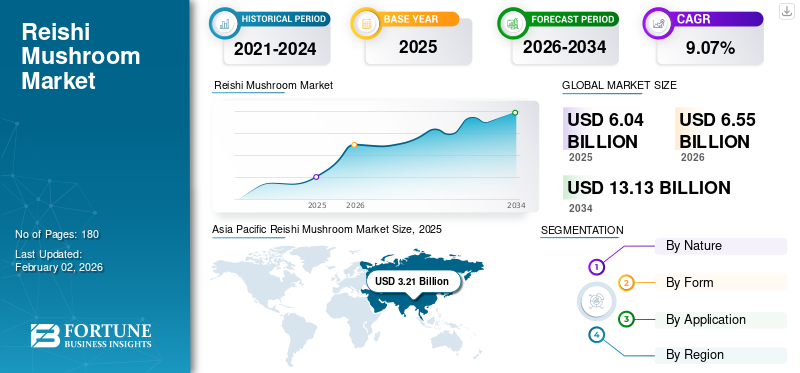
The global reishi mushroom market size was valued at USD 6.04 billion in 2025 and is projected to grow from USD 6.55 billion in 2026 to USD 13.13 billion by 2034, exhibiting a growth at CAGR of 9.07% during the forecast period. Asia Pacific dominated the reishi mushroom market with a market share of 18.39% in 2025.
A few key players in the market include Nammex, Hokkaido Reishi Co., Ltd., Bio Botanica, and others.
Reishi mushroom, also referred to as Ganoderma lucidum, is a reddish-brown medicinal fungus with a long-standing history of use in Korean, Chinese, and Japanese medicine. This mushroom is found in temperate and tropical deciduous forests, growing on hardwood trees such as beech, oak, and maple. With respect to health advantages, reishi is highly rich in bioactive compounds which offer immune-stimulating, anti-inflammatory, and antiviral properties. Traditionally, this type of mushroom is used for treating a range of health conditions such as respiratory issues, fatigue, asthma, and insomnia. However, according to modern research, it can be utilized as a complementary therapy besides conventional treatment. Along with the pharmaceuticals sector, it is gaining utmost traction in the functional food market and the emerging green cosmetics industry.
The expanding dietary supplements sector and growing functional foods and beverages industry are pivotal factors driving the market’s momentum.
Download Free sample to learn more about this report.
Reishi Mushroom Market Key Takeaways
 Global Market Size & Forecast
- 2025 Market Size: USD 6.04 billion
- 2026 Market Size: USD 6.55 billion
- 2034 Forecast Market Size: USD 13.13 billion
- CAGR: 9.07% from 2026–2034
 Market Share
- Asia Pacific dominated the reishi mushroom market with an 18.39% share in 2025.
- The conventional segment led the global market in 2024.
- The powdered form segment dominated the market with the highest share.
 Key Regional Highlights
Asia Pacific
Asia Pacific reached USD 3.21 billion in 2025 and is projected to reach USD 3.47 billion in 2026.
North America
North America was valued at USD 1.30 billion in 2025 and is expected to reach USD 1.41 billion in 2026.
Europe
Europe recorded USD 1.24 billion in 2025 and is projected to reach USD 1.35 billion in 2026.
U.S.
Demand for reishi mushroom products is supported by growing interest in functional foods and mushroom-based products.
Japan
Reishi mushroom demand is supported by its established use in traditional and wellness-focused products.
Read More

MARKET DYNAMICS
Market Drivers
Increasing Incidences of Chronic Ailments Propel Usage of Reishi Mushroom
The surging cases of health ailments are a crucial driver fueling the utilization of reishi mushrooms. Chronic health conditions (cancer, diabetes, and hypertension) are recognized as the main cause of death in almost all countries/regions worldwide. Poor nutrition, unhealthy lifestyles, and lack of physical activity are the key contributors to such chronic conditions. In order to curb the burden of health ailments, most consumers are seeking functional ingredients/products such as reishi, which can be incorporated into their daily diet. Although reishi has a long history in natural remedies, its demand has improved enormously in recent years. Also, the trend of holistic wellness and superfood products further drives the consumption of mushrooms.
Market Restraints
Complex Cultivation Requirements and Contamination Risks Hinder Market’s Potential
One major challenge observed in the global market is complex cultivation requirements. Reishi requires particular environmental conditions such as effective air exchange, high humidity (85-95%), and appropriate temperatures (22°-28°C). Variations from these conditions can result in poor crop growth, ultimately hindering the market’s potential. Moreover, maintaining such conditions throughout the cultivation cycle exacerbates the complexity. As a result, the aforementioned factors impede the global reishi mushroom market growth.
High contamination risk is another pivotal obstacle faced by manufacturers. The cultivation process of reishi is prone to contamination by yeasts, molds, and bacteria, which can lead to crop failure and poor yields. Nematodes, springtails, and flies are common pests that hamper mushrooms directly and affect the quality of the produce.
Market Opportunities
Adoption of Advanced Technology in Market Opens Lucrative Opportunities
The surging adoption of advanced technology in the mushroom growing sector creates growth possibilities in the market. Liquid culture technology is a popular method used for the efficient production of mushroom spawn. Using this technique can enhance yield stability, minimize contamination, and promote faster production. For industrial-scale manufacturing, the companies can utilize bioreactor technology, which substantially improves the scalability and strengthens the yield of bioactive components. Moreover, the continuous phase change extraction (CPCE) method is a prominent method that effectively boosts the release of polysaccharides. Along with this, techniques such as supercritical CO2 extraction and ultrasonic-assisted extraction can be utilized to extract active compounds with enhanced purity.
Reishi Mushroom Market Trends
Rising Inclination Toward Superfoods is the Prominent Trend
The global industry is experiencing a strong trend for superfoods, which is shaping marketing strategies, consumers’ behavior, and product innovation across the food & beverage market. In today’s modern era, health-conscious consumers, particularly Gen Z, are more proactive about wellness and ingredient-awareness. This inclination toward maintaining a healthy lifestyle boosts the usage of mushrooms. Moreover, superfoods, including reishi, align well with gluten-free, non-GMO, and organic preferences, necessitating consumers to incorporate such ingredients into their diet. Additionally, athletes and fitness enthusiasts highly seek superfood-infused items such as reishi-infused protein shakes/protein bars, which can support their overall performance and health.
Download Free sample to learn more about this report.
SEGMENTATION ANALYSIS
By Nature
Conventional Segment Dominated Market Owing to Higher Yield
Depending on nature, the market is distributed into conventional and organic.
The conventional sector leads in the global market in 2024. As compared to organic reishi, conventional farming methods utilize growth enhancers and pesticides, which minimize cultivation time and strengthen yield. Moreover, regular reishi are more economical than organic mushrooms, which entices consumers’ attention. Additionally, in comparison to organic reishi, conventional mushrooms are widely available across the market due to limited restrictions on inputs and large-scale production.
The organic category emerged as the fastest-growing segment during the forecast period. The surging demand for clean-label products and the emerging health-consciousness trend bolsters the global reishi mushroom market share.
By Form
Powder Form Led Industry Due to Easy Handling Properties
On the basis of form, the market is segmented into powder and liquid.
The powdered form dominated the industry by generating the highest share. Powdered components are less bulky and lighter in weight, which minimizes the chances of leakage. Moreover, it has minimal moisture content, which reduces the chances of spoilage. Additionally, powders are more stable than liquids and less susceptible to degradation than liquids. Also, powdered ingredients are cost-effective, further driving the segment’s potential.
The liquid category has a high CAGR during the forecast period. The dosing flexibility and faster absorption rate are the main factors augmenting the market’s momentum.
By Application
Pharmaceuticals Sector Led Market Owing to Health Advantages
Based on the application, the market is distributed into food and beverages, dietary supplements, personal care & cosmetics, and pharmaceuticals.
The pharmaceuticals sector led the global market in 2024. Reishi is considered a functional therapeutic agent and is known to offer numerous therapeutic benefits. This mushroom offers anti-inflammatory, antiviral, and antioxidant properties, which aid in maintaining the immune system. Moreover, it provides neuroprotective properties that assist in promoting nerve growth factor production. Also, it reduces high blood glucose and triglycerides, contributing to cardiovascular health.
The personal care & cosmetics category emerged as the fastest-growing segment during the forecast period. The rising use of plant-sourced ingredients and surging awareness of the health benefits of reishi mushrooms escalates its utilization rate.
Reishi Mushroom Market Regional Outlook
Based on regions, the market is segmented into North America, Europe, Asia Pacific, South America, and the Middle East & Africa.
Asia Pacific
Asia Pacific Reishi Mushroom Market Size, 2025 (USD Billion)
To get more information on the regional analysis of this market, Download Free sample
In 2025, Asia Pacific represented USD 3.21 billion, accounting for 18.39% of the worldwide market, and is projected to grow to USD 3.47 billion in 2026. Asia Pacific leads in the global market and holds the highest market share. Reishi has a long history of being utilized in traditional Chinese medicine, where it is used in creating pharmaceutical products. Alongside traditional medicines, this mushroom is widely used in nutraceutical and functional food applications to develop reishi-based energy bars, drinks, and supplements. Moreover, the expanding functional cosmetics sector in Asian countries such as China and Japan fuels the sales of reishi. Additionally, the robust R&D capabilities, specifically in Korea and Japan, support new product innovation, further strengthening the market’s potential. Besides this, strong Government support to improve the awareness of mushrooms also upgrades the regional growth.
North America
The North America market accounted for USD 1.3 billion in 2025, representing 18.39% of the global industry, and is expected to reach USD 1.41 billion in 2026. North America secured second position in the market globally. The rising demand for premium quality mushroom extracts and surging sustainability trends are the main factors boosting the market’s growth. In this region, consumers are increasingly gravitating toward preventive wellness strategies, which enhances the demand for functional ingredients such as reishi. Moreover, advancements in extraction technologies strengthen the efficacy and purity of reishi-infused products, ultimately boosting consumers’ confidence. As compared to other developing/developed regions, North America has a well-built infrastructure for marketing Reishi-based items through specialty health stores, wellness brands, and online platforms. Apart from this, the American countries are experiencing a trend of hybrid beverages, where individuals are seeking mushroom-based tea/coffee with adaptogenic advantages. Thus, all the factors mentioned above are anticipated to propel the acceptance rate of reishi.
The U.S. is the leading nation in the North American region. The emerging trend of functional snacking and increasing product innovation bolsters the nation’s momentum.
Europe
Europe recorded a market size of USD 1.24 billion in 2025, capturing 19.80% of the global market share, and is projected to reach USD 1.35 billion in 2026. Europe ranked third in the global industry and held a considerable market share. The region is witnessing a strong plant-based lifestyle movement, particularly in Germany and U.K., which has created a profitable market for reishi-based items. Similarly, in other regions, the improved awareness of mushrooms’ therapeutic benefits (antioxidant and immune support) has augmented their popularity in the supplements sector in Europe. Moreover, the beauty care industry is embracing reishi for its anti-aging and antioxidant properties, which drives the market’s growth. Along with this, the surging demand for natural ingredients-enriched edibles such as reishi-based beverages and snacks further appeals to consumers and drives the overall industry’s potential.
South America
South America is at its developing stage and is anticipated to grow at a higher pace in the future. The rising health & wellness awareness and growing demand for natural and functional foods will add to the growth.
Middle East & Africa
Middle East & Africa contributed 5.09% to the global market in 2025, with a valuation of USD 0.05 billion, and is projected to reach USD 0.05 billion in 2026. The Middle East & Africa are at their nascent stage and are expected to maintain the same growth in the near term. The surging demand for medicinal mushroom extracts and increasing inclination toward functional food and beverages can drive the growth of the market.
Latin America
The Latin America market was valued at USD 0.25 billion in 2025, capturing 12.44% of global revenue, and is estimated to reach USD 0.28 billion in 2026.
COMPETITIVE LANDSCAPE
Leading Players are Expanding Product Portfolio by Launching Novel Products
The active players in the global market include Nammex, Hokkaido Reishi Co., Ltd., and Bio Botanica. All these enterprises are aiming at captivating a wide consumer base by releasing new products. Via such launches, the firms operating in the market can enhance their image and attain high profits.
List of Key Reishi Mushroom Companies Profiled
- Nammex (Canada)
- Hokkaido Reishi Co., Ltd. (Japan)
- Bio Botanica (U.S.)
- Bristol Botanicals Limited (U.K.)
- DXN Holdings Bhd (Malaysia)
- Oriveda BV Inc. (Netherlands)
- Alphay International, Inc. (U.S.)
- KAAPA Biotech (Finland)
- Nuvedo (India)
- Fungi Perfecti LLC (U.S.)
KEY INDUSTRY DEVELOPMENTS
- September 2024: Renude, a U.S.-based beverages company, introduced a new hot chocolate, “Reishi Cacao,” which is free from seed oils, binders, and emulsifiers. This item can be purchased online and is available in three pack sizes across the U.S.
- September 2024: Applied Food Sciences, an American ingredients firm, and KAAPA Biotech, a biotechnology company in Finland, expanded their partnership by constructing a new state-of-the-art cultivation plant in Finland. Via this expansion, both companies will distribute high-quality chaga, reishi, shiitake, and others, for use in supplements, beverages, and food.
- December 2023: Applied Food Sciences, an organic ingredients enterprise located in the U.S., unveiled an organic functional mushroom line, which is certified organic. The four varieties launched include reishi, chaga, lion’s mane, and cordyceps, and are approved for use in beverage and food applications.
- January 2023: Pawse, a popular pet food firm in the U.S., announced the launch of “Mighty Mushrooms,” a functional mushroom-based item for pets. These freeze-dried chews are developed in the U.S. and comprise turkey tail, reishi, chaga, and other varieties of mushrooms.
- December 2022: Ethical Naturals, a botanical-based ingredients producer in the U.S., collaborated with Nammex, a Canadian mushroom extracts wholesaler, to release organic mushroom (reishi) extracts, “MycoCalm,” formulated for particular health concerns.
REPORT COVERAGES
The market report includes quantitative and qualitative insights into the market. It also offers a detailed global reishi mushroom market analysis of the market sizing and growth rate for all possible market segments. Key insights in the report include an overview of related markets, a competitive landscape, recent industry developments such as mergers & acquisitions, the regulatory environment in critical countries, and current global market trends.
Request for Customization to gain extensive market insights.
Report Scope & Segmentation
|
ATTRIBUTE |
DETAILS |
|
Study Period |
2021-2034 |
|
Base Year |
2025 |
|
Estimated Year |
2026 |
|
Forecast Period |
2026-2034 |
|
Historical Period |
2021-2024 |
|
Unit |
Value (USD Billion) |
|
Growth Rate |
CAGR of 9.07% from 2026 to 2034 |
|
Segmentation |
By Nature · Conventional · Organic |
|
By Form · Powder · Liquid |
|
|
By Application · Food and Beverages · Dietary Supplements · Personal Care & Cosmetics · Pharmaceuticals |
|
|
By Region · North America (By Nature, Form, Application, and Country) o U.S. (By Application) o Canada (By Application) o Mexico (By Application) · Europe (By Nature, Form, Application, and Country) o Germany (By Application) o France (By Application) o Italy (By Application) o Spain (By Application) o U.K. (By Application) o Rest of Europe (By Application) · Asia Pacific (By Nature, Form, Application, and Country) o China (By Application) o India (By Application) o Japan (By Application) o Australia (By Application) o Rest of Asia Pacific (By Application) · South America (By Nature, Form, Application, and Country) o Brazil (By Application) o Argentina (By Application) o Rest of South America (By Application) · Middle East & Africa (By Nature, Form, Application, and Country) o South Africa (By Application) o UAE (By Application) o Rest of the Middle East & Africa (By Application) |
Frequently Asked Questions
Fortune Business Insights says that the global market size was valued at USD 6.04 billion in 2025.
The market is expected to grow at a CAGR of 9.07% during the forecast period.
By nature, the conventional segment led the market.
Increasing incidences of chronic ailments propel the usage of reishi mushrooms.
Nammex, Hokkaido Reishi Co., Ltd., and Bio Botanica, are a few of the top players in the market.
Asia Pacific held the highest market with a share of 18.39% in 2025.
Adoption of technology in the reishi mushroom sector opens lucrative opportunities.



- 2021-2034
- 2025
- 2021-2024
- 180
-
(Offer valid till 15th Oct 2026)
Get 30-60 hrs Free Customization
Expand Regional and Country Coverage, Segments Analysis, Company Profiles, Competitive Benchmarking, and End-user Insights.




















Related Reports
-
US +1 833 909 2966 ( Toll Free )
-
Get In Touch With Us