Resilient Power Infrastructure Market Size, Share & Industry Analysis, By Solution (Grid Hardening Solutions, Grid Automation & Monitoring Solutions, Energy Storage Solutions, Microgrid Solutions, Cybersecurity Solutions, Resilience Software & Analytics Solutions, Engineering & Consulting Services & Others), By Deployment Area (Generation, Transmission, Distribution, Critical Facilities, Commercial & Industrial Facilities & Others), By End-User (Electric Utilities, Government & Public Sector, Commercial & Industrial, Critical Infrastructure Operators & Others), & Regional Forecast, 2026–2034
 Download Free Sample
Resilient Power Infrastructure Market Size and Future Outlook
 Listen to Audio Version
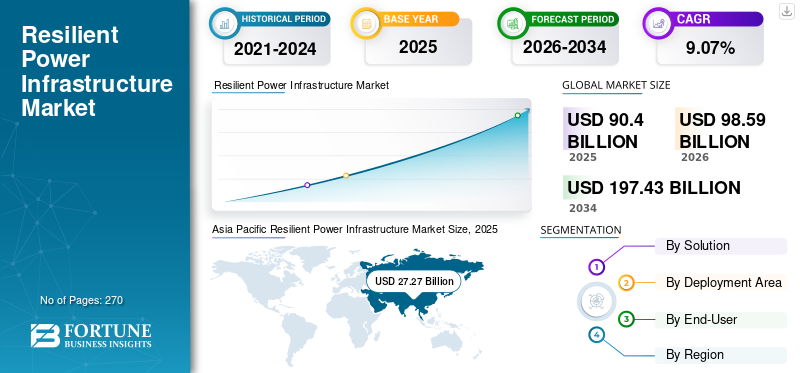
The global resilient power infrastructure market size was valued at USD 90.47 billion in 2025. The market is projected to grow from USD 98.59 billion in 2026 to USD 197.43 billion by 2034, exhibiting a CAGR of 9.07% during the forecast period. Asia Pacific dominated the resilient power infrastructure market with a market share of 30.14% in 2025.
Resilient power infrastructure refers to the technologies, systems, and solutions designed to enhance the reliability, security, adaptability, and recovery capabilities of electrical power infrastructure against disruptions caused by extreme weather events, natural disasters, cyberattacks, equipment failures, grid instability, and other operational risks. It encompasses a broad range of solutions including grid hardening systems, grid automation and monitoring technologies, energy storage systems, microgrids, cybersecurity platforms, resilience software and analytics solutions, engineering and consulting services, and other resilience-focused power infrastructure technologies that support continuous and secure electricity delivery.
The demand for resilient power infrastructure solutions is increasing globally due to the growing frequency and severity of climate-related events, rising grid modernization investments, increasing electricity demand, expanding renewable energy integration, and heightened concerns regarding energy security and grid reliability. Governments, utilities, industrial operators, and critical infrastructure owners are actively investing in resilient power systems to minimize outage risks, improve disaster preparedness, strengthen grid reliability, and ensure business continuity. Advancements in digital grid technologies, artificial intelligence-based grid analytics, distributed energy resources (DERs), battery energy storage systems, and cybersecurity solutions are further supporting market expansion. In addition, increasing investments in transmission and distribution modernization, critical facility protection, microgrid deployment, and utility resilience programs are creating substantial opportunities for technology providers, engineering firms, and power infrastructure companies across both developed and emerging economies.
The global market is moderately fragmented and characterized by the presence of electrical equipment manufacturers, grid technology providers, energy storage companies, software developers, engineering service providers, and utility infrastructure specialists. Leading companies such as Schneider Electric SE, Siemens AG, ABB Ltd., Eaton Corporation plc, General Electric Vernova Inc., Hitachi Energy Ltd., and Mitsubishi Electric Corporation are focusing on strengthening their resilience-focused portfolios. It is done through technological innovation, digitalization, strategic partnerships, acquisitions, and investments in grid modernization and distributed energy infrastructure.
Download Free sample to learn more about this report.
Resilient Power Infrastructure Market Key Takeaways
 Global Market Size & Forecast
- 2025 Market Size: USD 90.47 billion
- 2026 Market Size: USD 98.59 billion
- 2034 Forecast Market Size: USD 197.43 billion
- CAGR: 9.07% from 2026–2034
 Market Share
- Asia Pacific dominated the market with a 30.14% share, valued at USD 27.27 billion in 2025.
- Grid Hardening Solutions segment dominated the market with a 35.69% share in 2025.
- Electric Utilities segment dominated the market with a 38.65% share in 2025.
 Key Regional Highlights
North America
The market reached USD 31.05 billion in 2025, driven by grid hardening and transmission modernization.
Asia Pacific
The market reached USD 27.27 billion in 2025, supported by grid modernization and renewable energy integration.
Europe
The market reached USD 22.27 billion in 2025, driven by energy security and smart grid investments.
U.S.
The market reached USD 27.07 billion in 2025, supported by grid resilience and energy storage investments.
Japan
The market is supported by regional investments in grid modernization and renewable energy integration.
Read More

Resilient Power Infrastructure Market Trends
Increasing Deployment of Microgrids and Distributed Energy Resources for Grid Resilience
Utilities, governments, military installations, healthcare facilities, data centers, and industrial operators are increasingly deploying microgrids and Distributed Energy Resources (DERs) to improve energy resilience and maintain operations during grid outages. Microgrids equipped with renewable energy generation, battery storage systems, and intelligent control platforms provide localized power generation and islanding capabilities, enabling critical facilities to continue operating during grid disruptions. As extreme weather events and power outages become more frequent, organizations are increasingly adopting resilient microgrid solutions as part of broader energy security and disaster preparedness strategies.
In March 2025, Pacific Gas and Electric Company (PG&E) announced plans to award up to USD 43 million through California's Microgrid Incentive Program to support the development of nine new community-driven microgrids across Northern and Central California. The projects are intended to improve grid resilience and provide reliable backup power for communities vulnerable to wildfire-related outages and extreme weather events.
MARKET DYNAMICS
MARKET DRIVERS
Download Free sample to learn more about this report.
Rising Investments in Grid Modernization, Energy Transition, and Electrification Infrastructure are Driving Market Growth
The increasing global transition away from conventional fossil fuel-based energy systems toward cleaner and more sustainable sources of energy is significantly accelerating investments in resilient power infrastructure. Governments, utilities, and private-sector organizations are modernizing aging electric grids to accommodate rising electricity demand, integrate renewable energy resources, and improve overall grid reliability. As renewable energy generation from solar, wind, hydroelectric, and other low-carbon sources continues to expand, utilities are investing heavily in grid hardening solutions, advanced transmission and distribution networks, energy storage systems, grid automation technologies, and resilience-focused infrastructure to maintain stable and reliable electricity supply.
In addition, growing electrification across transportation, industrial operations, buildings, and critical infrastructure is placing increased pressure on existing power networks. Utilities are therefore prioritizing investments aimed at improving grid resilience, enhancing operational flexibility, reducing outage risks, and strengthening the ability of electric grids to withstand extreme weather events, cyber threats, and equipment failures. Advanced grid monitoring systems, intelligent substations, Distributed Energy Resource Management Systems (DERMS), microgrids, and battery energy storage systems are becoming critical components of next-generation resilient electricity networks.
In February 2025, Pacific Gas and Electric Company (PG&E) continued implementation of its System Hardening Program, including undergrounding power lines, installing covered conductors, strengthening transmission infrastructure, and deploying advanced grid monitoring technologies. These technologies were implemented to reduce wildfire risks, improve electric grid reliability, and enhance resilience across California's power network.
MARKET RESTRAINTS
High Capital Investment Requirements for Resilience Infrastructure Projects are Hindering Market Growth
Despite the long-term reliability and operational benefits offered by resilient power infrastructure solutions, implementation often requires substantial upfront capital investment. Grid hardening programs, underground transmission and distribution systems, advanced grid automation platforms, energy storage deployments, and cybersecurity infrastructure upgrades can involve significant project costs. Smaller utilities and infrastructure operators, particularly in developing regions, may face budgetary constraints that limit the pace of resilience investments. In addition, lengthy regulatory approvals, infrastructure permitting requirements, and uncertain project return-on-investment timelines can delay large-scale resilience initiatives.
For instance, utility-scale transmission hardening, undergrounding projects, and grid-scale energy storage deployments frequently require multi-year investment programs and substantial capital expenditures before reliability and resilience benefits are fully realized.
MARKET OPPORTUNITIES
Expansion of Renewable Energy Integration and Distributed Grid Architectures are Creating Substantial Opportunities
The growing deployment of renewable energy generation and distributed energy resources is creating substantial opportunities for resilient power infrastructure solutions. As power systems become increasingly decentralized, utilities are investing in advanced grid management technologies, energy storage systems, microgrids, and digital control platforms to maintain grid stability and reliability. Resilience-focused technologies enable operators to manage intermittent renewable generation, support grid flexibility, and improve power quality across complex electricity networks. Increasing investments in smart grids, distributed generation networks, and community energy resilience programs are expected to accelerate the resilient power infrastructure market growth over the forecast period.
In April 2025, Schneider Electric and GreenYellow announced the expansion of their strategic partnership to accelerate the deployment of distributed energy infrastructure, battery energy storage systems, and microgrid solutions across commercial and industrial facilities worldwide. The collaboration aims to enhance energy resilience, support renewable energy integration, reduce carbon emissions, and improve energy security for critical operations.
MARKET CHALLENGES
Aging Grid Infrastructure and Increasing Complexity of Grid Modernization Projects Limit Market Growth
The major challenges facing the market is the growing complexity associated with modernizing aging electricity networks while maintaining system reliability. Many transmission and distribution assets across North America, Europe, and parts of Asia Pacific were originally designed decades ago and are increasingly vulnerable to extreme weather events, equipment failures, and rising electricity demand. Utilities must simultaneously replace aging infrastructure, integrate renewable energy resources, deploy advanced grid automation technologies, and strengthen cybersecurity defenses without disrupting ongoing operations. The scale of these modernization efforts often requires extensive planning, coordination, and capital investment, creating implementation challenges for utilities and infrastructure operators.
In April 2025, PJM Interconnection reported a continued backlog of more than 2,000 generation and grid connection projects awaiting interconnection approval across its service territory. The growing queue highlighted the challenges associated with transmission infrastructure upgrades, grid planning complexity, and integrating new generation resources while maintaining system reliability.
Segmentation Analysis
By Solution
Grid Hardening Solutions Segment Dominated the Market Owing to Rising Investments in Grid Reliability and Climate Resilience Programs
Based on solution, the global market is segmented into grid hardening solutions, grid automation & monitoring solutions, energy storage solutions, microgrid solutions, cybersecurity solutions, resilience software & analytics solutions, engineering & consulting services, and others.
The grid hardening solutions segment dominated the market, accounting for approximately 35.69% share in 2025. It is driven by increasing investments in transmission and distribution network strengthening, underground cabling, covered conductors, storm-resistant infrastructure, wildfire mitigation systems, flood protection measures, and substation resilience upgrades. Utilities worldwide are prioritizing grid hardening initiatives to reduce outage frequency, improve disaster preparedness, and enhance network reliability amid the growing occurrence of extreme weather events. Government funding programs, utility resilience mandates, and aging infrastructure replacement projects continue to support the segment's leadership position across developed and emerging markets.
The energy storage solutions segment is emerging as the fastest-growing category and is projected to expand at a CAGR of 11.29% during the forecast period. The growth is driven by increasing deployment of Battery Energy Storage Systems (BESS) for grid stabilization, renewable energy integration, backup power support, peak load management, and resilience enhancement.
By Deployment Area
Distribution Segment Dominated the Market Owing to Growing Investments in Distribution Network Resilience and Reliability Enhancement
Based on deployment area, the global market is segmented into generation, transmission, distribution, critical facilities, commercial & industrial facilities, and others.
The distribution segment dominated the market, accounting for approximately 33.84% share in 2025. The growth is driven by extensive investments in distribution grid modernization, automated distribution management systems, smart switches, fault detection technologies, advanced monitoring systems, and infrastructure hardening initiatives. The distribution networks are particularly vulnerable to outages caused by storms, wildfires, floods, and equipment failures, making resilience investments a top priority for utilities. Increasing deployment of distributed energy resources, electric vehicle charging infrastructure, and smart grid technologies is further accelerating investments across distribution networks globally.
The critical facilities segment is projected to witness the fastest-growth, expanding at a CAGR of 10.07% during the forecast period. The growth is driven by increasing resilience requirements across hospitals, data centers, military facilities, airports, emergency response centers, water treatment plants, and telecommunications infrastructure. Operators of critical facilities are investing heavily in microgrids, battery energy storage systems, backup power solutions, cybersecurity platforms, and intelligent energy management systems to ensure uninterrupted operations during grid disruptions. Rising concerns regarding energy security, business continuity, and disaster preparedness are expected to support strong growth in this segment.
By End-User
To know how our report can help streamline your business, Speak to Analyst
Electric Utilities Segment Dominated the Market Owing to Large-Scale Grid Modernization and Resilience Investments
Based on end-user, the global market is segmented into electric utilities, government & public sector, commercial & industrial, critical infrastructure operators, and others.
The electric utilities segment dominated the market, accounting for approximately 38.65% of the resilient power infrastructure market share in 2025. The growth is driven by significant investments in grid modernization, transmission and distribution hardening, advanced grid automation systems, substation upgrades, energy storage deployments, and cybersecurity enhancements. Utilities remain the primary stakeholders responsible for maintaining reliable power delivery and are at the forefront of resilience investments aimed at reducing outage durations, improving system reliability, and supporting renewable energy integration. Government incentives, regulatory mandates, and increasing climate resilience requirements continue to strengthen demand from the utility sector.
The critical infrastructure operators segment is anticipated to register the fastest growth and is projected to expand at a CAGR of 10.0% during the forecast period. The growth is being fueled by increasing investments from data centers, telecommunications operators, airports, healthcare facilities, defense installations, transportation networks, and water utilities. These organizations are increasingly deploying resilient power infrastructure solutions such as microgrids, energy storage systems, advanced monitoring platforms, and cybersecurity technologies to ensure operational continuity and minimize risks associated with power disruptions. Growing digitalization, rising dependence on uninterrupted electricity supply, and increasing regulatory focus on infrastructure resilience are expected to accelerate segment growth over the forecast period.
Resilient Power Infrastructure Market Regional Outlook
By region, the market is categorized into Europe, North America, Asia Pacific, Latin America, and the Middle East & Africa.
Asia Pacific
Asia Pacific Resilient Power Infrastructure Market Size, 2025 (USD Billion)
To get more information on the regional analysis of this market, Download Free sample
Asia Pacific dominated the global market, accounting for approximately USD 27.27 billion in 2025. The region is witnessing substantial growth due to increasing investments in grid modernization, transmission and distribution expansion, renewable energy integration, energy storage deployment, and climate-resilient power infrastructure projects. The governments and utilities across China, India, Japan, Australia, and Southeast Asia are strengthening electricity networks to address rising electricity demand, support renewable energy targets, and improve resilience against extreme weather events. In addition, growing investments in smart grid technologies, microgrids, advanced monitoring systems, and battery energy storage solutions are further supporting market expansion throughout the region.
China Resilient Power Infrastructure Market
The China market in 2025 was estimated at approximately USD 9.15 billion. The market growth is driven by large-scale transmission expansion projects, increasing investments in Ultra-High-Voltage (UHV) networks, deployment of grid automation technologies, renewable energy integration initiatives, and government programs focused on enhancing grid reliability and energy security.
India Resilient Power Infrastructure Market
The Indian market size in 2025 was estimated at approximately USD 4.14 billion. The growth is supported by rising investments in transmission infrastructure, smart grid deployment, rural electrification upgrades, energy storage projects, and government initiatives focused on improving grid reliability and climate resilience.
Europe
Europe accounted for approximately USD 22.27 billion in 2025. The market is expanding due to increasing investments in energy security, grid modernization, renewable energy integration, and infrastructure resilience programs. The region's ambitious decarbonization goals, electrification initiatives, and growing deployment of distributed energy resources are encouraging utilities to strengthen transmission and distribution networks. Furthermore, rising investments in battery energy storage systems, cybersecurity solutions, and digital grid technologies are contributing to market growth across the region.
Germany Resilient Power Infrastructure Market
The Germany market in 2025 was estimated at approximately USD 5.74 billion. The growth is supported by transmission expansion projects, renewable energy integration requirements, smart grid investments, and increasing deployment of advanced substation automation technologies.
U.K. Resilient Power Infrastructure Market
The U.K. market size in 2025 was estimated at approximately USD 4.75 billion. The market is growing due to rising investments in transmission upgrades, offshore wind integration infrastructure, grid resilience initiatives, and advanced monitoring systems designed to improve network reliability.
North America
North America accounted for approximately USD 31.05 billion in 2025 and remains one of the largest markets for resilient power infrastructure globally. The market growth is driven by extensive investments in grid hardening, wildfire mitigation programs, storm-resilient infrastructure, energy storage deployment, and transmission modernization projects. Utilities across the U.S. and Canada are investing heavily in grid automation, advanced monitoring systems, underground distribution infrastructure, and cybersecurity technologies to improve resilience against extreme weather events and increasing electricity demand.
U.S. Resilient Power Infrastructure Market
The U.S. market size in 2025 was estimated at approximately USD 27.07 billion. The growth is driven by federal and state-level grid resilience programs, wildfire mitigation investments, microgrid deployment, battery energy storage expansion, and modernization of aging transmission and distribution infrastructure.
Middle East & Africa
The Middle East & Africa market accounted for approximately USD 5.27 billion in 2025. Market growth is being driven by increasing investments in transmission and distribution infrastructure, utility modernization programs, smart grid deployment, and critical infrastructure resilience projects. Governments across the Gulf region and Africa are focusing on strengthening electricity networks, integrating renewable energy resources, and improving energy security to support economic diversification and industrial development.
GCC Resilient Power Infrastructure Market
The GCC market in 2025 was estimated at approximately USD 2.55 billion. The growth is supported by utility modernization projects, renewable energy integration initiatives, smart grid investments, and infrastructure resilience programs across Saudi Arabia, the UAE, Qatar, Kuwait, Bahrain, and Oman.
Latin America
Latin America accounted for approximately USD 4.60 billion in 2025. The market is primarily driven by increasing investments in transmission infrastructure, renewable energy integration, utility modernization, and disaster-resilient electricity networks. Governments and utilities are investing in grid automation, energy storage systems, and smart grid technologies to improve service reliability and support growing electricity demand.
Brazil Resilient Power Infrastructure Market
The Brazil market in 2025 was estimated at approximately USD 2.04 billion. The growth is supported by transmission expansion projects, renewable energy integration, distribution network modernization, and increasing investments in grid reliability and energy security.
COMPETITIVE LANDSCAPE
KEY INDUSTRY PLAYERS
Major Players are Expanding Grid Modernization, Energy Storage, and Digital Resilience Portfolios to Strengthen Market Positioning
The resilient power infrastructure market remains highly competitive, with leading companies focusing on expanding their capabilities in grid modernization, energy storage, microgrids, digital grid management, and cybersecurity to strengthen their market positions. Market participants are increasingly developing integrated resilience solutions that combine grid hardening technologies, advanced automation systems, energy storage platforms, intelligent monitoring solutions, and resilience analytics software. Strategic acquisitions, technology partnerships, utility collaborations, product innovation, and investments in digital grid infrastructure have become key competitive strategies as utilities, governments, and critical infrastructure operators accelerate investments in power system resilience. The growing adoption of smart grids, Distributed Energy Resources (DERs), battery energy storage systems, microgrids, and cybersecurity solutions is encouraging market leaders to continuously enhance their technology portfolios and expand their global presence.
In May 2025, Hitachi Energy Ltd. announced the expansion of its grid modernization and digital power infrastructure portfolio through advanced grid automation, substation digitalization, and energy storage integration solutions. Such solutions are designed to help utilities improve grid reliability, strengthen resilience against extreme weather events, and support large-scale renewable energy integration initiatives.
LIST OF KEY RESILIENT POWER INFRASTRUCTURE COMPANIES PROFILED
- Simens AG (Germany)
- ABB Ltd. (Switzerland)
- Schneider Electric SE (France)
- Eaton Corporation plc (Ireland)
- Hitachi Energy Ltd. (Switzerland)
- General Electric Vernova Inc. (U.S.)
- Mitsubishi Electric Corporation (Japan)
- Honeywell International Inc. (U.S.)
- Cisco Systems, Inc. (U.S.)
- Itron, Inc. (U.S.)
KEY INDUSTRY DEVELOPMENTS
- November 2025: ABB Ltd. introduced advanced distribution automation and grid resilience solutions featuring intelligent fault detection, automated restoration, and real-time network visibility capabilities. The new solutions were developed to support utility resilience programs, reduce outage durations, and improve power system reliability.
- October 2025: Siemens AG expanded its Grid Software portfolio with enhanced Distributed Energy Resource Management System (DERMS) capabilities designed to improve renewable energy integration, optimize grid operations, and strengthen network resilience across increasingly decentralized power systems.
- September 2025: Hitachi Energy Ltd. launched new digital substation and grid automation solutions aimed at improving operational reliability, accelerating outage recovery, and supporting utility investments in resilient and intelligent power infrastructure.
- August 2025: Eaton Corporation plc expanded its microgrid and energy storage integration portfolio with advanced intelligent power management technologies designed to improve energy resilience, support critical infrastructure operations, and enhance grid flexibility during power disruptions.
- July 2025: General Electric Vernova Inc. announced enhancements to its GridOS® software platform with advanced grid orchestration and resilience management capabilities. The development was intended to help utilities improve situational awareness, optimize grid performance, and support large-scale renewable energy integration.
REPORT COVERAGE
The global resilient power infrastructure market analysis provides an in-depth study of the market size and forecast by all the market segments included in the report. It contains details on the market dynamics and market trends expected to drive the market in the forecast period. It offers information on technological advancements, new product launches, key industry developments, and partnerships, mergers & acquisitions. The market research report also includes a detailed competitive landscape, providing market share and profiles of key players.
Request for Customization to gain extensive market insights.
Report Scope & Segmentation
| ATTRIBUTE | DETAILS |
| Study Period | 2021-2034 |
| Base Year | 2025 |
| Estimated Year | 2026 |
| Forecast Period | 2026-2034 |
| Historical Period | 2021-2024 |
| Growth Rate | CAGR of 9.07% from 2026-2034 |
| Unit | Value (USD Billion) |
| Segmentation | By Solution, By Deployment Area, By End-User, and By Region |
| By Solution |
|
| By Deployment Area |
|
| By End-User |
|
| By Region |
|
Frequently Asked Questions
Fortune Business Insights says that the global market value stood at USD 90.47 billion in 2025 and is projected to reach USD 197.43 billion by 2034.
The market is expected to exhibit a CAGR of 9.07% during the forecast period.
The electric utilities segment led the market in terms of end-user.
Rising investments in grid modernization and infrastructure hardening driving market growth.
ABB Ltd, Siemens AG, Schneider Electric, and Eaton Corporation are among the prominent players in the market.
Asia Pacific dominated the market, with the highest share in 2025.



- 2021-2034
- 2025
- 2021-2024
- 270
Get 30-60 hrs Free Customization
Expand Regional and Country Coverage, Segments Analysis, Company Profiles, Competitive Benchmarking, and End-user Insights.



















Related Reports
-
US +1 833 909 2966 ( Toll Free )
-
Get In Touch With Us