Backpack Market Size, Share & Industry Analysis, By Product Type (Daily Commute, Travel, Business/Work, School/College, Sports & Fitness, Outdoor Adventure, Fashion/Lifestyle, and Others), By Price Range (Economy (below USD 50), Mid-Range (USD 50-150), Premium (USD 150-300), and Luxury (above USD 300)), By End-user (Men, Women, Unisex, and Kids), By Distribution Channel (Specialty Outdoor & Sports Stores, Supermarkets & Hypermarkets, Department Stores, Exclusive Brand Stores, Online/E-Commerce, and Others), and Regional Forecast, 2026-2034
 Download Free Sample
(Offer valid till 30th Sep 2026)

Backpack Market Size and Future Outlook
 Listen to Audio Version
The global backpack market size was valued at USD 20.30 billion in 2025 and is projected to grow from USD 22.12 billion in 2026 to USD 44.76 billion by 2034, registering a CAGR of 9.21% over the forecast period. Asia Pacific dominated the backpack market with a market share of 37.66% in 2025.
Backpack is an everyday vital product in modern daily routines, serving as a practical carry solution for students, travelers, professionals, commuters, and hikers. A backpack is a compact, lightweight, portable, multi-compartment bag designed to distribute weight evenly across the shoulders, making it ideal for carrying laptops, books, personal items, outdoor gear, and other essentials. Backpack’s importance has grown with lifestyle changes, the need for convenient, organized storage, and growing mobility in fast-paced environments. Key market drivers include expanding travel and rising interest in outdoor recreational activities, growing adoption of tech-friendly and ergonomic backpacks, consolidated by increasing usage of laptops in workplaces and schools. Moreover, consumer preferences for durable and sustainable materials, backed by the rise of eco-conscious brands unveiling organic cotton, recycled polyester, and biodegradable components. These aspects collectively ascribed to growing consumers demand for functional, versatile, and aesthetically appealing backpacks globally.
Some of the key players in the market include Nike, Adidas, VF Corporation, Samsonite, and Herschel Supply Co. leading at the forefront. These players maintain competitiveness through continuous product innovation, such as integrating lightweight materials, ergonomic designs, and tech-compatible compartments. They also invest heavily in sustainability initiatives, to gain competitive advantage.
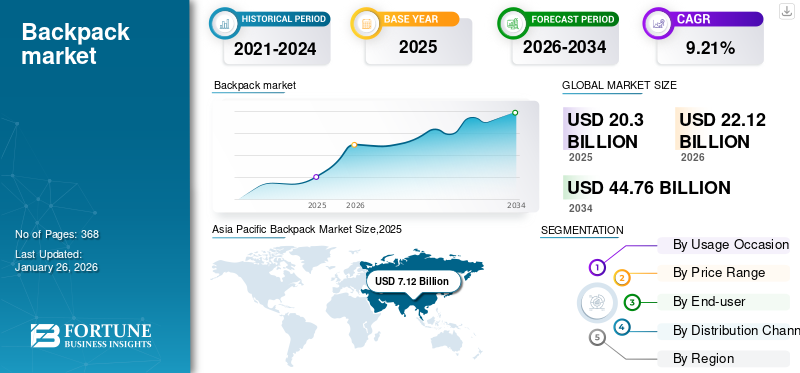
Download Free sample to learn more about this report.
Backpack market Key Takeaways
 Global Market Size & Forecast
- 2025 Market Size: USD 20.30 billion
- 2026 Market Size: USD 22.12 billion
- 2034 Forecast Market Size: USD 44.76 billion
- CAGR: 9.21% from 2026–2034
 Market Share
- Asia Pacific dominated the backpack market with a market share of 37.66% in 2025.
- The travel backpacks segment accounted for 46.54% of the global market share in 2026.
- The economy segment is anticipated to dominate with 42.68% share in 2025.
 Key Regional Highlights
Asia Pacific
The region generated USD 7.65 billion in 2025 and is expected to reach USD 8.44 billion in 2026, supported by rising disposable incomes, rapid urbanization, expanding manufacturing capacity, and growing e-commerce adoption.
North America
The market was valued at USD 7.06 billion in 2025 and is projected to reach USD 7.61 billion in 2026, driven by strong outdoor recreation, frequent travel, and high demand for durable backpacks.
Europe
The regional market reached USD 3.95 billion in 2025 and is forecast to grow to USD 4.29 billion in 2026, supported by increasing demand for sustainable materials and stylish, functional backpacks.
U.S.
The market is projected to reach USD 6.34 billion by 2026, driven by robust domestic travel activity, outdoor recreation participation, and widespread use of backpacks for work, education, and leisure.
Japan
The backpack market is projected to reach USD 0.97 billion by 2026, supported by steady consumer demand for high-quality and functional bags for commuting, travel, and everyday use.
Read More

MARKET DYNAMICS
MARKET DRIVERS
Rising Urban Mobility and On-the-Go Lifestyles to Trigger Product Adoption
Growing urban mobility and the necessity for hassle-free, efficient carrying solutions primarily drives the backpack market growth. As increasing number of people commute daily for work, education, and other personal activities, backpacks have become an integral part of the daily routine owing to their ergonomic design, weight distribution, and ability to carry multiple items such as laptops, study materials, documents, backpacks, and personal accessories comfortably and securely. Furthermore, the shift toward public transport and compact living in metropolitan cities has augmented the preference for shoulder bags over handbags or briefcases. Accompanied by this trend, global workforce mobility has grown multifold resulting in professional’s reliance on backpacks that can safely store and carry electronics. For instance, according to the International Labour Organization (ILO), more than 3.4 billion people are part of the global workforce, and a significant portion commutes daily to workplaces. This growing working population fuels the need for products. Moreover, the surge in trekking, hiking, cycling, and urban micro-mobility platforms such as shared bikes or e-scooters highlights the need for practical and durable bags.
MARKET RESTRAINTS
Environmental Waste and Sustainability Concerns to Hamper Product Demand
Environmental impact of synthetic materials, especially polyester and nylon, which dominate global bag production primarily obstructs market growth. These materials are derived from plastics and contribute to long-lasting waste in landfills when discarded. According to the UN Environment Programme (UNEP), over 400 million tons of plastic waste is produced every year, and a large share comes from the textile and fashion industries including bags and accessories that use polyester-based fabrics. UNEP also cited that only around 9% of global plastic is recycled, indicating most discarded synthetic bags contribute to long-term pollution. Moreover, the Ellen MacArthur Foundation underscores that the textile and fashion industry generates 92 million tons of waste annually, stressing that products made using virgin synthetics remain difficult to recycle. These factors in turn limit or increase compliance costs for manufacturers, thereby restraining overall market growth.
MARKET OPPORTUNITIES
Growing Demand for Sustainable and Recycled Backpacks to Create Lucrative Growth Opportunities
Inclining consumer shift toward eco-friendly, sustainable, and recycled-material backpacks provides lucrative growth opportunities. With rising environmental awareness, buyers particularly in younger and urban demographics are seeking products made from recycled materials, organic fibers, and low-impact manufacturing processes. This trend is supported by credible global data such as the Ellen MacArthur Foundation emphasizes that transitioning to circular textile systems could reduce textile waste by up to 80%, encouraging brands to adopt recycled inputs. Thus, the market has a strong opportunity to expand through biodegradable components, innovation in recycled materials, and circular manufacturing models.
BACKPACK MARKET TRENDS
Growth of Tech-Integrated and Smart Backpacks are Significant Market Trends
One notable trend in the market is the growing adoption of smart backpacks and tech-integrated, designed to support the digital lifestyles of professionals, students, and travelers. These bags often feature built-in USB charging ports, RFID-blocking pockets, anti-theft locking systems, and padded compartments for tablets and laptops. The trend is fueled by the global market expansion of mobile device usage reinforced by data from the International Telecommunication Union (ITU). It reports that more than 5.4 billion people globally use the internet (2023), indicating widespread dependence on digital devices during daily commutes. Moreover, as per the UNESCO, more than 1 billion students globally engage with digital learning tools, increasing the need for protective, device-friendly bags. These technologically advanced, credible shifts support the growing trend toward tech-enabled, feature-rich bag designs across global markets.
Download Free sample to learn more about this report.
Segmentation Analysis
By Usage Occasion
Large Student Base and Daily Essential Use to Strengthen School/College Segmental Growth
On the basis of the usage occasion, the market is classified into daily commute, travel, business/work, school/college, sports & fitness, outdoor adventure, fashion/lifestyle, and others.
The school/colleges segment accounted for a significant backpack market share in 2024. The growth of the segment is supported by heavy student’s reliance on bags as an everyday essential for carrying digital devices, books, stationery, and other personal items, making demand consistent and recurring. According to the UNESCO reports there are more than 1.5 billion learners enrolled globally, creating a huge and stable user base. Moreover, the segment also benefits from frequent replacement cycles due to wear and tear further contributing to segment’s market share.
The travel backpacks product type segment led the market, accounting for 46.54% of the global market share in 2026, driven by increasing travel, tourism, and adventure activities.
Meanwhile, the outdoor adventure segment is forecasted to grow at the highest CAGR over the projected years. Increasing participation in activities such as hiking, camping, trekking, and nature-based tourism and growing power of consumers to spend on designer and functional bags is anticipated to drive segmental growth.
To know how our report can help streamline your business, Speak to Analyst
By Price Range
High Mass-Market Demand and Affordability to Fuel Economy Segment’s Growth
In terms of price range, the market is categorized into economy (below USD 50), mid-range (USD 50-150), premium (USD 150-300), and luxury (above USD 300).
The economy segment captured the largest share of the market in 2024. In 2025, the segment is anticipated to dominate with 42.68% share. This price range caters to the broadest consumer base, providing durable and functional bags at accessible prices for daily commuters, students, and budget-conscious buyers. The economy segment is particularly dominant in price-sensitive regions across South America, Asia Pacific, and parts of Africa, where value for money drives purchase decisions.
The premium segment is expected to grow at a CAGR of 11.02% over the forecast period. Consumers are increasingly prioritizing advanced functionality, high-quality, sustainable materials, and brand prestige which is anticipated to supplement segment’s growth. Moreover, premium bags often feature superior craftsmanship, weather-resistant fabrics, laptop protection systems along with ergonomic designs. Consumers of today’s age are willing to spend on such features, fueling segmental expansion.
By End-user
Functional Preference and Broader Usage Needs to Fuel Men’s Segment Growth
In terms of end-user, the market is categorized into men, women, unisex, and kids.
The men’s segment commands the highest market share in 2024. In 2025, the segment is anticipated to dominate with 51.27% share. Men primarily relied on backpacks for their daily commute option as opposed to women who also have the alternative handbags, sling bags among others to carry for work and travel purposes. Men are also frequent users of adventure and outdoor gear, such as cycling, hiking, trekking, and gym that significantly contribute to overall demand. Moreover, data presented by the ILO showcases that global workforce participation rates are higher among men in many regions leading to greater usage of laptop and office backpacks.
The unisex segment is expected to grow at a CAGR of 12.11% over the forecast period. With growing consumer preferences for universal and versatile designs that appeal to both men and women, has reduced the appeal for gender-specific products, driving the global market size. Moreover, an inclining shift toward gender workplace equality and shared lifestyle trends, has prompted demand for multipurpose backpacks suitable for all genders leading market growth.
By Distribution Channel
Widespread Presence of Specialty Outdoor & Sports Stores to Drive Segment Expansion
Based on the distribution channels, the market is segmented into specialty outdoor & sports stores, supermarkets & hypermarkets, department stores, exclusive brand stores, online/e-commerce, and others.
The specialty outdoor & sports stores channel held the dominating position in 2024. The segment held the share of 34.36% in 2024. These offline stores exclusively offer detailed product knowledge, a deeper assortment of technical backpacks, and in-person shopping experience, leading to higher segmental share. Their curated selection of technical and premium brands also builds consumer trust, since shoppers can scrutinize the product’s quality and features before purchase.
The online/e-commerce distribution channel segment is set to flourish with a growth rate of 11.67% across the forecast period. Factors such as competitive pricing, wide product collection, convenient home deliveries, combined with rising internet and smartphone penetrations has enabled easy comparison and faster purchasing, fueling segment expansion.
Backpack Market Regional Outlook
By region, the market is categorized into Europe, North America, Asia Pacific, South America, and the Middle East & Africa.
Asia Pacific
Asia Pacific contributed approximately USD 7.65 billion to the global market in 2025, accounting for 37.66% share, and is expected to reach USD 8.44 billion in 2026. The factors fostering the dominance of the region include rising disposable income across developing nations, rapid urbanization, and a larger population base. The region’s vast manufacturing capacity in countries such as China and Vietnam which allows cost-efficient production and global exports consolidates further market growth. Moreover, students and professionals in metro cities across China, India, and Southeast Asia are increasingly investing in bags for daily commute, travel, and education leading to sustained product demand. In addition, growing e-commerce penetration in Asian markets has enabled easy product access and lower distribution cost, enhancing product demand. The Japan market is projected to reach USD 0.97 billion by 2026, the China market is projected to reach USD 3.27 billion by 2026, and the India market is projected to reach USD 1.94 billion by 2026.
Asia Pacific Backpack Market Size, 2025 (USD Billion)
To get more information on the regional analysis of this market, Download Free sample
North America and Europe
In 2025, North America held 34.76% of the global market share, reaching a valuation of USD 7.06 billion, and is projected to grow to USD 7.61 billion in 2026. The growth of the market in these regions is primarily driven by large outdoor-recreation communities, strong culture of tourism and travel for businesses, education, and weekend mobility purposes, along with high penetration of laptops and tech adoption. For instance, according to the Outdoor Industry Association (OIA), 168 million Americans participated in outdoor activities in 2023, fueling solid demand for trekking, hiking, school, and travel backpack designed for performance and durability. The U.S. Travel Association data for 2023, cited that domestic travel exceeded 2.3 billion trips, strengthening market growth. The U.S. market is projected to reach USD 6.34 billion by 2026.
On other hand, strong emphasis of European consumers on using sustainable and eco-friendly materials in daily life, including backpacks, is fueling the European market growth. The market in Europe reached USD 3.95 billion in 2025, representing 19.46% of total market revenue, and is projected to reach USD 4.29 billion in 2026. The UK market is projected to reach USD 0.74 billion by 2026 and the Germany market is projected to reach USD 0.92 billion by 2026. European cities rely heavily on public transport such as buses, metro, cycling, and walking where hands-free and compact carry solutions such as shoulder bags are essential for daily commuting, supplementing market growth. Furthermore, the region is a fashion hub with strong demand for designer, luxury, stylish bags that blend functionality with aesthetics for work, leisure, and school. For instance, German brands such as deuter sport GmbH, provide stylish and functional bags suitable for all types of travels.
South America and Middle East & Africa
Over the forecast period, South America and the Middle East & Africa regions would witness moderate growth in this industry. In 2025, South America represented USD 1.03 billion, accounting for 5.10% of the worldwide market, and is projected to grow to USD 1.11 billion in 2026. Rising urbanization, increasing outdoor and adventure tourism, growing students and youth population, and rising demand for affordable yet durable everyday carry products is anticipated to drive South America’s market growth. In the Middle East & Africa, UAE is set to attain the value of USD 0.06 billion in 2025. The Middle East & Africa region captured 3.02% of the global market in 2025, generating USD 0.61 billion in revenue, and is projected to reach USD 0.67 billion in 2026.
COMPETITIVE LANDSCAPE
Key Industry Players
Key Players Competing on Product Innovation and Sustainability
The global market is highly competitive, led by major brands such as Adidas, Nike, VF Corporation, Samsonite, and Herschel Supply Co., all of whom distinguish themselves through strong branding, innovation, and sustainability. A primary strategy adopted by the leading players is the adoption of sustainable materials, with brands increasingly using organic, recycled, and repurposed materials in response to global sustainability movements. Moreover, key players reinforced their market position through robust omnichannel distribution, integrating retail partnerships, e-commerce, and direct-to-consumer platforms to reach a widespread audience more effectively. Celebrity collaborations, lifestyle-driven marketing, and geographic expansion further enhance their visibility and market hold, helping them stay afloat in a rapidly evolving and highly dynamic market environment.
LIST OF KEY BACKPACK COMPANIES PROFILED
- Samsonite International S.A. (Luxembourg)
- VF Corporation (U.S.)
- Thule Group (France)
- Osprey (U.S.)
- Victorinox (Switzerland)
- Away (U.S.)
- Fenix Outdoor International AG (Switzerland)
- Global Uprising PBC (dba Cotopaxi) (U.S.)
- Quince (U.S.)
- Travelpro Products, Inc. (U.S.)
- United States Luggage Company, LLC. (U.S.)
- Moët Hennessy Louis Vuitton (LVMH ) (France)
- Delsey Paris (France)
KEY INDUSTRY DEVELOPMENTS
- August 2025: Osprey introduced its most advanced ‘Run Collection’ of running backpacks and hydration accessories for every distance. The products are featured to use bluesign-approved materials and 100% recycled polyester treated with PFAS-free durable water repellent (DWR).
- February 2025: JanSport, the backpack brand of VF Corporation, partnered with L2 Brands, a company in collegiate and destination apparel, to expand its presence on college campuses nationwide. This strategic partnership will introduce a new lineup of collegiate-branded JanSport backpacks launching in university bookstores.
- September 2023: Osprey Packs unveiled Technical Line with a wave of new products across its core technical pack range, including, Pro Series, The Talon, Fit (EF) line, Talon-Tempest Velocity, and Talon Earth. These technical daypacks are featured to be made from renewable materials, and follow sustainable manufacturing processes.
- July 2023: Thule expanded and refreshed its Thule Paramount bag collection specifically for active city life. The collection includes a variety of bags such as crossbodies, totes, slings, panniers, and backpacks, all designed, and equipped with various features, such as, loops for attaching bike lights and hidden security pockets to keep essentials safe during city travel.
- January 2023: JanSport launched a highly adaptive bag and backpack range designed specifically for individuals with mobility impairments. The collection includes both backpacks and crossbody bags in colors such as black and misty rose, combining inclusive design with JanSport's recognizable style.
REPORT COVERAGE
The global backpack market forecast provides an in-depth study of market size & projection by all the market segments included in the report. It includes details on the market dynamics and market trends expected to drive the market in the forecast period. The backpack industry overview offers information on the technological advancements, new product launches, key industry developments, and details on partnerships, mergers & acquisitions. It also encompasses a detailed competitive landscape with information on the market share and profiles of key operating players.
Request for Customization to gain extensive market insights.
Report Scope & Segmentation
| Attributes | Details |
| Study Period | 2021-2034 |
| Base Year | 2025 |
| Forecast Period | 2026-2034 |
| Historical Period | 2021-2024 |
| Growth Rate | CAGR of 9.21% from 2026-2034 |
| Unit | Value (USD Billion) |
| Segmentation |
By Usage Occasion
By Price Range
By End-user
By Distribution Channel
By Region
|
Frequently Asked Questions
The global backpack market size was valued at USD 20.30 billion in 2025 and is projected to grow from USD 22.12 billion in 2026 to USD 44.76 billion by 2034
In 2025, the market value stood at USD 7.65 billion.
The market is expected to exhibit a CAGR of 9.21% during the forecast period.
The school/college segment led the market by usage occasion.
Expanding travel and rising interest in outdoor recreation, growing adoption of tech-friendly and ergonomic backpacks, consolidated by increasing usage of laptops in workplaces and schools, mainly drive the growth of the market.
Nike, Adidas, VF Corporation, Samsonite, and Herschel Supply Co. are some of the prominent players in the market.
Asia Pacific dominated the market in 2024.
Inclining consumer shift toward eco-friendly, sustainable, and recycled-material backpacks are some of the factors that are expected to favor the product adoption.



- 2021-2034
- 2025
- 2021-2024
- 368
-
(Offer valid till 30th Sep 2026)
Get 30-60 hrs Free Customization
Expand Regional and Country Coverage, Segments Analysis, Company Profiles, Competitive Benchmarking, and End-user Insights.











Related Reports
-
US +1 833 909 2966 ( Toll Free )
-
Get In Touch With Us