Sleep Trackers Market Size, Share & Industry Analysis, By Technology (Actigraphy Based, Polysomnography-Integrated, HRV-Focused, Oximetry-Based (SpO₂) Devices, and Others), By Device (Watches, Bands, Rings, and Others), By Application (Personal Wellness & Lifestyle Improvement, Clinical & Health Monitoring, Sports & Performance Optimization, and Others), By End User (Business to Business and Business to Consumer), and Regional Forecast, 2026-2034
 Download Free Sample
KEY MARKET INSIGHTS
 Listen to Audio Version
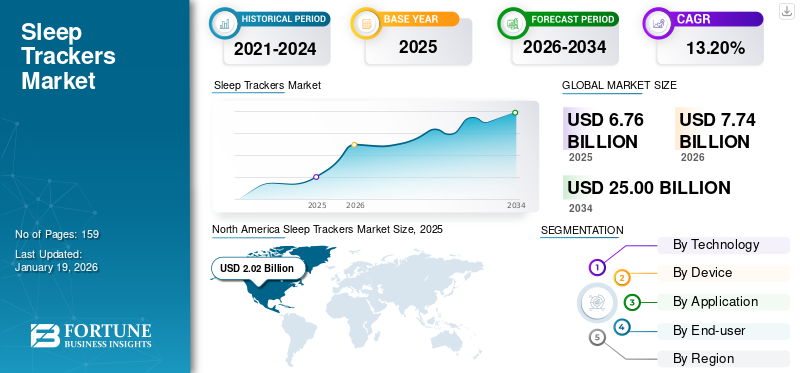
The global sleep trackers market size was valued at USD 6.76 billion in 2025 and is projected to grow from USD 7.74 billion in 2026 to USD 25.00 billion by 2034, exhibiting a CAGR of 13.20% during the forecast period. Asia Pacific dominated the sleep trackers market with a market share of 31.45% in 2025.
Sleep is one of the crucial pillars for physical, mental, and cognitive well-being. Monitoring sleep can help in the early diagnosis of many obstructive sleep disorders by observing sleep patterns using sensors and algorithms. These devices monitor and store data related to sleep cycles and help in diagnosis by providing crucial data and disease management, such as insomnia, sleep apnea or circadian rhythm disruption. For such applications, sleep trackers are used and are estimated to witness exponential growth in demand during the forecasted years.
These devices are increasingly used by fitness enthusiasts for healthcare management, improving performance, and speeding the recovery of athletes. Many key companies are collaborating with sports celebrities to enhance product adoption.
- For instance, in January 2025, Charles Leclerc, a renowned racing driver, partnered with Eight Sleep as an athlete ambassador and investor. The company’s clientele also includes numerous sports celebrities such as Taylor Fritz, Brock Purdy, Aaron Judge, Jimmy Butler, and more.
The global market has exhibited steady positive growth, with market projections exhibiting a continued growth trajectory. Major companies present in the market, includes Koninklijke Philips N.V., Withings, ResMed, Ouraring Inc., and Garmin Ltd., offer major solutions for the wearable sleep tracker market.
Download Free sample to learn more about this report.
Sleep Trackers Market Key Takeaways
 Global Market Size & Forecast
- 2025 Market Size: USD 6.76 billion
- 2026 Market Size: USD 7.74 billion
- 2034 Forecast Market Size: USD 25.00 billion
- CAGR: 13.20% from 2026–2034
 Market Share
- Asia Pacific dominated the sleep trackers market with a 31.45% share in 2025.
- The actigraphy-based devices segment is projected to hold the largest market share during the forecast period.
- The watches segment is estimated to account for the highest market share.
 Key Regional Highlights
Asia Pacific
Asia Pacific generated USD 2.13 billion in 2025 and is projected to reach USD 2.46 billion in 2026.
North America
North America accounted for USD 2.02 billion in 2025 and is expected to grow to USD 2.31 billion in 2026.
Europe
Europe reached USD 1.96 billion in 2025 and is projected to attain USD 2.24 billion in 2026.
U.S.
The U.S. remains a key market for sleep trackers, driven by strong adoption of wearable health technologies.
Japan
Growing consumer focus on sleep health and wearable devices is supporting market growth in Japan.
Read More

MARKET DYNAMICS
MARKET DRIVERS
Increasing Burden of Sleep Disorders to Drive the Market Growth
The rising prevalence of sleep problems due to stress, obesity, aging, and lifestyle changes is generating strong demand for diagnostics and health monitoring. Sleep trackers provide an affordable and accessible alternative to in-lab polysomnography, enabling early diagnosis, wider screening, and integration into digital health systems.
- For instance, in 2023, the American Academy of Sleep Medicine reported that obstructive sleep apnea affects nearly 30.0 million Americans. This gap has accelerated the adoption of wearable devices such as trackers (Fitbit, Apple Watch) and clinically validated devices (Withings Sleep Analyzer) to expand detection and monitoring outside traditional sleep labs. Such factors are expected to drive the growth of the market.
MARKET RESTRAINTS
Irregularity in Data to Erode Consumer Trust and Hamper the Market Growth
One of the major factors hampering the market growth is irregularity of data and lack of standardization in the global market. Some devices are classified as medical grade, while others are consumer grade. They monitor different parameters, and irregularities are witnessed in the results by them. This irregularity in the results can hamper the interoperability of these devices and erode consumer trust, hampering their adoption.
- For instance, in September 2022, Frontiers in Computer Science published an article titled ‘Comparing consumer-grade sleep trackers for research purposes: A field study’ that reported different readings by medical and consumer-grade sleep tracking devices.
MARKET OPPORTUNITIES
Improvement in Sensor Technology to Offer Lucrative Growth Opportunity in the Market
The technological advancement of sensor technology is expected to boost the access of these wearable technologies to people Miniaturization of these trackers and advanced optical and heart rate sensors, and noninvasive sensors for blood oxygenation levels, expands the application of these devices and enhances their role in health monitoring and management.
- For instance, in wearable technologies July 2025, Apple Inc. launched a new Apple Watch to help identify signs of moderate to severe sleep apnoea in Australia. These watches have upgraded sensors, like an accelerometer, to monitor small movements at the wrist that are associated with interruptions in normal respiratory patterns, called Breathing Disturbances.
Increasing adoption of these technologies by health enthusiasts, along with increasing adoption of digital health technologies to improve disease monitoring, by multifold. These advances are anticipated to offer potential for the sleep trackers market growth in the forthcoming years.
MARKET CHALLENGES
Strict Regulatory Framework and Need for Compliance with Data Security Measures May Restrict Market Growth
Adopting of these products requires adherence to strict data security guidelines such as HIPAA & GDPR, PIPL, LGBD, and EHR integration, which in turns necessitates the presence of data protection measures, improved transparency, and greater accountability. They collect biometric and behavioral data, and are at high risk of data theft. These frameworks manage how clinically sensitive data is stored and utilized. These frameworks aim to ensure the safety and accuracy. The management of sensitive data collected from patients also raises privacy risks, which requires greater compliance with norms and secure data handling.
SLEEP TRACKERS MARKET TRENDS
Integration of Medical-Grade Validation in Consumer Grade Devices is a Prominent Trend Observed in the Market
The market currently lacks standardization and often finds irregularity in its operations and administration due to differences in product categories. Consumer devices lack medical accuracy but are affordable, and vice versa for medical devices. By integrating medical-grade validation, these devices gain credibility in healthcare, enabling their use in remote patient monitoring and clinical decision-making, boosting their adoption.
- For instance, in October 2023, Withings launched the Sleep Analyzer, aimed at improving adherence to sleep apnea treatment. It helped in sleep apnea detection, bridging the gap between wellness tracking and medical diagnostics. Such convergence of medical and consumer-grade devices is expected to propel the growth of the market by making efforts to mitigate the challenges.
Download Free sample to learn more about this report.
Segmentation Analysis
By Technology
New Product Launches by Key Industry Players to Propel Actigraphy-Based Devices Growth
Based on the technology, the market is divided into actigraphy-based devices, Polysomnography-Integrated, HRV-focused devices, oximetry-based (SpO₂) devices, and others.
The actigraphy-based devices are projected to dominate the market during the forecasted years. These devices are medical-grade and provide scientifically proven, high-precision data for clinical trials. Benefits such as the extraction of precision data and long-term unbiased monitoring reinforce their dominant position in the market. Also, various leading companies are actively engaging in new product launches to meet the rising demand for accurate data monitoring.
- For instance, in April 2023, Empatica Inc. launched Empatica Actigraphy. The tool was an addition to the health monitoring platform of the company. The tool expanded its data and hardware capabilities for application in sleep and activity studies.
The polysomnography-integrated sleep tracking devices are expected to growth with a significant CAGR during the forecast period. The segment is expected to grow due to recent approvals following product launches. These multiparameter testing devices created a benchmark for the diagnosis of sleep disorders. It determines the sleep stages, rapid eye movement, heart rhythm, and body movements for detailed analysis.
- For instance, in September 2023, Beacon Biosignals received clearance from the U.S. FDA for Dreem 3S, an advanced wearable headband with integrated machine learning algorithms to capture electroencephalogram (EEG) data from the brain. The devices monitor sleep architecture and aid in the diagnosis of disturbed sleep.
On the other hand, oximetry-based (SpO₂) devices are anticipated to grow with a significant CAGR. These are medical-grade devices and, unlike others, they measure oxygen saturation and help in the diagnosis of sleep apnea, COPD, asthma, or cardiovascular stress. Also, wide applications and new product launches, are expected to account for high growth during the forecast period.
- For example, in May 2025, Apnimed, Inc. launched a pulse oximeter and connected software platform exhibiting promising results for monitoring obstructive sleep apnea (OSA) and other sleep-related breathing diseases, according to research presented at ATS 2025. This tool could potentially expand patient access to care through pulmonologists to manage routine sleep apnea in their patients, instead of a sleep specialist bridging the gap in between.
Furthermore, the HRV- focused devices (heart rate variability) and others segment are expected to account for a sizable market share due to growing demand.
By Device
New Product Launches for Watches to Reinforce Dominance of the Segment
In regard with devices, the market is classified into watches, bands, rings, and others.
The watches segment is estimated to hold the most significant share of the market. The high segmental share of the watches is attributed to their effectiveness in monitoring sleep and awake cycles along with HRV sensors. These watches are increasingly used by sports enthusiasts focusing on performance improvement. Various key companies are offering these watches in order to capture the market share.
- For instance, in July 2025, Samsung Electronics launched the Galaxy Watch8, which included smarter health features. The device is expected to help users build tailored routines with tools for sleep guidance, running coaching, antioxidant, and vascular load tracking—such developments are expected to boost the segmental growth.
The ring is projected to grow substantially in the upcoming years. These rings measure heart rate, SpO2, and skin temperatures through finger capillaries and provide more precise data than wrist sensors. These rings are more discrete and provide optimum data collection for recovery.
Adjourning to these benefits, new product launches are witnessed to meet the growing demand.
- For instance, in July 2024, Samsung launched its newest wearable device- The Galaxy Ring to attract health-tracking technology lovers.
On the other hand, the band is expected to hold a substantial market share during the forecasted period. The bands are expected to grow because of greater comfort, longer battery life, and accuracy due to sensory placement.
By Application
Increasing Adoption Of Digital Health Technologies To Surge Demand For Clinical & Health Monitoring
As per the application, the market is segmented into personal wellness & lifestyle improvement, clinical & health monitoring, sports & performance optimization, and others.
On the other hand, the clinical & health monitoring segment is anticipated to account for the largest share in the market. The increasing adoption of digital health technologies for health monitoring and diagnosis of sleep disorders is expected to drive the segmental growth.
- For instance, in December 2024, DormoTech received clearance from the U.S. FDA for DormoVision X, a wireless, AI-powered home sleep testing platform. The cloud-based sleep diagnostics platform is used for clinical health monitoring.
The personal wellness & lifestyle improvement is expected to grow substantially during the forecast period. The increasing focus of people towards health and wellbeing, and reaffirmation of the importance of sleep, to drive the growth of the segment in the forecasted years.
- For instance, in June 2025, SmartRingX launched 3, 6, and 12-month wellness plans with real-time biometrics for sleep, stress, and recovery goals. The company aimed to design for health tracking while supporting sustainable lifestyle habits. It targeted individuals who are serious about proactive health, combining comfort, performance, and long-term habit-forming potential.
The sports & performance optimization is also estimated to hold a major segmental share. The growing collaboration among sports celebrities and key companies is for enhancing their performance through sleep management. These factors contribute to the segment growth.
The others segment comprises research institutions and data collection centers, and is anticipated to grow with a moderate CAGR during 2025-2032.
By End User
Numerous Collaborations Between corporations and Key Players to Drive Growth of Business to Business Segment
As per the end user, the market can be classified into business-to-business and business-to-consumer.
The business-to-business segment is expected to grow with highest CAGR over the forthcoming years. The increasing adoption of these health monitoring platforms used by corporates for their employees to enhance their health and overall wellbeing. Improvement in team member health bears numerous benefits, such as reduced costs for insurance and improved productivity.
- For instance, in August 2023, SleepScore Labs launched SleepScore for Business, a personalized and adaptive Corporate Wellness Program to enhance team member health, well-being, and productivity through sleep improvement. There’s a need to invest in a Corporate Wellness Program that is proven to deliver engagement, retention, and quantified objective outcomes—such developments to bolster the growth.
On the other hand, the business to consumer segment is expected to grow at a stable CAGR in the forecast period. Increasing use by individuals to improve their quality of living and health are adopting these technologies coupled with athletes, to optimize their performance, is expected to drive the segmental growth.
SLEEP TRACKERS MARKET REGIONAL OUTLOOK
On the basis of regional analysis, the global market is segmented into North America, Europe, Asia Pacific, Latin America, and the Middle East & Africa.
North America
North America Sleep Trackers Market Size, 2025 (USD Billion)
To get more information on the regional analysis of this market, Download Free sample
The North America region captured 29.95% of the global market in 2025, generating USD 2.02 billion in revenue, and is projected to reach USD 2.31 billion in 2026. Technological advancements in sensor technology, incorporation of digital health, and increasing focus on health management in the region to drive the market growth in the region.
U.S.
In the North America region, U.S. emerges as the dominant country. The country has showcased a dominant presence in the region. The high market share of the country is attributed to its robust healthcare infrastructure and high investment. Also, the country is a technological hub for inventions. Due to these factors, the demand for sleep trackers is increasing, promoting new product launches. These factors are projected to enable the U.S. market to witness considerable CAGR across the forecast period.
- In January 2025, Samsung launched its Galaxy Fit 3 in the US. The device can monitor sleep patterns, detect snoring, check blood oxygen levels, and measure heart rate—such developments to driving the growth in the country.
Europe
Europe maintained a strong presence in the global market, reaching USD 1.96 billion in 2025, accounting for 29.03% share, and is expected to reach USD 2.24 billion in 2026. The increasing prevalence of sleep disorders in the region is expected to propel the regional market. This drives new product launches in the region.
- For instance, in June 2024, Zepp Health expanded the accessibility of its smart ring, the Amazfit Helio Ring, by launching it in Europe. The company further reduced the pricing of these devices. Such developments are expected to drive the regional growth.
Asia Pacific
In 2025, Asia Pacific generated USD 2.13 billion, contributing 31.45% to global market revenue, and is projected to grow to USD 2.46 billion in 2026. The robust technological environment of the Asia Pacific countries, such as Japan and South Korea, supports the growth of wearable sleep tracking devices. Asia Pacific is forecasted to grow due to these factors, encouraging new product launches.
- For instance, in January 2021, ResMed Inc. launched a new wireless sleep monitoring device product in Japan using technology developed by its BiancaMed. The device enabled wireless, non-contact sleep monitoring, connecting to healthcare support services in Japan. This aided in the growth of its footprint across the Asia Pacific region.
Latin America & Middle East & Africa
The Latin America and Middle East & Africa region is estimated to account for a comparatively limited share of the global market. Middle East & Africa recorded a market size of USD 0.25 billion in 2025, capturing 3.69% of the global market share, and is projected to reach USD 0.28 billion in 2026. Moreover, there is a growing demand for efficient and precise data collection for better diagnosis of sleep disorders. Also, various new product launches are projected to boost market growth in both the regions. The Latin America market generated USD 0.4 billion in 2025, representing 5.88% of the global market landscape, and is expected to reach USD 0.44 billion in 2026.
COMPETITIVE LANDSCAPE
KEY INDUSTRY PLAYERS
Innovative Solution Launches by Major Companies to Boost Their Market Prominence
In terms of competitive landscape, the market demonstrates a semi-fragmented structure with the presence of major companies, including Koninklijke Philips N.V., Withings, ResMed, and Ouraring Inc. The dominating share of these companies is attributable to innovative launches of products, superior R&D undertakings, offerings of major solutions, and important strategic partnerships to maintain their market presence.
- For instance, in May 2025, Oracle, the Cleveland Clinic, and G42 announced a strategic partnership to launch an AI-based global healthcare delivery platform.
A few major companies in the market are Google, SAMSUNG, and Garmin Ltd. Such players are focusing on launches of new solutions and strategic partnerships/collaborations to further sustain their revenue share across 2025-2032.
LIST OF KEY SLEEP TRACKERS MARKET COMPANIES PROFILED
- Koninklijke Philips N.V., (Netherlands)
- Withings (France)
- ResMed (U.S.)
- Ouraring Inc. (Finland)
- Garmin Ltd. (Switzerland)
- Google (U.S.)
- SAMSUNG (South Korea)
KEY INDUSTRY DEVELOPMENTS
- November 2025: ResMed unveiled a comprehensive brand evolution design. The strategic move aimed to unify its brand portfolio to serve more people and healthcare providers globally and reflect growing direct-to-consumer engagement.
- December 2024: BodiMetrics partnered with EnsoData to enhance home sleep apnea testing. The partnership integrated EnsoSleep AI with the circul Pro smart ring, enabling accessible home sleep apnea testing and multi-night monitoring.
- April 2024: Beacon Biosignals collaborated with Takeda to advance neurobiomarkers and endpoints for sleep disorders. The collaboration enabled conducting at-home sleep monitoring.
- September 2022: Amazon introduced Halo Rise, a no-contact sleep tracker to improve sleep and health.
- September 2022: Sleep Cycle partnered with Gympass, world's largest corporate wellbeing platform available to millions of employees globally. The partnership aimed to provide Gympass users to gain access to the sleep health functionality that Sleep Cycle provides.
REPORT COVERAGE
The global sleep trackers market report includes a comprehensive global market analysis that considers the key market dynamics impacting the global market, such as drivers, growth opportunities, restraints, and challenges. In terms of the key insights included in the market report, the following are key insights: key industry developments, technological advancements in these solutions, etc. The market research report also includes a detailed analysis of key segments such as technology, device, application and end-user.
Request for Customization to gain extensive market insights.
Report Scope & Segmentation
|
ATTRIBUTE |
DETAILS |
|
Study Period |
2021-2034 |
|
Base Year |
2025 |
|
Estimated Year |
2026 |
|
Forecast Period |
2026-2034 |
|
Historical Period |
2021-2024 |
|
Growth Rate |
CAGR of 13.20% from 2026-2034 |
|
Unit |
Value (USD billion) |
|
Segmentation |
By Technology
|
|
By Device
|
|
|
By Application
|
|
|
By End-user
|
|
|
By Region
|
Frequently Asked Questions
Fortune Business Insights says that the global market size was valued at USD 7.74 billion in 2026 and is projected to reach USD 25.00 billion by 2034, exhibiting a CAGR of 13.20% during the forecast period.
In 2025, North America stood at USD 2.02 billion.
Registering a CAGR of 13.20%, the market will exhibit rapid growth over the forecast period.
On the basis of the device, watches are expected to lead the market growth in the forecast period.
The increasing burden of sleep disorders to drive the market growth is one of the key factors driving the market growth.
Koninklijke Philips N.V., Withings, and ResMed are major players in the global market.
North America dominated the market in terms of share in 2025.
Technological advancement in sensor technologies, increasing adoption of digital health, and rising awareness of the importance of sleep are expected to drive the adoption of the products.



- 2021-2034
- 2025
- 2021-2024
- 159
Get 30-60 hrs Free Customization
Expand Regional and Country Coverage, Segments Analysis, Company Profiles, Competitive Benchmarking, and End-user Insights.













.webp)






-
US +1 833 909 2966 ( Toll Free )
-
Get In Touch With Us