Smart Ring Market Size, Share & Industry Analysis, By Application (Health & Wellness Tracking, Fitness & Activity Tracking, Medical/Clinical Monitoring, Lifestyle & Productivity and Others), By Technology (Bluetooth Low Energy (BLE) and NFC), By Distribution Channel (Direct-to-Consumer, E-commerce Marketplaces and Retail/Electronics Stores), By End-user (Corporate, Individuals/Professionals, Healthcare, and Others) and Regional Forecast, 2026-2034
 Download Free Sample
(Offer valid till 30th Sep 2026)

SMART RING MARKET SIZE AND FUTURE OUTLOOK
 Listen to Audio Version
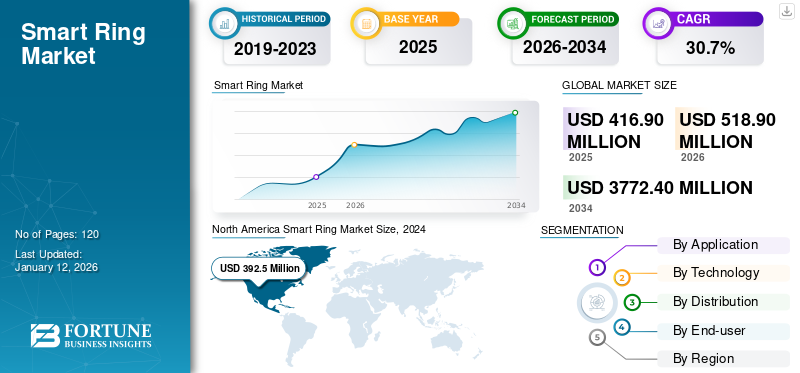
The global smart ring market size was valued at USD 416.9 million in 2025 and is projected to grow from USD 518.9 million in 2026 to USD 3772.4 million by 2034, exhibiting a CAGR of 29.30% during the forecast period. North America dominated the global smart ring market with a share of 45.10% in 2025.
Smart rings are small, lightweight gadgets featuring smart sensors that allow users to monitor several health indicators, including heart rate, sleep quality, activity intensity, and blood oxygen levels. A major factor driving the increasing popularity of smart technology is its capacity to offer instant health information conveniently. Compared to larger wearable gadgets, these rings are made for constant wear, allowing for ongoing data collection and monitoring without interruption. This makes them attractive, especially for those seeking a smooth method to oversee their health and wellness.
Additionally, this technology is increasingly being linked to mobile applications, allowing users to retrieve and review health information from anywhere. This link enhances health management by enabling users to exchange their information with healthcare providers, fostering enhanced patient care and customized treatment plans.
Market players such as Oura Ring, Ultrahuman, Samsung, and Noise are focusing on investment opportunities and the acquisition of other players in order to expand their market dominance. For instance, Oura Ring has acquired three companies in the last two years, namely Sparta Science, Veri, and Proxy.
Download Free sample to learn more about this report.
Smart Ring Market KEY TAKEAWAYS
 Market Size & Forecast
- 2025 Market Size: USD 416.9 million
- 2026 Market Size: USD 518.9 million
- 2034 Forecast Market Size: USD 3,772.4 million
- CAGR: 29.30% from 2026–2034
 Market Share
- North America dominated the smart ring market with a 45.10% share in 2025.
- The Individuals/Professionals segment is expected to account for 45.89% of the global market in 2026.
- The Bluetooth Low Energy (BLE) segment is projected to capture 55.81% of the market share in 2026.
 Key Regional Highlights
North America
North America held a 45.10% market share in 2025, generating USD 188.1 million, and is projected to reach USD 237.6 million in 2026.
North America
Europe market was valued at USD 60.4 million in 2025 and is projected to grow to USD 74.7 million in 2026.
Asia Pacific
Asia Pacific accounted for 30.10% of the global market in 2025, reaching USD 125.6 million, and is expected to rise to USD 155.2 million in 2026.
U.S.
U.S. The smart ring market is projected to reach USD 136.8 million by 2026.
Japan
Japan The smart ring market is estimated at USD 14.9 million in 2026, accounting for approximately 1.3% of global revenue.
Read More

IMPACT OF AI
Implementation of AI Capabilities to Fuel Market Growth
The integration of Artificial Intelligence (AI) into the smart ring is revolutionizing wearable tech by enhancing capabilities and user satisfaction. AI-driven algorithms enable intelligent health monitoring, providing immediate evaluations of heart rate, sleep patterns, and activity metrics and offering personalized insights and recommendations. Additionally, AI enhances data accuracy and predictive capabilities, making rings more reliable for health and fitness applications.
- In December 2024, Oura raised USD 200 million at a valuation of USD 5 billion to invest in the development of AI-powered wearables.
MARKET DYNAMICS
Smart Ring Market Trends
Integration of NFC Technology into Smart Rings Fuels Major Market Trends
The integration of NFC (Near Field Communication) technology into smart rings is transforming how consumers engage with their environment, providing effortless and contactless payments, access management, and transportation options.
NFC-equipped rings such as Mclear, Ringpay, and Token Ring enable users to execute payments, open doors, and utilize public transport with a simple tap, eliminating the necessity for cards, keys, or mobile phones. For instance,
- In July 2024, Vezopay launched Africa’s first smart ring for seamless contactless payments. It enables fast contactless payments in just 1 second, connecting hands to any terminal.
This gadget merges convenience, security, and style, making it more than a simple wearable—they represent the future of seamless living.
Download Free sample to learn more about this report.
MARKET DYNAMICS
Market Drivers
Growing Emphasis on Health, Fitness, and Preventive Care to Enhance Market Development
The growing worldwide emphasis on health, wellness, and preventive care is a major factor propelling the market growth. Lately, consumers have become more proactive in managing their health, driven by an awareness of lifestyle-related diseases, the importance of mental well-being, and the need for continuous health tracking. The World Health Organization (WHO) mentions that Non-Communicable Diseases (NCDs), such as cardiovascular diseases, diabetes, and respiratory disorders, account for 71% of global deaths, highlighting the necessity for health initiatives.
Compact and modern design rings are increasingly favored by individuals who prioritize their health. These gadgets provide enhanced tracking features, such as heart rate monitoring, sleep quality assessment, activity monitoring, blood oxygen saturation (SpO2) tracking, and even stress level evaluation. For instance,
- A survey by industry experts found that 75% of consumers consider health and fitness tracking as a key feature when purchasing wearable devices. This underscores the importance of health metrics in driving wearable technology adoption.
- According to the World Health Organization (WHO), stress-related health issues are on the rise, with 1 in 4 people globally experiencing mental health problems. Smart rings that offer stress monitoring features are increasingly sought after as tools for managing mental well-being.
Market Restraints
Competition from Smartwatches and Fitness Bands Can Hamper Market Growth
A major challenge for the market is the tough competition from established wearable technology, especially smartwatches and fitness trackers. These devices dominate the global wearable technology market, offering various features at affordable prices, making it difficult for this technology to capture a significant share. For instance,
- As per industry experts, smartwatches represented 29.1% of the worldwide wearable device market share in 2024, establishing them as the largest segment in the sector.
Smartwatches, such as the Apple Watch and Samsung Galaxy Watch, are very popular due to their flexibility. They monitor health indicators such as heart rate, sleep, and activity while also featuring extras such as GPS, mobile alerts, app connections, and even contactless payment options.
Market Opportunities
Advancing Women’s Health Insights through Continuous Bio-Signal Monitoring Unlocks Significant Market Potential
The women’s health category remains significantly less saturated compared to broader wearable segments. While traditional wrist-based devices provide general wellness indicators, they often lack the precision required for temperature-based insights or are not consistently worn during sleep.
There is also rising consumer interest in personalized health guidance driven by lifestyle shifts, increased awareness of hormonal health, and broader acceptance of digital health solutions. Smart rings can leverage this trend by enabling users to track cycle-related symptoms, understand fertility windows, and gain insights into how sleep, stress, or activity patterns correlate with the hormonal phase.
The instances given below highlight how the growing demand for women’s health insights is opening new opportunities for smart rings:
- In August 2025, Oura expanded its smart ring features for women’s health by updating Pregnancy Insights and launching a Perimenopause Check-In, offering personalized tracking, educational insights, and expert support through the app.
- In June 2025, Healthtech startup Janitri launched Momi, a smart ring for maternal and postpartum care that tracks vitals and provides personalized recovery, nutrition, and wellness guidance.
Segmentation Analysis
By End-User
Extensive Use of Technology in Athletic Purposes to Drive Individuals/Professionals Segmental Growth
Based on end-user, the market is divided into corporate, individuals/professionals, healthcare, and others (government & defense, insurance, etc.)
The Individuals/professionals segment is expected to lead the market, contributing 45.89% globally in 2026 due to the extensive use of technology for personal, athletic, and professional purposes. Technology is favored by individuals for tracking health and fitness, providing functions such as heart rate monitoring, sleep analysis, and activity tracking.
Athletes, especially, represent an important subset within this group, as the technology offers advanced metrics such as recovery rate, stress levels, and workout efficiency, aiding them in enhancing performance and avoiding injuries. For instance,
- In June 2024, Gareth Southgate and his 26-member England team were given an Oura Ring to wear throughout the Euros. It will serve as a resource for tracking health, recovery, and sleep patterns.
Healthcare is expected to witness the highest Compound Annual Growth Rate (CAGR) of 39.3% during the forecast period.
To know how our report can help streamline your business, Speak to Analyst
By Application
Health & Wellness Segment Rises Owing to Everyday Consumer Needs
Based on application, the market is segmented into health & wellness tracking, fitness & activity tracking, medical/clinical monitoring, lifestyle & productivity, and others.
Health & Wellness tracking holds the majority share by application in 2024. In 2025, the segment is anticipated to dominate with a 35.9% as it directly addresses everyday consumer needs. Users increasingly seek convenient, always-on devices to monitor vital signs such as heart rate, sleep quality, activity levels, and stress without the bulk of traditional wearables. Smart rings offer comfort, discretion, and continuous data collection, making them ideal for long-term health monitoring.
Medical/Clinical Monitoring is expected to witness the highest Compound Annual Growth Rate (CAGR) of 40.7% during the forecast period.
By Technology
Widespread Usage of Wireless Communication Fuels Bluetooth Low Energy (BLE) Segmental Growth
Based on technology, the market is bifurcated into Bluetooth Low Energy (BLE) and NFC.
Bluetooth Low Energy (BLE) holds the highest share of the market due to its widespread application in wireless communication and its ability to facilitate seamless connections between rings and different devices such as smartphones, tablets, and laptops. Bluetooth technology enables instant data synchronization, making it ideal for monitoring health and fitness, getting notifications, and using various smart functionalities. The Bluetooth Low Energy (BLE) segment is expected to capture 55.81% of the market share in 2026.
The above bar graph represents the shipments of Bluetooth devices, which are increasing year by year.
NFC technology is expected to witness the highest CAGR of 36.3% during the forecast period.
By Distribution Channel
Rising Digital-First Nature of Wearable Technology Sales Leads Direct-to-Consumer Segment’s Growth
Based on distribution channel, the market is bifurcated into direct-to-consumer, e-commerce marketplaces, and retail/electronics stores.
Direct-to-Consumer holds the majority share by distribution in 2024. In 2025, the segment is anticipated to dominate with a 68.0% due to the digital-first nature of wearable technology sales. Brands commonly sell through their own websites and online platforms, allowing better customer engagement, pricing control, and access to product education. Consumers also prefer online purchases for convenience, customization options, and easy comparison of features.
E-commerce marketplaces are expected to witness the highest CAGR of 36.7% during the forecast period.
SMART RING MARKET REGIONAL OUTLOOK
By region, the market is categorized into Europe, North America, Asia Pacific, Latin America, and the Middle East & Africa.
North America
North America Smart Ring Market Size, 2025 (USD Million) To get more information on the regional analysis of this market, Download Free sample
North America contributed approximately USD 188.1 million to the global market in 2025, accounting for 45.10% share, and is expected to reach USD 237.6 million in 2026. North America holds the highest share of the market due to its advanced technological infrastructure, higher consumer awareness of wearable technology, and a strong focus on health and fitness. The region hosts numerous top tech firms and startups that are advancing innovation in this technology. Furthermore, the rising use of connected health technologies, along with an increasing focus on preventive healthcare, has driven the demand for technology. For instance,
- As per the 2022 IT World Canada study, 33% of Canadians utilize at least one wearable tech device, while 61% intend to boost their usage of wearable technologies and related apps in the upcoming year.
U.S. Smart Ring Market
Based on North America’s strong contribution and the U.S. dominance within the region, the U.S. market can be analytically approximated at around USD 500.1 million in 2025, accounting for roughly 44.28% of smart ring sales. The U.S. market is projected to reach USD 136.8 Million by 2026.
Europe
In 2025, the Europe market stood at USD 60.4 million, representing 14.50% of global demand, and is projected to grow to USD 74.7 million in 2026. The growth is driven by a combination of technological advancements, increasing health awareness, and an emphasis on fitness and wellness. Consumers throughout Europe, notably in Germany, the U.K., and France, are increasingly utilizing wearable devices to monitor their health metrics, such as heart rate, sleep tracking, and exercise intensity. Furthermore, the region’s strong healthcare system and growing focus on preventive care are additionally boosting the demand for smart technology. For instance,
- In 2022, the University of Manchester initiated a pilot program to evaluate wearable devices such as smart rings and watches on individuals who have undergone cancer therapy. The purpose of the trial was to acquire a new understanding of how individuals manage cancer treatment and what measures can be taken to enhance their recovery.
U.K Smart Ring Market
The U.K. smart ring market in 2026 is estimated at around USD 24.6 million, representing roughly 6.7% of global smart ring revenues.
Germany Smart Ring Market
Germany’s smart ring market is projected to reach approximately USD 19.2 million in 2026, equivalent to around 5.3% of global smart ring sales.
Asia Pacific
The Asia Pacific region captured 30.10% of the global market in 2025, generating USD 125.6 million in revenue, and is projected to reach USD 155.2 million in 2026. A distinct mix of demographic, economic, and technological influences fuels this growth. A major factor contributing to this growth is the region’s vast and swiftly increasing population, especially in nations such as India and China, where urbanization and higher disposable incomes are developing a large consumer market for wearable technology. For instance,
- As reported by the Statesman, Smart Ring is expanding in India by shipping over 72,000 rings in the second quarter of 2024. Ultrahuman possesses 48.4% of the shares, with Pi Ring in second at 27.5% and Aabo in third place at 10.5%.
As an increasing number of individuals in the region obtain smartphones and internet access, the acceptance of connected gadgets is speeding up.
The market size for China is likely to be valued at USD 24.8 million in 2025, and India’s market is expected to hit USD 11.5 million in 2025.
Japan Smart Ring Market
The Japan smart ring market in 2026 is estimated at around USD 14.9 million, accounting for roughly 1.3% of global smart ring revenues.
China Smart Ring Market
China’s smart ring market is projected to be one of the largest worldwide, with 2026 revenues estimated at around USD 56.6 million, representing roughly 2.19% of global smart ring sales.
India Smart Ring Market
The India smart ring market in 2026 is estimated at around USD 42 million, accounting for roughly 1.0% of global smart ring revenues.
South America and the Middle East & Africa
In 2025, Middle East & Africa generated USD 27.7 million, contributing 6.60% to global market revenue, and is projected to grow to USD 33.4 million in 2026. The growing use of wearable technology drives it. The UAE and Turkey are at the forefront of this trend, fueled by increasing disposable incomes and expanding interest in fitness and wellness. The region’s push toward digital healthcare is creating opportunities for smart technology, particularly for remote health monitoring. The GCC market is expected to hit USD 15.9 million in 2025. For instance,
- In January 2024, Metabolic, a Dubai-based startup, partnered with Oura Ring to help combat the Middle East region’s metabolic diseases crisis. The aim is to stop the loss of billions in healthcare systems treating illnesses such as diabetes, liver disease, and high cholesterol.
The market share is projected to grow with a considerable CAGR across South American countries. Brazil and Argentina are experiencing an increase in demand for wearable technology, which is propelled by citizens seeking convenient methods to track their health and well-being.
GCC Smart Ring Market
The GCC smart ring market is projected to reach around USD 15.9 million in 2025, representing roughly 1.4% of global smart ring revenues.
Latin America
Latin America recorded a market size of USD 15.2 million in 2025, capturing 3.70% of the global market share, and is projected to reach USD 18.1 million in 2026.
COMPETITIVE LANDSCAPE
Key Industry Players
Key Players Implement Strategic Initiatives to Adapt to Tech Changes
The market players are improving their product portfolios due to the increasing demand for more accurate health-tracking products. They are implementing various business strategies, such as partnerships, mergers, and acquisitions, to expand their businesses across the world.
Major Players in the Smart Ring Market
RingConn, Movano Health, Oura Health Oy, Mclear Limited, Circular, Ultrahuman Healthcare Pvt Ltd, Zepp Health Corporation, and Samsung, among others, are the largest players in the market.
LIST OF KEY SMART RING COMPANIES PROFILED:
- RingConn (U.S.)
- Movano Health (U.S.)
- Oura Health Oy (Finland)
- Mclear Limited (U.K.)
- Circular (France)
- Ultrahuman Healthcare Pvt Ltd (India)
- Zepp Health Corporation (China)
- Samsung (South Korea)
- Noise (India)
- Imaging Marketing Limited (India)
- Pi Ring (India)
- Gabit (India)
- Jackcom (China)
- Gabit (India)
- Nuanic (Finland)
- Aabo (India)
- Adivaa Smart (India)
- Origami Group Limited (China)
- Fittr (India)
- Sevenring Innovations Pvt Ltd. (India)
KEY INDUSTRY DEVELOPMENTS
- March 2025: Movano Health has upgraded its Evie smart ring with new data visualization features, Apple Health integration, menstrual cycle tracking, and 7- to 30-day trend graphs for mood, sleep, and vital signs, enhancing its focus on women’s health and wellness.
- January 2025: Ultrahuman extends its partnership with UAE Team Emirates, a UCI WorldTour cycling team, to further enhance the team’s training, recovery, and performance by utilizing Ultrahuman’s technology.
- January 2025: QALO introduced its innovative silicon health-monitoring ring featuring nanotechnology. The ring includes capabilities such as tracking heart rate, oxygen level, heart rate variability, sleep phases, and stress indicators. These measurements can be accessed through a free app at no subscription fee.
- October 2024: Oura secured a USD 96 million contract from the U.S. Department of Defense. The contract involves providing rings and data services to the Pentagon’s Defense Health Agency Workforce.
- October 2024: Samsung introduced the Galaxy Ring in India, featuring AI-driven health and fitness tracking capabilities. It has been introduced in three color choices: Titanium Black, Titanium Silver, and Titanium Gold.
REPORT COVERAGE
The report provides a detailed analysis of the market and focuses on key aspects such as leading companies, product types, and leading applications of the product. Besides, it offers insights into the market trends and highlights key industry developments. In addition to the factors above, it encompasses several factors that contributed to the growth of the market in recent years.
Request for Customization to gain extensive market insights.
Report Scope & Segmentation
|
ATTRIBUTE |
DETAILS |
|
Study Period |
2021-2034 |
|
Base Year |
2025 |
|
Estimated Year |
2026 |
|
Forecast Period |
2026-2034 |
|
Historical Period |
2021-2024 |
|
Growth Rate |
CAGR of 29.30% from 2026-2034 |
|
Unit |
Value (USD Billion) |
|
Segmentation |
By Application, Technology, Distribution Channel, End-user, and Region |
|
|
By Application
|
|
|
By Technology
|
|
|
By Distribution Channel
|
|
|
By End-user
|
|
By Region |
· North America (By Application, By Technology, By Distribution Channel, By End-user, and By Country) o U.S. o Canada o Mexico · Europe (By Application, By Technology, By Distribution Channel, By End-user, and By Country) o U.K. o Germany o France o Italy o Spain o Russia o Benelux o Nordics o Rest of Europe · Asia Pacific (By Application, By Technology, By Distribution Channel, By End-user, and By Country) o China o India o Japan o South Korea o ASEAN o Oceania o Rest of Asia Pacific · Middle East and Africa (By Application, By Technology, By Distribution Channel, By End-user, and By Country) o Turkey o Israel o GCC o North Africa o South Africa o Rest of Middle East & Africa · South America (By Application, By Technology, By Distribution Channel, By End-user, and By Country) o Brazil o Argentina o Rest of South America |
Frequently Asked Questions
The market is projected to record a valuation of USD 3772.4 million by 2034.
In 2025, the market was valued at USD 416.9 million.
The market is projected to grow at a CAGR of 29.30% during the forecast period of 2026-2034.
The individuals/professionals segment is expected to hold the highest share of the market.
Growing emphasis on health and fitness to enhance market progress.
Oura Health Oy, Ultrahuman Samsung, Mclear Limited, Circular, and Zepp Health Corporation are the top players in the market.
North America is expected to hold the highest market share.
By end-user, Healthcare is expected to grow with the highest CAGR during the forecast period.



- 2021-2034
- 2025
- 2021-2024
- 120
-
(Offer valid till 30th Sep 2026)
Get 30-60 hrs Free Customization
Expand Regional and Country Coverage, Segments Analysis, Company Profiles, Competitive Benchmarking, and End-user Insights.




















Related Reports
-
US +1 833 909 2966 ( Toll Free )
-
Get In Touch With Us