Smart Yoga Mat Market Size, Share & Industry Analysis, By Connectivity (Bluetooth-Enabled, WiFi-Enabled, and Hybrid Connectivity), By Material Type (Natural Rubber, Thermoplastic Elastomer (TPE), Polyvinyl Chloride (PVC), and Others), By End User (Individual Consumers, Yoga Studios & Fitness Centers, and Healthcare & Rehabilitation Centers) By Distribution Channel (Online and Offline), and Regional Forecast, 2026-2034
 Download Free Sample
(Offer valid till 15th Oct 2026)

Smart Yoga Mat Market Size and Future Outlook
 Listen to Audio Version
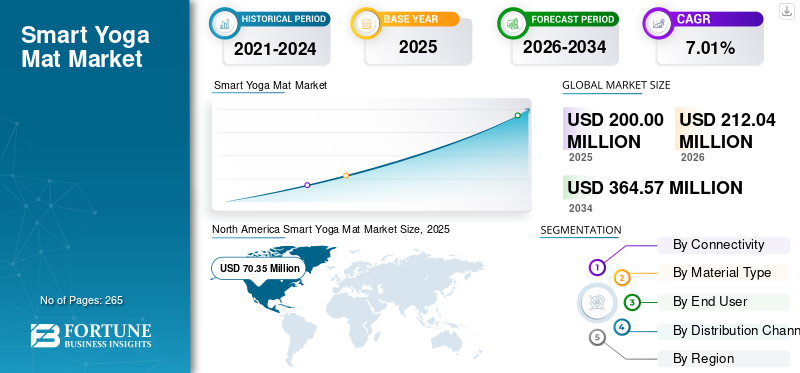
The smart yoga mat market size was valued at USD 200.00 million in 2025. The market is projected to grow from USD 212.04 million in 2026 to USD 364.57 million by 2034, exhibiting a CAGR of 7.01% during the forecast period. North America dominated the smart yoga mat market with a market share of 35.18% in 2025.
The market is experiencing consistent growth, fueled by health-conscious consumers, growing adoption of connected fitness technologies, proliferation of at-home wellness practices, and increasing number of yoga studios & fitness centers. Smart mats integrate AI and sensors to guide individuals on posture and provide instant feedback through mobile apps, fostering user engagement and efficiency. Furthermore, demand for personalized workouts and pre-immunization trends prompts adoption amongst consumers, as digital fitness equipment ecosystems and urban wellness trends evolve rapidly.
Key players in the market include SmartMat Inc., YogiFi, Liforme Ltd., Manduka LLC, and Gaiam Inc. These market players remain active by heavily investing in research and development to integrate IoT, AI, and sensor-based posture-tracking technology. As these technologies enable a personalized coaching experience and real-time feedback, consumers are attracted to invest highly on these products. Moreover, app-based ecosystem development, strategic partnerships, and product differentiation further create a brand image that sets them apart.
Download Free sample to learn more about this report.
Smart Yoga Mat Market Key Takeaways
 Global Market Size & Forecast
- 2025 Market Size: USD 200.00 million
- 2026 Market Size: USD 212.04 million
- 2034 Forecast Market Size: USD 364.57 million
- CAGR: 7.01% from 2026–2034
 Market Share
- North America dominated the smart yoga mat market with a 35.18% share in 2025.
- The hybrid connectivity segment is anticipated to grow at a CAGR of 7.84% during the forecast period.
- The PU, cork, cotton/jute, and hybrid materials segment is expected to grow at a CAGR of 7.91% over the forecast period.
 Key Regional Highlights
North America
North America led the market with a valuation of USD 70.35 million in 2025 and is projected to grow at a CAGR of 6.64%.
Asia Pacific
Asia Pacific reached USD 55.80 million in 2025 and is expected to register the fastest regional growth at a CAGR of 7.93%.
Europe
Europe accounted for USD 41.89 million in 2025, representing 20.95% of the global market.
U.S.
The smart yoga mat market was valued at USD 58.60 million in 2025.
Japan
The smart yoga mat market was valued at USD 8.39 million in 2025.
Read More

SMART YOGA MAT MARKET TRENDS
Rising Integration of AI-Powered Personalization is Emerging Market Trend
Younger generations are seeking personalized experiences, allowing integration of AI-driven customization in yoga mat products. With a growing need for efficient home exercise routines, the development of smart products that analyze one’s position during exercise and ensure proper performance is crucial. It has become a significant factor driving market and boosting engagement as well as retention rates. Therefore, the demand for such features among manufacturers is increasing, leading to market expansion.
MARKET DYNAMICS
MARKET DRIVERS
Download Free sample to learn more about this report.
Surging Adoption of Home-Based Fitness Solutions to Accelerate Market Expansion
The growing trend of home-based fitness has been a critical driver of the market. The fast-paced lifestyle and dominance of telecommuting has driven the growing demand for at-home workouts, which require intelligent yoga mats that provide real-time feedback and guided workouts. Thus, key market participants have started expanding their portfolios by offering mobile applications.
MARKET RESTRAINTS
High Product Cost and Limited Affordability Restricts Mass Product Adoption
Premium pricing of smart yoga mats is one of the key limitation for market development. Smart yoga mats are highly sophisticated products featuring sensors, artificial intelligence, and app connectivity. This has increased the product's manufacturing costs, hindering availability for budget-conscious customers. Customers have shown a preference for traditional yoga mats with basic functionality, that are available at a lower price point. It has affected market expansion, particularly in developing nations.
MARKET OPPORTUNITIES
Expansion into Emerging Markets through Affordable Smart Solutions Creates New Growth Opportunities
Increased smartphone adoption and affordability of internet connectivity services in emerging economies have created significant market growth opportunities. Growing consumer awareness about fitness devices has enabled emerging economies to adopt connected fitness devices. Consequently, manufacturers have a strong incentive to develop cost-effective smart yoga mats equipped with all necessary capabilities to support such economies. This leads to access into an underdeveloped market.
MARKET CHALLENGES
Data Privacy and Connectivity Issues Limits Consumer Trust and Product Adoption
Challenges with app connectivity and data tracking for smart yoga mats hampers market growth. This is due to such device collect data on the user's performance. On the other hand, limited internet connectivity in different locations hinders the application of this product. In this regard, users feel insecure while using technology-based products. The manufacturer needs to focus on increasing the security of their product.
Segmentation Analysis
By Connectivity
Ease of Use and Low Power Consumption to Drive Growth of Bluetooth Connectivity
The market is segmented, by connectivity, into bluetooth-enabled, Wi-Fi-enabled, and hybrid connectivity.
The bluetooth-enabled connectivity segment holds the highest market share in terms of revenue due to its high level of compatibility with various devices and ease of connection. Such advanced yoga mats can be easily connected to smartphones, regardless of internet availability, to provide instant feedback with minimal hassle. In such cases, advanced yoga mats that feature Bluetooth technology are more convenient and energy-efficient than those with Wi-Fi technology. Therefore, consumers have been showing higher interest in using advanced yoga mats with bluetooth technology, especially at home.
The hybrid connectivity segment is anticipated to rise at the second-fastest CAGR of 7.84% over the forecast period.
To know how our report can help streamline your business, Speak to Analyst
By Material Type
Durability and Premium Appeal to Drive Growth of Polyvinyl chloride Material
Based on the material type, the market is divided into natural rubber, Thermoplastic Elastomer (TPE), Polyvinyl Chloride (PVC), and others.
Polyvinyl chloride leads the market as it is the most cost-effective material. Moreover, the material’s characteristics, including durability, flexibility, and grip, at a significantly reduced price, make it the preferred choice compared to other high-end materials such as TPE or natural rubber. The affordability of PVC yoga mats has enabled them to reach a larger audience.
The other segment, comprising materials such as PU, cork, cotton/jute, and hybrid materials, is anticipated to grow at the second-fastest CAGR of 7.91% over the forecast period.
By End User
Rising Home Fitness Trend to Amplify Growth of Individual Consumer Segment
Based on end user, the market is segmented into individual consumers, yoga studios & fitness centers, and healthcare & rehabilitation centers.
The individual consumer segment dominated market growth. The segment’s growth is attributed to the rising percentage of the population working from home who embrace home-based fitness routines. With busy lifestyles and hectic work schedules, individuals are increasingly conscious of their health, which encourages them to practice fitness in the comfort of their own space, thereby driving market growth. This widespread adoption has led to higher sales volumes as compared to institutional shoppers. Thus, manufacturers highly emphasize direct-to-consumer offerings, reinforcing the segment’s prominent position.
In addition, the healthcare & rehabilitation centers segment is projected to grow at the second-fastest CAGR of 7.99% during the forecast period.
By Distribution Channel
E-commerce Expansion and Wider Accessibility to Drive Growth of Online Channel
Based on distribution channels, the market is segmented into offline and online.
The offline segment dominates the market in 2025. This high market share was driven by the tactile experience offered by the offline channel. Consumers can assess the product's texture, quality, and grip by touching and feeling it. The offline channel includes department stores, hypermarkets/supermarkets, specialty fitness stores, and multi-brand outlets, enabling immediate product availability and hands-on experience, thus boosting consumer confidence. Consequently, individuals are more inclined to make higher-value purchases through offline channels, contributing to a larger share of the segment.
In addition, the online segment is projected to grow at the second-fastest CAGR of 8.10% during the forecast period.
Smart Yoga Mat Market Regional Outlook
By geography, the market is categorized into Europe, North America, Asia Pacific, South America, and the Middle East & Africa.
North America
North America Smart Yoga Mat Market Size, 2025 (USD Million)
To get more information on the regional analysis of this market, Download Free sample
North America has emerged as a dominating region in the market. It is projected to grow at a CAGR of 6.64% in the coming years, and reached a valuation of USD 70.35 million by 2025. The regional market is driven by early adoption of connected fitness devices and a strong culture of home-based wellness. Higher consumer disposable income, coupled with growing health consciousness, enables consumers to invest in advanced fitness-tracking tools. Moreover, the widespread use of wearable devices and the integration of fitness app features with smart yoga mats enhance the user experience.
U.S. Smart Yoga Mat Market
Given North America’s strong contribution, the U.S. market reached USD 58.60 million in 2025, accounting for roughly 29.30% of global market sales. Advanced digital infrastructure, high consumer spending power, and the trend toward connected home fitness solutions are driving U.S. market growth.
Europe
Europe held the third-largest share in 2025, valued at USD 41.89 million and accounting for 20.95% of the global market. Europe’s market growth is bolstered by strong demand for green, eco-friendly fitness products. This has led to a growing trend of using TPE and natural rubber in fitness. In addition, a growing trend in fitness and wellness, especially yoga, is driving the market's growth. The digital fitness market in Europe is also growing, which in turn helps drive market growth.
U.K. Smart Yoga Mat Market
The U.K. market in 2025 reached USD 7.13 million, representing roughly 3.57% of global market revenues.
Germany Smart Yoga Mat Market
Germany’s market reached USD 9.10 million in 2025, equivalent to around 4.55% of global market sales.
Asia Pacific
The Asia Pacific market is growing at a CAGR of 7.93% and reached USD 55.80 million in 2025. A growing population, especially younger generations with access to health and wellness information and knowledge, rising consumer spending power in emerging countries, and increasing smartphone penetration, enabling the adoption of app-connected fitness solutions, drive the country’s market growth. Moreover, the expansion of digital fitness platforms and the trend toward wearable devices are supplementing market growth.
Japan Smart Yoga Mat Market
The Japanese market in 2025 was valued at USD 8.39 million, accounting for roughly 4.19% of global market revenues. The Japanese yoga mat market is driven by an aging population seeking convenient, low-impact home fitness solutions and a strong focus on preventive healthcare.
China Smart Yoga Mat Market
China’s market in 2025 was valued at USD 17.74 million in revenues, representing roughly 8.876% of global market sales.
India Smart Yoga Mat Market
The Indian market in 2025 was valued at USD 12.54 million, accounting for roughly 6.27% of global market revenues.
South America and the Middle East & Africa
The South America, Latin America, and the Middle East & Africa regions are expected to witness moderate growth in this market during the forecast period. The South America market reached USD 18.25 million in 2025. The market in South America is influenced by rising health awareness, the growing adoption of affordable connected fitness technologies, and the expansion of internet infrastructure. In the Middle East and Africa, the UAE reached USD 3.19 million in 2025.
South Africa Smart Yoga Mat Market
The South African market reached USD 2.69 million in 2025, representing roughly 1.34% of global market revenues.
COMPETITIVE LANDSCAPE
Key Industry Players
Competitive Pricing and Product Innovation Increases Competition Amongst Players
The smart yoga mat market is moderately fragmented, with companies competing on innovation, digitalization, and brand positioning. Firms are focusing more on R&D to introduce AI-based posture correction and feedback to their products to improve customer experience. Partnerships with fitness apps and wellness platforms are also creating opportunities for companies to increase their customer base through digitalization. Furthermore, companies are focusing more on differentiating their products through eco-friendly materials and premium features. Moreover, companies are expanding their businesses through e-commerce platforms, which is another key factor in increasing their competitive position in the market and exploring more opportunities in emerging markets through frequent product launches and geographical expansions.
LIST OF KEY SMART YOGA MAT COMPANIES PROFILED
- YogiFi (U.S.)
- Liforme Ltd. (U.K.)
- Manduka LLC (U.S.)
- SmartMat Inc. (Belgium)
- PureLabs (FitMat) (Italy)
- Gaiam, Inc. (U.S)
- Tangram Factory (South Korea)
- Technogym S.p.A. (Italy)
- Backslash Fit (U.S.)
- Yoga Design Lab (Indonesia)
KEY INDUSTRY DEVELOPMENTS
- March 2026: YogiFi, a flagship product/brand developed and owned by Wellnesys Technologies, secured government backing from India’s Technology Development Board to scale up mass production of its AI-powered smart yoga mat, supporting commercialization and positioning India as a hub for smart wellness technologies.
- April 2025: Amazon announced the acquisition of Body Labs, a digital body modeling firm, to enhance smart fitness offerings, including yoga mats with improved body tracking and personalized analytics.
- June 2024: YogiFi presented its AI-powered advanced yoga mat to India’s Union Council of Ministers on International Yoga Day, highlighting AI-based feedback and real-time posture tracing, reinforcing product visibility and institutional adoption.
- May 2024: Huawei Product Launch, introduced the Huawei Fit Mat, featuring advanced sensors and AI algorithms for posture analysis and personalized coaching, marking the company’s entry into the smart yoga mat segment.
- June 2023: YogiFi formed a strategic partnership with Samsung Electronics, integrating advanced yoga mats with Samsung’s smart TVs to enhance connected home fitness ecosystems and enable immediate posture tracking on larger screens.
REPORT COVERAGE
The global smart yoga mat market analysis includes a comprehensive study of the market & forecast by all the market segmentations included in the report. This qualitative and quantitative report includes details on the market dynamics and market trends expected to drive the market over the forecast period. It provides information on key aspects, including technologically advanced products, the regulatory environment, and new launches. Additionally, it details partnerships, mergers & acquisitions, and key industry developments, along with their regional prevalence. The global market research report also provides a detailed competitive landscape, including market share and profiles of key players.
Request for Customization to gain extensive market insights.
Report Scope & Segmentation
| ATTRIBUTE | DETAILS |
| Study Period | 2021-2034 |
| Base Year | 2025 |
| Estimated Year | 2026 |
| Forecast Period | 2026-2034 |
| Historical Period | 2021-2024 |
| Growth Rate | CAGR of 7.01% from 2026 to 2034 |
| Unit | Value (USD Million) |
| Segmentation | By Connectivity, Material Type, End User, Distribution Channel, and Region |
| By Connectivity |
|
| By Material Type |
|
| By End User |
|
| By Distribution Channel |
|
| By Region |
|
Frequently Asked Questions
According to Fortune Business Insights, the global market value stood at USD 200.00 million in 2025 and is projected to reach USD 364.57 million by 2034.
In 2025, the North America market value stood at USD 70.35 million.
The market is expected to grow at a CAGR of 7.01% over the forecast period.
In terms of connectivity, the bluetooth-enabled segment leads the market.
Heightened health consciousness, growing adoption of connected fitness technologies, and the proliferation of at-home wellness practices are driving market growth.
SmartMat Inc., YogiFi, Liforme Ltd., Manduka LLC, and Gaiam Inc. are the major players in the global market.
North America dominated the market in 2025.



- 2021-2034
- 2025
- 2021-2024
- 265
-
(Offer valid till 15th Oct 2026)
Get 30-60 hrs Free Customization
Expand Regional and Country Coverage, Segments Analysis, Company Profiles, Competitive Benchmarking, and End-user Insights.



















Related Reports
-
US +1 833 909 2966 ( Toll Free )
-
Get In Touch With Us