Space-Based Missile Warning and Tracking Systems Market Size, Share & Industry Analysis, By Component (Space Segment, Ground Segment, and Software & Data Processing), By Orbital Regime (LEO, MEO, and GEO), By System Architecture (Dedicated Large Satellites and Proliferated Small-Satellite Constellations), By Threat Type (Ballistic Missiles and Hypersonic Glide/Cruise Missiles), By Offering (New System Development, Modernization & Upgrades, and Sustainment), By End User (Defense & Space Forces, Missile Defense Agencies, and Intelligence Organizations), and Regional Forecast, 2026-2034
 Download Free Sample
Space-Based Missile Warning and Tracking Systems Market Size and Future Outlook
 Listen to Audio Version
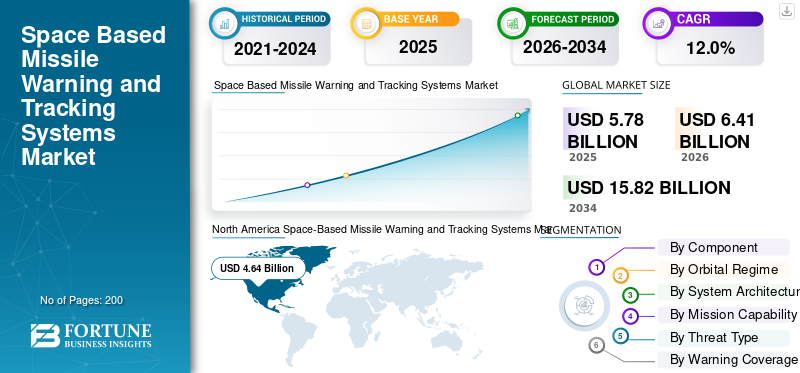
The global space-based missile warning and tracking systems market size was valued at USD 5.78 billion in 2025. The market is projected to grow from USD 6.41 billion in 2026 to USD 15.82 billion by 2034, exhibiting a CAGR of 12.0% during the forecast period. North America dominated the space based missile warning and tracking systems market with a market share of 80.28% in 2025.
Space-based missile warning and tracking systems are orbital satellite networks that use infrared sensors to detect, track, and provide early alerts of rocket and missile launches from Earth. The market provides missile warning satellites, Infrared Sensors (IR), ground infrastructure, data-processing software, and secure Space-Based C4ISR links to detect launches and support Ballistic Missile Defense (BMD) operations. Growth is fueled by growing Hypersonic Missile Tracking requirements, Next-Generation OPIR modernization, and proliferated LEO Constellations growing under programs such as the Space Development Agency (SDA) Tracking Layer and HBTSS.
Key Defense Aerospace Contractors, including Lockheed Martin Corporation, Northrop Grumman Corporation, L3Harris Technologies Inc., and Sierra Space, are advancing the market through improved infrared payloads, onboard processing, resilient satellite platforms, and interoperable ground systems.
Download Free sample to learn more about this report.
SPACE-BASED MISSILE WARNING AND TRACKING SYSTEMS MARKET TRENDS
Shift toward Proliferated Multi-Orbit Architectures Reshapes Market Development
Defense agencies are shifting from a limited number of large geostationary satellites toward layered architectures combining proliferated LEO Constellations, medium Earth orbit systems, and Next-Generation OPIR assets. This model improves coverage and resilience while expanding demand for Infrared Sensors (IR), onboard processing, secure communications, and Space-Based C4ISR integration.
In June 2025, Space Systems Command awarded BAE Systems a USD 1.2 billion contract for 10 Epoch 2 MEO satellites designed to provide resilient global Hypersonic Missile Tracking alongside lower-orbit warning systems.
MARKET DYNAMICS
MARKET DRIVERS
Download Free sample to learn more about this report.
Growing Hypersonic and Advanced Missile Threats Drive Market Growth
Hypersonic glide vehicles follow lower, maneuverable, and less predictable flight paths than conventional ballistic missiles, increasing the need for continuous tracking from launch through interception. This evolving threat is propelling investment in the Tracking Layer, HBTSS, advanced infrared payloads, and a globally connected Early Warning Network supporting Ballistic Missile Defense (BMD) operations.
In July 2026, the Space Development Agency (SDA) awarded agreements valued at approx. USD 1.75 billion for 36 additional Tranche 3 missile-warning, tracking, and missile-defense satellites to address evolving threats.
MARKET RESTRAINTS
High Development and Launch Costs Restrain Market Expansion
Space-based missile-warning programs require radiation-resistant sensors, secure satellite buses, specialized ground infrastructure, launch services, and extensive testing. These large capital-intensive requirements restrict participation to well-funded governments and established defense aerospace contractors. Moreover, launcher availability and integration schedules can delay operational deployment. All these factors are hindering the space-based missile warning and tracking systems market growth.
MARKET OPPORTUNITIES
Fire-Control-Quality Tracking Creates New Growth Opportunities
The mission requirements are expanding beyond launch detection and strategic warning toward precision tracking data capable of supporting interceptor engagement. This transition creates opportunities for suppliers of medium-field-of-view sensors, onboard processors, tactical data links, target-discrimination algorithms, and ground systems connecting Missile Warning Satellites with Ballistic Missile Defense (BMD) assets.
MARKET CHALLENGES
Multi-Orbit Interoperability and Data Fusion Remain Major Challenges
LEO, MEO, GEO, and terrestrial sensors must exchange and correlate tracking data without creating delays, duplicate tracks, or inconsistent threat assessments. The effectiveness of the broader Early Warning Network therefore depends on common ground systems, reliable sensor handovers, secure Space-Based C4ISR, and algorithms capable of fusing data across multiple orbital regimes.
Impact of Ongoing Conflicts and Increasing Geopolitical Tensions
Escalating Missile Threats and Strategic Rivalries Accelerate Market Growth
The Russia–Ukraine war, Middle East missile exchanges, North Korean weapons development, and growing Indo-Pacific tensions have reinforced the need for persistent, global missile surveillance. Governments are prioritizing Missile Warning Satellites, Hypersonic Missile Tracking, and resilient Proliferated LEO Constellations that can support rapid warning, threat identification, and Ballistic Missile Defense (BMD) operations. This security environment is accelerating investment in the Tracking Layer, Next-Generation OPIR, advanced Infrared Sensors (IR), and integrated Space-Based C4ISR networks, while encouraging allies to improve warning-data sharing and reduce dependence on vulnerable single-orbit architectures.
Segmentation Analysis
By Component
Space Segment Dominated Market Due to High Spacecraft and Sensor Acquisition Value
By component, the market is categorized into space segment, ground segment, software & data processing, and services.
The space segment held the largest global space-based missile warning and tracking systems market share in 2025, supported by the high value of satellite platforms, Infrared Sensors (IR), onboard processors, secure communication payloads, and mission-specific power and thermal systems. Ground infrastructure and software remain important, but the spacecraft and payload typically represent the largest share of program acquisition expenditure.
The software & data processing segment, which consists of detection algorithms, target classification, trajectory estimation, sensor fusion, command-and-control interfaces, artificial intelligence-based processing, cybersecurity, and tactical data-generation software, is expected to grow at the highest CAGR of 14.4% over the forecast period.
To know how our report can help streamline your business, Speak to Analyst
By Orbital Regime
Low Earth Orbit Segment Dominated Market Due to Persistent Coverage and Low-Latency Data Delivery
On the basis of orbital regime, the market is classified into low Earth orbit, medium Earth orbit, geostationary Earth orbit, and highly elliptical orbit.
The low Earth orbit segment held the largest market share in 2025, as defense agencies expanded Proliferated LEO constellations for faster revisit rates, multi-angle observation, and direct tactical data transmission. LEO deployment also distributes capability across more spacecraft, improving resilience compared with architectures dependent on a limited number of high-value satellites.
The medium Earth orbit segment is expected to show the fastest growth, registering a CAGR of 14.4% over the forecast period.
By System Architecture
Dedicated Large Satellite Systems Dominated Market Due to Established OPIR Constellations and High Program Value
By system architecture, the market is classified into dedicated large satellite systems, proliferated small-satellite constellations, hosted payloads, and technology demonstrators.
Dedicated large satellite systems held the largest global market share in 2025. Existing strategic-warning architectures remain centered on high-value Defense Support Program, SBIRS, and successor OPIR systems that provide broad-area surveillance and long-duration operations. Mission Delta 4 currently operates three OPIR satellite constellations, supporting major expenditure on spacecraft, control infrastructure, and lifecycle support.
The proliferated small-satellite constellations segment is expected to show the fastest growth, registering a CAGR of 17.5% over the forecast period.
By Mission Capability
Persistent Missile Tracking Segment Dominated Market Due to Continuous Target-Custody Requirements
On the basis of mission capability, the market is classified into launch detection & early warning, persistent missile tracking, fire-control-quality tracking, and battlespace awareness & technical intelligence.
The persistent missile tracking held the largest market share in 2025, as modern threats must be monitored beyond their initial launch signature. Maneuvering ballistic and hypersonic systems require continuous observation, sensor handovers, trajectory refinement, and data fusion before required information can be transferred to Ballistic Missile Defense (BMD) networks.
The fire-control-quality tracking segment is expected to show the fastest growth, registering a CAGR of 13.3% over the forecast period.
By Threat Type
Ballistic Missiles Segment Dominated Market Due to Large Installed Warning Architecture
On the basis of threat type, the market is classified into ballistic missiles, hypersonic glide vehicles, hypersonic cruise missiles, and other advanced missile threats.
Ballistic missiles held the largest global market share in 2025, reflecting the long-established requirement to detect intercontinental, intermediate-range, submarine-launched, and theater ballistic missiles. Existing missile warning satellites and strategic command networks were primarily developed around ballistic-missile launch signatures, creating a substantially larger installed base than emerging hypersonic-specific systems.
The hypersonic glide vehicles segment is expected to show the fastest growth, registering a CAGR of 17.8% over the forecast period.
By Warning Coverage
Strategic/Global Warning Segment Dominated Market Due to National-Level Early-Warning Requirements
By warning coverage, the market is divided into strategic/global warning and theater/regional warning.
The strategic/global warning segment held the largest global market share in 2025, as national command authorities require persistent surveillance across broad geographic areas and multiple launch corridors. These missions rely on long-duration OPIR coverage, resilient ground processing, and an integrated Early Warning Network capable of supporting national decision-making and strategic deterrence.
The theater/regional warning segment is expected to show the fastest market growth, registering a CAGR of 13.0% over the forecast period.
By Offering
New System Development & Production Segment Dominated Market Due to Rapid Constellation Expansion
By offering, the market is further divided into new system development & production, modernization & upgrades, and operations, sustainment & support.
The new system development & production segment held the largest market share in 2025, as governments replaced legacy systems and deployed new LEO, MEO, GEO, and polar-orbiting capabilities. Spending remains focused on satellite production, infrared payload development, ground-system integration, launch preparation, and initial constellation deployment.
The modernization & upgrades segment is expected to show the fastest market growth, registering a CAGR of 13.5% over the forecast period.
By End User
Intelligence and Strategic Warning Organizations Segment Dominated Market Due to Central Role of National Threat Assessment
Based on end user, the market is segmented into defense & space forces, missile defense agencies & commands, intelligence & strategic warning organizations, and multinational/allied defense organizations.
The intelligence & strategic warning organizations segment dominated the market in 2025. These organizations receive, validate, and distribute missile-event data for national command authorities, combatant commands, and defense networks. Their requirements influence sensor sensitivity, technical-intelligence processing, threat classification, and warning-system availability.
The missile defense agencies & commands segment is expected to show the fastest market growth, registering a CAGR of 12.9% over the forecast period.
Space-Based Missile Warning and Tracking Systems Market Regional Outlook
North America Dominates Market Due to Concentrated U.S. Missile-Warning Investment
By geography, the market is categorized into North America, Europe, Asia Pacific, and Rest of the World.
North America
North America Space-Based Missile Warning and Tracking Systems Market Size, 2025 (USD Billion)
To get more information on the regional analysis of this market, Download Free sample
North America holds the largest market share and is anticipated to grow at a CAGR of 10.1% over the forecast period, driven primarily by U.S. investment in Next-Generation OPIR, the SDA Tracking Layer, HBTSS, resilient MEO systems, ground processing, and Space-Based C4ISR integration. The region is also a center for the main acquisition agencies, operational commands, sensor manufacturers, satellite producers, and Defense Aerospace Contractors supporting these programs.
U.S. Space-Based Missile Warning and Tracking Systems Market
Based on the strong contribution of North America to the market and the dominance of the U.S. within the region, the U.S. market stood at around USD 4.59 billion in 2025. It is anticipated to grow at a CAGR of 10.0% over the forecast period.
Europe
The market in Europe is anticipated to grow at the highest CAGR of 23.0% during the forecast period, with demand concentrated in Russia and emerging multinational European programs. EU member states are moving from fragmented national capabilities toward shared missile-warning architectures covering ballistic, hypersonic, and anti-satellite threats. Programs such as ODIN’S EYE II are expected to strengthen regional demand for infrared payloads, satellite platforms, processing software, and interoperable ground infrastructure. However, Europe remains behind North America in operational deployment.
France Space-Based Missile Warning and Tracking Systems Market
The market in France reached approximately USD 0.03 billion in 2025, equivalent to around 11.27% of European revenues.
Asia Pacific
Asia Pacific is anticipated to grow at a CAGR of 14.8% over the forecast period, supported by increasing missile activity and defense-space investment across China, Japan, India, South Korea, and Australia. Regional governments are strengthening satellite reconnaissance, launch-detection, tracking, and early-warning networks to monitor ballistic and hypersonic threats.
China Space-Based Missile Warning and Tracking Systems Market
The Chinese market revenues stood at around USD 0.51 billion in 2025, representing roughly 68.42% of Asia Pacific sales.
India Space-Based Missile Warning and Tracking Systems Market
The Indian market in 2025 stood at around USD 0.07 billion and is anticipated to grow at a CAGR of 17.5% during the forecast period.
Rest of the World
The Rest of the World (Middle East & Africa and Latin America) holds a comparatively smaller market share but is expected to grow at a 17.6% CAGR during the forecast period. Demand is led by Israel and selected Gulf countries, where repeated missile and drone attacks have increased requirements for rapid warning, sensor fusion, and integration with U.S.-controlled space and missile-defense networks.
Latin America Space-Based Missile Warning and Tracking Systems Market
The market in Latin America reached around USD 0.03 billion in 2025 and is anticipated to grow at a CAGR of 19.5% during the forecast period.
COMPETITIVE LANDSCAPE
Key Industry Players
Leading Companies Strengthen Market Positions Through Multi-Orbit Programs
The competitive landscape of the space-based missile warning and tracking systems market is led by recognized defense and space contractors, including Lockheed Martin Corporation, Northrop Grumman Corporation, L3Harris Technologies, Inc., BAE Systems plc, and Sierra Space Corporation. These companies hold strong positions across strategic missile-warning satellites, infrared payloads, resilient MEO systems, proliferated LEO architectures, ground processing, and secure data delivery. Their technical experience, classified-program credentials, manufacturing capacity, and long-term relationships with U.S. defense agencies create substantial entry barriers for smaller suppliers.
Competition is gradually shifting from single-prime, large-satellite programs toward multi-vendor constellation procurement. The Space Development Agency’s Tracking Layer and the Space Force’s resilient MEO architecture increasingly distribute awards across several contractors to improve production speed, resilience, and supplier diversity.
LIST OF KEY SPACE-BASED MISSILE WARNING AND TRACKING SYSTEM COMPANIES PROFILED
- Lockheed Martin Corporation (U.S.)
- Northrop Grumman Corporation (U.S.)
- L3Harris Technologies, Inc. (U.S.)
- BAE Systems plc (U.K.)
- The Boeing Company (U.S.)
- Sierra Space Corporation (U.S.)
- Space Exploration Technologies Corp. (U.S.)
- RTX Corporation (U.S.)
- Kratos Defense & Security Solutions, Inc. (U.S.)
- Rocket Lab USA, Inc. (U.S.)
- OHB SE (Germany)
- Airbus SE (Netherlands)
- Thales S.A. (France)
- Leonardo S.p.A. (Italy)
- HENSOLDT AG (Germany)
- GMV Innovating Solutions S.L. (Spain)
- ArianeGroup SAS (France)
- Telespazio S.p.A. (Italy)
KEY INDUSTRY DEVELOPMENTS
- July 2026: The Space Development Agency awarded L3Harris Technologies a contract with a potential value of approximately USD 955 million to deliver 18 HBTSS-like missile-defense satellites across two Low-Earth-orbit planes under the Accelerated Missile Defense Tranche 3 program.
- July 2026: The Space Development Agency awarded Sierra Space a contract valued at approximately USD 798 million to produce 18 missile-warning and missile-tracking satellites for the Tranche 3 Tracking Layer.
- January 2026: The U.S. Space Force’s Space Systems Command awarded SpaceX launch task orders with a combined value of USD 739 million for nine missions supporting SDA Tracking Layer satellites, fire-control demonstration spacecraft, and National Reconnaissance Office payloads.
REPORT COVERAGE
The global space-based missile warning and tracking systems market analysis provides an in-depth study of market size, market segmentation, company profiling & forecast by all the market segments included in the report. It includes details on the market dynamics and trends that are expected to drive the market during the forecast period. It offers information on the technological advancements, new product launches, key industry experts’ developments, and details on strategic partnerships, mergers & acquisitions. The market research report also encompasses a detailed competitive landscape with information on the market share and profiles of key players.
Request for Customization to gain extensive market insights.
Report Scope & Segmentation
| ATTRIBUTE | DETAILS |
| Study Period | 2021-2034 |
| Base Year | 2025 |
| Estimated Year | 2026 |
| Forecast Period | 2026-2034 |
| Historical Period | 2021-2024 |
| Growth Rate | CAGR of 12.0% from 2026 to 2034 |
| Unit | Value (USD Billion) |
|
Segmentation |
By Component
|
|
By Orbital Regime
|
|
|
By System Architecture
|
|
|
By Mission Capability
|
|
|
By Threat Type
|
|
|
By Warning Coverage
|
|
|
By Offering
|
|
|
By End User
|
|
|
By Region
|
Frequently Asked Questions
Fortune Business Insights says that the global market value stood at USD 5.78 billion in 2025 and is projected to reach USD 15.82 billion by 2034.
In 2025, the North America market value stood at USD 4.64 billion.
The market is expected to exhibit a CAGR of 12.0% during the forecast period.
Dedicated large satellite systems led the market by system architecture.
Growing hypersonic and advanced missile threats drive market growth.
Key players in the market include Lockheed Martin Corporation, Northrop Grumman Corporation, L3Harris Technologies, Inc., and BAE Systems plc.
North America dominated the market share in 2025.



- 2021-2034
- 2025
- 2021-2024
- 200
Get 30-60 hrs Free Customization
Expand Regional and Country Coverage, Segments Analysis, Company Profiles, Competitive Benchmarking, and End-user Insights.




















-
US +1 833 909 2966 ( Toll Free )
-
Get In Touch With Us