Sustainable Transportation Fuel Market Size, Share & Industry Analysis, By Feedstock (Vegetable Oils, Sugarcane, Corn, and Others), By Fuel Type (Renewable Diesel (HVO), Biodiesel, Bioethanol, and Others), By End User (Commercial Fleet Operators, Passenger Vehicles, and Others), and Regional Forecast, 2026-2034
 Download Free Sample
Sustainable Transportation Fuel Market Size and Future Outlook
 Listen to Audio Version
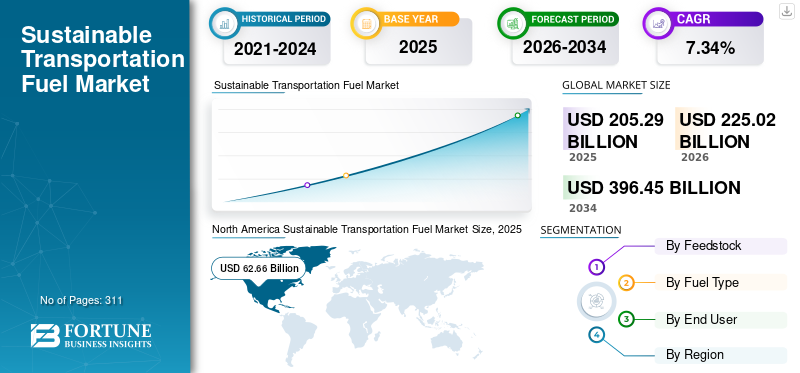
The global sustainable transportation fuel market size was valued at USD 205.29 billion in 2025. The market is projected to grow from USD 225.02 billion in 2026 to USD 396.45 billion by 2034, exhibiting a CAGR of 7.34% during the forecast period. North America dominated the sustainable transportation fuel market with a market share of 30.52% in 2025.
Sustainable transportation fuel refers to low-carbon and renewable fuels produced from biomass, waste feedstocks, renewable electricity, or other sustainable resources to reduce greenhouse gas emissions from the transportation sector. These fuels include bioethanol, biodiesel, renewable diesel (HVO), Sustainable Aviation Fuel (SAF), Renewable Natural Gas (RNG), renewable hydrogen fuel, and synthetic e-fuels. They are used across road, aviation, marine, and rail transport as alternative transportation fuels while supporting energy security and compliance with global carbon emission reduction targets. Increasing government mandates, advancements in fuel production technologies, and investments in advanced biofuels and hydrogen-based fuels are driving the growth of the market.
The growth of the market is primarily driven by increasingly stringent government regulations aimed at reducing greenhouse gas emissions and achieving net-zero targets across the transportation sector. Rising biofuel blending mandates, growing investments in sustainable aviation fuel, renewable diesel, and advanced biofuels, along with expanding renewable hydrogen initiatives, are accelerating market adoption. In addition, increasing demand for low-carbon fuels from road transport, aviation, and marine industries, supported by favorable incentives and advancements in production technologies, is creating significant growth opportunities worldwide.
The market is led by companies such as Neste Oyj, Archer Daniels Midland Company (ADM), Raízen S.A., bp plc, and TotalEnergies SE. These companies are actively expanding renewable fuel production capacities, investing in advanced biofuels such as renewable diesel (HVO) and sustainable aviation fuel, and strengthening feedstock diversification through waste oils, agricultural residues, and other sustainable raw materials. They are also developing strategic partnerships across the transportation value chain, converting conventional refineries into biorefineries, and investing in renewable hydrogen and other low-carbon fuel technologies to support global transportation fuel decarbonization and meet evolving regulatory requirements.
Download Free sample to learn more about this report.
Sustainable Transportation Fuel Market Trends
Rapid Commercialization of Sustainable Aviation Fuel and Advanced Renewable Fuels Emerges as a Significant Market Trend
One of the most significant trends shaping the market is the rapid commercialization of Sustainable Aviation Fuel (SAF) and other advanced renewable fuels. While road transport continues to account for the largest share of renewable fuel consumption, aviation has emerged as a strategic growth area due to stringent decarbonization targets. Governments across Europe, North America, and Asia Pacific are introducing blending mandates and financial incentives to accelerate SAF adoption.
- For instance, the International Air Transport Association (IATA) estimated that global SAF production reached approximately 2.4 billion liters in 2025, nearly double the previous year's output, although it still represents less than 1% of total aviation fuel demand. This supply gap is encouraging substantial investments in HEFA, alcohol-to-jet, and Power-to-Liquid (PtL) technologies.
Energy companies are also converting conventional refineries into integrated biorefineries capable of producing renewable diesel and SAF simultaneously. The increasing commercialization of waste-based feedstocks, renewable hydrogen, and synthetic fuels is expanding the portfolio of low-carbon transportation fuels. As airlines, logistics companies, and governments pursue net-zero commitments, advanced renewable fuels are expected to become a key pillar of the global transportation energy transition.
MARKET DYNAMICS
Market Drivers
Download Free sample to learn more about this report.
Increasing Government Decarbonization Policies and Renewable Fuel Mandates to Push the Market Growth
Government policies aimed at reducing greenhouse gas emissions remain the strongest driver of the sustainable transportation fuel market growth. Countries worldwide are implementing renewable fuel standards, low-carbon fuel regulations, and mandatory blending requirements to decrease dependence on fossil fuels. Programs such as the U.S. Renewable Fuel Standard (RFS), the European Union Renewable Energy Directive (RED III), FuelEU Maritime, and ReFuelEU Aviation are creating long-term demand for bioethanol, biodiesel, renewable diesel, and SAF.
- According to the International Energy Agency (IEA), global biofuel demand is projected to increase by approximately 30% between 2023 and 2028, reaching nearly 200 billion liters, driven primarily by supportive government policies.
In parallel, countries including India, Brazil, Indonesia, and Thailand continue expanding ethanol fuel and biodiesel blending mandates. Fiscal incentives, carbon pricing mechanisms, production tax credits, and grants for advanced biofuel facilities further encourage private investment. These regulatory frameworks reduce investment risk while stimulating capacity expansion, technology development, and commercialization of next-generation sustainable fuels, making policy support the primary catalyst for long-term market growth.
|
Rank |
Market Driver |
Overall Impact Rank |
CAGR Contribution (2026-2034) |
Impact 2026-2028 |
Impact 2029-2031 |
Impact 2032-2034 |
|
1 |
Strengthening government mandates, blending targets, carbon-reduction policies, and incentives supporting sustainable transportation fuels |
High |
2.35% |
High |
High |
High |
|
2 |
Rapid expansion of sustainable aviation fuel and low-carbon marine fuel demand across aviation and shipping |
High |
1.90% |
High |
High |
High |
|
3 |
Increasing investment in biofuel, renewable diesel, biomethane, hydrogen, and e-fuel production capacity |
High |
1.60% |
Medium |
High |
High |
|
4 |
Growing decarbonization commitments by airlines, shipping companies, logistics operators, fleet owners, and fuel suppliers |
Medium-High |
1.35% |
Medium |
High |
High |
|
5 |
Rising demand for energy security, fossil-fuel import reduction, and diversification of transportation fuel supplies |
Medium |
1.15% |
Medium |
Medium |
High |
|
6 |
Others, including technological improvements, feedstock diversification, corporate offtake agreements, infrastructure expansion, and increasing consumer preference for low-carbon mobility |
Low |
0.87% |
Low |
Medium |
Medium |
|
Total Positive Growth Contribution |
+9.22% |
Market Restraints
Limited Availability of Sustainable Feedstocks to Restrain the Market Growth
Despite growing demand, the market continues to face challenges related to the limited availability of sustainable feedstocks. Conventional feedstocks such as corn, sugarcane, vegetable oils, and animal fats are already extensively utilized for food, feed, and industrial applications, limiting additional supply. Advanced feedstocks including agricultural residues, municipal solid waste, algae, and forestry residues remain commercially constrained due to collection, processing, and logistics challenges.
- According to the IEA, waste-based feedstocks account for only a relatively small share of global biofuel production despite their significant decarbonization potential.
Feedstock shortages also increase production costs for renewable diesel and SAF, particularly for fuels produced from used cooking oil and waste animal fats, where competition among producers continues to intensify. Regional differences in agricultural production further complicate supply security, forcing producers to rely on imports and increasing exposure to price volatility. Without substantial improvements in feedstock productivity, waste collection systems, and advanced biomass conversion technologies, feedstock limitations are expected to remain one of the principal constraints on market expansion.
|
Rank |
Market Restraint |
Impact on Market Growth |
Estimated Contribution to CAGR (2026-2034) |
2026-2028 |
2029-2031 |
2032-2034 |
|
1 |
High production costs and price premiums of sustainable fuels compared with conventional gasoline, diesel, marine fuel, and jet fuel |
High |
−0.62% |
High |
High |
Medium |
|
2 |
Limited availability, competing uses, and sustainability concerns associated with biomass, waste oils, agricultural residues, and renewable electricity feedstocks |
High |
−0.51% |
High |
Medium |
Medium |
|
3 |
Insufficient production, storage, blending, transportation, bunkering, hydrogen-refueling, and airport fuel-distribution infrastructure |
Medium-High |
−0.43% |
High |
Medium |
Medium |
|
4 |
Others, including uncertain policy implementation, complex certification requirements, technology risks, financing constraints, indirect land-use concerns, and competition from battery-electric mobility |
Low |
−0.32% |
Medium |
Low |
Low |
|
Total Negative Growth Impact |
-1.88 |
Market Opportunities
Expansion of Renewable Hydrogen and Synthetic Fuel Production to Create New Growth Avenues
Renewable hydrogen and hydrogen-derived synthetic fuels represent one of the largest long-term opportunities within the market. These fuels offer significant decarbonization potential for sectors where direct electrification remains challenging, including aviation, maritime shipping, and long-haul freight transport. Governments are increasingly investing in hydrogen infrastructure through dedicated national hydrogen strategies and large-scale funding programs.
- According to the International Renewable Energy Agency (IRENA), more than 300 million tons per year of renewable hydrogen could be traded globally by 2050 under ambitious decarbonization scenarios. Further, supporting the production of e-methanol, e-kerosene, and green ammonia.
Major energy companies are investing in electrolysis capacity, carbon capture integration, and Power-to-X technologies to commercialize these fuels. The growing demand for carbon-neutral marine fuels and aviation fuels further strengthens investment prospects. As electrolyzer costs decline, renewable electricity capacity expands, and carbon capture technologies mature, renewable hydrogen-based fuels are expected to transition from niche applications to commercially viable transportation fuels, creating substantial opportunities across the global energy value chain.
Market Challenges
High Production Costs Compared with Conventional Fossil Fuels to Limit Market Growth
The most significant challenge facing the market is the relatively high production cost of renewable fuels compared with conventional petroleum-based fuels. Advanced fuels such as SAF, renewable hydrogen, e-fuels, and renewable methanol require sophisticated processing technologies, high capital investment, and premium feedstocks, resulting in significantly higher production costs.
- According to the International Air Transport Association (IATA), SAF remains approximately two to five times more expensive than conventional jet fuel, depending on the production pathway and feedstock.
Similar cost challenges affect renewable hydrogen and synthetic fuels, where large-scale commercialization is still developing. Infrastructure investments required for fuel distribution, storage, and refueling further increase project costs. In many developing economies, limited policy support and inadequate financial incentives slow investment in new production facilities. Although technological improvements, economies of scale, and government incentives are expected to reduce costs over time, achieving price competitiveness with fossil fuels remains essential for widespread adoption. Addressing this challenge will require continued innovation, stronger policy support, and significant investment across the renewable fuel value chain.
Segmentation Analysis
By Feedstock
Well-established Agricultural Practices and Extensive Ethanol Refining Infrastructure Led to the Corn Segment Growth
Based on feedstock, the market segment covers vegetable oils, sugarcane, corn, and others.
The corn segment accounted for the dominant sustainable transportation fuel market share in 2025 owing to increasing global bioethanol production, primarily driven by large-scale production in North America. Well-established agricultural practices, extensive ethanol refining infrastructure, and long-standing renewable fuel policies have enabled corn ethanol to become one of the largest renewable transportation fuels worldwide. Continuous improvements in crop productivity, enzyme technologies, and biorefinery efficiency have enhanced production economics and reduced emissions. However, concerns regarding food-versus-fuel competition, fertilizer usage, and indirect land-use impacts continue to influence policy discussions in several regions. To address these concerns, producers are increasingly investing in carbon capture, process efficiency improvements, and sustainable farming practices to enhance the environmental performance of corn-based ethanol.
The vegetable oils segment is projected to grow at the fastest CAGR of 8.13% during the forecast period.
To know how our report can help streamline your business, Speak to Analyst
By Fuel Type
Widespread Gasoline Blending Programs Led to the Bioethanol Segment Growth
Based on fuel type, the market is segmented into renewable diesel (HVO), biodiesel, bioethanol, and others.
The bioethanol segment accounted for approximately 39.41% of the market share in 2025. The segment’s dominance is primarily driven by widespread gasoline blending programs in North America, Latin America, and Asia Pacific. Produced mainly from corn and sugarcane, bioethanol has become a mature renewable fuel supported by well-established agricultural supply chains and extensive production infrastructure. Countries such as the U.S. and Brazil dominate global production, while India and several Southeast Asian nations are rapidly increasing ethanol blending targets to reduce fossil fuel imports and transportation emissions. Continuous improvements in ethanol production efficiency and increasing commercialization of second-generation (2G) cellulosic ethanol are further enhancing the environmental performance of this fuel. Owing to its scalability, commercial maturity, and regulatory support, bioethanol is expected to maintain the largest share of the market over the forecast period.
Renewable diesel (HVO) is the fastest-growing segment and is expected to grow at a CAGR of 8.14% during the forecast period.
By End User
Greenhouse Gas Emissions Reduction Initiatives to Propel Commercial Fleet Operators Segment Growth
Based on end user, the market is segmented into commercial fleet operators, passenger vehicles, and others.
The commercial fleet operators segment represented the largest market share of around 40.17% in 2025. These operators constitute a major end-user segment in the global market, encompassing logistics companies, public transportation operators, airlines, shipping companies, and other commercial green mobility solutions providers. This segment is witnessing rapid adoption of renewable diesel (HVO), biodiesel, Renewable Natural Gas (RNG), and Sustainable Aviation Fuel (SAF) as fleet operators seek to reduce greenhouse gas emissions while meeting increasingly stringent environmental regulations. Unlike passenger vehicles, commercial fleets consume significantly larger fuel volumes, making fuel switching an effective pathway to achieve corporate sustainability goals. Governments are also supporting fleet decarbonization through renewable fuel mandates, low-carbon fuel standards, and financial incentives. As freight transportation, aviation, and maritime industries face increasing pressure to achieve net-zero emissions, commercial fleet operators are expected to remain one of the fastest-growing consumers of sustainable transportation fuels worldwide.
The passenger vehicles segment is expected to grow with a CAGR of 7.19% during the forecast period.
Sustainable Transportation Fuel Market Regional Outlook
By region, the market has been studied across North America, Europe, Asia Pacific, Latin America, and the Middle East & Africa.
North America
North America Sustainable Transportation Fuel Market Size, 2025 (USD Billion)
To get more information on the regional analysis of this market, Download Free sample
North America is the dominant region in the market and in 2025 it was valued at USD 62.66 billion, accounting for approximately 30.52% of global revenues. North America is one of the leading markets, supported by strong policy frameworks, advanced refining infrastructure, and abundant agricultural feedstocks. The U.S. leads the region through renewable fuel production, while Canada continues expanding clean energy transportation fuel initiatives under its Clean Fuel Regulations. According to the U.S. Energy Information Administration (EIA), fuel ethanol production in the U.S. averaged around 1.05 million barrels per day in 2024, reflecting the region's mature biofuel industry. Increasing investments in renewable diesel and sustainable aviation fuel facilities are further strengthening North America's position as a global production hub for low-carbon transportation fuels.
U.S. Sustainable Transportation Fuel Market
The U.S. market was valued at USD 55.00 billion in 2025 and is estimated to reach USD 60.54 billion by 2026. The country is the world's largest producer of renewable transportation fuels, supported by the Renewable Fuel Standard (RFS), which mandates increasing volumes of renewable fuels to be blended into transportation fuels. This regulatory framework continues to drive continued investments in ethanol, renewable diesel, and Sustainable Aviation Fuel (SAF). The U.S. also leads globally in renewable diesel capacity expansion, with several petroleum refineries converted into renewable fuel facilities, strengthening long-term market growth.
Europe
Europe accounted for USD 57.80 billion in 2025, representing approximately 28.15% of global revenues. Europe remains a key market driven by ambitious climate policies and strong regulatory support for renewable transportation fuels. The region is accelerating the transition toward advanced biofuels, renewable diesel, and sustainable aviation fuel while reducing dependence on conventional fossil fuels. The European Union's ReFuelEU Aviation Regulation requires aviation fuel suppliers to include 2% SAF from 2025, with progressively increasing mandates in subsequent years. This regulatory certainty is encouraging refinery conversions, long-term fuel supply agreements, and investments in advanced feedstocks, reinforcing Europe's leadership in sustainable fuel adoption.
Germany Sustainable Transportation Fuel Market
Germany was valued at USD 13.69 billion in 2025 and is estimated to reach USD 15.02 billion by 2026. Germany is one of Europe's leading markets due to its strong decarbonization policies and advanced biofuel infrastructure. The country is increasingly shifting from conventional crop-based biofuels toward advanced biofuels, renewable diesel, and e-fuels to meet climate targets. Germany also promotes renewable hydrogen through its National Hydrogen Strategy, positioning the country as a major future producer and consumer of hydrogen-derived transportation fuels.
U.K. Sustainable Transportation Fuel Market
The U.K. market was valued at USD 10.59 billion in 2025 and is estimated to reach USD 11.64 billion by 2026. The country is accelerating the adoption of such fuels through ambitious carbon reduction policies and increasing investments in SAF and advanced biofuels. The country's Renewable Transport Fuel Obligation (RTFO) encourages suppliers to increase renewable fuel content while rewarding fuels with lower lifecycle emissions. Growing investments in waste-based fuel production and SAF manufacturing are strengthening the U.K.'s position in the European low-carbon transportation fuel market.
Asia Pacific
The Asia Pacific market was valued at USD 54.24 billion in 2025, accounting for approximately 26.42% of the global market. Asia Pacific is emerging as the fastest-growing regional market due to expanding transportation demand, rising energy security concerns, and increasingly stringent renewable fuel policies. Countries including China, India, Indonesia, Thailand, and Japan are expanding domestic biofuel production while investing in advanced renewable fuel technologies. For example, India achieved nationwide availability of E20 gasoline (20% ethanol blending) in 2025, significantly increasing domestic ethanol consumption and reducing gasoline imports. Growing investments in renewable hydrogen, SAF, and advanced biofuel facilities are expected to further accelerate market growth across the region.
China Sustainable Transportation Fuel Market
China remains the dominant contributor in Asia Pacific, valued at USD 27.02 billion in 2025, and is estimated to reach USD 30.01 billion by 2026. The country is rapidly expanding its renewable transportation fuel sector to improve energy security and reduce transport emissions. Alongside ethanol blending initiatives, the country is making significant investments in renewable hydrogen, green methanol, and sustainable aviation fuel production. China also leads the world in renewable energy deployment, providing a strong foundation for future production of hydrogen-based transportation fuels and synthetic e-fuels.
India Sustainable Transportation Fuel Market
India was valued at USD 5.20 billion in 2025 and is estimated to reach USD 5.80 billion by 2026. India is among the fastest-growing markets, driven by strong government policies to reduce crude oil imports and improve energy independence. Simultaneously, investments in Compressed Biogas (CBG), second-generation ethanol, and sustainable aviation fuel are expanding India's renewable fuel portfolio beyond conventional bioethanol.
Japan Sustainable Transportation Fuel Market
Japan was valued at USD 8.58 billion in 2025 and is estimated to reach USD 9.50 billion by 2026. The country is prioritizing advanced sustainable fuels to decarbonize sectors where electrification is challenging, particularly aviation, maritime transport, and heavy-duty mobility. Japan is investing heavily in renewable hydrogen, ammonia, and synthetic fuels through public-private partnerships under its Green Growth Strategy. Japanese energy companies are also developing international supply chains for hydrogen and low-carbon fuels to strengthen long-term energy security.
Latin America
Latin America accounted for USD 19.64 billion in 2025, accounting for approximately 9.57% of global revenues. The region plays a strategic role in the global market due to its abundant agricultural resources and well-established biofuel industries. Brazil continues to dominate regional production through its integrated sugarcane ethanol industry, while several neighboring countries are expanding biodiesel and ethanol blending programs. According to UNICA (Brazilian Sugarcane Industry Association), flex-fuel vehicles account for more than 80% of Brazil's light-duty vehicle fleet, supporting sustained demand for ethanol-based transportation fuels. Continued investments in advanced ethanol technologies and agricultural productivity are expected to strengthen the region's competitive position in renewable fuels.
Middle East & Africa
The Middle East & Africa region was valued at USD 10.95 billion in 2025. The region is an emerging market with growing opportunities in renewable transportation fuels, particularly renewable hydrogen, e-fuels, and sustainable aviation fuel. While conventional biofuel production remains relatively limited, governments are leveraging abundant renewable energy resources to establish future export-oriented clean fuel industries. For example, Saudi Arabia's NEOM Green Hydrogen Project, expected to produce approximately 600 tons of renewable hydrogen per day upon completion, is among the world's largest green hydrogen developments and is expected to support future production of hydrogen-derived transportation fuels. Increasing investments in renewable energy infrastructure and export-focused fuel production are expected to enhance the region's role in the global value chain.
GCC Sustainable Transportation Fuel Market
The GCC market was valued at USD 6.10 billion in 2025 and is estimated to reach USD 6.70 billion by 2026. The GCC is emerging as a strategic hub for next-generation renewable transportation fuels through large-scale energy infrastructure and continued investments in advanced fuel production. Countries including Saudi Arabia and the UAE are investing in renewable hydrogen, green ammonia, and synthetic fuel projects aimed at both domestic use and exports. These investments are positioning the GCC countries as future suppliers of low-carbon transportation fuels while supporting national economic diversification and net-zero ambitions.
COMPETITIVE LANDSCAPE
Key Industry Players
Extensive Production Capabilities and Sustainable Practices Drive Market Share Growth for Companies
Leading companies such as Neste Oyj, Archer Daniels Midland Company (ADM), Raízen S.A., bp plc, and TotalEnergies SE hold a dominant position in the sustainable transportation fuel market. These companies are expanding production of bioethanol, biodiesel, renewable diesel, sustainable aviation fuel, and other low-carbon fuels through new capacity additions, refinery conversions, and advanced processing technologies. Their efforts also include greater use of waste- and residue-based feedstocks, strategic partnerships with airlines and fleet operators, and investments in renewable hydrogen and e-fuels. These initiatives are improving fuel availability, reducing lifecycle emissions, and accelerating the commercialization of sustainable transport fuels worldwide.
List of Key Sustainable Transportation Fuel Companies Profiled
- Neste Oyj (Finland)
- Chevron (U.S.)
- Valero Energy Corporation (U.S.)
- POET, LLC (U.S.)
- ADM (Archer Daniels Midland Company) (U.S.)
- Raízen S.A. (Brazil)
- bp plc (U.K.)
- TotalEnergies SE (France)
- Eni S.p.A. (Italy)
- World Energy, LLC (U.S.)
- Gevo, Inc. (U.S.)
- LanzaJet, Inc. (U.S.)
- Verbio SE (Germany)
- Darling Ingredients Inc. (U.S.)
- UPM-Kymmene Corporation (Finland)
KEY INDUSTRY DEVELOPMENTS
- February 2026: Eni approved the final investment decision to convert units at its Sannazzaro de' Burgondi refinery (Italy) into a new biorefinery under its Enilive business. The project will increase production capacity for renewable diesel (HVO) and Sustainable Aviation Fuel (SAF) using renewable feedstocks, further strengthening Europe's advanced biofuel production capacity and supporting transport decarbonization.
- June 2025: Neste and Chevron Lummus Global announced a strategic collaboration to develop a novel technology for converting lignocellulosic biomass, such as agricultural waste and forestry residues, into renewable diesel and sustainable aviation fuel. Pilot results demonstrated improved conversion performance compared to existing technologies, supporting commercialization of advanced waste-based fuels and expanding the industry's feedstock base.
- April 2025: BioLite acquired Goal Zero, combining two established brands in portable power and off-grid energy. The deal strengthened their combined position across outdoor, emergency, and renewable portable energy solutions.
- May 2024: Gevo signed a long-term agreement with Shell Aviation for the supply of sustainable aviation fuel from its future commercial production facilities. The agreement strengthens market confidence in advanced biofuel technologies and supports the expansion of commercial SAF production capacity to meet growing airline demand for lower-carbon aviation fuels.
- May 2024: TotalEnergies continued the transformation of its Grandpuits refinery in France into a zero-crude biorefinery focused on producing sustainable aviation fuel from waste and residue feedstocks. The investment strengthens Europe's renewable fuel supply chain while supporting the region's aviation decarbonization objectives and increasing production of advanced renewable fuels.
REPORT COVERAGE
The report provides a comprehensive analysis of the market, focusing on key aspects such as leading companies, product processes, and Porter’s Five Forces. Additionally, the report provides valuable insights into market trends and highlights key industry developments. In addition to the factors mentioned above, the report also encompasses several factors that contributed to the market's growth in recent years.
Request for Customization to gain extensive market insights.
REPORT SCOPE & SEGMENTATION
| ATTRIBUTE | DETAILS |
| Study Period | 2021-2034 |
| Base Year | 2025 |
| Estimated Year | 2026 |
| Forecast Period | 2026-2034 |
| Historical Period | 2021-2024 |
| Growth Rate | CAGR of 7.34% from 2026 to 2034 |
| Unit | Value (USD Billion) |
|
Segmentation |
By Feedstock
|
|
By Fuel Type
|
|
|
By End User
|
|
|
By Region
|
Frequently Asked Questions
Fortune Business Insights says that the global market value stood at USD 205.29 billion in 2025 and is projected to reach USD 396.45 billion by 2034.
The market is expected to exhibit a CAGR of 7.34% during the forecast period.
The commercial fleet operators segment led the market in terms of end user.
Increasing government decarbonization policies and renewable fuel mandates are the key factors driving the market.
Neste Oyj, Archer Daniels Midland Company (ADM), Raízen S.A., bp plc, and TotalEnergies SE are some of the prominent players in the market.
North America is the leading region in the market.



- 2021-2034
- 2025
- 2021-2024
- 311
Get 30-60 hrs Free Customization
Expand Regional and Country Coverage, Segments Analysis, Company Profiles, Competitive Benchmarking, and End-user Insights.



















Related Reports
-
US +1 833 909 2966 ( Toll Free )
-
Get In Touch With Us