System In Package Advanced Integration Market Size, Share & Industry Analysis, By Integration Type (2D Integration, 3D Integration, and Heterogeneous Integration), By Advanced Packaging Technology (Fan-Out Wafer-Level Packaging (FOWLP), System-in-Package (SiP) with Advanced Materials, and Chip-on-Board (COB) Integration), By End-use Industry (Consumer Electronics, Automotive, Telecom & Networking, Healthcare, and Industrial Automation), and Regional Forecast, 2026 – 2034
 Download Free Sample
 SYSTEM IN PACKAGE ADVANCED INTEGRATION MARKET SIZE AND FUTURE OUTLOOK
 Listen to Audio Version
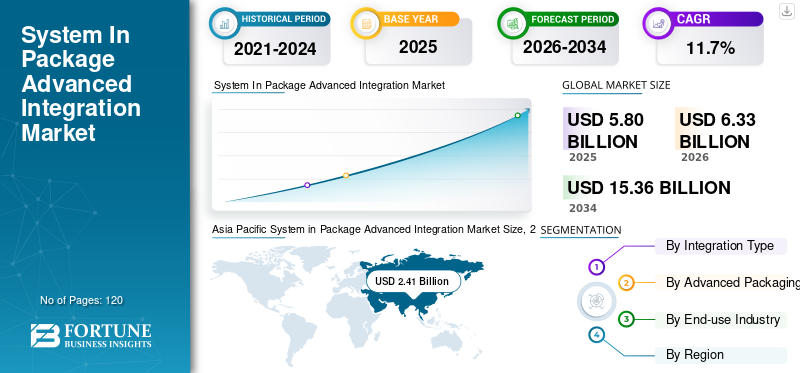
The system in package advanced integration market size was valued at USD 5.80 billion in 2025. The market is projected to grow from USD 6.33 billion in 2026 to USD 15.36 billion by 2034, exhibiting a CAGR of 11.7% during the forecast period. Asia Pacific dominated the system in package advanced integration market with a market share of 41.55% in 2025.
System in package advanced integration refers to the sector for integrating multiple semiconductor components into a small package that uses advanced technologies such as 3D stacking and heterogeneous integration. This creates more performance, less size, and more functionality. The market growth is driven by the rising demand for compact, high-performance electronic devices across sectors such as smartphones, automotive electronics, and 5G infrastructure.
Furthermore, many key market players, such as ASE Technology Holding Co., Ltd., Intel Corporation, Amkor Technology, and Samsung Electronics Co., Ltd., operating in the market, are focusing on product innovation, advanced packaging capacity expansion, and strategic partnerships to strengthen their position in the market.
Download Free sample to learn more about this report.
System In Package Advanced Integration Market Key Takeaways
 Global Market Size & Forecast
- 2025 Market Size: USD 5.80 billion
- 2026 Market Size: USD 6.33 billion
- 2034 Forecast Market Size: USD 15.36 billion
- CAGR: 11.7% from 2026-2034
 Market Share
- Asia Pacific dominated the system in package advanced integration market with a 41.55% share in 2025.
- The 3D integration segment is projected to grow at the highest CAGR of 14.0% during the forecast period.
- The Fan-Out Wafer-Level Packaging (FOWLP) segment is anticipated to register the highest CAGR of 13.8% during the forecast period.
 Key Regional Highlights
Asia Pacific
Asia Pacific accounted for USD 2.41 billion in 2025, maintaining its position as the largest regional market.
North America
North America is projected to reach USD 1.89 billion in 2026, ranking as the second-largest regional market.
Europe
Europe is expected to reach USD 1.29 billion in 2026, registering the highest regional CAGR of 15.7%.
U.S.
The market is estimated to reach USD 1.40 billion in 2026, accounting for around 22.1% of global sales.
Japan
The market is estimated to reach USD 0.48 billion in 2026, representing approximately 7.6% of global revenues.
Read More

IMPACT OF GENERATIVE AI
Rising Generative AI Workloads Fuels Advanced SiP and Packaging Solutions
Generative AI is driving demand for SiP (System in Package) advanced integration, as AI chips require high-bandwidth memory, chiplets, 2.5D/3D packaging, and better power efficiency than most chip packaging solutions present in the market. Therefore, companies need to develop their advanced packaging capabilities and invest in heterogeneous integration to support the design of AI accelerators, data centers, and edge AI devices. For instance,
- In October 2025, Amkor broke ground on its advanced packaging and test campus in Arizona, with planned investment potentially reaching USD 7 billion to support AI and high-performance chips.
- In May 2024, ASE introduced powerSiP, aimed at improving power efficiency by 50% for AI and data center applications.
SYSTEM IN PACKAGE ADVANCED INTEGRATION MARKET TRENDS
Increasing Use of SiP in Automotive Electronics is Emerging Market Trend
As vehicles become software-driven, connected, electrified, and autonomous, the automotive sector is embracing SiP advanced integration solutions. SiP is a method that allows small, dependable semiconductor modules to be built with compact and reliable semiconductor modules for Advanced Driver Assistance Systems (ADAS), radar, lidar, infotainment, digital cockpit, battery management, power control, and in-vehicle connectivity.
Incorporating multiple Integrated Circuits (ICs), sensors, memory, Radio-Frequency (RF), and power management devices into one small package through SiP advanced integration provides manufacturers with new opportunities to reduce their circuit board footprint, enhance electrical signal performance, improve heat dissipation, and overall system reliability.
The rapid transition to Electric Vehicles (EVs) and ADAS has generated additional demand for high-performance, extremely small automotive electronic solutions. SiP-based solutions will increasingly be a key component for automotive compute platforms, smart cockpit solutions, communication devices, and sensor fusion applications where low latency, high reliability, and small form factor are critical. For instance,
- In April 2026, Microchip Technology introduced an automotive-qualified hybrid MCU SiP for automotive and e-mobility HMI applications, integrating an MPU and memory into one package for digital cockpit clusters, HVAC control, EV chargers, and other automotive systems.
MARKET DYNAMICS
MARKET DRIVERS
Download Free sample to learn more about this report.
Growing Demand for Compact and High-Performance Electronic Devices Drives Market Growth
Consumer electronics such as smartphones, wearables, tablets, and portable computing devices have significantly evolved over the past few years. These changes have greatly increased the demand for compact and high-performance semiconductor solutions. There is a growing trend for manufacturers to provide more features within smaller sizes. One way manufacturers are doing this is through advanced integration via system in package, which brings together processors, memory, RF modules, and sensors into one small package, thus providing increased performance and decreased size and power consumption. Increasing processing speeds, as well as longer battery life, will drive manufacturers to adopt advanced packaging technologies, including 2.5D/3D and heterogeneous integration. Collectively, these factors drive the system in package advanced integration market growth. For instance,
- In March 2024, TSMC highlighted strong growth in advanced packaging demand driven by AI and high-performance devices, noting that CoWoS capacity is being significantly expanded to support compact, high-performance chip designs.
MARKET RESTRAINTS
High Initial Capital Investment Needs May Hinder Market Growth
Implementing advanced integration technologies through the adoption of SiP requires large upfront costs in advanced packaging infrastructure, including wafer level packaging equipment, cleanroom facilities, tools necessary to support 2.5/3D integration and testing capabilities. The need for substantial capital expenditures is an ongoing barrier to entry and growth for all semiconductor manufacturers but most particularly for smaller and mid-tier manufacturers.
Additionally, the long return on investment aligned with advanced packaging investments also creates significant financial risk due to the rapid advancement of technologies and the cyclical nature of most semiconductor markets. Therefore, many manufacturers turn to strategic partnerships or outsourcing rather than developing internal capabilities. This trend will slow both the pace of innovation and the ability of those companies to grow their businesses.
MARKET OPPORTUNITIES
Rising Demand for 5G and Future 6G Infrastructure Creating New Opportunities for Market Growth
High-speed global deployment of fifth-generation cellular networks and advancements in sixth-generation mobile telecommunications systems are creating a significant demand for high-frequency/high-performing semiconductor packaging solutions. System in package advanced integration is an essential element in the creation of compact radio frequency front-end modules and ‘antenna in package’ design architectures, allowing for multiple components including power amplifiers, filters, and transceivers to be contained together in one package with improved performance and reduced footprint.
With the ongoing growth of capacity for telecom network operators, moving toward ultra-low latency telecommunications, the demand for highly integrated and efficient packaging solutions will also continue to increase across base stations and edge devices. For instance,
- In February 2024, Qualcomm introduced its next-generation 5G RF front-end solutions designed to support advanced antenna modules and improve power efficiency for high-band connectivity.
Segmentation Analysis
By Integration Type
Cost Efficiency and Manufacturing Maturity Driving Dominance of 2D Integration
Based on the integration type, the market is divided into 2D integration, 3D integration and heterogeneous integration.
2D integration accounted for the largest market share in 2025. This is owing to its low cost, manufacturing maturity, and wide usage in consumer electronics and telecom products. Many manufacturers are still choosing 2D SiPs since they provide the best combination of performance and scalability without the added complexity or expense of 3D or heterogeneous integration options.
3D integration is anticipated to grow at the highest CAGR of 14.0% over the forecast period. This is owing to its ability to deliver superior performance, higher integration density, and improved power efficiency, which are critical for advanced applications such as AI, high-performance computing, and next-generation telecom systems.
By Advanced Packaging Technology
Cost Efficiency and Simplicity Driving Dominance of Chip-On-Board (COB) Integration Segment
Based on the advanced packaging technology, the market is categorized into Fan-Out Wafer-Level Packaging (FOWLP), System-In-Package (SiP) with advanced materials, and Chip-On-Board (COB) integration.
Chip-On-Board (COB) integration is anticipated to account for the largest market share over the forecast period. This is owing to its low cost, easy assembly, and the strong acceptance of COB in high-volume consumer electronics and industrial applications. COB is still a preferred technology for certain applications above a moderate performance level where lower packaging costs are reasonable. Therefore many industries use COB instead of more complex and costly advanced packaging methods as they cannot justify the extra cost of using advanced packaging technologies.
Fan-Out Wafer-Level Packaging (FOWLP) is anticipated to grow at the highest CAGR of 13.8% over the forecast period. This is owing to its ability to deliver higher I/O density, improved electrical performance, and thinner form factors, making it ideal for advanced applications such as AI chips, 5G devices, and high-performance consumer electronics.
By End-use Industry
To know how our report can help streamline your business, Speak to Analyst
High Demand for Compact Consumer Devices Driving Dominance of Consumer Electronics Segment
Based on the end-use industry, the market is classified into consumer electronics, automotive, telecom & networking, healthcare, and industrial automation.
Consumer electronics dominated the market share in 2025. This is owing to a high demand volume for smartphones, wearables, tablets and other compact electronic devices, requiring small yet highly functional semiconductor solutions. The ongoing need to create smaller, more functional and energy-efficient electronic products by creating inch-thick multipurpose SoCs is leading to the generation a high number of advanced SiP integration methods.
Automotive is anticipated to grow at the highest CAGR of 15.0% during the forecast period. This is owing to increasing adoption of advanced electronics in electric vehicles, ADAS, and autonomous driving systems, which require highly integrated, reliable, and high-performance SiP solutions.
System in Package Advanced Integration Market Regional Outlook
By geography, the market is categorized into North America, South America, Europe, Middle East & Africa, and Asia Pacific.
Asia Pacific
Asia Pacific System in Package Advanced Integration Market Size, 2025 (USD Billion)
To get more information on the regional analysis of this market, Download Free sample
Asia Pacific accounted for the largest system in package advanced integration market share in 2024, valuing at USD 2.28 billion, and also maintained the leading share in 2025, with USD 2.41 billion. The market in the Asia Pacific is expected to increase, due to having a strong semiconductor manufacturing ecosystem and a large number of top electronics manufacturers located in China, Japan, South Korea, and Taiwan. The region is also expected to see increased consumer electronics usage, high rates of 5G infrastructure deployment, and considerable amounts of investment into advanced packaging technologies, thus increasing adoption rates of SiP solutions. For instance,
- In May 2024, TrendForce reported that TSMC’s advanced packaging capacity was fully booked by NVIDIA and AMD through 2025, and that its CoWoS monthly capacity was expected to increase from around 15,000 units in 2023 to 45,000–50,000 units by the end of 2024.
These factors play a significant role in fueling the regional market growth.
China System in Package Advanced Integration Market
China’s market is projected to be one of the largest worldwide, with 2026 revenues estimated at around USD 0.59 billion, representing roughly 9.3% of global sales.
To know how our report can help streamline your business, Speak to Analyst
Japan System in Package Advanced Integration Market
The Japan market in 2026 is estimated at around USD 0.48 billion, accounting for roughly 7.6% of global revenues. This is owing to the strong presence of leading semiconductor companies, advanced automotive electronics adoption, and high demand for miniaturized consumer devices in Japan.
India System in Package Advanced Integration Market
The India market in 2026 is estimated at around USD 0.35 billion, accounting for roughly 5.5% of global revenues.
North America
North America is estimated to reach USD 1.89 billion in 2026 and secure the position of the second-largest region in the market. This is owing to demand for AI, advanced telecommunications infrastructure, and high-performance computing. In addition, the increasing use of system in package products in areas such as automotive electronics, data centers, and 5G networks are further driving the requirement for high-performance semiconductor packaging and advanced integration technologies. For instance,
- In April 2024, the U.S. Department of Commerce announced funding under the CHIPS and Science Act to support advanced packaging and semiconductor manufacturing, with billions allocated to strengthen domestic capabilities in advanced node chips and packaging technologies.
U.S. System in Package Advanced Integration Market
Based on North America’s significant contribution, the U.S. market can be analytically approximated at around USD 1.40 billion in 2026, accounting for roughly 22.1% of global sales.
Europe
Europe is projected to grow at a CAGR of 15.7% in the coming years, which is the highest among all regions, and reach a valuation of USD 1.29 billion by 2026. The fast-growing European market is primarily driven by increasing demand for automotive electronics, industrial automation, telecom infrastructure, and medical devices. The largest economies in the region, such as Germany, France, Italy, and the U.K. are leading these trends. In addition, many countries in Europe have committed to investing in local semiconductor manufacturing (localization) and developing new advanced packaging methods to reduce their reliance on global supply chains and support new and emerging applications such as electric vehicles, artificial intelligence, and 6G telecommunications. For instance,
- In December 2024, the European Commission approved approximately USD 1.5 billion in Italian state aid for Silicon Box’s advanced semiconductor packaging facility in Novara, Italy, representing a total project investment of USD 3.4 billion and expected to create 1,600 high-skilled jobs.
U.K. System in Package Advanced Integration Market
The U.K. market in 2026 is estimated at around USD 0.22 billion, representing roughly 3.5% of global revenues.
Germany System in Package Advanced Integration Market
Germany’s market is projected to reach approximately USD 0.29 billion in 2026, equivalent to around 4.6% of global sales.
South America
South America is expected to witness moderate growth in this market space during the forecast period. The South America market is set to reach a valuation of USD 0.27 billion in 2026. This is driven by rising demand for consumer electronics, telecom connectivity, automotive electronics, and industrial automation, particularly in Brazil and Argentina. Expanding 5G deployment, growing electronics consumption, and gradual adoption of EV and connected vehicle technologies are also supporting demand for compact and cost-efficient SiP advanced integration solutions.
Middle East & Africa
The Middle East & Africa is estimated to reach USD 0.33 billion in 2026 and expected to grow at a prominent growth rate in the coming years. This is driven by increasing investment into 5G infrastructure and smart city initiatives, as well as establishing data centers and connected automotive technologies in GCC nations, Turkey, Israel, and South Africa. Increased demand for digital transformation and compact/power-efficient semiconductor modules will escalate the adoption of SiP advanced integration across telecoms, industry and consumer electronics. In the Middle East & Africa, the GCC is set to reach a value of USD 0.11 billion in 2026.
COMPETITIVE LANDSCAPE
Key Industry Players
Focus on Expanding Advanced Packaging Capabilities by Key Players to Propel Market Competition
The system in package advanced integration market holds a semi-consolidated market structure, with prominent players such as ASE Technology Holding Co., Ltd., Intel Corporation, Amkor Technology, Inc., TSMC, and Samsung Electronics Co., Ltd., holding significant positions. These companies are driving market growth through continuous investments in advanced integration technologies, including 2.5D/3D packaging, heterogeneous integration, fan-out wafer-level packaging, and chiplet-based architectures. Strategic initiatives such as expanding advanced packaging capacity, enhancing interconnect technologies, and developing next-generation SiP solutions are enabling improved performance, higher bandwidth, and enhanced power efficiency for applications in AI, 5G, automotive, and high-performance computing.
Other notable players in the global market include Qualcomm Incorporated, Broadcom Inc., Micron Technology, Inc., STMicroelectronics N.V., and NXP Semiconductors N.V. These companies are increasingly focusing on strengthening heterogeneous integration capabilities, optimizing design and manufacturing processes, and scaling production capacity to address rising demand. Strategic investments in advanced packaging facilities, innovation in multi-chip integration, and expansion of global manufacturing footprints are expected to reinforce their market positioning and support sustained growth.
LIST OF KEY SYSTEM IN PACKAGE ADVANCED INTEGRATION COMPANIES PROFILED
- ASE Technology Holding Co., Ltd. (Taiwan)
- Intel Corporation (U.S.)
- Amkor Technology (U.S.)
- Taiwan Semiconductor Manufacturing Company (TSMC) (Taiwan)
- Qualcomm Incorporated (U.S.)
- Samsung Electronics Co., Ltd. (South Korea)
- Broadcom, Inc. (U.S.)
- Micron Technology, Inc. (U.S.)
- STMicroelectronics N.V. (Switzerland)
- NXP Semiconductors N.V. (Netherlands)
KEY INDUSTRY DEVELOPMENTS
- October 2025: ASE announced an investment of USD 578.6 million, to build a new advanced chip packaging facility in Kaohsiung, Taiwan. The facility is aimed at supporting rising demand from AI, HPC, and automotive applications.
- June 2025: Synopsys announced continued collaboration with Samsung Foundry to support AI and multi-die designs using Samsung’s advanced packaging technologies, including I-CubeS 2.5D packaging. The collaboration helps customers accelerate tape-outs for AI, HPC, and advanced edge applications.
- April 2025: Intel Foundry held its Direct Connect event, where it highlighted its advanced packaging roadmap, EMIB/Foveros momentum, and ecosystem partnerships for next-generation foundry customers. The development supports Intel’s positioning in heterogeneous integration and advanced packaging for AI-era chips.
- April 2025: TSMC unveiled SoW-X, a CoWoS-based wafer-scale system offering up to 40x the computing power of current CoWoS solutions, with volume production scheduled for 2027. This strengthens TSMC’s advanced packaging roadmap for AI and high performance computing applications.
- October 2024: Amkor and TSMC signed an MoU to collaborate on advanced packaging and test capabilities in Arizona. The partnership targets leading-edge packaging support for high-performance computing and communications applications.
- May 2024: STMicroelectronics introduced new automotive and industrial microcontrollers with embedded integration capabilities, supporting compact system-level packaging and high-performance applications. This aligns with increasing use of SiP in automotive and industrial sectors.
- April 2024: Broadcom expanded its AI infrastructure portfolio with new networking and custom accelerator solutions, emphasizing high bandwidth, multi-chip integration for hyperscale data centers. This supports demand for advanced packaging and interconnect technologies.
REPORT COVERAGE
The market analysis includes a comprehensive study of the market size & forecast by all the market segments included in the report. It includes details on the market dynamics and market trends expected to drive the market over the forecast period. It provides information on key aspects, including an overview of technological advancements, pipeline candidates, the regulatory environment, and product launches. Additionally, it details partnerships, mergers & acquisitions, as well as key industry developments and prevalence by key regions. The global market research report also provides a detailed competitive landscape with information on the market share and profiles of key operating players.
Request for Customization to gain extensive market insights.
Report Scope & Segmentation
| ATTRIBUTE | DETAILS |
| Study Period | 2021-2034 |
| Base Year | 2025 |
| Estimated Year | 2026 |
| Forecast Period | 2026-2034 |
| Historical Period | 2021-2024 |
| Growth Rate | CAGR of 11.7% from 2026-2034 |
| Unit | Value (USD Billion) |
| Segmentation | By Integration Type, Advanced Packaging Technology, End-use Industry, and Region |
| By Integration Type |
|
| By Advanced Packaging Technology |
|
| By End-use Industry |
|
| By Region |
|
Frequently Asked Questions
According to Fortune Business Insights, the global market value stood at USD 5.80 billion in 2025 and is projected to reach USD 15.36 billion by 2034.
In 2025, Asia Pacifics market value stood at USD 2.41 billion.
The market is growing at a CAGR of 11.7% during the forecast period of 2026-2034.
By end-use industry, consumer electronics segment is expected to lead the market.
Growing demand for compact and high-performance electronic devices drives market growth.
ASE Technology Holding Co., Ltd., Intel Corporation, Amkor Technology, Inc., TSMC, Samsung Electronics Co., Ltd., and Broadcom Inc. are the major players in the global market.
Asia Pacific dominated the market in 2025.


- 2021-2034
- 2025
- 2021-2024
- 120
Get 30-60 hrs Free Customization
Expand Regional and Country Coverage, Segments Analysis, Company Profiles, Competitive Benchmarking, and End-user Insights.




















Related Reports
-
US +1 833 909 2966 ( Toll Free )
-
Get In Touch With Us