Transmission Substation Market Size, Share & Industry Analysis, By Voltage (Below 132 kV, above 132–220 kV, above 220–400 kV, above 400–765 kV, and above 765 kV), By Insulation Type (Gas Insulated Substation and Air Insulated Substation), By End User (Transportation, Renewable Energy, Utilities, Oil & Gas, Industrial & Commercial, and Others), and Regional Forecast, 2026-2034
 Download Free Sample
Transmission Substation Market Size and Future Outlook
 Listen to Audio Version
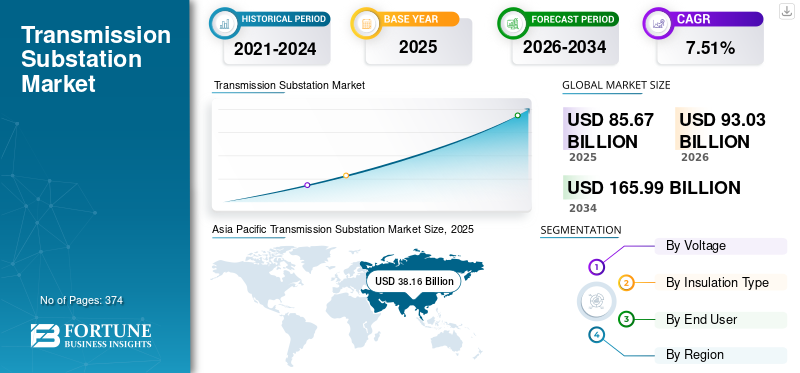
The global transmission substation market size was valued at USD 85.67 billion in 2025. The market is projected to grow from USD 93.03 billion in 2026 to USD 165.99 billion by 2034, exhibiting a CAGR of 7.51% during the forecast period. Asia Pacific dominated the dental implants market with a market share of 44.54% in 2025.
A transmission substation is a high-voltage electrical facility that transforms, switches, controls, and distributes electricity within the transmission network to ensure the reliable power transfer from generating stations to distribution systems and large industrial consumers. It houses critical equipment, such as power transformers, circuit breakers, switchgear, busbars, protection relays, and control systems, to regulate voltage levels and maintain grid stability. Transmission substations also facilitate renewable energy integration, interconnection of transmission lines, fault isolation, and real-time grid monitoring. They are a vital component of modern power systems, supporting the secure, efficient, and uninterrupted electricity transmission over long distances.
The growth of the market is primarily driven by increasing investments in grid modernization, expansion of renewable energy capacity, and rising electricity demand worldwide. Governments and utilities are upgrading aging transmission infrastructure and constructing new substation solutions to improve grid reliability and resilience while accommodating variable renewable power sources. Rapid electrification of transportation, industrial sectors, and data centers is further increasing the need for high-capacity transmission networks. Additionally, growing deployment of HVDC corridors, cross-border interconnections, and digital substations equipped with advanced automation and protection systems is accelerating market growth globally.
Siemens Energy AG, GE Vernova Inc., Schneider Electric SE, ABB Ltd., and Hitachi Energy Ltd. are among the leading players in the market. Leading companies are investing in digital substations, GIS technology, HVDC solutions, and advanced protection and automation systems to meet the growing demand for reliable and efficient power networks. Strategic initiatives such as product innovation, manufacturing capacity expansion, partnerships with utilities, and turnkey EPC contracts are strengthening their market positions. Increasing investments in renewable energy integration, grid modernization, and cross-border transmission projects continue to create significant growth opportunities for both global and regional market participants.
Download Free sample to learn more about this report.
TRANSMISSION SUBSTATION MARKET KEY TAKEAWAYS
 Global Market Size & Forecast
- 2025 Market Size: USD 85.67 billion
- 2026 Market Size: USD 93.03 billion
- 2034 Forecast Market Size: USD 165.99 billion
- CAGR: 7.51% from 2026–2034
 Market Share
- Asia Pacific dominated the market with a 44.54% share in 2025.
- The 220–400 kV segment held the largest market share 31.04% in 2025.
- The Utilities segment held the largest market share 52.30% in 2025.
 Key Regional Highlights
Asia Pacific
Asia Pacific reached USD 38.16 billion in 2025, accounting for 44.55% of global revenue, driven by rapid urbanization, industrialization, smart grid adoption, and extensive high-voltage transmission investments.
Europe
Europe reached USD 18.73 billion in 2025, accounting for 21.87% of global revenue, supported by renewable energy integration, cross-border electricity trading, and investments in digital substations and high-voltage interconnectors.
North America
North America reached USD 13.80 billion in 2025, accounting for 16.10% of global revenue, driven by aging grid replacement, renewable energy integration, grid resilience initiatives, and rising electricity demand from data centers.
U.S.
The market reached USD 11.42 billion in 2025 and is projected to reach USD 12.40 billion by 2026, supported by grid modernization, renewable energy integration, and infrastructure replacement.
Japan
The market reached USD 3.81 billion in 2025 and is projected to reach USD 4.13 billion by 2026, driven by aging infrastructure modernization, grid resilience initiatives, and growing adoption of GIS and digital substations.
Read More

Transmission Substation Market Trends
Accelerating Adoption of Digital and IEC 61850-Based Transmission Substations is Amplifying Market Growth
Digital substations are emerging as one of the most significant trends shaping the global market as utilities increasingly prioritize grid intelligence, automation, and operational efficiency. Unlike conventional substations, digital substations utilize IEC 61850 communication standards, process bus architecture, intelligent electronic devices (IEDs), and fiber-optic communication to improve system reliability while reducing engineering complexity and maintenance costs. The transition is being accelerated by the integration of renewable energy sources into the grid, which requires real-time monitoring and advanced protection systems to manage fluctuating power flows. According to the International Energy Agency (IEA), global investment in electricity grids exceeded USD 400 billion in 2024, with a growing proportion allocated to digitalization and grid modernization initiatives. Europe, China, Japan, and the Middle East are witnessing increasing deployment of digital substations within new transmission projects and brownfield upgrades. Utilities such as National Grid, TenneT, State Grid Corporation of China, and Power Grid Corporation of India are incorporating digital technologies into major transmission expansion programs. As utilities continue investing in cybersecurity, asset monitoring, predictive maintenance, and digital protection systems, the adoption of digital transmission substations is expected to accelerate significantly throughout the forecast period.
MARKET DYNAMICS
Market Drivers
Download Free sample to learn more about this report.
Rapid Expansion of Renewable Energy Capacity to Push Market Growth
The rapid expansion of renewable energy generation is one of the strongest growth drivers for the market worldwide. Large-scale solar parks, offshore wind farms, hydroelectric projects, and battery energy storage systems require new high-voltage substations to connect generation assets with national transmission networks. Renewable energy resources are frequently located far from demand centers, necessitating significant investment in transmission corridors, substations, and HVDC infrastructure. According to the International Renewable Energy Agency (IRENA), global renewable power capacity increased by approximately 585 GW during 2024, representing the largest annual capacity addition ever recorded. The International Energy Agency estimates that over 80 million kilometers of electricity grids will require expansion or modernization by 2040 to meet global climate goals. Countries including China, India, Germany, the U.S., Saudi Arabia, and Australia continue to invest heavily in renewable energy evacuation infrastructure through the development of new transmission substations. Offshore wind projects in Europe and Asia, together with utility-scale solar projects across the Middle East and North America, are substantially increasing demand for high-voltage GIS, AIS, and digital substations, making renewable integration one of the primary long-term growth drivers for the market.
|
Rank |
Market Driver |
Overall Impact Rank |
CAGR Contribution (2026-2034) |
Impact 2026-2028 |
Impact 2029-2031 |
Impact 2032-2034 |
|
1 |
Rising expansion of renewable energy capacity |
High |
+2.50% |
High |
High |
Medium |
|
2 |
Accelerating integration of renewable energy projects requiring new transmission substations, grid interconnections, and power evacuation infrastructure |
High |
+2.08% |
High |
High |
Medium |
|
3 |
Growing deployment of high-voltage and ultra-high-voltage transmission networks to support long-distance bulk power transmission and cross-border interconnections |
High |
+1.72% |
Medium |
High |
High |
|
4 |
Increasing adoption of digital substations, IEC 61850-based automation, advanced protection systems, and real-time grid monitoring technologies |
Medium-High |
+1.42% |
Medium |
High |
High |
|
5 |
Continuous investments in smart grid development, electrification, and utility resilience initiatives driving upgrades of existing transmission substations |
Medium |
+1.13% |
Medium |
Medium |
High |
|
6 |
Others, including replacement of aging substation equipment, industrial electrification, rail electrification, data-center expansion, and increasing electricity demand |
Low |
+0.60% |
Low |
Low |
Medium |
|
|
Total Positive Growth Contribution |
|
+9.45% |
|
|
|
Market Restraints
High Capital Investment and Long Project Development Timelines to Limit Market Growth
The market continues to face challenges associated with high capital investment requirements and lengthy project development cycles. The construction of high-voltage substations involves substantial expenditure on land acquisition, civil works, transformers, GIS or AIS equipment, protection systems, control buildings, and engineering services. Extra-high-voltage and HVDC substations require even greater investments due to the need for specialized equipment and advanced control technologies. In addition to high capital costs, projects frequently encounter delays caused by environmental impact assessments, permitting procedures, public consultations, right-of-way approvals, and procurement complexities. According to the International Energy Agency, delays in permitting and transmission infrastructure development have become one of the major obstacles to global energy transition objectives. In many developed economies, transmission projects often require five to ten years from planning to commissioning due to regulatory approval and stakeholder engagement. Inflation in the prices of raw materials, including copper, electrical steel, aluminum, and specialized electrical equipment, has further increased project costs in recent years. These financial and regulatory challenges can delay investment decisions, slow transmission expansion, and limit the pace of new transmission substation deployment.
|
Rank |
Market Restraint |
Estimated Contribution to CAGR (2026-2034) |
Impact on Market Growth |
Impact (2026-2028) |
Impact (2029-2031) |
Impact (2031-2034) |
|
1 |
High capital investment requirements and long-term project development timelines |
High |
-0.68% |
High |
High |
High |
|
2 |
Lengthy permitting processes, environmental clearances, right-of-way challenges, and complex regulatory approvals delaying transmission substation development and expansion projects |
High |
-0.57% |
High |
Medium |
Medium |
|
3 |
Supply-chain constraints and price volatility of critical electrical equipment, including power transformers, GIS, circuit breakers, copper, and electrical steel, resulting in procurement delays and higher project costs |
Medium-High |
-0.43% |
High |
Medium |
Medium |
|
4 |
Others, including shortage of skilled engineering personnel, cybersecurity risks, land-availability constraints, utility budget limitations, and community opposition to transmission infrastructure |
Low |
-0.26% |
Medium |
Low |
Low |
|
|
Total Negative Growth Impact |
|
-1.94 |
|
|
|
Market Opportunities
Expansion of HVDC Transmission Systems and Cross-Border Grid Interconnections to Create New Growth Avenues
The global expansion of high-voltage direct current (HVDC) transmission systems and cross-border grid interconnections presents significant opportunities for the transmission substation market. The increasing deployment of renewable energy generation requires long-distance bulk power transmission with lower electrical losses, making HVDC technology increasingly attractive for utilities and transmission operators. HVDC converter substations, which represent some of the highest-value assets within transmission networks, are witnessing growing demand across Asia, Europe, the Middle East, and North America. According to the International Energy Agency, achieving global net-zero targets will require transmission network expansion of more than 25 million kilometers by 2030, including numerous cross-border interconnections and ultra-high-voltage corridors. China continues to expand the world's largest UHV AC/DC transmission network to transport renewable electricity over thousands of kilometers, while Europe is strengthening offshore wind interconnections through projects in the North Sea and Baltic Sea. Similar investments are emerging across India, GCC countries, Australia, and Latin America. These developments are creating substantial opportunities for manufacturers of GIS, transformers, protection systems, digital substations, and EPC contractors specializing in large-scale transmission infrastructure.
Market Challenges
Growing Pressure on Supply Chains and Skilled Workforce Shortages to Limit Market Growth
One of the major challenges facing the transmission substation market is the growing pressure on global supply chains and the shortage of skilled engineering resources. Rising demand for transformers, GIS equipment, high-voltage switchgear, protection relays, and power cables has significantly increased manufacturing lead times. According to the International Energy Agency's Building the Future Transmission Grid report, delivery times for large power transformers have increased from approximately 12-18 months to more than 24 months in several markets due to manufacturing capacity constraints and growing global demand. Similar supply chain pressures are also affecting GIS equipment, circuit breakers, and high-voltage conductors. At the same time, utilities and EPC contractors are facing shortages of experienced protection engineers, commissioning specialists, relay technicians, and high-voltage construction personnel. These workforce constraints increase project execution risks, delay commissioning schedules, and raise installation costs. Furthermore, the rapid adoption of digital substations requires specialized expertise in IEC 61850 communication protocols, cybersecurity, automation software, and intelligent electronic devices, creating an additional skills gap that utilities and manufacturers must address to support future transmission infrastructure expansion.
Segmentation Analysis
By Voltage
Widespread Use in Transmitting Bulk Electricity Over Long Distances Encouraged 220–400 kV Segment Growth
Based on voltage, the market is segmented into below 132 kV, above 132–220 kV, above 220–400 kV, above 400–765 kV, and above 765 kV.
The 220–400 kV segment held the largest market share, accounting for approximately 31.04% in 2025. The segment accounts for one of the largest market shares in value terms owing to its widespread use in backbone transmission networks. These substations play a critical role in transmitting bulk electricity over long distances while connecting major power generation facilities, renewable energy parks, and regional transmission corridors. Utilities are increasingly investing in this voltage class to strengthen grid resilience, reduce transmission congestion, and support cross-border electricity trading. Growing renewable energy integration, expansion of offshore wind projects, and increasing electricity demand from industrial facilities and data centers continue to drive investments in 220–400 kV substations. In addition, advanced protection systems, digital substations, and high-capacity transformers further enhance the importance of this segment within modern transmission infrastructure.
The above 765 kV segment is expected to grow at a CAGR of 8.56% over the forecast period.
To know how our report can help streamline your business, Speak to Analyst
By Insulation Type
Lower Installation Cost and Simpler Design Boosted Air Insulated Substation Segment Growth
Based on insulation type, the market is segmented into gas insulated substation and air insulated substation.
The air insulated substation segment accounted for the major transmission substation market share in 2025. The segment continues to hold the largest share of the market owing to its lower installation cost, simpler design, and widespread deployment across utility transmission networks. AIS substations are particularly suitable for regions where land availability is not a major constraint, including North America, Latin America, India, Southeast Asia, and many parts of Africa. They are extensively used for greenfield transmission projects, renewable energy evacuation, rural electrification, and grid expansion programs due to their cost-effectiveness and ease of maintenance. In addition, AIS technology offers greater flexibility for future capacity expansion, making it the preferred choice for large outdoor substations.
The gas insulated substation segment is expected to grow at a CAGR of 8.20% during the forecast period.
By End User
Continuous Investments in Grid Expansion and Modernization Propelled Utilities Segment Growth
Based on End User, the market is segmented into transportation, renewable energy, utilities, oil & gas, industrial & commercial, and others.
The utilities segment captured the largest market share, accounting for around 52.30% in 2025. The segment dominates the market owing to continuous investments in grid expansion, modernization, and replacement of aging electrical infrastructure. Transmission system operators and electric utilities are constructing new substations and upgrading existing facilities to improve grid reliability, reduce transmission congestion, and support increasing electricity demand. Utilities are also investing in advanced substations, digital protection systems, substation automation, and high-voltage transformers to support renewable energy integration and enhance operational efficiency. Large-scale national transmission expansion programs across China, India, the U.S., Europe, and the Middle East continue to position utilities as the largest end-user segment globally.
The renewable energy segment is expected to grow at a CAGR of 8.66% over the forecast period.
Transmission Substation Market Regional Outlook
By region, the market has been studied across North America, Europe, Asia Pacific, Latin America, and the Middle East & Africa.
North America
Asia Pacific Transmission Substation Market Size, 2025 (USD Billion)
To get more information on the regional analysis of this market, Download Free sample
The market in North America was valued at USD 13.80 billion in 2025, accounting for approximately 16.10% of global revenues. North America represents a mature yet steadily expanding market, driven by the replacement of aging grid infrastructure and increasing integration of renewable energy projects. The region is witnessing substantial investments in high-voltage substations to improve grid resilience against extreme weather events and meet the growing demand for electricity, driven by electrification and hyperscale data centers. According to the U.S. Department of Energy (DOE), the U.S. announced more than USD 13 billion in federal funding and financing opportunities for grid modernization and transmission expansion under the Grid Resilience and Innovation Partnerships (GRIP) Program and related initiatives. Canada is also investing in transmission infrastructure to support hydroelectric development and critical mineral projects, reinforcing the region's long-term demand for advanced transmission substations.
U.S. Transmission Substation Market
The U.S. market was valued at USD 11.42 billion in 2025 and is estimated to reach USD 12.40 billion in 2026. The U.S. is the largest market in North America, supported by extensive investments in grid modernization, renewable energy integration, and aging infrastructure replacement. Large-scale transmission projects are being developed to connect utility-scale solar, wind, and battery energy storage facilities while improving grid resilience against extreme weather events. In addition, the expansion of hyperscale data centers and manufacturing facilities is increasing the demand for high-voltage substations, particularly in rapidly growing industrial regions.
Europe
The Europe market was valued at USD 18.73 billion in 2025, representing approximately 21.87% of global revenues. The region remains one of the most technologically advanced transmission substation markets due to its strong emphasis on renewable energy integration, cross-border electricity trading, and decarbonization. Transmission system operators are investing heavily in digital substations, offshore wind connections, and high-voltage interconnectors to strengthen regional grid stability. According to the European Commission, more than USD 6.55 billion has been allocated through the Connecting Europe Facility (CEF) Energy between 2021 and 2027 to support cross-border electricity and energy infrastructure projects. Countries such as Germany, the U.K., France, and Italy are expanding high-voltage transmission networks to facilitate offshore wind integration, enhance energy security, and reduce transmission congestion across interconnected European markets.
Germany Transmission Substation Market
The Germany market was valued at USD 3.99 billion in 2025 and is estimated to reach USD 4.35 billion in 2026. Germany remains one of Europe's leading markets due to its ongoing energy transition and large-scale deployment of renewable energy. The country is strengthening north-south transmission corridors to transport wind-generated electricity from coastal regions to industrial centers in southern Germany. Grid expansion, digital substations, and cross-border interconnections continue to drive investments in high-voltage transmission infrastructure.
U.K. Transmission Substation Market
The U.K. market was valued at USD 2.74 billion in 2025 and is estimated to reach USD 2.97 billion in 2026. The market is driven by offshore wind expansion, transmission network reinforcement, and the transition toward a net-zero electricity system. Major investments are being made to connect offshore wind farms in the North Sea and strengthen the national transmission network through new GIS and digital substations. In addition, increasing electricity demand driven by transport electrification and heat pump adoption continues to support long-term substation investments.
Asia Pacific
Asia Pacific dominated the market, valued at USD 38.16 billion in 2025, accounting for approximately 44.55% of the global market. The growth is owing to rapid urbanization, industrialization, the adoption of smart grid technologies, and substantial investments in electricity infrastructure. China and India continue to construct extensive ultra-high-voltage transmission corridors, while Southeast Asian countries are strengthening national grids to support growing electricity consumption. According to China's National Energy Administration (NEA), China added approximately 429 GW of new power generation capacity during 2024, creating significant demand for transmission substations and grid infrastructure to evacuate new renewable and conventional generation. Simultaneously, countries including Australia, Vietnam, Indonesia, and India are expanding renewable energy zones and interstate transmission corridors, making Asia Pacific the largest regional market for both AIS and GIS transmission substations.
China Transmission Substation Market
China remained the dominant contributor to the Asia Pacific market, valued at USD 21.08 billion in 2025, and is estimated to reach USD 23.04 billion in 2026. China dominates the global market through continuous expansion of its ultra-high-voltage (UHV) AC and DC transmission network. Massive investments in renewable energy bases across western China require long-distance transmission infrastructure to supply electricity to major urban and industrial centers. The country's ongoing industrialization, electrification, and digital grid development continue to generate substantial demand for advanced transmission substations.
India Transmission Substation Market
The Indian market was valued at USD 5.64 billion in 2025 and is estimated to reach USD 6.19 billion in 2026. India is one of the fastest-growing markets, driven by rapidly increasing electricity demand, renewable energy expansion, and interstate transmission development. The government continues to invest in 400 kV and 765 kV substations to support renewable energy zones, Green Energy Corridor projects, and nationwide transmission strengthening. Industrial growth, urbanization, and rural electrification are further accelerating the deployment of new high-voltage substations across the country.
Japan Transmission Substation Market
Japan was valued at USD 3.81 billion in 2025 and is estimated to reach USD 4.13 billion in 2026. Japan's market is defined by continuous modernization of aging infrastructure and increasing emphasis on grid resilience and reliability. Utilities are investing in GIS and digital substations to improve operational efficiency, particularly in densely populated urban areas where space constraints favor compact installations. Renewable energy integration and grid reinforcement following energy sector reforms continue to support steady transmission substation market growth.
Latin America
Latin America accounted for USD 5.83 billion in 2025, accounting for approximately 6.81% of global revenues. Latin America is experiencing steady growth in transmission substation investments as governments modernize electricity infrastructure and connect renewable energy resources with urban demand centers. Brazil, Chile, Colombia, and Mexico continue to expand high-voltage transmission networks to improve grid reliability and facilitate renewable energy integration. According to Brazil's National Electric Energy Agency (ANEEL), transmission auctions conducted in recent years have awarded contracts for thousands of kilometers of new transmission lines and hundreds of associated substation bays, representing billions of dollars in infrastructure investment. Mining developments, hydropower expansion, and increasing solar and wind installations across the region are further driving demand for high-voltage transmission substations and associated grid equipment.
Middle East & Africa
The Middle East & Africa region was valued at USD 9.15 billion in 2025. The market is expanding due to increasing investments in utility infrastructure, industrial diversification, renewable energy projects, and cross-border power interconnections. GCC countries are investing significantly in transmission networks to support smart cities, industrial zones, desalination facilities, and large-scale renewable energy developments, while African nations continue expanding electricity access and grid reliability. The African Development Bank (AfDB) has committed USD 10 billion under its Mission 300 initiative, launched in partnership with the World Bank Group, to help expand electricity access across Africa by 2030 through investments in generation, transmission, and distribution infrastructure. Simultaneously, Saudi Arabia, the UAE, Egypt, Morocco, and South Africa are implementing major transmission expansion programs, which continue to stimulate advanced transmission substations across the region.
GCC Transmission Substation Market
The GCC market was valued at USD 5.50 billion in 2025 and is estimated to reach USD 5.95 billion in 2026. The GCC represents the largest market in the Middle East, supported by investments in smart cities, industrial diversification, renewable energy projects, and regional grid interconnections. Countries such as Saudi Arabia and the UAE are deploying advanced GIS and digital substations for mega-projects, utility expansion, and large industrial developments. Growing electricity demand from desalination plants, hydrogen projects, and economic diversification initiatives continues to create strong opportunities for transmission infrastructure investment.
COMPETITIVE LANDSCAPE
Key Industry Players
Key Players are Investing in Research and Development to Boost their Market Share
Siemens Energy AG, GE Vernova, Schneider Electric, ABB Ltd., and Hitachi Energy Ltd. are among the most influential technology companies driving the market. Leading companies in the industry maintain their market leadership through continuous investment in research and development, advanced grid technologies, and the expansion of their global manufacturing and engineering capabilities. These companies focus on developing high-voltage equipment, digital substations, intelligent protection systems, and grid automation solutions that improve reliability and operational efficiency. Strategic partnerships with utilities, transmission system operators, EPC contractors, and government agencies enable these companies to secure large-scale infrastructure projects worldwide. Additionally, their emphasis on product innovation, sustainability, localized manufacturing, and comprehensive lifecycle services strengthens their competitive position while supporting the growing demand for resilient and modern electricity transmission networks.
List of Key Transmission Substation Companies Profiled
- Hitachi Energy Ltd. (Switzerland)
- ABB Ltd. (Switzerland)
- Siemens Energy AG (Germany)
- Schneider Electric SE (France)
- GE Vernova Inc. (U.S.)
- Mitsubishi Electric Corporation (Japan)
- Toshiba Energy Systems & Solutions Corporation (Japan)
- Hyosung Heavy Industries Corporation (South Korea)
- NR Electric Co., Ltd. (China)
- Bharat Heavy Electricals Limited (BHEL) (India)
- Fuji Electric Co., Ltd. (Japan)s
- Larsen & Toubro (L&T) (India)
- Elsewedy Electric (Egypt)
- Hyundai Electric & Energy Systems Co., Ltd. (South Korea)
- CG Power and Industrial Solutions Ltd. (India)
KEY INDUSTRY DEVELOPMENTS
- May 2026: SSEN Transmission awarded framework agreements to GE Vernova and Hitachi Energy to deploy modular transmission substations across Scotland. The modular approach is expected to accelerate grid connections, reduce construction time, and support rapid expansion of renewable energy infrastructure.
- April 2026: Hitachi Energy announced a strategic partnership with Ørsted to provide end-to-end electrical infrastructure for offshore wind projects. The collaboration includes offshore substations, grid connection technologies, and transmission solutions to support large-scale renewable energy integration.
- May 2025: Trench Group entered into long-term framework agreements with GE Vernova, Hitachi Energy, and Siemens Energy to supply high-voltage grid components for transmission infrastructure. These strategic partnerships strengthen supply chains for transmission substations and support the growing global demand for grid modernization and renewable energy integration.
- April 2025: Hitachi Energy, in consortium with Bharat Heavy Electricals Limited (BHEL), secured a major contract from Adani Energy Solutions to deliver a 950 km, 6 GW HVDC transmission link connecting Rajasthan with Uttar Pradesh. The project would strengthen renewable energy evacuation and is among India's largest transmission infrastructure developments.
- February 2025: Siemens Energy continued execution of the SuedLink project by supplying HVDC converter station technology for one of Germany's largest underground transmission corridors. The project is designed to transport renewable electricity from northern Germany to major industrial regions in the south, supporting the country's energy transition.
REPORT COVERAGE
The transmission substation report provides a comprehensive analysis of the market, focusing on key aspects such as leading companies, product processes, and Porter’s Five Forces. Additionally, the report provides valuable insights into market trends and highlights key industry developments. In addition to the factors mentioned above, the report also encompasses several factors that contributed to the market's growth in recent years.
Request for Customization to gain extensive market insights.
REPORT SCOPE & SEGMENTATION
| ATTRIBUTE | DETAILS |
| Study Period | 2021-2034 |
| Base Year | 2025 |
| Estimated Year | 2026 |
| Forecast Period | 2026-2034 |
| Historical Period | 2021-2024 |
| Growth Rate | CAGR of 7.51% from 2026 to 2034 |
| Unit | Value (USD Billion) and Volume (Units) |
|
Segmentation |
By Voltage
|
|
By Insulation Type
|
|
|
By End User
|
|
|
By Region
|
Frequently Asked Questions
According to Fortune Business Insights, the global market value stood at USD 85.67 billion in 2025 and is projected to reach USD 165.99 billion by 2034.
In 2025, the market value stood at USD 38.16 billion.
The market is expected to exhibit a CAGR of 7.51% during the forecast period.
By voltage, the above 220–400 kV segment led the market.
Growing expansion of renewable energy capacity are the key factor driving market expansion.
Siemens Energy AG, GE Vernova Inc., Schneider Electric SE, ABB Ltd., and Hitachi Energy Ltd. are the major players in the global market.
Asia Pacific dominated the market in 2025.



- 2021-2034
- 2025
- 2021-2024
- 374
Get 30-60 hrs Free Customization
Expand Regional and Country Coverage, Segments Analysis, Company Profiles, Competitive Benchmarking, and End-user Insights.



















Related Reports
-
US +1 833 909 2966 ( Toll Free )
-
Get In Touch With Us