Truck Platooning Market Size, Share & Industry Analysis, By Technology (Adaptive Cruise Control (ACC), Blind Spot Warning (BSW), Forward Collision Warning (FCW), Lane Keep Assistance (LKA), Autonomous Emergency Braking (AEB), and Others), By Infrastructure Type (Vehicle-to-Vehicle (V2V), Vehicle-to-Infrastructure (V2I), and Others), By Level of Autonomy (Semi-autonomous and Fully Autonomous), and Regional Forecast, 2026-2034
 Download Free Sample
(Offer valid till 30th Sep 2026)

Truck Platooning Market Analysis
 Listen to Audio Version
The global truck platooning market size was valued at USD 150.16 million in 2025 and is projected to grow from USD 216.49 million in 2026 to USD 10,152.50 million by 2034, exhibiting a CAGR of 61.80% during the forecast period. Europe dominated the market with a market share of 49.54% in 2025.
Truck platooning is an emerging technology enabling trucks to communicate and follow closely, reducing air drag and enhancing efficiency and fuel economy. A combination of connected vehicle technology and production systems allows the trucks to closely follow each other by communicating through V2V infrastructure, and others. Therefore, trucks continuously communicate and coordinate travel with other trucks in proximity.
As the adoption of new-generation trucks is increasing across logistics and transportation operations, so is the demand for truck platooning. The technology is nascent and evolving continuously owing to the significant R&D investment from major players such as Pelton Technology Inc., Scania AB, and Volkswagen. Moreover, increasing demand for efficient fleet operations among fleet managers worldwide is anticipated to boost market growth.
The COVID-19 pandemic negatively impacted the truck platooning industry. Significantly dropped logistics and transportation operations due to stringent government guidelines and closed manufacturing facilities resulted in a drop in demand for platooning. Economic instability induced by COVID-19 also restrained key players from investing in nascent technologies, such as autonomous trucks, platooning, and related technologies.
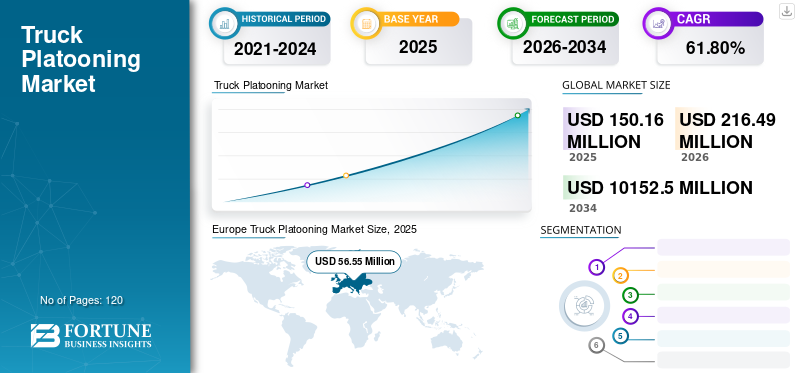
Download Free sample to learn more about this report.
Global Truck Platooning Market Key Takeaways
 Market Size & Forecast
- 2025 Market Size: USD 150.16 million
- 2026 Market Size: USD 216.49 million
- 2034 Forecast Market Size: USD 10,152.50 million
- CAGR: 61.80% from 2026–2034
 Market Share
- Europe dominated the truck platooning market with a 49.54% share in 2025.
- The Adaptive Cruise Control (ACC) segment accounted for 32.33% of the market in 2026.
- The Vehicle-to-Vehicle (V2V) segment is forecasted to capture the largest global truck platooning market share of 60.05% in 2026.
 Key Regional Highlights
Europe
The Europe market generated USD 56.55 million in 2025, representing 49.54% of the global market landscape, and is expected to reach USD 81.7 million in 2026, supported by strong adoption of connected and autonomous trucking technologies.
North America
North America representing 37.66% of the global market, and is projected to reach USD 81.7 million in 2026 & is benefiting from government-backed pilot projects and investments in autonomous vehicle deployment.
Asia Pacific
Asia Pacific contributed 12.62% to the global market in 2025, with a valuation of USD 18.95 million, and is projected to reach USD 27.78 million in 2026.
U.S.
The market is projected to reach USD 70 million by 2026, driven by increasing support for autonomous transportation and platooning initiatives.
Japan
The market reached USD 6.8 million in 2025 and is expected to grow to USD 10 million by 2026, supported by advanced automotive technologies and strong logistics infrastructure.
Read More

Truck Platooning Market Trends
Increasing Adoption of Autonomous Truck Fleets to Drive Market Growth
Autonomy is one of the major ongoing megatrends in the automotive and transportation sector. Similarly, in the case of the trucking industry, penetration of autonomy has been witnessing consistent growth over the past decade. As platooning requires a significant level of autonomy for efficient operations, adopting autonomous trucks in the trucking industry is anticipated to boost market growth during the forecast period. For instance, in January 2023, U.S.-based startup Outrider raised nearly USD 73 million in funding to ramp up its autonomous truck operations.
Download Free sample to learn more about this report.
Truck Platooning Market Growth Factors
Increasing Demand for Road Safety to Drive Market Growth
Increasing demand for road safety worldwide is driving the market growth. Trucks used for logistics and transportation carry a heavy load of cargo. Therefore, increasing number of road accidents of these heavy-duty trucks has fueled the demand for road safety. According to the National Highway Traffic Safety Administration (NHTSA), 523,796 large trucks were involved in traffic crashes across the U.S. in 2021. Platooning improves road safety by managing the speed, travel, braking, and other truck parameters through V2V communication across the fleet of trucks. Hence, surging demand for road safety worldwide is anticipated to boost market growth in future.
Truck platooning systems often integrate safety features, such as adaptive cruise control, which adjusts the vehicle's speed to maintain a safe following distance. Collision avoidance systems enhance safety by providing warnings or taking corrective actions to prevent accidents. These technologies collectively contribute to safer road conditions.
Surging Demand for Efficient Trucking Operations to Fuel the Market Growth
The trucking industry is continuously trying to improve the efficiency of truck fleets for cost-effective long-distance deliveries. Platooning optimizes transport through effective utilization of the roads assisting the logistics companies to deliver goods faster. Additionally, effective road utilization also reduces traffic jams. Through platooning technology, the trucks form road trains by traveling closely in a single file; this significantly reduces the air drag on the trucks resulting in improved fuel economy. All these factors improve the efficiency of trucking operations, further fueling the demand for truck platooning. Truck platooning entails a group of trucks closely following one another, minimizing aerodynamic drag. This leads to enhanced fuel efficiency by reducing air resistance experienced by the trucks. The consequent decrease in fuel consumption translates into significant cost savings for fleet operators, ultimately bolstering overall profitability.
RESTRAINING FACTORS
High Cost of Platooning Technology May Hamper the Market Growth
Platooning is a nascent technology; therefore, high hardware, technology, and operating costs are restraining its adoption in developing & underdeveloped economies. Additionally, truck platooning requires trucks equipped with a significant level of automation. Hence, the slow adoption of automated trucks in these developing & underdeveloped economies is also anticipated to hamper the truck platooning market growth.
The legal framework and regulations governing autonomous and connected vehicles, including truck platooning, are not standardized globally or nationally. Varying regulations across different jurisdictions create uncertainty and hinder the widespread adoption of these technologies.
Truck Platooning Market Segmentation Analysis
By Technology Analysis
Stringent Government Regulations Related to Road Safety Are Expected to Drive the Adaptive Cruise Control (ACC) Market Growth
By technology, the market is segmented into Adaptive Cruise Control (ACC), Blind Spot Warning (BSW), Forward Collision Warning (FCW), Lane Keep Assistance (LKA), Autonomous Emergency Braking (AEB), and others.
The Adaptive Cruise Control (ACC) segment holds the major market share of 32.33% in 2026 and is growing with 34.71% in 2025. Platooning requires commercially available adaptive cruise control and collision avoidance systems as key components for effective operation. Therefore, the demand for adaptive cruise control among platooned trucks is increasing rapidly. Adaptive cruise control automatically adjusts the vehicle's speed to match the vehicle running in front. Therefore, surging demand for accurate speed matching among the platooned trucks is anticipated to propel the segment growth.
The Forward Collision Warning (FCW) segment is anticipated to witness the fastest growth rate during the forecast period. Forward collision warning is important to avoid accidents when vehicles run unsupervised. Moreover, forward collision warning is a highly important technology for platooning on autonomous fleets in the coming years. Therefore, increasing demand for forward collision warning in autonomous trucks for enhanced road safety and crash prevention is anticipated to boost the market growth.
By Infrastructure Type Analysis
Rising Penetration of V2V Communication Between Truck Fleets to Drive Segment Growth
By infrastructure type, the market is classified into Vehicle-to-Vehicle (V2V), Vehicle-to-Infrastructure (V2I), and others.
The Vehicle-to-Vehicle (V2V) segment is forecasted to capture the largest global truck platooning market share of 60.05% in 2026. The V2V segment is estimated to reach a value of USD 91.3 million in 2025. Platooned trucks use Wi-Fi connection, V2V communication, radar, and other sensors to communicate with the fleet effectively. Therefore, as the demand for effective communication between platooned trucks increases, so does V2V communication. Major key players focused on improving the range of V2V connectivity for long-distance communication. Therefore, surging R&D investments in V2V communication technology will accelerate market growth over the forecast period.
The Vehicle-to-Infrastructure (V2I) segment is anticipated to witness the highest growth rate during the forecast period. V2I enables wirelessly exchanging data and allows communication between vehicle and road infrastructure. Increasing demand for V2I communication for the safe & effective operations of autonomous truck fleets is expected to fuel the market growth in the coming years.
To know how our report can help streamline your business, Speak to Analyst
By Level of Autonomy Analysis
Surging Investments to Develop Fully Autonomous Trucks to Propel the Segment Growth
By level of autonomy, the market is categorized into semi-autonomous and fully autonomous.
The semi-autonomous segment is expected to lead the market in 2026 with a share of 92.38% and is likely to continue its dominance throughout the forecast period. Currently, most of the trucks in the market are of semi-autonomous technology. These trucks have Advanced Driver Assistance (ADAS) and connected technology. Therefore, the surging use of these semi-autonomous trucks for platooning will likely drive market growth during the forecast period. Additionally, the penetration of autonomy in the trucking industry is not up to the market and is expected to take significant time to reach maturity. Therefore, using semi-autonomous trucks is the only viable option for fleet managers. All these factors are anticipated to boost the segment growth in future years.
The fully autonomous segment is projected to grow fastest over the forecast period. Fully autonomous technology is being tested and expected to take over semi-autonomous trucks in upcoming years. Therefore, rising demand for these autonomous truck fleets in truck platooning is driving the investment in self-driving technology. For instance, in April 2023, one of the leading autonomous driving technology companies, Aurora, announced its plans to roll out an autonomous trucking service between Houston and Dallas to test its self-driving freight-hauling services by 2024. Therefore, key players' initiatives to commercialize autonomous trucking are anticipated to ramp up market growth in the coming years.
REGIONAL INSIGHTS
Technological Advancements in European Trucking Industry to Drive Market Growth
Regionally, the market is categorized into North America, Europe, Asia Pacific, and the rest of the world.
Europe Truck Platooning Market Size, 2025 (USD Million)
To get more information on the regional analysis of this market, Download Free sample
Europe
The Europe market generated USD 56.55 million in 2025, representing 49.54% of the global market landscape, and is expected to reach USD 81.7 million in 2026, and is expected to continue its dominance throughout the forecast period. Europe is projected to exhibit a CAGR of 57%. The presence of major trucking companies, such as Daimler, MAN, and others, is driving market growth in the region. For instance, most truck platooning technology providers, such as Volvo, Daimler, Scania, MAN, and others, are based in Europe. The UK market is projected to reach USD 8 million by 2026, while the Germany market is projected to reach USD 40 million by 2026.
Additionally, the ENSEMBLE project aims to implement multi-brand truck platooning in Europe to fuel economy and improve traffic safety, which is likely to drive market growth. Moreover, the stringency of safety norms in Europe is higher than in any other country. For instance, advanced emergency braking and lane-keep assistance have been mandatory for all trucks in Europe since 2015. All these factors will support the market growth in the coming years.
Asia Pacific
Asia Pacific contributed 12.62% to the global market in 2025, with a valuation of USD 18.95 million, and is projected to reach USD 27.78 million in 2026. The Asia Pacific market is expected to witness the fastest growth rate during the forecast period. The truck platooning market in Japan is expected to reach an estimated value of USD 6.8 million in 2025. The rapidly growing trucking industry, coupled with the strong presence of manufacturing and logistics sectors in emerging economies, including India, China, and others, is expected to influence the adoption of commercial vehicle platooning in the region. Moreover, APAC accounts for truck sales more than any other region. The market in China is expected to grow at a steady CAGR of 59.1%. Therefore, the vast availability of truck fleets and advanced trucking technologies developed by key players operating in China, Japan, and India are anticipated to fuel the market growth in future. The Japan market is projected to reach USD 10 million by 2026, the China market is projected to reach USD 20 million by 2026, and the India market is projected to reach USD 0.3 million by 2026.
North America
In 2025, North America accounted for USD 56.55 million, representing 37.66% of the global market, and is projected to reach USD 81.7 million in 2026. Governments in North America are showing increasing interest in supporting and promoting the adoption of autonomous vehicle technologies. Various initiatives, grants, and pilot projects are being launched to encourage the implementation of platooning and explore its benefits. The U.S. market is projected to reach USD 70 million by 2026.
The rest of the World contributed approximately USD 0.27 million to the global market in 2025, accounting for 0.18% share, and is expected to reach USD 0.37 million in 2026.
List of Key Companies in the Truck Platooning Market
Players Focus on Strategic Acquisitions to Gain Competitive Advantage in the Market
Almost all the key players operating in this industry, including Daimler, Volvo, and others are focused on strategic partnerships & acquisitions for the development and early deployment of autonomous truck fleets. For instance, in February 2023, Torc Robotics, a Daimler Truck subsidiary, announced the acquisition of Algolux Inc. The acquisition assisted the company in bringing SAE level 4 autonomous trucks into series production in the U.S. within a decade. Therefore, as autonomous trucks' availability increases worldwide, the utilization of efficient truck platooning technology in logistics and transportation activities is expected to grow rapidly in the coming years.
LIST OF KEY COMPANIES PROFILED:
- AB Volvo (Sweden)
- Daimler (Germany)
- Scania (Sweden)
- Peloton Technology (U.S.)
- Continental AG (Germany)
- Volkswagen AG (Germany)
- Wabco (Switzerland)
- Navistar, Inc. (U.S.)
- MAN (Germany)
- ZF Friedrichshafen AG (Germany)
- Bendix Commercial Vehicles Systems LLC (U.S.)
KEY INDUSTRY DEVELOPMENTS:
- June 2023 – TuSimple, a global autonomous driving technology company, began testing its level 4 autonomous vehicles. The test run started in Japan’s critical freight corridor. The freight corridor connects the major Japanese cities, including Nagoya, Osaka, and Tokyo.
- June 2023 – TuSimple started testing its autonomous trucks on public roads in China. The ‘Driver Out’ run was approved by the government of Shanghai.
- May 2023 – EASE Logistics partnered with the Ohio Department of Logistics (ODOT) and DriveOhio's Rural Automated Driving Systems (ADS) project to deploy automated trucking technology on revenue-generating routes.
- February 2023 – Italian transport company IVECO and American-based trucking technology company Plus started public road testing of its jointly developed new generation of automated trucks in Germany.
- February 2022 – Waymo started testing its autonomous trucks in Texas in partnership with a leading global logistics service provider, CH Robinson.
REPORT COVERAGE
The report provides detailed truck platooning market analysis and focuses on key aspects such as leading companies, product types, technology, design, and technology. Besides this, the report offers insight into the market trends and highlights key industry developments. In addition to the factors mentioned above, the report encompasses several factors that have contributed to the growth of the market in recent years.
Request for Customization to gain extensive market insights.
Report Scope & Segmentation
|
ATTRIBUTE |
DETAILS |
|
|
Study Period |
2021-2034 |
|
|
Base Year |
2025 |
|
|
Estimated Year |
2026 |
|
|
Forecast Period |
2026-2034 |
|
|
Historical Period |
2021-2024 |
|
|
Unit |
Value (USD Million) |
|
|
Growth Rate |
CAGR of 61.80% from 2026 to 2034 |
|
|
Segmentation |
By Technology
By Infrastructure Type
By Level of Autonomy
By Geography
|
|
Frequently Asked Questions
Fortune Business Insights says that the market was valued at USD 150.16 million in 2025 and is projected to reach USD 10,152.50 million in 2034.
The market is expected to register a CAGR of 61.80% during the forecast period (2026-2034).
Increasing demand for safe & efficient logistics operations to drive the market growth.
Europe led the market size in 2025.
The semi-autonomous segment dominated the market in 2025.



- 2021-2034
- 2025
- 2021-2024
- 120
-
(Offer valid till 30th Sep 2026)
Get 30-60 hrs Free Customization
Expand Regional and Country Coverage, Segments Analysis, Company Profiles, Competitive Benchmarking, and End-user Insights.




















Related Reports
-
US +1 833 909 2966 ( Toll Free )
-
Get In Touch With Us