UV Filters Market Size, Share & Industry Analysis, By Product Type (Organic and Inorganic), By Application (Sunscreens, Oils, and Others), and Regional Forecast, 2026-2034
 Download Free Sample
KEY MARKET INSIGHTS
 Listen to Audio Version
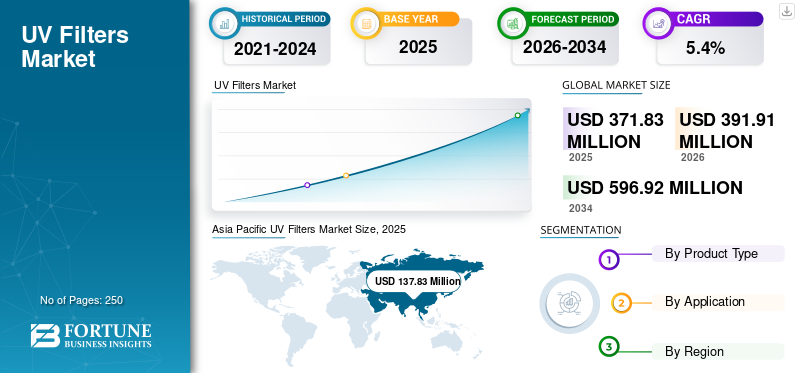
The global UV filters market size was valued at USD 371.83 million in 2025 and is estimated to increase from USD 391.91 million in 2026 to USD 596.92 million by 2034, demonstrating a CAGR of 5.40% between 2026-2034. Asia Pacific dominated the UV filters market with a market share of 37.07% in 2025.
Ultraviolet (UV) filters are substances that protect the skin from the harmful effects of UV radiation. They are commonly used in sunscreens, sunglasses, and other UV protective products. The two main types of UV radiation that can damage the skin are UVA and UVB. UV filters work by either absorbing or reflecting harmful rays and preventing them from penetrating the skin. Some common filters include avobenzone, octinoxate, and zinc oxide.
UV filters are important for protecting the skin during outdoor activities and preventing skin cancer and premature aging caused by UV exposure. Moreover, the popularity of outdoor activities such as hiking, swimming, and sports has contributed to the growth of the market. In addition, the rising use of such filters in industrial applications such as plastics, textiles, and paints will lead to market growth.
Download Free sample to learn more about this report.
UV FILTERS MARKET KEY TAKEAWAYS
 Global Market Size & Forecast
- 2025 Market Size: USD 371.83 million
- 2026 Market Size: USD 391.91 million
- 2034 Forecast Market Size: USD 596.92 million
- CAGR: 5.40% from 2026–2034
 Market Share
- Asia Pacific dominated the UV filters market with a 37.07% share in 2025.
- Organic UV filters held the largest market share by product type.
- Sunscreens accounted for the dominant share by application.
 Key Regional Highlights
North America
North America is growing with rising personal care spending.
Asia Pacific
Asia Pacific led the market with a 37.07% share in 2025.
Europe
Europe is driven by growing UV protection awareness.
U.S.
U.S.: Personal care spending is supporting market growth.
Japan
Japan: Strong personal care demand is driving adoption.
Read More

UV Filters Market Trends
Increasing Product Use in Electronic Devices to Protect Screens from UV Damage to Boost Market Growth
The use of ultraviolet filters in electronic devices, such as smartphones and laptops, has become increasingly prevalent in recent years. These filters are designed to protect screens from the harmful effects of UV radiation. The radiation, which is present in sunlight and other sources of light, can cause damage to the screen over time, resulting in reduced visibility, color distortion, and other issues. Ultraviolet filters work by blocking out harmful UV rays while allowing visible light to pass through. This helps to reduce the risk of screen damage and extends the life of the device. Some electronic devices come with built-in UV filters, while others require users to purchase separate filters to attach to the screen.
- Asia Pacific witnessed a uv filters market growth from USD 113.05 million in 2021 to USD 117.71 million in 2022.
Despite the benefits of UV filter, it is important to note that they are not foolproof. In some cases, prolonged exposure to UV radiation can still cause damage to the screen, even with a filter in place. Additionally, some users have reported that UV filters can cause a slight reduction in screen brightness or clarity. Overall, the use of products in electronic devices is a positive development that helps to protect these devices and extend their lifespan. As technology continues to advance, the product will likely become even more effective and widely used in the years to come.
Download Free sample to learn more about this report.
UV Filters Market Growth Factors
Increasing Awareness about Harmful Effects of UV Radiation on Human Health to Drive Market Growth
Over the past few years, there has been a significant increase in the consumption of UV filters. This increased consumption can be attributed to the growing awareness among people about the harmful effects of UV radiation on human health. UV radiation can cause long-term damage to the skin, including skin cancer, premature aging, and other skin-related problems.
Ultraviolet filters are a type of chemical compound that can absorb or reflect UV radiation. They are commonly found in various skincare and cosmetic products, such as sunscreens, moisturizers, and anti-aging creams. These products are becoming increasingly popular as people are realizing the importance of protecting their skin from the sun's harmful rays.
Thus, the increasing consumption of UV filters is a positive trend, as it indicates that people are becoming more aware of the importance of sun protection. Using products that contain these filters can protect the skin from the harmful effects of UV radiation and help maintain healthy, youthful-looking skin. These factors are expected to help boost the growth of the market in the coming years.
RESTRAINING FACTORS
Stringent Government Regulations May Restrict Market Growth
The product demand has been impacted by some of the strict regulations enforced by regulatory bodies worldwide. The safety and efficacy of these filters are subject to regulation and approval by both national and international health authorities. In fact, safety standards in the European Union, U.S., and Japan require that new filters pass a rigorous toxicological safety evaluation before being approved for use.
For instance, the EU Commission conducted a review of the Cosmetics Regulation in 2018 to address concerns about endocrine-disrupting substances. The regulation only permits the use of certain categories of ingredients in cosmetics if they are authorized and included in the positive lists of Annexes IV, V, and VI. The EU Commission may modify these annexes based on scientific risk assessments conducted by the independent committee, the Scientific Committee on Consumer Safety (SCCS).
The regulations set by the regulatory bodies in the countries regarding the content of UV filters in cosmetics and personal care products may vary based on the region’s human safety norms. Another factor affecting the market growth is the availability of raw materials for filter production.
Segmentation Analysis
By Product Type Analysis
Organic Segment Held Dominant Share as it is Suitable for a Variety of Applications
Based on product type, the market is segmented into organic and inorganic.
The organic segment held the largest UV filters market share in 2022. These are chemical compounds used in sunscreens and other personal care products to absorb ultraviolet radiation. They are derived from organic compounds and work by absorbing the UV light before it can penetrate the skin. Organic filters are preferred over inorganic filters as they are more effective at absorbing a broader range of UV radiation and do not leave a white cast on the skin. They are also more stable and less likely to degrade when exposed to UV radiation. Organic UV minerals are used in a variety of applications, including lotions, creams, sprays, and makeup products.
Inorganic UV filters are anticipated to show significant growth during the forecast period. These are other chemical compounds used in sunscreens and other personal care products to protect the skin from ultraviolet radiation. They are typically derived from minerals such as zinc oxide and titanium dioxide and are often referred to as physical or mineral sunscreens. They provide immediate protection against UV radiation, as they reflect and scatter the UV light away from the skin as soon as they are applied. Overall, inorganic filters are a useful tool for protecting the skin from the harmful effects of UV radiation, particularly for people with sensitive skin or those who are concerned about the potential risks associated with organic material.
By Application Analysis
To know how our report can help streamline your business, Speak to Analyst
Sunscreens Segment Holds Major Share Owing to Growing Consumption from Skin-Care Industry
Based on application, the market is segmented as sunscreens, oils, and others.
Sunscreens accounted for the dominant share of the market. These are the most commonly used products for the consumption of UV minerals due to their ease of use and effectiveness. In fact, sunscreens account for the largest demand for UV filtering agents, as millions of people around the world use them on a daily basis. Sunscreens contain various types of UV filters, including chemical and physical filters, to provide broad-spectrum protection against both UVA and UVB rays. The product demand in sunscreens is expected to continue to grow over the coming years as people become increasingly aware of the importance of protecting their skin from the damaging effects of the sun.
UV filter can also be found in oils that show stable growth in terms of demand. This provides an alternative method of applying UV protection to the skin. These oils contain UV filter that absorb or reflect UV radiation. Oils that contain UV agents are commonly used in hair and skincare products, as well as in sunscreens. They are particularly beneficial for people with dry skin, as they can help moisturize and protect the skin at the same time. However, it is important to note that oils should not be used as a replacement for sunscreen, as they may not provide adequate protection on their own.
UV filters are used not only in skin care products and sunscreens but also in various industrial applications. They are commonly used in the production of plastics, coatings, adhesives, and textiles to protect them from the harmful effects of UV radiation. Ultraviolet filters are added to these products to prevent degradation and discoloration caused by exposure to the sun. Additionally, UV agents can be found in water treatment systems to eliminate harmful microorganisms and bacteria. The use of ultraviolet filters in various industrial applications helps to increase the durability and longevity of products, ensuring they remain functional for an extended period. The oils segment is expected to hold a 5.75% share in 2026.
REGIONAL ANALYSIS
Based on region, the market is fragmented into North America, Europe, Asia Pacific, Latin America, and the Middle East & Africa.
Asia Pacific UV Filters Market Size, 2025 (USD Million)
To get more information on the regional analysis of this market, Download Free sample
Asia Pacific
Asia Pacific dominated the global market in 2025, with a market size of USD 137.83 million. The demand for the product is particularly high in Japan, South Korea, China, and India, which are among the largest markets for personal care products in the world. Moreover, the growing popularity of anti-aging and anti-pollution personal care products that contain UV minerals is further boosting the demand for these products in the region.
- In China, the others segment is estimated to hold a 17.76% market share in 2022.
To know how our report can help streamline your business, Speak to Analyst
North America
The market in North America is also expected to witness significant growth in the coming years. The U.S. is a major contributor to the material market in North America, accounting for a significant share of the region's overall market. The increase in consumer spending on personal care products and growing consumer awareness are cited as the key factors driving the UV filters market growth in North America.
Europe
Europe has witnessed significant industrial growth in the current decade. The increasing awareness about the harmful effects of UV rays on the skin and the rising incidence of skin cancer have been the key drivers of the market growth in the region. Some of the major players in Europe include BASF SE, Croda International, DSM Nutritional Products, and Symrise AG, among others.
Latin America
The market growth in Latin America is associated with the rising demand in industries such as personal care and plastics. The product demand is particularly high in countries such as Brazil, Mexico, and Argentina, which are among the largest markets for personal care products in the region.
Middle East & Africa
The Middle East & Africa is expected to exhibit significant market growth driven by the GCC region due to higher temperatures in summer and heat waves in most of the desert regions such as Saudi Arabia, UAE, and Qatar, which are among the largest markets for personal care products. Additionally, the automotive and industrial sectors are also contributing to the growth of the market in the region.
List of Key Companies in UV Filters Market
Acquisitions and Capacity Expansion are the Key Strategic Initiatives Adopted by the Companies to Increase Market Presence
Major players operating in the market are Croda International Plc, Dow, DSM, BASF SE, and others. Companies are involved in capacity expansion, new product launches, joint ventures, acquisitions, and partnerships to gain a competitive edge in the market.
BASF SE has a strong presence in Europe and North America. The company is the region's biggest supplier of specialty solutions for industries such as petrochemicals and specialty chemicals. Similarly, the other key market players have established a strong regional presence, robust distribution channels, and varied product offerings.
LIST OF KEY COMPANIES PROFILED:
- Croda International Plc (U.K.)
- Dow (U.S.)
- DSM (Netherlands)
- BASF SE (Germany)
- Sunjin Beauty Science (South Korea)
- Salicylates and Chemicals Pvt Ltd. (India)
- Chemspec Chemicals Private Limited (India)
- Symrise AG (Germany)
- Givaudan (Switzerland)
- Kobo Products Inc. (U.S.)
KEY INDUSTRY DEVELOPMENTS:
- October 2023 – BASF announced plans to invest in capacity expansion for cosmetic ingredients in Düsseldorf. This move was aimed at meeting the growing demand for high-quality cosmetic ingredients in the European market. The company planned to invest a substantial amount in the expansion project, which will involve the construction of a new production line for skin care & sun-protection ingredients. The new line is expected to increase the production capacity of BASF's existing facility in Düsseldorf by up to 25%. This investment is part of the company's overall strategy to expand its presence in the cosmetics industry and to offer customers a broader range of innovative and sustainable solutions. With this expansion, BASF will be well-positioned to meet the evolving needs of its customers in the cosmetics sector and to maintain its leadership position in the market.
- October 2023 – Symrise AG announced its increase of holdings to 49% in Kobo Products Inc., a leading innovator of active delivery systems for cosmetic applications. This move is expected to strengthen Symrise's position in the global cosmetic market further by expanding its portfolio of ultraviolet filters and cosmetic ingredients and offering more diverse solutions to its customers. Kobo Products Inc. is known for its cutting-edge technologies that provide enhanced performance, protection, and sensory experiences to cosmetic products. With this acquisition, Symrise aimed to provide its customers with even more innovative and sustainable solutions that meet their evolving needs and preferences.
- September 2023 – BASF Care Chemicals expanded its production capabilities with the launch of its new Uvinul a Plus production facility in Jinshan, China. The facility has now come on full stream, which means that it is now fully operational. This new production site will enable BASF to meet the growing demand for Uvinul A Plus, which is a key ingredient used in sunscreens and other personal care products. With this expansion, BASF will be able to provide high-quality products and services to its customers in China and other countries in the Asia Pacific region. The plant is expected to generate significant local employment opportunities and contribute to the regional economy.
REPORT COVERAGE
The market report provides a detailed analysis of the market and focuses on crucial aspects such as the competitive landscape, products, and applications. The report also offers insights into market trends and highlights vital industry developments. This report includes historical data & forecasts revenue growth at the global, regional, and country levels, and provides an analysis of the industry's latest market dynamics and opportunities. In addition to the factors mentioned above, the report encompasses various factors contributing to the market growth in recent years.
Request for Customization to gain extensive market insights.
Report Scope & Segmentation
|
ATTRIBUTE |
DETAILS |
|
Study Period |
2021-2034 |
|
Base Year |
2025 |
|
Estimated Year |
2026 |
|
Forecast Period |
2026-2034 |
|
Historical Period |
2021-2024 |
|
Growth Rate |
CAGR of 5.4% from 2026 to 2034 |
|
Unit |
Value (USD Million), Volume (Kiloton) |
|
Segmentation
|
By Product Type
|
|
By Application
|
|
|
By Region
|
Frequently Asked Questions
Fortune Business Insights says that the global market size was USD 371.83 million in 2025 and is projected to reach USD 596.92 million by 2034.
In 2025, the Asia Pacific market value stood at USD 137.83 million.
Growing at a CAGR of 5.4%, the market will exhibit steady growth during the forecast period (2026-2034).
Based on application, the sunscreens segment is leading the market.
Increasing awareness about the harmful effects of UV radiation on human health is a key factor driving market growth.
Croda International Plc, Dow, DSM, and BASF SE are a few of the leading players in the market.
Asia Pacific dominates the global market share.
Increasing demand from electronic devices to protect screens from UV damage is expected to surge the product adoption.



- 2021-2034
- 2025
- 2021-2024
- 250
Get 30-60 hrs Free Customization
Expand Regional and Country Coverage, Segments Analysis, Company Profiles, Competitive Benchmarking, and End-user Insights.


















-
US +1 833 909 2966 ( Toll Free )
-
Get In Touch With Us