Veterinary CT Scanner Market Size, Share & Industry Analysis, By Product Type (Stationary CT Scanners and Portable CT Scanners), By Animal Type (Companion Animals, Livestock, and Others), By Application (Orthopedic & Musculoskeletal Imaging, Neurology, Oncology, Dental & Maxillofacial Imaging, and Others), By End-user (Veterinary Hospitals & Clinics, Veterinary Diagnostic Imaging Centers, and Others), and Regional Forecast, 2026-2034
 Download Free Sample
Veterinary CT Scanner Market Size and Future Outlook
 Listen to Audio Version
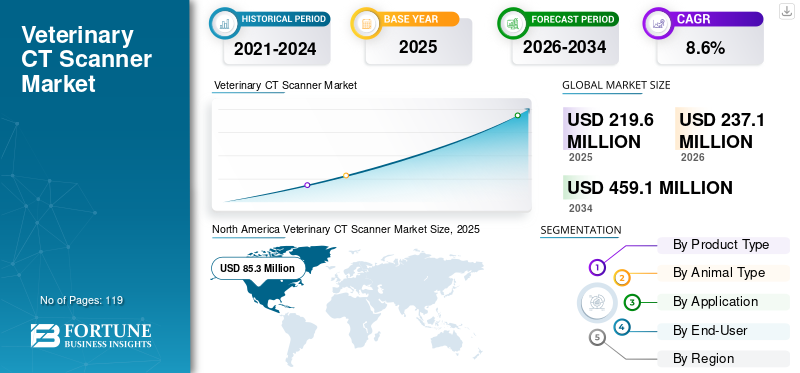
The global veterinary CT scanner market size was valued at USD 219.6 million in 2025 and is projected to grow from USD 237.1 million in 2026 to USD 459.1 million by 2034, exhibiting a CAGR of 8.6% during the forecast period. North America dominated the veterinary CT scanner market with a market share of 38.84% in 2025.
Veterinary CT scanners are imaging systems used by veterinarians to create detailed cross-sectional images of animals’ bones, joints, chest, head, and internal organs. These systems help doctors diagnose fractures, tumors, spinal problems, soft tissue injuries, and other complex conditions more clearly than standard X-rays. The market growth is attributed to rising pet ownership, growing spending on more advanced care, and increasing veterinary hospitals. In addition, technological advancements coupled with new product introductions are also projected to accelerate market growth during the forecast period.
- For instance, in September 2025, Pioneer Equine Hospital announced introduction of Asto CT Equina standing CT scanner. The new system is incorporated with AI technology.
Furthermore, many key industry players, such as Epica Animal Health, Animage, LLC, Hallmarq Veterinary Imaging, and Planmed Oy operating in the market, are focusing on developing various innovative technologies to offer better products with improved accuracy and efficiency.
Download Free sample to learn more about this report.
Veterinary CT Scanner Market KEY TAKEAWAYS
 Global Market Size & Forecast
- 2025 Market Size: USD 219.6 million
- 2026 Market Size: USD 237.1 million
- 2034 Forecast Market Size: USD 459.1 million
- CAGR: 8.6% from 2026–2034
 Market Share
- North America dominated the veterinary CT scanner market with a 38.84% share in 2025.
- The Stationary CT Scanners segment held the largest market share due to widespread adoption in veterinary hospitals.
- The Companion Animals segment accounted for the largest market share, driven by increasing pet ownership.
 Key Regional Highlights
North America
The market was valued at USD 85.3 million in 2025 and continues to lead due to rising pet ownership.
Europe
The market is projected to reach USD 66.4 million in 2026, growing at a 8.1% CAGR.
Asia Pacific
The market is expected to reach USD 53.9 million in 2026, driven by increasing veterinary healthcare expenditure.
U.S.
The market is estimated at USD 82.5 million in 2026, accounting for 34.8% of global revenues.
Japan
The market is estimated at USD 5.9 million in 2026, accounting for 2.5% of global revenues.
Read More

VETERINARY CT SCANNER MARKET TRENDS
Rising Emphasis on Adoption of Animal Specific and Highly Ergonomic Systems is One of Important Trend Observed in Market
A key trend in the market is the development of systems specifically designed for animals. Instead of using adapted human CT scanners, manufacturers are focusing on creating machines that suit different animal sizes and clinical workflows. In addition, these systems are designed to reduce scanning time, improve handling, and simplify operation for veterinary staff. Moreover, there is also a growing focus on making systems more compact and easier to install in clinics. This helps smaller and mid-sized practices adopt CT technology.
MARKET DYNAMICS
MARKET DRIVERS
Download Free sample to learn more about this report.
Rising Spending on Advanced Pet Healthcare to Accelerate Market Growth
Increasing spending on advanced pet healthcare is prominently driving the global veterinary CT scanner market growth. The affection of pet owners toward pets is leading to preventive animal care, which is eventually driving the number of diagnostic procedures. Moreover, this has also increased demand for accurate and early diagnosis, especially for serious conditions such as cancer, fractures, and neurological disorders. Furthermore, veterinary clinics are responding by adopting advanced imaging technologies to meet these expectations. In addition, the growing number of pet insurance policies in some regions is making expensive diagnostic procedures more accessible.
- For instance, in January 2026, Pet Service Holding N.V. entered into a strategic partnership with Figo Pet Insurance. The duo is planning to expand its operations in the international market.
MARKET RESTRAINTS
High Cost and Limited Affordability to Deter Market Growth
The high cost of veterinary CT scanners remains a major restraint for the market. These systems require significant investment not only for purchase but also for installation, maintenance, and operation. Moreover, clinics also need trained professionals and proper infrastructure to use CT systems effectively. Smaller veterinary practices may find it difficult to justify such investments due to lower patient volume. In many regions, pet insurance coverage is still limited, which means pet owners must pay out of pocket for advanced diagnostics. This reduces the number of patients opting for CT scans.
MARKET OPPORTUNITIES
Growth of Specialty Veterinary Centers to Offer Lucrative Market Opportunities
A strong opportunity in the market is the growth of specialty veterinary centers and referral hospitals. These facilities focus on advanced treatments such as orthopedics, oncology, and neurology, where CT imaging plays an important role. As more specialty centers are established, the demand for advanced diagnostic tools including CT scanners is expected to increase. Moreover, these centers often handle complex cases that require precise imaging, making CT an essential part of their services. In addition, collaboration between general clinics and referral centers is increasing, where patients are referred for advanced imaging. This trend is expanding the usage of CT scanners beyond traditional large hospitals.
MARKET CHALLENGES
Need for Skilled Professionals and Workflow Integration to Pose a Critical Challenge to Market Growth
Veterinary CT imaging requires specific expertise, and not all clinics have access to skilled radiologists or trained staff. In addition, integrating CT imaging into daily clinical workflows can be challenging for smaller practices. Moreover, clinics need to manage scheduling, anesthesia, and post-scan analysis efficiently. Without proper training and workflow management, the full benefits of CT systems cannot be realized. This makes adoption slower in smaller clinics and highlights the need for better training programs and support systems in the market.
Segmentation Analysis
By Product Type
Stable Imaging Performance and Wide Product Availability of Stationary CT scanners to Boost Segment Growth
Based on product type, the market is divided into stationary CT scanners and portable CT scanners.
Stationary CT scanners hold the largest share of the market as they are widely used in hospitals and established veterinary clinics. In addition, these systems provide stable imaging performance and are suitable for handling a high number of cases. They are typically installed in dedicated imaging rooms and are preferred for consistent and routine use. Moreover, veterinary hospitals also rely on these systems for accurate diagnosis of complex cases, especially where high image quality is required.
The portable CT scanner segment is anticipated to rise with a CAGR of 10.3% over the forecast period.
To know how our report can help streamline your business, Speak to Analyst
By Animal Type
Increasing Ownership of Companion Animals Accelerated Segment Growth
Based on animal type, the market is segmented into companion animals, livestock, and others.
In 2025, the companion animals segment dominated the global market. Dogs and cats are the most frequently treated animals in veterinary clinics, and their owners are more likely to spend on advanced diagnostic procedures. The rising trend of pet humanization has increased demand for better healthcare services, including imaging. In addition, conditions such as tumors, fractures, and neurological issues are commonly diagnosed in companion animals using CT scans. Moreover, urban pet ownership is increasing, further driving demand. Furthermore, the high volume of cases and willingness to pay for treatment, companion animals remain the leading segment in this market.
- For instance, in May 2024, according to a data published by NCBI, the India is witnessing an estimated 12% annual rise in pet ownership.
The livestock segment is anticipated to rise with a CAGR of 6.9% over the forecast period.
By Application
Substantial Prevalence of Orthopedic Conditions Among Pets Boosted Segment Growth
Based on application, the market is segmented into orthopedic & musculoskeletal imaging, neurology, oncology, dental & maxillofacial imaging, and others.
In 2025, the orthopedic & musculoskeletal imaging segment dominated the global market. These include fractures, ligament injuries, spinal problems, and lameness issues, which are common in both companion animals and horses. CT imaging provides detailed views of bone structures that are not easily visible with traditional X-rays. This makes it especially useful in surgical planning and treatment decisions. Since orthopedic conditions are among the most frequent reasons for advanced imaging in veterinary practice, this application continues to dominate the market and drive consistent demand for CT scanners.
The oncology segment is anticipated to rise with a CAGR of 6.9% over the forecast period.
By End-User
Higher Procedural Volume in Veterinary Hospitals & Clinics Accelerated Segment Growth
Based on end-user, the market is segmented into veterinary hospitals & clinics, veterinary diagnostic imaging centers, and others.
In 2025, veterinary hospitals & clinics held highest market share. Veterinary hospitals and clinics hold the largest share of the market as they are the primary centers where animal diagnosis and treatment take place. In addition, larger hospitals and specialty clinics are more likely to invest in CT scanners due to higher patient volumes and the need for advanced diagnostic capabilities. These facilities also have trained staff and infrastructure required to operate CT systems.
In addition, veterinary diagnostic imaging centers segment is projected to grow at a CAGR of 9.4% during the study period.
Veterinary CT Scanner Market Regional Outlook
By geography, the market is categorized into Europe, North America, Asia Pacific, Latin America, and the Middle East & Africa.
North America
North America Veterinary CT Scanner Market Size, 2025 (USD Million)
To get more information on the regional analysis of this market, Download Free sample
North America held the dominant share in 2024, valuing at USD 79.3 million, and also maintained the leading share in 2025, with USD 85.3 million. The market in North America is expected to increase due to rise in pet ownership, growing spending on animal health, and technological advancements in veterinary diagnostic systems.
U.S. Veterinary CT Scanner Market
Based on North America’s strong contribution and the U.S. dominance within the region, the U.S. market can be analytically approximated at around USD 82.5 million in 2026, accounting for roughly 34.8% of global sales.
Europe
Europe is projected to record a growth rate of 8.1% in the coming years, and reach a valuation of USD 66.4 million by 2026. The region is estimated to witness considerable market growth due to rising investments for new product development, and rising demand for accurate pet diagnostics.
U.K. Veterinary CT Scanner Market
The U.K. market is estimated at around USD 12.0 million in 2026, representing roughly 5.0% of global revenues.
Germany Veterinary CT Scanner Market
Germany’s market is projected to reach approximately USD 16.1 million in 2026, equivalent to around 6.8% of global sales.
Asia Pacific
Asia Pacific is estimated to reach USD 53.9 million in 2026 and secure the position of the third-largest region in the market. Increasing expenses on veterinary health coupled with rising number of product launches are expected to accelerate market growth during the forecast period.
Japan Veterinary CT Scanner Market
The Japan market is estimated at around USD 5.9 million in 2026, accounting for roughly 2.5% of global revenues.
China Veterinary CT Scanner Market
China’s market is projected to be one of the largest globally, with 2026 revenues estimated at around USD 19.4 million, representing roughly 8.2% of global sales.
India Veterinary CT Scanner Market
The Indian market is estimated at around USD 13.4 million in 2026, accounting for roughly 5.6% of global revenues.
Latin America and Middle East & Africa
The Latin America and Middle East & Africa regions are expected to witness moderate growth in this market during the forecast period. The Latin America market is set to reach a valuation of USD 15.0 million in 2026. In Latin America, modernization of veterinary imaging technologies is projected to have positive impact on the market. Also, in Middle East & Africa, growing demand for accurate pet diagnostics and increasing pet ownership are estimated to augment market growth by 2034.
GCC Veterinary CT Scanner Market
The GCC market is set to reach a value of USD 3.8 million in 2026.
South Africa Veterinary CT Scanner Market
The South Africa market is projected to reach around USD 1.6 million in 2026, representing roughly 0.68% of global revenues.
COMPETITIVE LANDSCAPE
Key Industry Players
Growing Number of Product Launches Coupled with Technological Advancements by Key Players to Boost Market Progress
The global market holds a semi-consolidated market structure, constituting prominent players such as Epica Animal Health, Animage, LLC, Hallmarq Veterinary Imaging, and Planmed Oy. The significant global veterinary CT scanner market share of these companies is due to numerous strategic activities, including distribution collaborations and implementation of new programs.
- For instance, in August 2025, Epica International announced strategic partnership with Esaote North America, Inc. to expand its reach across veterinary and human CT imaging.
Other notable players in the global market include Xoran Technologies LLC, iCRco, Inc., Canon Medical Systems Corporation, Shenzhen Bizvet Bio-tech Co., Ltd., and Shenzhen SONTU Medical Imaging Equipment Co., Ltd. These companies are expected to prioritize collaborations to increase their global market share during the forecast period.
LIST OF KEY VETERINARY CT SCANNER COMPANIES PROFILED IN REPORT
- Epica Animal Health (U.S.)
- Animage, LLC (U.S.)
- Hallmarq Veterinary Imaging (U.K.)
- Planmed Oy (Finland)
- Xoran Technologies LLC (U.S.)
- iCRco, Inc. (U.S.)
- Canon Medical Systems Corporation (Japan)
- Shenzhen Bizvet Bio-tech Co., Ltd. (China)
- Shenzhen SONTU Medical Imaging Equipment Co., Ltd. (China)
- Guangzhou Yueshen Medical Equipment Co., Ltd. (China)
KEY INDUSTRY DEVELOPMENTS
- September 2025: The UC Davis Veterinary Medical Hospital announced opening of its new all species imaging center. The center is equipped with advanced scanner.
- September 2025: Asto CT and IMV Imaging entered into strategic partnership with an aim to develop new imaging technology.
- October 2024: WOORIEN Co., Ltd. announced launch of its new solution called as 'MyVet CT Plus'. This new solution is specifically designed for animal CT imaging.
- August 2024: Epica International partnered with Nexposai to add AI and augmented reality to demonstrations of its veterinary CT scanners.
- March 2021: Hallmarq Veterinary Imaging announced the addition of its Standing Equine Leg CT system to improve lameness diagnosis in horses.
REPORT COVERAGE
The global veterinary CT scanner market analysis includes a comprehensive study of the market size & forecast by all the market segments included in the report. It includes details on the market dynamics and market trends expected to drive the market over the forecast period. It provides information on key aspects, including an overview of technological advancements and product launches. Additionally, it details partnerships, mergers & acquisitions, as well as key industry developments and investments by key regions. The global market research report also provides a depth competitive landscape with information on the market share and profiles of key operating players.
Request for Customization to gain extensive market insights.
Report Scope & Segmentation
| ATTRIBUTE | DETAILS |
| Study Period | 2021-2034 |
| Base Year | 2025 |
| Estimated Year | 2026 |
| Forecast Period | 2026-2034 |
| Historical Period | 2021-2024 |
| Growth Rate | CAGR of 8.6% from 2026-2034 |
| Unit | Value (USD Million) |
| Segmentation | By Product Type, Animal Type, Application, End-User, and Region |
| By Product Type |
|
| By Animal Type |
|
| By Application |
|
| By End-User |
|
| By Region |
|
Frequently Asked Questions
According to Fortune Business Insights, the global market value stood at USD 219.6 million in 2025 and is projected to reach USD 459.1 million by 2034.
In 2025, the North America’s market value stood at USD 85.3 million.
The market is expected to exhibit a CAGR of 8.6% during the forecast period of 2026-2034.
By product type, the stationary CT scanners segment is expected to lead the market.
Rising emphasis on preventive healthcare and technological advancements in veterinary scanning are driving market expansion.
Epica Animal Health, Animage, LLC, Hallmarq Veterinary Imaging, and Planmed Oy are the major players in the global market.
North America held the largest market share in 2025.



- 2021-2034
- 2025
- 2021-2024
- 119
Get 30-60 hrs Free Customization
Expand Regional and Country Coverage, Segments Analysis, Company Profiles, Competitive Benchmarking, and End-user Insights.













.webp)






-
US +1 833 909 2966 ( Toll Free )
-
Get In Touch With Us