Automated Guided Vehicle Market Size, Share & Industry Analysis, By Type (Tow Vehicles, Automated Forklift Trucks, Underride/Tunneling Vehicles, and Assembly Line Vehicles), By Navigation Technology (Laser Guided, Magnetic Guided, and Vision Guided), By Application (Transportation & Distribution, Storage & Assembly, and Packaging), By Battery Type (Lithium-Ion, Lead-Acid, and Nickel-Based Battery), By Industry (Automotive, E-commerce & Retail, 3PL, Food & Beverage, and Healthcare & Pharmaceuticals), and Regional Forecast, 2026-2034
 Download Free Sample
Automated Guided Vehicle Market Size
 Listen to Audio Version
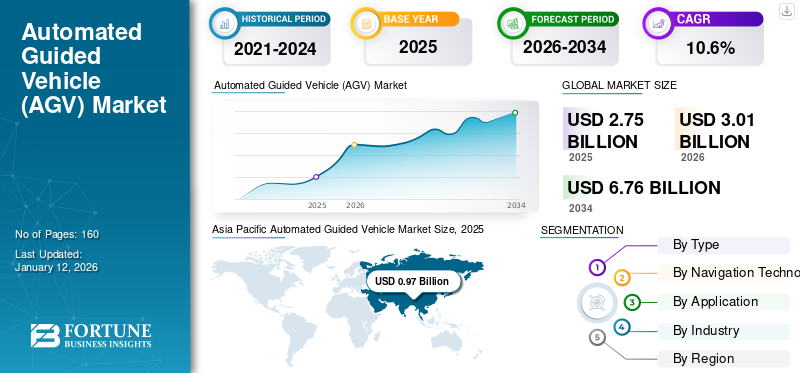
The global automated guided vehicle market size was valued at USD 5.52 billion in 2025 and is projected to grow from USD 6.05 billion in 2026 to USD 13.57 billion by 2034, exhibiting a CAGR of 10.6% during the forecast period. Asia Pacific dominated the automated guided vehicle market with a market share of 35.51% in 2025.
Automated Guided Vehicle (AGV) comprises autonomous material handling vehicles and intelligent transportation systems designed to move raw materials, components, pallets, finished goods, and inventory within warehouses and distribution centers, manufacturing facilities, and logistics hubs without direct human intervention. The market includes forklift AGVs, tow vehicles, unit load carriers, pallet trucks, assembly line vehicles, and heavy-load AGVs equipped with advanced navigation technologies such as laser guidance, vision guidance, cameras and sensors to navigate, natural feature navigation, and fleet management software. Growing investments in warehouse automation, e-commerce fulfillment infrastructure, smart factories, and supply chain digitalization are driving demand for AGVs globally. The increasing adoption of lithium-ion batteries, AI-enabled traffic management systems, real-time fleet orchestration platforms, predictive maintenance solutions, and autonomous warehouse operations is further improving productivity, operational safety, and material flow efficiency across industrial facilities. AGVs are increasingly being integrated across production lines to support automated material movement and synchronized manufacturing workflows.
- For instance, in February 2025, Jungheinrich AG expanded its autonomous mobile robotics and AGV portfolio with enhanced fleet coordination and intelligent navigation capabilities, improving material handling efficiency and warehouse throughput across high-volume distribution operations.
Daifuku Co., Ltd., KION Group AG (Dematic), Toyota Industries Corporation, Jungheinrich AG, SSI SCHAEFER Group, Murata Machinery, Ltd., KUKA AG, and Seegrid Corporation are among the major companies operating in the market.
Download Free sample to learn more about this report.
Automated Guided Vehicle Market Key Takeaways
 Global Market Size & Forecast
- 2025 Market Size: USD 5.52 billion
- 2026 Market Size: USD 6.05 billion
- 2034 Forecast Market Size: USD 13.57 billion
- CAGR: 10.6% from 2026–2034
 Market Share
- Asia Pacific dominated the automated guided vehicle market with a 35.51% share in 2025.
- Automated forklift trucks held the largest share by type in 2025.
- Laser guided technology held the largest share by navigation technology in 2025.
 Key Regional Highlights
Asia Pacific
Asia Pacific dominated the market with USD 1.96 billion in revenue in 2025, representing a 35.51% share.
North America
North America generated USD 1.61 billion in revenue in 2025, supported by strong warehouse automation investments.
Europe
Europe is expected to witness steady growth driven by industrial automation and logistics modernization.
U.S.
U.S..: The market is estimated at USD 1.41 billion in 2026, driven by warehouse automation and advanced manufacturing investments.
Japan
Japan: The market is estimated at USD 0.37 billion in 2026, accounting for roughly 6.2% of global sales.
Read More

Automated Guided Vehicle Market Trends
Growing Adoption of AI-Orchestrated Warehouse Automation and Intelligent Material Flow Systems is Accelerating Market Expansion
Demand for Automated Guided Vehicles (AGVs) is increasingly being driven by the rapid adoption of warehouse automation, smart manufacturing initiatives, and intelligent logistics operations across e-commerce fulfillment centers, distribution hubs, automotive plants, electronics manufacturing facilities, and third-party logistics (3PL) warehouses. As operators focus on improving throughput, reducing labor dependency, minimizing operational errors, and supporting around-the-clock material movement, AGV manufacturers are integrating artificial intelligence (AI), machine vision, fleet orchestration software, real-time traffic management systems, digital twins, and cloud-connected monitoring platforms into autonomous material handling solutions. The market is witnessing growing deployment of forklift AGVs, pallet transport vehicles, unit load carriers, and autonomous tugger systems that optimize inventory movement, streamline warehouse workflows, and improve facility-wide productivity. The transition from manually operated material handling processes toward intelligent, connected, and autonomous intralogistics ecosystems is enabling organizations to enhance supply chain efficiency, increase warehouse capacity utilization, and support high-volume fulfillment operations while advancing long-term digital transformation strategies across industrial and logistics environments.
- For instance, in March 2025, AGILOX Services GmbH enhanced its autonomous mobile robot and AGV ecosystem with advanced swarm intelligence capabilities, enabling dynamic fleet coordination and more efficient material transport across warehouse and manufacturing operations.
Market Dynamics
Market Drivers
Download Free sample to learn more about this report.
Rising Warehouse Automation Investments and E-commerce Fulfillment Expansion Driving Market Growth
The automated guided vehicle market growth is increasingly being driven by growing investments in warehouse automation, e-commerce fulfillment infrastructure, smart manufacturing facilities, and logistics modernization initiatives across developed and emerging economies. Retailers, manufacturers, and third-party logistics providers are allocating substantial capital toward automated distribution centers, high-density storage facilities, and intelligent material handling systems to improve operational efficiency and meet rising order volumes. Automated guided vehicles enable organizations to optimize inventory movement, reduce labor dependency, improve warehouse throughput, and support continuous operations across complex logistics environments. The growing deployment of forklift AGVs, pallet transport vehicles, autonomous tugger systems, and fleet management platforms is supporting faster material flow, improved inventory accuracy, and enhanced supply chain performance. Additionally, increasing labor shortages, rising fulfillment speed requirements, and expanding adoption of Industry 4.0 technologies continue to strengthen market growth globally.
- For instance, in February 2026, Toyota Material Handling expanded its autonomous logistics solutions portfolio with advanced AGV systems designed to improve warehouse productivity, operational safety, and material handling efficiency across large-scale distribution facilities.
Market Restraints
High Equipment Ownership Costs and Integration Expenses to Limit Market Expansion
The growth of the market is constrained by high system acquisition costs, integration expenses, infrastructure modification requirements, and deployment complexity associated with AGV implementation. Advanced AGV solutions require substantial upfront investment in vehicles, navigation technologies, fleet management software, charging infrastructure, safety systems, and warehouse connectivity platforms, making adoption challenging for small and medium-sized enterprises. In addition, legacy facility layouts, changing warehouse configurations, interoperability challenges, and integration with Warehouse Management Systems (WMS), Manufacturing Execution Systems (MES), and Enterprise Resource Planning (ERP) platforms can prolong deployment timelines and increase project costs. Operators also face challenges related to workforce training, operational disruptions during implementation, cybersecurity concerns, and ongoing maintenance requirements. As a result, many organizations continue to rely on conventional forklifts and manual material handling processes, which can moderate AGV adoption in cost-sensitive and operationally complex environments.
Market Opportunities
Growing Adoption of Flexible Manufacturing, Micro-Fulfillment Centers, and AI-Driven Intralogistics Creating Significant Market Opportunities
A major opportunity emerging within the market is the increasing adoption of flexible manufacturing systems, micro-fulfillment centers, dark warehouses, and AI-driven intralogistics solutions across e-commerce, retail, automotive, electronics, healthcare, and third-party logistics operations. As organizations seek to improve material flow efficiency, support high-mix production environments, enhance inventory visibility, and reduce labor dependency, demand is rising for intelligent AGV fleets, autonomous warehouse transport systems, fleet orchestration software, and real-time material handling optimization platforms. Growing investments in smart factories, semiconductor manufacturing facilities, next-generation distribution centers, and autonomous supply chain ecosystems are creating opportunities for manufacturers to expand beyond traditional vehicle sales toward software-enabled automation, fleet-as-a-service, and lifecycle support offerings.
- For instance, in January 2026, Daifuku Co., Ltd. expanded its intelligent intralogistics portfolio with enhanced AGV fleet management and warehouse automation solutions designed to improve operational flexibility and material flow efficiency across large-scale fulfillment facilities.
Market Challenges
Interoperability, Mixed Automation Environments, and Cybersecurity Risks Affecting AGV Deployments
One of the major challenges affecting the market is ensuring seamless interoperability between AGVs and increasingly complex warehouse and manufacturing ecosystems. Many facilities operate a combination of legacy material handling equipment, warehouse management systems (WMS), manufacturing execution systems (MES), enterprise resource planning (ERP) platforms, conveyors, robotic systems, and manually operated vehicles, making system integration and real-time coordination technically demanding. As AGV fleets become more connected through cloud-based fleet management platforms and Industrial Internet of Things (IIoT) technologies, cybersecurity, data integrity, and network reliability have become critical operational concerns. In addition, maintaining safe collaboration between autonomous vehicles and human workers while ensuring uninterrupted operations in dynamic environments requires continuous software updates, fleet optimization, and workforce training. These factors increase operational complexity and remain key challenges for AGV manufacturers, system integrators, and end users across logistics and industrial facilities.
Segmentation Analysis
By Type
Automated Forklift Trucks Segment Led Market Owing to Its Extensive Deployment Across Warehouses, Distribution Centers, and Manufacturing Facilities
By type, the market is segmented into tow vehicles, automated forklift trucks, underride/ tunneling vehicles, assembly line vehicles, and others.
Automated forklift trucks segment held the largest automated guided vehicle market share in 2025, driven by their widespread deployment across warehouses, distribution centers, manufacturing plants, and third-party logistics facilities. These vehicles perform pallet transportation, storage and retrieval operations, dock-to-stock movement, and inventory handling activities while reducing labor dependency and improving operational efficiency. Compared with other AGV types, automated forklift trucks offer greater versatility, seamless integration with existing warehouse infrastructure, and the ability to handle a broad range of palletized goods, resulting in high adoption across industries. Growing investments in warehouse automation, e-commerce fulfillment centers, smart factories, and logistics modernization initiatives continue to support strong demand for automated forklift trucks globally.
- For instance, in March 2025, Toyota Material Handling expanded its autonomous forklift portfolio with enhanced navigation and safety capabilities, strengthening automated pallet handling operations across high-volume warehouse and distribution environments.
Tow vehicles segment is expected to witness the significant growth rate, with a CAGR of 10.8% during the forecast period, driven by increasing adoption in automotive manufacturing, e-commerce fulfillment centers, and large-scale industrial facilities requiring efficient horizontal transportation of materials.
To know how our report can help streamline your business, Speak to Analyst
By Navigation Technology
Laser Guided Segment Led Market Owing to Its High Accuracy, Scalability, and Extensive Deployment Across Warehousing and Manufacturing Operations
By navigation technology, the market is segmented into laser guided, magnetic guided, vision guided, and others.
Laser guided segment held the largest market share in 2025, driven by its widespread deployment across warehouses, distribution centers, manufacturing facilities, and third-party logistics operations. Laser-guided AGVs offer high navigation accuracy, route flexibility, reliable performance, and scalability in complex industrial environments, making them the preferred choice for large-scale material handling applications. Compared with other navigation technologies, laser guidance requires minimal physical infrastructure modifications and supports dynamic route optimization, enabling operators to adapt quickly to changing facility layouts and workflow requirements. Growing investments in warehouse automation, e-commerce fulfillment infrastructure, and smart manufacturing facilities continue to support strong demand for laser-guided AGVs globally.
Vision guided segment is expected to witness the significant growth rate, with a CAGR of 10.7% during the forecast period, driven by increasing adoption of AI-powered navigation, machine vision technologies, and flexible automation systems across dynamic warehouse and manufacturing environments.
By Application
Transportation & Distribution Segment Led Market Owing to Its Extensive Utilization Across Warehouses, Distribution Centers, and Logistics Networks
By application, the market is segmented into transportation & distribution, storage & assembly, and packaging.
Transportation & distribution segment held the largest market share in 2025, driven by its widespread deployment across warehouses, e-commerce fulfillment centers, manufacturing facilities, and third-party logistics operations. AGVs are extensively used for pallet movement, raw material transportation, finished goods transfer, dock-to-stock operations, and inter-facility material flow, enabling organizations to improve productivity and reduce manual handling requirements. Compared with other application areas, transportation and distribution activities account for the highest volume of repetitive material movement tasks, resulting in greater AGV utilization and fleet deployment. Growing investments in warehouse automation, supply chain modernization, omnichannel fulfillment networks, and smart logistics infrastructure continue to support strong demand for AGVs in transportation and distribution applications globally.
Storage & assembly segment is expected to witness the highest growth rate, with a CAGR of 10.7% during the forecast period, driven by increasing adoption of smart manufacturing, flexible production systems, and automated storage operations across automotive, electronics, semiconductor, and industrial manufacturing facilities.
By Battery Type
Lithium-Ion Battery Segment Led Market Owing to Its Superior Performance, Fast Charging Capabilities, and Growing Adoption Across Automated Material Handling Operations
By battery type, the market is segmented into lithium-ion battery, lead-acid battery, nickel-based battery, and others (sodium-ion and fuel cell-based power systems).
Lithium-Ion battery segment held the largest market share in 2025, driven by its extensive deployment across warehouses, distribution centers, manufacturing facilities, and logistics operations utilizing AGVs. Lithium-ion batteries offer significant advantages, including faster charging, opportunity charging capabilities, longer service life, higher energy efficiency, and reduced maintenance requirements compared with conventional battery technologies. These benefits enable AGV operators to maximize vehicle uptime, improve fleet productivity, and support continuous operations in high-throughput environments. Growing investments in warehouse automation, e-commerce fulfillment infrastructure, smart factories, and autonomous material handling systems continue to strengthen demand for lithium-ion-powered AGVs globally.
Others (Sodium-Ion and Fuel Cell-Based Power Systems) segment is expected to witness the highest growth rate, with a CAGR of 14.4% during the forecast period, driven by increasing interest in alternative energy storage technologies, extended operating requirements, and sustainability-focused automation strategies.
By Industry
Automotive Segment Led Market Owing to Extensive Adoption of AGVs Across Assembly Operations, Component Logistics, and Intralogistics Workflows
By industry, the market is segmented into automotive, e-commerce & retail, third-party logistics (3pl), food & beverage, healthcare & pharmaceuticals, electronics & semiconductor, manufacturing, paper & packaging, chemicals, aerospace & defense, and others (mining and textile).
Automotive segment held the largest market share in 2025, driven by the extensive deployment of AGVs across vehicle assembly plants, component manufacturing facilities, battery production units, and internal logistics operations. AGVs play a critical role in transporting raw materials, engines, batteries, body components, and finished assemblies across production environments while supporting just-in-time and just-in-sequence manufacturing processes. Compared with other industries, automotive manufacturing has one of the highest levels of industrial automation and material handling intensity, resulting in significant AGV fleet deployment. Growing investments in electric vehicle production, battery gigafactories, smart manufacturing facilities, and flexible assembly operations continue to support strong demand for AGVs across the automotive sector globally.
E-commerce & retail segment is expected to witness the highest growth rate, with a CAGR of 12.4% over the forecast period, driven by increasing investments in automated fulfillment centers, omnichannel distribution networks, micro-fulfillment facilities, and high-throughput warehouse operations.
Automated Guided Vehicle Market Regional Outlook
By geography, the market is categorized into Europe, North America, Asia Pacific, South America, and the Middle East & Africa.
Asia Pacific
Asia Pacific Automated Guided Vehicle Market Size, 2025 (USD Billion)
To get more information on the regional analysis of this market, Download Free sample
Asia Pacific region dominates market and accounted for USD 1.96 billion in 2025 globally. China and India represent major markets due to their extensive construction activities, advanced equipment fleets, and strong infrastructure spending, while India and Southeast Asia are emerging as high-growth markets driven by smart city initiatives, industrial corridor developments, and rising government investments in roads, railways, airports, and logistics infrastructure. Demand for automated guided vehicle continues to increase as contractors, infrastructure developers, and industrial companies seek to improve productivity, reduce project timelines, and support large-scale construction activities.
China Automated Guided Vehicle Market
China’s market is projected to remain the dominant in the Asia Pacific region, with 2026 revenues estimated at around USD 0.87 billion, representing roughly 14.4% of global sales.
Japan Automated Guided Vehicle Market
The market is estimated at around USD 0.37 billion in 2026, accounting for roughly 6.2% of the global sales.
India Automated Guided Vehicle Market
The market is estimated at around USD 0.48 billion in 2026, accounting for roughly 7.9% of global sales.
North America
The North America market accounted for USD 1.61 billion in revenue in 2025, supported by rapid warehouse automation investments, expanding e-commerce fulfillment networks, increasing adoption of smart manufacturing technologies, and growing demand for autonomous material handling solutions across the U.S. and Canada. Regional demand is strongly influenced by large-scale distribution center development, logistics modernization initiatives, automotive production expansion, semiconductor manufacturing investments, and increasing deployment of Industry 4.0 technologies. The region benefits from advanced automation infrastructure, high labor costs, strong technology adoption rates, and widespread implementation of artificial intelligence (AI), warehouse management systems (WMS), and connected fleet orchestration platforms.
U.S. Automated Guided Vehicle Market
The U.S. is expected to dominate the market with an estimated revenue of about USD 1.41 billion in 2026, driven by substantial investments in warehouse automation, e-commerce fulfillment infrastructure, industrial reshoring initiatives, and advanced manufacturing facilities. Demand for AGVs remains particularly strong across distribution centers, automotive assembly plants, semiconductor fabrication facilities, third-party logistics warehouses, and retail fulfillment operations. The country continues to experience growing adoption of autonomous material handling systems, AI-enabled fleet management platforms, intelligent navigation technologies, and predictive maintenance solutions aimed at improving productivity, reducing labor dependency, and optimizing supply chain performance.
Europe
The Europe market is expected to witness steady growth during the forecast period, driven by increasing investments in industrial automation, smart manufacturing initiatives, logistics modernization programs, and sustainable warehouse operations. Regional demand is closely associated with expanding e-commerce networks, automotive production facilities, advanced manufacturing plants, and growing adoption of autonomous intralogistics solutions. Europe remains one of the most technologically advanced markets for AGVs, with manufacturers and logistics operators increasingly adopting AI-driven fleet management systems, laser-guided navigation technologies, lithium-ion-powered vehicles, and intelligent warehouse automation platforms.
U.K. Automated Guided Vehicle Market
The U.K. market is estimated at around USD 0.21 billion in 2026, representing roughly 3.4% of global sales.
Germany Automated Guided Vehicle Market
Germany’s market is projected to reach approximately USD 0.30 billion in 2026, equivalent to around 4.9%
Middle East & Africa
The Middle East & Africa market is driven by increasing investments in logistics infrastructure, warehouse modernization, industrial diversification programs, and supply chain automation initiatives across GCC countries, South Africa, and other regional markets. Demand is closely linked to the development of distribution centers, free trade zones, e-commerce fulfillment facilities, and manufacturing hubs requiring efficient material handling solutions. GCC countries lead regional demand due to substantial investments in logistics infrastructure, economic diversification initiatives, and growing adoption of warehouse automation technologies. Rising deployment of AGVs across logistics, food & beverage, and manufacturing operations continues to support market growth across the region.
GCC Automated Guided Vehicle Market
The GCC market is projected to reach around USD 0.29 billion in 2026, representing roughly 4.8% of the global sales.
South America
The South America market is driven by increasing investments in warehouse expansion, logistics infrastructure modernization, e-commerce fulfillment operations, and manufacturing automation initiatives across Brazil, Argentina, Chile, Colombia, Peru, and other regional economies. Demand is mainly linked to distribution center development, retail logistics networks, food & beverage processing facilities, automotive manufacturing operations, and third-party logistics expansion requiring efficient material handling and intralogistics solutions. Growing adoption of warehouse automation technologies and increasing focus on supply chain efficiency continue to support AGV deployment across the region.
Brazil Automated Guided Vehicle Market
The Brazil market is projected to reach around USD 0.20 billion in 2026, representing roughly 3.2% of the global sales.
Competitive Landscape
Key Industry Players
Leading Companies to Focus On Fleet Intelligence, Warehouse Automation Expertise, and Advanced Navigation Technologies to Strengthen Market Share
The automated guided vehicle market is moderately concentrated, with competitive positioning shaped by navigation technology capabilities, fleet management software, warehouse automation expertise, product portfolio breadth, systems integration capabilities, and global service network strength. Leading companies including Daifuku Co., Ltd., KION Group AG (Dematic), Toyota Industries Corporation, Jungheinrich AG, SSI SCHAEFER Group, Murata Machinery, Ltd., KUKA AG, Swisslog Holding AG, AGILOX Services GmbH, and Seegrid Corporation maintain strong market positions through diversified portfolios spanning automated forklift trucks, tow vehicles, unit load carriers, assembly line AGVs, warehouse execution software, and intelligent material handling solutions.
Competitive differentiation is increasingly influenced by the ability to deliver scalable intralogistics solutions, intelligent fleet coordination, real-time traffic management, predictive maintenance capabilities, and seamless integration with warehouse management systems (WMS), manufacturing execution systems (MES), and enterprise resource planning (ERP) platforms. Manufacturers are investing in lithium-ion-powered AGVs, swarm intelligence technologies, digital twin capabilities, and software-driven automation solutions to improve warehouse throughput, optimize material flow, reduce labor dependency, and address evolving customer requirements across logistics, manufacturing, automotive, e-commerce, healthcare, and industrial applications.
- For instance, in February 2026, AGILOX Services GmbH expanded its autonomous intralogistics platform with advanced swarm intelligence capabilities, strengthening dynamic fleet coordination and warehouse automation efficiency across high-volume logistics operations.
List of Key Automated Guided Vehicle Companies Profiled in Report
- Daifuku Co., Ltd. (Japan)
- KION Group AG (Germany)
- Toyota Industries Corporation (Japan)
- Jungheinrich AG (Germany)
- SSI SCHAEFER Group (Germany)
- Murata Machinery, Ltd. (Japan)
- KUKA AG (Germany)
- Swisslog Holding AG (Switzerland)
- AGILOX Services GmbH (Austria)
- Seegrid Corporation (U.S.)
Key Industry Developments
- March 2026: Daifuku Co., Ltd. expanded its warehouse automation portfolio by enhancing AGV fleet management capabilities, improving material flow optimization and operational efficiency across large-scale distribution centers.
- February 2026: AGILOX Services GmbH introduced advanced swarm intelligence functionality for its AGV platform, enabling decentralized fleet coordination and dynamic route optimization in warehouse environments.
- October 2025: Jungheinrich AG expanded its autonomous mobile robot and AGV offerings with enhanced navigation and warehouse integration capabilities, strengthening intralogistics automation across manufacturing and distribution facilities.
- August 2025: Toyota Material Handling launched next-generation autonomous forklift solutions featuring improved safety systems, intelligent navigation technologies, and advanced fleet connectivity for material handling operations.
- May 2025: KION Group AG (Dematic) enhanced its automated warehouse solutions portfolio through expanded AGV and software integration capabilities, supporting higher throughput and operational flexibility in e-commerce fulfillment centers.
Report Coverage
The global automated guided vehicle market analysis includes a comprehensive study of market size and forecast across all segments covered in the report. It provides detailed insights into market dynamics, growth drivers, restraints, opportunities, and key industry trends expected to influence market development during the forecast period. The study examines critical aspects including warehouse automation investments, e-commerce fulfillment expansion, smart manufacturing adoption, and intralogistics modernization, autonomous material handling trends, fleet management technologies, intelligent navigation systems, lithium-ion battery adoption, and AI-enabled warehouse automation developments. Additionally, it analyzes product launches, strategic partnerships, facility expansions, mergers & acquisitions, and other key industry developments undertaken by leading AGV manufacturers and automation solution providers. The report also provides an in-depth competitive landscape, market share analysis, and profiles of major companies operating in the global industry.
Request for Customization to gain extensive market insights.
Report Scope & Segmentation
| ATTRIBUTE | DETAILS |
| Study Period | 2021-2034 |
| Base Year | 2025 |
| Estimated Year | 2026 |
| Forecast Period | 2026-2034 |
| Historical Period | 2021-2024 |
| Growth Rate | CAGR of 10.6% from 2026-2034 |
| Unit | Value (USD Billion) |
| Segmentation | By Type, Navigation Technology, Application, Battery Type, Industry, and Region |
| By Type |
|
| By Navigation Technology |
|
| By Application |
|
| By Battery Type |
|
| By Industry |
|
| By Region |
|
Frequently Asked Questions
According to Fortune Business Insights, the global market value stands at USD 6.05 billion in 2026 and is projected to reach USD 13.57 billion by 2034.
In 2025, the Asia Pacific’s market value stood at USD 1.96 billion.
The market is expected to exhibit a CAGR of 10.6% during the forecast period (2026-2034).
By industry, the automotive segment led the market.
Growing warehouse automation investments, e-commerce fulfillment expansion, smart manufacturing adoption, labor shortages, logistics modernization, autonomous material handling demand, and AI-enabled fleet management technologies drive market growth.
Daifuku Co., Ltd., KION Group AG, Toyota Industries Corporation, Jungheinrich AG, and SSI SCHAEFER Group are the top players in the market.
Asia Pacific held the largest market share in 2025.


- 2021-2034
- 2025
- 2021-2024
- 160
Get 30-60 hrs Free Customization
Expand Regional and Country Coverage, Segments Analysis, Company Profiles, Competitive Benchmarking, and End-user Insights.















Related Reports
-
US +1 833 909 2966 ( Toll Free )
-
Get In Touch With Us