Virtual Clinical Trials Market Size, Share & Industry Analysis, By Solutions (Software, Services, and Hardware {Wearables, ePro Devices, and Others}), By Study Type (Interventional, Observational, Diagnostic Trials, and Others), By Disease Indication (Oncology, Cardiovascular Diseases, Metabolic/Endocrinology, Infectious Disease, Immunology, Ophthalmology, and Others), By Phase, By Trial Type, By End User (Pharmaceutical & Biotechnology Companies, CROs, Academic & Research Institutes, Medical Device Companies, and Others), and Regional Forecast, 2026-2034
 Download Free Sample
Virtual Clinical Trials Market Size and Future Outlook
 Listen to Audio Version
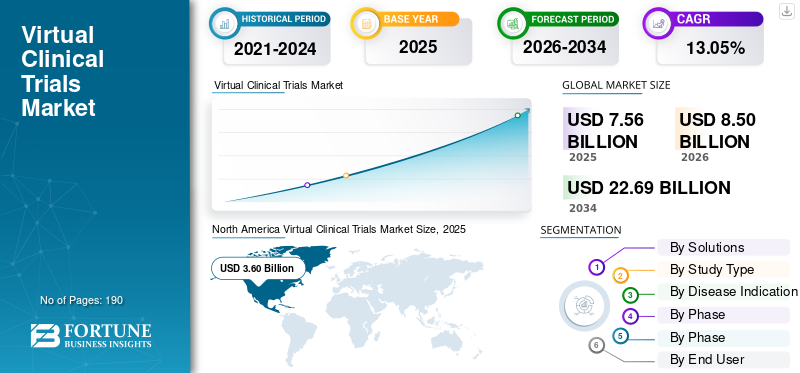
The virtual clinical trials market size was valued at USD 7.56 billion in 2025 and is projected to grow from USD 8.50 billion in 2026 to USD 22.69 billion by 2034, exhibiting a CAGR of 13.05% during the forecast period. North America dominated the virtual clinical trials market with a market share of 47.62% in 2025.
The market is growing as sponsors and CROs are shifting from fully site-based studies to hybrid and decentralized trial models. This trend is mainly driven by the need to improve patient convenience, reduce recruitment delays, lower site burden, and collect real-time patient data through digital tools. As clinical trials become more complex and geographically distributed, companies are adopting eConsent, eCOA/ePRO, telehealth, remote monitoring, and patient engagement platforms to make participation easier and improve trial continuity. As a result, virtual clinical trial solutions are becoming an important part of modern clinical research, especially for studies that require frequent follow-ups, broader patient access, and faster data collection.
- For instance, in November 2025, Medidata collaborated with CTI Clinical Trial and Consulting to use Medidata Patient Experience for patient-centric studies across oncology, metabolic, cardiovascular, CNS, and immune conditions. The partnership aimed to support more flexible and patient-friendly clinical trials by improving digital engagement and decentralized trial workflows.
Furthermore, major players, such as IQVIA Inc., MEDIDATA, Thermo Fisher Scientific Inc., and ICON plc., are actively participating in strategic collaborations and acquisitions to expand their offerings, facilitate interchangeability, enhance market access, and strengthen their market presence.
Download Free sample to learn more about this report.
Virtual Clinical Trials Market Key Takeways
 Global Market Size & Forecast
- 2025 Market Size: USD 7.56 billion
- 2026 Market Size: USD 8.50 billion
- 2034 Forecast Market Size: USD 22.69 billion
- CAGR: 13.05% from 2026–2034
 Market Share
- North America dominated the virtual clinical trials market with a 47.62% share in 2025.
- The Interventional Studies segment accounted for the largest market share in 2026.
- The Phase III segment is expected to hold the largest market share in 2026.
 Key Regional Highlights
North America
North America maintained its leading position with a market value of USD 3.60 billion in 2025.
Europe
Europe is projected to reach USD 2.23 billion by 2026, growing at a CAGR of 13.91% during the forecast period.
Asia Pacific
Asia Pacific is estimated to reach USD 1.08 billion in 2026, securing its position as the third-largest regional market.
U.S.
U.S. The market is projected to reach USD 3.70 billion by 2026.
Japan
Japan The market is projected to reach USD 0.30 billion by 2026.
Read More

VIRTUAL CLINICAL TRIALS MARKET TRENDS
Growing Use of eConsent and eCOA Platforms to Improve Patient Participation is a Prominent Market Trend Observed
The growing use of eConsent and eCOA platforms is a key trend in the market. Sponsors focus on making trial participation easier, faster, and more patient-friendly. Traditional consent and outcome assessment processes often require patients to visit trial sites, complete paper-based forms, and depend heavily on site staff for follow-ups. This increases patient burden and can affect recruitment, retention, and data completeness. As a result, pharmaceutical companies are adopting digital consent and electronic outcome assessment tools that enable patients to review study information remotely, submit responses via mobile devices, and stay connected with study teams throughout the trial. This trend is helping improve participation rates, reduce operational delays, and support more flexible hybrid and decentralized clinical trial models.
- For instance, in October 2025, Medidata announced advances to Medidata Consent, its electronic informed consent technology delivered through the Medidata app. The company stated that the updated solution was designed to improve adaptability, usability, and global compliance while helping reduce adoption barriers and support patient recruitment from the first patient interaction.
MARKET DYNAMICS
MARKET DRIVERS
Download Free sample to learn more about this report.
Rising Demand to Reduce Clinical Trial Cost and Operational Burden to Propel Market Growth
The rising demand to reduce clinical trial costs and operational burdens is a major driver of the virtual clinical trials market growth. Traditional site-based trials often require frequent patient visits, large site teams, manual documentation, repeated follow-ups, and complex coordination between sponsors, investigators, and participants. These factors increase trial cost, slows enrollment, and creates pressure on already burdened research sites. As a result, sponsors are adopting virtual and hybrid trial models and participating in strategic collaborations as companies look for faster, more cost-efficient, and patient-friendly ways to conduct clinical research.
- For instance, in October 2025, Dassault Systèmes extended its collaboration with Sanofi to use Medidata Experiences across clinical development. The Medidata’s AI-embedded, platform-based solutions unifies trial processes, reduce silos, and help reduce costs and delays across clinical workflows.
MARKET RESTRAINTS
Data Privacy and Cybersecurity Concerns Limiting Wider Adoption of Virtual Clinical Trials
Data privacy and cybersecurity concerns are a key restraint for the market. These trials depend on digital platforms, wearable devices, mobile apps, cloud systems, telehealth tools, and remote data transfer. Since virtual trials collect sensitive patient health data outside traditional clinical sites, sponsors must ensure strong protection for consent records, clinical endpoints, patient-reported outcomes, and device-generated data. Any weakness in cybersecurity can increase the risk of data breaches, unauthorized access, regulatory penalties, and loss of patient trust. This makes sponsors and CROs more cautious while adopting fully virtual trial models, especially across regions with different privacy laws and data protection standards. As a result, concerns about secure data handling, compliance, and platform reliability can slow the broader adoption of decentralized and virtual clinical trials.
- For instance, in September 2025, Holland & Knight highlighted that data breaches in clinical trials can create privacy, regulatory, ethical, liability, and patient-trust risks as clinical research involves protected health information and human-subject protections. This supports the concern that cybersecurity incidents and weak data governance can directly limit sponsor confidence in digital and decentralized clinical trial models.
MARKET OPPORTUNITIES
Expanding Trial Access Across Underserved and Hard-to-Reach Patient Groups Creates New Market Growth Opportunities
The growing need to improve access to clinical trials is creating a strong market opportunity for the market. Traditional site-based trials often limit participation to patients living near major hospitals or research centers, which can reduce enrollment speed and limit patient diversity. Virtual and hybrid trial models help address this gap by using eConsent, telemedicine, remote monitoring, ePRO/eCOA, home nursing, and direct-to-patient logistics to bring trial activities closer to patients. This allows sponsors to reach rural populations, elderly patients, rare disease communities, and participants with mobility or travel limitations. As a result, virtual clinical trial providers have a strong opportunity to support more inclusive recruitment, faster enrollment, better retention, and broader geographic coverage for global studies.
- For instance, in April 2025, Medable launched Medable Studio, an AI-enabled platform designed to help clinical teams configure and deploy digital and decentralized trial applications faster. The company stated that the solution supports patient-facing workflows, including eConsent, eCOA, telehealth, and remote data capture, helping sponsors design more flexible and accessible trial experiences.
MARKET CHALLENGES
Limited Patient Digital Literacy Creating Barriers to Virtual Trial Participation Remains a Prominent Challenge
Limited digital literacy among patients is a key challenge for the market, as these trials depend on patients using smartphones, wearable devices, eConsent tools, telemedicine platforms, ePRO/eCOA applications, and remote monitoring systems. Many elderly patients, rural populations, low-income groups, and participants with limited technology exposure may find it difficult to install apps, complete digital consent, record outcomes, use connected devices, or attend virtual visits without support. This can reduce patient confidence, increase dropout risk, and affect the quality and completeness of trial data. Sponsors and CROs, therefore, need to invest in training, multilingual support, device provisioning, helpdesks, and simplified user interfaces to make virtual trials more inclusive. As a result, while virtual trials can improve Access, low digital readiness among some patient groups remains a practical challenge that can slow adoption and limit participation across diverse populations.
- For instance, in March 2026, JMIR Publications published a review titled ‘Key Challenges and Barriers to Digital Literacy for Older Adults: Scoping Review’, which reported that digital literacy barriers among older adults often occur together with health limitations, lack of support, technology design issues, and resource constraints.
Segmentation Analysis
By Solutions
Software Segment Dominated Due to Rising Dependence on Integrated Digital Trial Platforms
Based on the solutions, the market is categorized into software, services, and hardware.
The software segment dominated the market, as virtual clinical trials primarily rely on digital platforms to manage consent, patient enrollment, eCOA/ePRO, telehealth, remote monitoring, EDC, safety workflows, and patient engagement. Sponsors and CROs prefer software-led models as they enable trial teams to manage decentralized activities through a connected system rather than multiple manual or paper-based processes. As trial designs become more complex, software platforms also help improve data quality, reduce site burden, and support real-time study oversight. This makes software the core layer of virtual clinical trial execution, while services and hardware usually support the platform-based workflow.
- For instance, in February 2026, ObvioHealth, a leader in clinical trial solutions, collaborated with Novotech, a clinical research organization (CRO). Under the collaboration, Novotech licensed ObvioGo across multiple clinical trials as a standardized participant-facing digital layer to support decentralized and hybrid study designs at scale.
The hardware segment is expected to grow at a CAGR of 14.70% over the forecast period.
To know how our report can help streamline your business, Speak to Analyst
By Study Type
Interventional Studies Led Owing to Higher Need for Structured Monitoring and Patient Follow-up
Based on study type, the market is segmented into interventional, observational, diagnostic trials, and others.
In 2025, the interventional segment held the largest virtual clinical trials market share as most virtual clinical trial investments are linked to studies in which patients receive a treatment, device, procedure, or digital intervention and require structured follow-up. These studies require frequent patient engagement, consent management, outcome reporting, remote monitoring, drug accountability, and safety tracking, thereby creating stronger demand for virtual trial platforms and services. Observational studies also use digital tools, but their operational intensity and regulatory burden are usually lower than those of interventional trials. As a result, decentralized and hybrid technologies are increasingly adopted in interventional studies to reduce patient travel, improve retention, and accelerate trial execution.
- For instance, in October 2025, Curavit Clinical Research announced that it had completed virtual recruitment for half of the participants in the APPROVE decentralized clinical trial two months ahead of schedule. The randomized trial evaluated a prescription digital therapeutic for overactive bladder, demonstrating how virtual recruitment and decentralized execution can accelerate the progress of interventional trials.
The diagnostic trials segment is projected to grow at a 17.19% CAGR during the forecast period.
By Disease Indication
Oncology Dominated Due to High Trial Activity and Complex Patient Monitoring Requirements
Based on disease indication, the market is segmented into oncology, cardiovascular diseases, metabolic/endocrinology, infectious disease, immunology, ophthalmology, and others.
The oncology segment dominated the market. This is owing to numerous cancer trials, clinical complexity, and growing need for repeated follow-ups. Oncology patients may face a travel burden due to disease severity or treatment schedules, underscoring the value of hybrid visits, remote data capture, digital consent, and patient engagement tools. Sponsors also focus heavily on oncology due to strong drug development activity and the need to accelerate enrollment in competitive therapeutic areas. As a result, virtual clinical trial solutions are widely used in oncology to improve patient access, reduce site dependency, and support more efficient study execution.
- For instance, in October 2024, Medidata launched bundled solutions to support oncology and vaccine trials, combining multiple Medidata technologies and learnings from thousands of previous trials to streamline Phase II and Phase III study management in these therapeutic areas.
The immunology segment is projected to grow at a CAGR of 15.51% during the forecast period.
By Phase
Phase 3 Trials Led Due to Large Patient Enrollment and Higher Operational Complexity
Based on the phase, the market is segmented into phase 1, phase 2, phase 3, and phase 4.
The phase 3 segment dominated the market due to longer timelines, greater monitoring needs, and higher operational costs than early-stage trials. These studies require strong patient retention, consistent endpoint collection, safety reporting, and scalable coordination across geographies, making virtual and hybrid tools highly useful. Sponsors use eConsent, eCOA/ePRO, remote monitoring, telehealth, digital recruitment, and direct-to-patient logistics in phase 3 trials to reduce patient burden and improve execution efficiency. Therefore, phase 3 studies generate higher demand for virtual clinical trial platforms and services. The American Cancer Society notes that clinical trial phases are designed to answer different questions and keep participants safe.
- For instance, in June 2025, CustomerInsights.AI launched ciATHENA, an agentic AI platform for life sciences commercial analytics. The platform helps pharma teams ask questions about trend breaks, market access favorability, formulary access scoring, and commercial performance, showing how structured analytics is being used to convert complex market data into timely insights.
The phase 4 segment is projected to grow at a CAGR of 14.19% during the forecast period.
By Trial Type
Hybrid Trials Dominated as Sponsors Prefer a Balanced Site-Based and Remote Trial Model
Based on trial type, the market is segmented into fully virtual trials and hybrid trials.
In 2025, the hybrid trials segment held the largest share in the market, as most sponsors preferred a balanced model combining site-based visits with remote trial activities. Hybrid models allow sponsors to keep critical site-based activities while using eConsent, telehealth, eCOA/ePRO, wearables, home nursing, and direct-to-patient logistics for suitable parts of the protocol. As a result, hybrid trials offer better regulatory comfort, broader patient access, and practical flexibility, making them the most widely adopted model in the market.
- For instance, in September 2025, Science 37 and Catalent announced a strategic partnership to redefine how investigational medicinal products are delivered directly to patients’ homes for clinical research. The partnership strengthened Science 37’s direct-to-patient trial model and supported wider use of hybrid trial workflows by combining decentralized Access with reliable clinical supply logistics.
The fully virtual trials segment is projected to grow at a CAGR of 15.54% over the forecast period.
By End User
Pharmaceutical & Biotechnology Companies Led Due to Strong Clinical Development Spending and Trial Sponsorship
Based on end user, the market is segmented into pharmaceutical & biotechnology companies, CROs, academic & research institutes, medical device companies, and others.
In 2025, the pharmaceutical & biotechnology companies segment dominated the market as these companies are the primary sponsors of drug development programs and bear the greatest responsibility for trial timelines, patient recruitment, regulatory submissions, and development cost control. Virtual clinical trial platforms help these companies reduce operational delays, improve patient retention, expand trial access, and collect high-quality data across global studies. CROs are important users and implementation partners, but many virtual-trial investments are ultimately driven by pharma and biotech sponsors seeking faster, more efficient clinical development. As a result, pharmaceutical and biotechnology companies account for the strongest demand for decentralized trial technologies and services.
- For instance, in August 2025, IQVIA collaborated with Flagship Pioneering to accelerate the development of breakthrough life sciences companies. The collaboration was designed to leverage IQVIA’s AI, analytics, and clinical trial design and execution technologies to create a more seamless, efficient approach to drug development for Flagship’s ecosystem companies.
The medical device companies segment is projected to grow at a CAGR of 15.97% over the forecast period.
Virtual Clinical Trials Market Regional Outlook
By geography, the market is categorized into Europe, North America, Asia Pacific, Latin America, and Middle East & Africa.
North America
North America Virtual Clinical Trials Market Size, 2025 (USD Billion)
To get more information on the regional analysis of this market, Download Free sample
North America held the dominant share in 2024 at USD 3.17 billion and maintained its leading position in 2025 at USD 3.60 billion. The regional market is growing due to high clinical trial activity, strong adoption of digital health tools, and early use of decentralized and hybrid trial models by pharma companies and CROs in the region. The presence of major virtual trial platform providers, advanced healthcare infrastructure, and regulatory support for remote trial elements further supports adoption.
U.S. Virtual Clinical Trials Market
Given North America's substantial contribution, the U.S. market is estimated at around USD 3.70 billion in 2026, accounting for roughly 43.48% of the global sales.
Europe
Europe is projected to grow at CAGR of 13.91% over the coming years, the second-highest among all regions, and reach a valuation of USD 2.23 billion by 2026. The overall growth of the market in Europe is supported by rising digital transformation in clinical research, strong pharmaceutical R&D activity, and increasing focus on patient-centric trial designs.
U.K. Virtual Clinical Trials Market
The U.K. market is estimated at USD 0.39 billion in 2026, accounting for roughly 4.59% of the global market.
Germany Virtual Clinical Trials Market
Germany's market is projected to reach approximately USD 0.44 billion in 2026, equivalent to around 5.22% of the global market.
Asia Pacific
Asia Pacific is estimated to reach USD 1.08 billion in 2026 and secure the position of the third-largest region in the market. The market is expanding due to the growing number of clinical trials, large patient population, and increasing outsourcing of clinical research to countries in the region. Improving digital healthcare infrastructure and rising pharma investments are also encouraging the adoption of virtual trial solutions.
China Virtual Clinical Trials Market
China market in 2026 is estimated at around USD 0.41 billion, accounting for approximately 4.87% of the global market.
Japan Virtual Clinical Trials Market
Japan's market is projected to be among the largest worldwide, with 2026 revenues estimated at around USD 0.30 billion, accounting for approximately 3.49% of global sales.
India Virtual Clinical Trials Market
The Indian market in 2026 is estimated at around USD 0.15 billion, accounting for roughly 1.75% of global revenue.
Latin America and the Middle East & Africa
The Latin America and Middle East & Africa regions are expected to witness significant growth in this market during the forecast period. The market in Latin America is estimated to reach a valuation of USD 0.62 billion in 2026. Growth in the region is driven by increasing clinical trial participation, improving healthcare digitization, and the need to reach diverse patient populations across large geographies. In the Middle East & Africa, the GCC is set to reach USD 0.03 billion in 2026.
South Africa Virtual Clinical Trials Market
The South African market is projected to reach approximately USD 0.14 billion by 2026, accounting for roughly 1.69% of global revenue.
COMPETITIVE LANDSCAPE
Key Industry Players
New Product Launches by Key Companies Propels Market Competition
The virtual clinical trials market is moderately consolidated, with competition led by companies offering integrated digital platforms, decentralized trial services, remote patient engagement tools, and clinical data capture solutions. Major players such as Medidata, IQVIA Inc., Medable, Signant Health, and Clario are strengthening their market positions through platform expansions, AI-enabled workflow tools, partnerships, acquisitions, and wider adoption of hybrid trial models. The increasing focus on patient-centric trial design, remote data collection, and operational efficiency is expected to improve commercial acceptance and widen the future use of virtual and decentralized clinical trial solutions.
- For instance, in August 2025, Oracle enhanced Oracle Clinical One Data Collection with EHR interoperability, improved site data collection, and integration with Oracle Safety One Argus and other safety solutions. The update strengthened Oracle’s position in connected clinical trial workflows by helping sponsors reduce data friction, simplify site operations, and support more efficient hybrid and decentralized trial execution.
Other notable participants in the market are expected to focus on advancing eConsent, eCOA/ePRO, remote monitoring, telehealth, direct-to-patient logistics, and patient-facing digital tools to improve recruitment and retention. The market remains strongly innovation-driven, with established players holding stronger near-term share due to enterprise customer bases and global trial experience. In contrast, specialized virtual trial companies compete through flexible platforms, faster deployment, and patient-centric decentralized trial models.
LIST OF KEY VIRTUAL CLINICAL TRIALS COMPANIES PROFILED
- IQVIA Inc. (U.S.)
- Medidata (France)
- Thermo Fisher Scientific Inc. (U.S.)
- ICON plc (Ireland)
- Parexel (U.S.)
- Signant Health (U.S.)
- Clario (U.S.)
- Veeva Systems (U.S.)
- Medable (U.S.)
- Oracle (U.S.)
KEY INDUSTRY DEVELOPMENTS
- June 2026: ZEISS Medical Technology, collaborated with Envision Health Technologies, to help advance glaucoma care through gamified virtual reality (VR) The collaboration aimed to firmly strengthen scientific and clinical credibility in VR-based visual function testing.
- February 2026: ObvioHealth collaborated with Oracle Health to directly integrate ObvioGo with Oracle Health and Life Sciences Clinical One Data Collection to help organizations support decentralized and hybrid clinical trials at scale. The integrated offering extends Oracle Health and Life Sciences Clinical R&D portfolio with ObvioGo's enterprise-grade ePRO, eConsent, and eCOA capabilities.
- November 2025: Medidata, a Dassault Systèmes company, collaborated with CTI Clinical Trial and Consulting (CTI) on advanced therapies. The new agreement places the Medidata Patient Experience and its Medidata eCOA at the heart of CTI’s patient-centric research and innovation, elevating data integrity and expediting the delivery of life-changing medicines.
- October 2025: Castor launched Castor Catalyst, an AI-powered platform developed on Google Cloud’s infrastructure and AI, designed to automate the most burdensome tasks in clinical studies.
- September 2025: Science 37 partnered with Catalent to redefine how investigational medicinal products (IMPs) are delivered directly to patients’ homes for clinical research.
REPORT COVERAGE
The report provides a detailed analysis of the virtual clinical trials market across the pharmaceutical value chain. The report analyzes key factors supporting market growth and other insights. Additionally, the report examines competitive positioning, recent solution developments, partnerships, collaborations, and technological advancements by key players in the market. This helps stakeholders understand current market dynamics, identify high-growth areas, and plan better pricing, access, and commercialization strategies.
Request for Customization to gain extensive market insights.
Report Scope & Segmentation
| ATTRIBUTE | DETAILS |
| Study Period | 2021-2034 |
| Base Year | 2025 |
| Estimated Year | 2026 |
| Forecast Period | 2026-2034 |
| Historical Period | 2021-2024 |
| Growth Rate | CAGR of 13.05% from 2026 to 2034 |
| Unit | Value (USD Billion) |
| Segmentation | By Solutions, Study Type, Disease Indication, Phase, Trial Type, End User, and Region |
| By Solutions |
|
| By Study Type |
|
| By Disease Indication |
|
| By Phase |
|
| By Trial Type |
|
| By End User |
|
| By Region |
|
Frequently Asked Questions
According to Fortune Business Insights, the global market value stood at USD 7.56 billion in 2025 and is projected to reach USD 22.69 billion by 2034.
In 2025, the North America market value stood at USD 3.60 billion.
The market is expected to grow at a CAGR of 13.05% over the forecast period of 2026-2034.
The software solution segment is expected to lead the market.
Rising demand to reduce clinical trial cost and operational burden is a key driver for market growth.
IQVIA Inc., MEDIDATA., Thermo Fisher Scientific Inc., and ICON plc. are the major players in the global market.
North America accounted for the largest share of the market in 2025.



- 2021-2034
- 2025
- 2021-2024
- 190
Get 30-60 hrs Free Customization
Expand Regional and Country Coverage, Segments Analysis, Company Profiles, Competitive Benchmarking, and End-user Insights.













.webp)






Related Reports
-
US +1 833 909 2966 ( Toll Free )
-
Get In Touch With Us