Water Quality Monitoring Systems Market Size, Share & Industry Analysis, By Component (Sensors & Probes, Analyzers, Sampling Systems, Data Acquisition & Transmission Systems, and Others), By Deployment Mode (Fixed, Portable, and Others), By End User (Industrial, Commercial, and Others), Regional Forecast, 2026-2034
 Download Free Sample
Water Quality Monitoring Systems Market Size and Future Outlook
 Listen to Audio Version
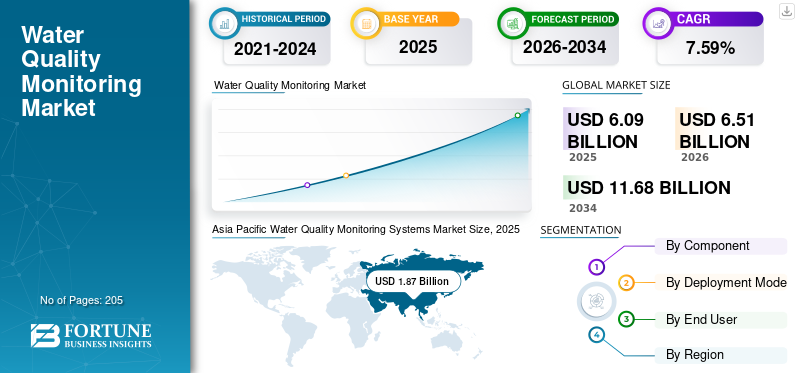
The global water quality monitoring systems market size was valued at USD 6.09 billion in 2025. The market is projected to grow from USD 6.51 billion in 2026 to USD 11.68 billion by 2034, exhibiting a CAGR of 7.59% during the forecast period. Asia Pacific dominated the water quality monitoring systems market with a market share of 30.71% in 2025.
Water quality monitoring systems are used to measure and analyze physical, chemical, and biological parameters of water to ensure its safety and compliance with regulatory standards. The growth of the market is strongly driven by rising water contamination, public health risks, and tightening regulatory oversight globally. The World Health Organization (WHO) reported in 2019 that unsafe water, sanitation, and hygiene contribute to approximately 829,000 deaths annually, highlighting the urgent need for continuous water quality surveillance. Water quality monitoring systems play a critical role in ensuring clean water across drinking, industrial, and environmental sources. Water quality monitoring systems enable real time data collection and analysis, allowing rapid detection of contamination and ensuring timely action to maintain water safety and regulatory compliance.
According to the WHO/UNICEF Joint Monitoring Programme (JMP) 2023 update, around 2 billion people still lack safely managed drinking water services, increasing demand for reliable testing and monitoring infrastructure. The United Nations Environment Programme (UNEP) stated in 2021 that nearly 80% of global wastewater is discharged into the environment without adequate treatment, creating strong regulatory pressure for industrial and municipal monitoring systems. Furthermore, UN-Water noted in its 2023 SDG 6 Progress Report that global water quality management coverage remains insufficient in many developing regions, accelerating investments in digital and real-time monitoring technologies.
- For instance, in March 2023, the United Nations Environment Programme (UNEP), under the World Water Quality Alliance, expanded its global freshwater quality monitoring initiative to support countries in strengthening national monitoring networks and data reporting for SDG 6.3. This initiative emphasized the deployment of digital water quality monitoring systems and standardized data platforms to improve real-time assessment of rivers, lakes, and groundwater quality globally.
Some of the leading companies operating in the industry include Xylem, Agilent Technologies, Inc., Teledyne Technologies Incorporated, and others. Xylem Inc. is a leading global water technology company providing advanced solutions for water quality monitoring and analysis. The company offers a broad portfolio of sensors, analyzers, and digital monitoring platforms designed for drinking water, wastewater, and environmental applications. Through smart and connected technologies, Xylem supports utilities and industries in ensuring regulatory compliance and sustainable water management. Smart city initiatives are accelerating the adoption of advanced water quality monitoring systems to enable real-time data management, efficient resource utilization, and sustainable urban water infrastructure.
Download Free sample to learn more about this report.
Water Quality Monitoring Systems Market Key Takeaways
 Global Market Size & Forecast
- 2025 Market Size: USD 6.09 Billion
- 2026 Market Size: USD 6.51 Billion
- 2034 Forecast Market Size: USD 11.68 Billion
- CAGR: 7.59% from 2026–2034
 Market Share
- Asia Pacific dominated the market with a 30.71% share in 2025.
- Sensors & probes led the market in 2025.
- Industrial was the leading end-user segment in 2025.
 Key Regional Highlights
Asia Pacific
Asia Pacific generated USD 1.87 billion in 2025, accounting for 30.71% of the global market.
North America
reached USD 1.86 billion in 2025, driven by strong regulations and digital monitoring adoption.
Europe
recorded USD 1.34 billion in 2025, supported by strict environmental and water quality standards.
U.S
The market reached USD 1.55 billion in 2025, representing 25.49% of the global market.
Japan
The market was valued at USD 0.22 billion in 2025, driven by smart water infrastructure investments.
Read More

WATER QUALITY MONITORING SYSTEMS MARKET TRENDS
Increasing Adoption of Smart and IoT-Enabled Water Quality Monitoring Systems are Key Market Trends
The prominent trends in the market are the growing adoption of smart, sensor-based, and IoT-enabled monitoring solutions. Utilities and industries are increasingly shifting from conventional manual sampling methods to real-time, automated monitoring networks that provide continuous data on parameters such as pH, turbidity, dissolved oxygen, conductivity, and contaminants. The growing market for real time water quality monitoring is driven by stricter regulations, rising pollution levels, and the need for rapid contamination detection to ensure safe and reliable water supply.
Water quality monitoring systems measure key parameters such as pH, turbidity, dissolved oxygen, conductivity, and residual chlorine to assess overall water safety and quality. This transition is driven by stricter environmental regulations, rising concerns over emerging pollutants, and the need for faster response to contamination events. Integration with cloud platforms, data analytics, and remote monitoring dashboards is enabling predictive maintenance and improved decision-making.
MARKET DYNAMICS
MARKET DRIVERS
Download Free sample to learn more about this report.
Stringent Regulatory Frameworks and Growing Water Safety Concerns to Drive Market Growth
One of the primary drivers of the water quality monitoring systems market growth is the strengthening of regulatory frameworks aimed at protecting public health and the environment. Governments and environmental agencies globally are implementing stricter standards for drinking water quality, industrial discharge, and wastewater treatment. Compliance with these regulations requires continuous and accurate monitoring of physical, chemical, and biological parameters.
At the same time, increasing incidents of water contamination, aging water infrastructure, and rising industrial effluents have intensified the need for reliable monitoring systems. Rapid urbanization and population growth are further pressuring municipal utilities to ensure a safe and uninterrupted water supply. Additionally, growing awareness among communities about waterborne diseases and environmental sustainability is encouraging investments in advanced monitoring technologies. These factors are anticipated to drive the CAGR during the forecast period.
MARKET RESTRAINTS
High Installation Costs and Technical Complexity to Hamper Market Demand
The key restraint in the market is the high initial investment required for advanced monitoring infrastructure. Deployment of real-time, sensor-based systems involves costs related to equipment procurement, calibration tools, data management software, and network integration. For small municipalities and developing regions, budget constraints often limit large-scale implementation.
In addition, ongoing maintenance, sensor replacement, and periodic calibration add to operational expenses. Technical complexity is another challenge, as accurate monitoring requires skilled personnel for installation, data interpretation, and system management. In remote or rural areas, limited technical expertise and inadequate digital infrastructure can hinder the effective utilization of monitoring systems.
MARKET OPPORTUNITIES
Expansion of Digital Water Infrastructure and Emerging Market Investments to Create Market Opportunities
The significant opportunities in the market are emerging from the expansion of digital water infrastructure and increasing investments in developing economies. Governments and international organizations are prioritizing smart water management under sustainability and climate resilience programs, creating demand for integrated monitoring networks.
Rapid urbanization in Asia, Africa, and Latin America is driving the development of new water treatment and distribution facilities, where advanced monitoring systems can be incorporated from the outset. Additionally, growing industrialization and stricter discharge norms are encouraging industries to adopt automated monitoring solutions to ensure compliance and operational efficiency.
MARKET CHALLENGES
Data Reliability Issues and Infrastructure Limitations to Challenge Market Growth
A major challenge in the market is ensuring data accuracy and long-term reliability of sensors operating in diverse environmental conditions. Factors such as biofouling, temperature fluctuations, chemical interference, and sediment buildup can affect sensor performance, leading to inaccurate readings and frequent recalibration needs.
Maintaining consistent data quality across large and distributed monitoring networks can be complex, particularly in remote or harsh locations. Additionally, many regions continue to rely on aging water infrastructure that is not fully compatible with modern digital monitoring technologies, making integration difficult and costly.
Segmentation Analysis
By Component
Sensors & Probes Segment Dominated Due to their Critical Role in Real-time Detection of Key Water Parameters
Based on component, the market is classified into sensors & probes, analyzers, sampling systems, data acquisition & transmission systems, and others.
In 2025, sensors & probes dominated the water quality monitoring systems market share due to their critical role in real-time detection and measurement of key water parameters. These components directly measure variables such as pH, dissolved oxygen, turbidity, conductivity, temperature, and chemical contaminants, forming the foundation of both portable and online monitoring systems. Their widespread adoption is driven by the increasing need for continuous monitoring in municipal water treatment plants, industrial facilities, and environmental surveillance programs.
The data acquisition & transmission systems segment is experiencing the highest growth and is expected to grow at a CAGR of 8.94% over the forecast period.
To know how our report can help streamline your business, Speak to Analyst
By Deployment Mode
Fixed Segment Dominated Due to Continuous Real-Time Monitoring Capabilities
Based on deployment mode, the market is classified into fixed, portable, and others.
In 2025, the fixed segment dominated the global market primarily due to their ability to provide continuous, real-time data for critical water management operations. Unlike portable systems that rely on manual sampling at specific intervals, fixed installations operate around the clock, enabling early detection of contamination events and rapid corrective action. Municipal water treatment plants, wastewater facilities, and large industrial units depend on uninterrupted monitoring to ensure regulatory compliance and operational stability.
The portable segment is expected to grow at a CAGR of 8.33% over the forecast period.
By End User
Industrial Segment Dominated Due to High Regulatory Compliance and Discharge Monitoring
On the basis of end user, the market is classified into industrial, commercial, and others.
In 2025, the industrial segment dominated the global market. Industries such as power generation, oil & gas, chemicals, pharmaceuticals, food & beverages, and mining generate significant volumes of wastewater that must comply with environmental standards before discharge. Continuous monitoring of parameters such as pH, chemical oxygen demand, dissolved oxygen, heavy metals, and turbidity is essential to avoid penalties and operational disruptions.
The commercial segment is expected to grow at a CAGR of 5.91% over the projected period.
Water Quality Monitoring Systems Market Regional Outlook
By geography, the market is categorized into North America, Europe, Asia Pacific, Latin America, and the Middle East & Africa.
Asia Pacific
Asia Pacific Water Quality Monitoring Systems Market Size, 2025 (USD Billion)
To get more information on the regional analysis of this market, Download Free sample
Asia Pacific reached a valuation of USD 1.87 billion in 2025 and secured the largest share of the market. The region’s market growth is driven by rapid urbanization, industrial expansion, and increasing pressure on freshwater resources. Growing populations in China, India, and Southeast Asian nations are intensifying demand for safe drinking water and efficient wastewater management. Governments across the region are strengthening environmental regulations and investing in river-cleaning programs, smart water infrastructure, and pollution control initiatives.
Japan Water Quality Monitoring Systems Market
The Japan market was valued at around USD 0.22 billion in 2025, accounting for roughly 3.69% of global revenues. Japan’s market is driven by advanced technological adoption, strict environmental standards, and continuous investment in smart water infrastructure modernization.
China Water Quality Monitoring Systems Market
China’s market is projected to be significant globally, with 2025 revenues valued at around USD 0.67 billion, representing roughly 10.97% of the global market.
India Water Quality Monitoring Systems Market
The Indian market was valued at around USD 0.37 billion in 2025, accounting for roughly 6.15% of global revenues.
North America
North America held the second-highest share in 2025, valued at USD 1.86 billion, and also took a significant share in 2026 with USD 1.97 billion. The growth is driven by strong regulatory enforcement, advanced infrastructure, and widespread adoption of digital monitoring technologies. North America’s market is primarily driven by stringent regulatory standards and strong enforcement mechanisms across the U.S. and Canada. Agencies such as the U.S. Environmental Protection Agency (EPA) and Environment and Climate Change Canada mandate continuous monitoring of drinking water and industrial discharge, encouraging utilities and industries to deploy advanced systems. Aging water infrastructure across several municipalities has increased investments in modernization and digital monitoring technologies to prevent contamination incidents.
U.S. Water Quality Monitoring Systems Market
Based on North America’s strong contribution and the U.S. dominance within the region, the U.S. market was valued at around USD 1.55 billion in 2025, accounting for roughly 25.49% of the global market size.
Europe
Europe is projected to record a growth rate of 5.98% in the coming years, which is the third-highest among all regions, and reached a valuation of USD 1.34 billion in 2025. Europe’s market is driven by strict environmental directives and sustainability commitments across the region. Regulations such as the European Union Water Framework Directive and Drinking Water Directive require member states to maintain high standards for surface water, groundwater, and potable water quality, encouraging continuous monitoring adoption. Strong emphasis on wastewater treatment, industrial discharge control, and circular water management further supports demand for advanced monitoring technologies.
Germany Water Quality Monitoring Systems Market
The Germany market was valued to be around USD 0.36 billion in 2025 and is estimated at around USD 0.38 billion in 2026, representing roughly 5.87% of the global revenues. The growth is driven by its ability to provide continuous data, early contamination detection, and improved regulatory compliance.
Latin America
Latin America is expected to witness moderate growth in this market during the forecast period. The Latin America market reached a valuation of USD 0.61 billion in 2025 and is driven by increasing efforts to address water pollution, urban wastewater discharge, and limited access to safely managed drinking water in several countries. Rapid urbanization in Brazil, Mexico, and Argentina has placed pressure on aging water infrastructure, encouraging governments to invest in monitoring and treatment upgrades.
Brazil Water Quality Monitoring Systems Market
Brazil's market was valued to be around USD 0.28 billion in 2025, representing roughly 4.55% of the market revenues.
Middle East & Africa
The Middle East & Africa are expected to witness significant growth in this market during the forecast period. The Middle East & Africa market reached a valuation of USD 0.41 billion in 2025 and is driven by increasing water scarcity, desalination dependence, and growing regulatory focus on water reuse and wastewater management. Countries in the Gulf region are investing heavily in desalination plants and advanced treatment facilities, where continuous monitoring is essential to maintain operational efficiency and water safety standards.
GCC Water Quality Monitoring Systems Market
The GCC market was valued to be around USD 0.20 billion in 2025, representing roughly 3.25% of the global market.
COMPETITIVE LANDSCAPE
Key Industry Players
Major players are Actively Expanding their Market Share Via Partnerships, Business Expansion, and Technological Advancements
The global water quality monitoring systems market holds a consolidated market structure, constituting prominent players such as Xylem, Agilent Technologies, Inc., Teledyne Technologies Incorporated, and others. Companies are adopting targeted growth strategies focused on strengthening their product portfolio, technical capability, expanding manufacturing presence, and other areas.
Other key players in the global market include General Electric Company, Danaher Corporation,
Evoqua Water Technologies LLC, and others. These companies are expected to prioritize new product launches and collaborations to increase their global market share during the forecast period.
LIST OF KEY WATER QUALITY MONITORING SYSTEMS COMPANIES PROFILED IN REPORT
- Xylem (U.S.)
- Agilent Technologies, Inc. (U.S.)
- Teledyne Technologies Incorporated (U.S.)
- General Electric Company (U.S.)
- Danaher Corporation (U.S.)
- Evoqua Water Technologies LLC (U.S.)
- Pentair (U.K.)
- HORIBA, Ltd. (Japan)
- Emerson Electric Co. (U.S.)
- Siemens (Germany)
KEY INDUSTRY DEVELOPMENTS
- January 2026: In-Situ, Inc. launched the RDO Trio®, combining dissolved oxygen, conductivity, and temperature measurement with salinity compensation and automated antifouling for continuous field monitoring. The strategic objective was to support reliable monitoring in aquaculture and coastal environments. Capabilities involved optical sensing, salinity compensation, automated wiping, Modbus connectivity, and real-time water quality monitoring in challenging environments.
- July 2026: Xylem Inc. acquired TriOS Mess- und Datentechnik GmbH, integrating optical sensing and measurement systems into its analytical instrumentation portfolio for utilities, industry, and environmental research. The strategic objective was to expand connected, real-time water quality monitoring. Capabilities involved optical sensors, multi-parameter measurement, nutrient detection, pollutant monitoring, and continuous water quality analysis across systems.
- March 2026: Bluesonde announced Aquatic Sensors as its official North American distributor for the Bluesonde Buoy, expanding access to continuous marine and freshwater monitoring for researchers, utilities, and coastal managers. The strategic objective was to scale regional deployment. Capabilities involved anti-fouling hardware, remote connectivity, sensor integration, autonomous deployment, and real-time water quality monitoring across aquatic environments.
- January 2026: CSignum launched through-ice wireless monitoring using its EM-2Q electromagnetic field signalling system, enabling cable-free continuous measurements beneath ice for winter water studies. The strategic objective was to extend monitoring into challenging seasonal conditions. Capabilities involved electromagnetic signalling, wireless telemetry, sonde integration, real-time data transmission, and continuous water quality monitoring beneath ice-covered freshwater systems.
- February 2026: Lexington city officials launched a volunteer-based water quality monitoring program aimed at testing local creeks and assessing watershed health. The initiative encourages community participation in collecting water samples and tracking parameters such as turbidity, temperature, and contamination indicators. The program supports long-term environmental planning, improves early detection of pollution sources, and strengthens collaboration between local authorities, environmental groups, and residents to protect regional water resources.
- February 2026: Multiple Indian cities strengthened water testing and monitoring enforcement following contamination complaints from residents. Municipal authorities increased sampling frequency, conducted infrastructure inspections, and introduced stricter compliance measures for treatment facilities. These actions underscore the growing recognition of automated monitoring systems as essential tools for maintaining drinking water safety and restoring public confidence in urban water supply networks.
- February 2026: The Rajasthan government announced plans to develop real-time water supply monitoring software through an AI Centre of Excellence. The system will use digital dashboards and analytics to monitor water distribution, detect leakages, and ensure quality compliance across urban and rural networks. This initiative aims to improve transparency, reduce inefficiencies, and enhance response times to contamination events while strengthening overall water governance infrastructure in the state.
- February 2026: Following a major sewage spill into the Potomac River, federal authorities ordered intervention measures to intensify water quality testing and environmental oversight. Agencies increased sampling frequency and deployed additional monitoring resources to assess contamination levels. The event underscored the importance of robust wastewater infrastructure, emergency response protocols, and continuous river monitoring systems to safeguard drinking water sources and aquatic ecosystems.
- October 2025: An IoT-based smart water quality monitoring system was presented in Springer conference proceedings, outlining advancements in real-time sensing, wireless communication, and cloud integration. The research emphasized improved detection of contaminants and automated data analysis. Such academic contributions support the commercialization of next-generation monitoring technologies and strengthen digital water management frameworks globally.
REPORT COVERAGE
The global water quality monitoring systems market analysis provides an in-depth study of the market size & forecast by all the market segments included in the report. It includes details on the market dynamics and the market trends expected to drive the market during the forecast period. It offers information on the technological advancements, new product launches, key industry developments, and details on partnerships, mergers & acquisitions. The market research report also encompasses a detailed competitive landscape with information on the market share and profiles of key operating players.
Request for Customization to gain extensive market insights.
Report Scope & Segmentation
| ATTRIBUTE | DETAILS |
| Study Period | 2021-2034 |
| Base Year | 2025 |
| Estimated Year | 2026 |
| Forecast Period | 2026-2034 |
| Historical Period | 2021-2024 |
| Growth Rate | CAGR of 7.59% from 2026-2034 |
| Unit | Value (USD Billion) |
| Segmentation | By Component, Deployment Mode, End User, and Region |
| By Component |
|
| By Deployment Mode |
|
| By End User |
|
| By Region |
|
Frequently Asked Questions
Fortune Business Insights says that the global market value stood at USD 6.09 billion in 2025 and is projected to reach USD 11.68 billion by 2034.
In 2025, the Asia Pacifics market value stood at USD 1.87 billion.
The market is expected to exhibit a CAGR of 7.59% during the forecast period of 2026-2034.
The sensors & probes segment led the market by component.
Stringent water quality regulations, rising contamination concerns, growing industrial discharge monitoring needs, infrastructure modernization, and increasing adoption of real-time and IoT-enabled monitoring technologies are the key factors driving the market.
Xylem, Agilent Technologies, Inc., Teledyne Technologies Incorporated are some of the top players in the market.
Asia Pacific held the largest market share in 2025.
Increasing regulatory compliance requirements, rising public health awareness, expanding wastewater treatment infrastructure, industrial sustainability initiatives, and advancements in smart sensor and digital monitoring technologies are expected to favor product adoption.



- 2021-2034
- 2025
- 2021-2024
- 205
Get 30-60 hrs Free Customization
Expand Regional and Country Coverage, Segments Analysis, Company Profiles, Competitive Benchmarking, and End-user Insights.



















Related Reports
-
US +1 833 909 2966 ( Toll Free )
-
Get In Touch With Us