Wheat Protein Market Size, Share & Industry Analysis, By Product Type (Wheat Gluten, Wheat Protein Isolates, Hydrolyzed Wheat Protein, and Textured Wheat Protein), By Form (Dry and Liquid), By Concentration (75% Concentration, 80% Concentration, and 95% Concentration), By Application (Food & Beverages [Bakery & Confectionery, Dairy Alternatives, Meat Alternatives, Nutritional Bars, Snacks, and Others], Animal Feed, Personal Care & Cosmetics, and Others) and Regional Forecast, 2026-2034
 Download Free Sample
(Offer valid till 30th Sep 2026)

Wheat Protein Market Size and Future Outlook
 Listen to Audio Version
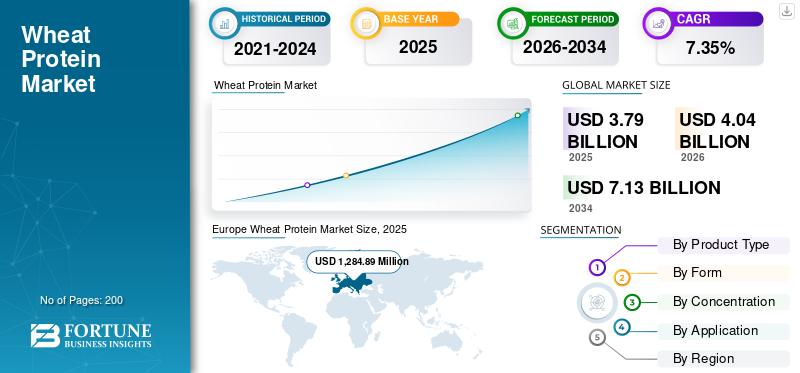
The global wheat protein market size was valued at USD 3,798.62 million in 2025 and is projected to grow from USD 4,048.37 million in 2026 to USD 7,138.48 million by 2034, exhibiting a CAGR of 7.35% during the forecast period. Europe dominated the wheat protein market with a market share of 33.83% in 2025.
Wheat protein refers to protein-rich ingredients derived from wheat through processing methods such as separation, concentration, hydrolysis, and texturization. These ingredients are widely used across bakery, processed foods, sports nutrition, meat alternatives, dairy alternatives, animal feed, and personal care applications due to their functional benefits, including emulsification, water binding, elasticity, foaming, and textural enhancement. Global market growth is being supported by rising demand for plant-based proteins, increasing consumption of convenience and fortified foods, and the broader adoption of functional ingredients by wheat protein manufacturers.
The global market demand is led by key companies, including Archer Daniels Midland Company, Cargill, Incorporated, Roquette Frères, MGP Ingredients, Inc., and Crespel & Deiters Group. These companies compete based on ingredient functionality, customized formulations, product purity, texturization technology, application development, and global distribution capabilities.
Download Free sample to learn more about this report.
Wheat Protein Market Key Takeaways
 Market Size & Forecast
- 2025 Market Size: USD 3,798.62 million
- 2026 Market Size: USD 4,048.37 million
- 2034 Forecast Market Size: USD 7,138.48 million
- CAGR: 7.35% from 2026–2034
 Market Share
- Europe dominated the wheat protein market with a 33.83% share in 2025.
- The wheat gluten segment dominated the market in 2025, valued at USD 2,715.39 million.
- The dry segment led the global market in 2025, reaching USD 3,555.17 million.
 Key Regional Highlights
Europe
Europe led the market with a value of USD 1,284.89 million in 2025 and is projected to grow steadily during the forecast period.
Asia Pacific
Asia Pacific was valued at USD 1,117.90 million in 2025 and is expected to register the fastest growth rate.
North America
North America reached USD 966.89 million in 2025 and is projected to expand at a healthy pace.
U.S.
The market was valued at USD 791.06 million in 2025, leading the North American region.
Japan
The market is expected to benefit from rising demand for plant-based and functional protein ingredients.
Read More

Wheat Protein Market Trends
Rising Adoption of Plant-Based and Functional Protein Ingredients to Shape Industry Trends
The wheat protein industry is witnessing steady momentum as food manufacturers increasingly use wheat-derived proteins to improve texture, nutritional value, and processing efficiency across multiple end-use categories. Wheat gluten remains highly preferred in bakery applications due to its viscoelasticity and structure-building properties, while textured wheat protein is gaining traction in meat alternatives owing to its fibrous bite and meat-like chew. At the same time, isolates and hydrolyzed variants are benefiting from demand in nutritional products, specialized formulations, and personal care applications.
- For instance, in June 2025, Roquette recently launched two innovative textured proteins under its NUTRALYS plant-based portfolio, targeting meat alternatives and sustainable food applications. NUTRALYS T WHEAT 600L is Roquette's first textured wheat protein, offering over 60% protein content with fibrous, chicken-like texture. It provides chewiness, tenderness, and a naturally light color, using sustainably sourced European wheat for better traceability and clean-label appeal.
MARKET DYNAMICS
Market Drivers
Download Free sample to learn more about this report.
Expanding Demand for Protein-Enriched Foods, Bakery Products, and Meat Alternatives to Support Market Growth
A key driver for the market is the sustained global demand for processed wheat-based food products and protein-enriched formulations. Wheat protein plays a critical role in enhancing dough strength, elasticity, chewiness, water absorption, and finished-product consistency, making it especially valuable in bakery, confectionery, snacks, and convenience foods.
- S. Department of Agriculture (USDA) states that consumer demand for wheat flour-based food products remains relatively stable and is closely tied to population and changing tastes, while the agency’s 2024 flour milling summary indicated that all wheat ground for flour in the U.S. reached 916 million bushels, with total flour production of 425 million hundredweight, both up 1% year over year.
Market Restraints
Raw Material Price Volatility, Functional Limitations in Some End Uses, and Allergen Concerns Restricts Growth
Despite favorable demand conditions, the market faces restraints linked to raw material volatility and supply uncertainty. Wheat protein economics are highly sensitive to wheat harvests, grain quality, energy costs, and processing yields.
- According to the Food and Agriculture Organization (FAO), global wheat production is anticipated to decline by nearly 3% to 810 million tons in 2026, reflecting softer prices and area cutbacks, even though supply remains above the five-year average. Such fluctuations can affect pricing and procurement stability for ingredient manufacturers.
Another challenge is application-specific substitution. In some food systems, manufacturers may prefer pea, soy, rice, fava, or dairy proteins depending on label positioning, allergen profile, solubility targets, or sensory requirements. Wheat protein also faces limitations among gluten-sensitive consumer segments, which can restrict adoption in certain health-positioned products and force producers to carefully position wheat-based offerings versus gluten-free alternatives.
Market Opportunities
Rising Use in Meat Analogues, High-Protein Snacks, Animal Nutrition, and Personal Care to Expand Market Reach
The market is entering a broader opportunity phase as manufacturers move beyond traditional bakery usage into adjacent high-growth applications. Textured wheat protein is witnessing stronger uptake in plant-based meat, hybrid protein systems, fillings, and savory convenience foods due to its ability to deliver structure and bite. There is also meaningful headroom in sports nutrition, fortified snacks, nutritional bars, and protein-enriched baked goods, where wheat protein can be used to improve protein density and functionality. In animal nutrition, wheat protein derivatives and co-products benefit from their digestibility and formulation flexibility, while in personal care, hydrolyzed wheat protein is increasingly used in hair and skin products for film-forming and conditioning properties. These factors drive the wheat protein market growth.
WHEAT PROTEIN MARKET SEGMENTATION ANALYSIS
By Product Type
Wheat Gluten Segment Dominated Due to Its Strong Functional Performance in Bakery and Processed Foods
Based on product type, the wheat protein market is segmented into wheat gluten, wheat protein isolates, hydrolyzed wheat protein, and textured wheat protein.
The wheat gluten segment dominated the market in 2025, reaching USD 2,715.39 million, supported by its widespread use in bakery, confectionery, noodles, snacks, and meat analogues. Its strong viscoelastic properties, dough-strengthening capability, and cost-effectiveness make it the most commercially established wheat protein category.
Among all product types, textured wheat protein is projected to register the fastest CAGR of 8.98% during the forecast period, reflecting strong innovation activity and growing use in next-generation plant-based foods.
To know how our report can help streamline your business, Speak to Analyst
By Form
Dry Segment Dominated the Market Due to Better Shelf Stability and Ease of Handling
Based on form, the market is segmented into dry and liquid.
The dry segment led the global wheat protein market share in 2025, reaching USD 3,555.17 million, owing to its superior shelf life, ease of transportation, simple storage requirements, and widespread compatibility with industrial food processing systems. Dry wheat proteins are preferred across bakery premixes, snacks, extruded foods, meat alternatives, and animal feed as they are convenient to handle and blend into bulk manufacturing workflows. This format also supports better dosage control and lower logistics costs compared with liquid systems.
The liquid segment is projected to grow at the fastest CAGR of 9.11% during the forecast period, albeit from a smaller base, supported by niche food, beverage, and industrial applications.
By Concentration
The 75% Concentration Segment Dominated the Market Due to Its Broad Commercial Use and Cost-Performance Balance
Based on concentration, the market is segmented into 75% concentration, 80% concentration, and 95% concentration.
The 75% concentration segment dominated the market in 2025, valued at USD 2,101.84 million, as it offers a balanced combination of functionality, affordability, and suitability for mainstream food applications. It is widely used by manufacturers seeking performance benefits in bakery, processed food, and general protein-fortification applications without moving into more premium pricing brackets.
Among these, the 95% concentration segment is projected to register the fastest CAGR of 8.40% during the forecast period, reflecting growing demand for high-performance protein ingredients in specialized end uses.
By Application
Food & Beverages Segment Dominated Due to Broad Usage Across Processed and Functional Food Systems
Based on application, the market is segmented into food & beverages, animal feed, personal care & cosmetics, and others.
The food & beverages segment dominated the market and was valued at USD 3,238.25 million in 2025, driven by the extensive use of wheat protein in mainstream processed foods, fortified products, convenience meals, and functional formulations. Within the broader market, bakery & confectionery remained one of the most important use areas, supported by the ingredient’s role in improving structure, elasticity, and texture.
Among all applications, the personal care & cosmetics segment recorded a CAGR of 9.74% over the forecast period, reflecting the market’s gradual diversification beyond traditional food uses.
Wheat Protein Market Regional Outlook
Regionally, the market is studied across North America, Europe, Asia Pacific, South America, and the Middle East & Africa.
Europe
Europe Wheat Protein Market Size, 2025 (USD Million)
To get more information on the regional analysis of this market, Download Free sample
Europe accounted for a significant share of the global market, valued at USD 1,284.89 million in 2025, and is projected to expand at a CAGR of 7.06% during the forecast period. The region benefits from established wheat processing infrastructure, high use of wheat-derived ingredients in bakery and savory products, and rising demand for clean-label and plant-based formulations.
Germany Wheat Protein Market
Germany was valued at approximately USD 296.02 million in 2025, driven by strong demand for plant-based foods, bakery products, meat alternatives, and technical food ingredients. The country’s food processing base and innovation in wheat texturates and specialty ingredients make it an important demand and supply center within the regional market.
U.K. Wheat Protein Market
The U.K. market reached around USD 258.57 million in 2025, supported by growing consumption of convenient, fortified, and plant-forward foods. Demand is particularly visible in premium bakery, ready meals, snacks, and meat-alternative formulations, where wheat protein provides texture, elasticity, and protein enhancement.
North America
North America was valued at USD 966.89 million in 2025 and is projected to grow at a CAGR of 7.49% during the forecast period. Growth in the region is primarily supported by strong processed food demand, high adoption of plant-based proteins, mature bakery and snack industries, and growing use of wheat protein in meat substitutes, nutrition products, and animal feed.
U.S. Wheat Protein Market
The U.S. represents the leading market in North America, valued at USD 791.06 million in 2025, supported by its large bakery industry, strong demand for wheat protein-enriched foods, and rising commercial activity in plant-based meat and functional ingredients.
Asia Pacific
Asia Pacific was valued at USD 1,117.90 million in 2025 and is projected to register the fastest CAGR of 7.95% during the forecast period. Growth is being driven by rapid urbanization, increasing disposable incomes, expansion of modern food retail, and rising demand for processed foods, noodles, bakery items, snacks, and alternative proteins.
China Wheat Protein Market
China accounted for the largest market in the region, valued at approximately USD 172.50 million in 2025, supported by its vast processed food industry, large-scale wheat consumption, and increasing demand for plant-based and convenience food products. Textured wheat protein, wheat gluten, and higher-protein ingredients are finding broader use across noodles, bakery, snacks, and meat-alternative applications.
South America and the Middle East & Africa
South America was valued at USD 352.56 million in 2025 and is projected to grow at a CAGR of 6.31% during the forecast period. Market growth is supported by improving penetration of processed foods, steady growth in bakery and snack applications, and increasing interest in affordable plant-based protein ingredients.
The Middle East & Africa market was valued at USD 76.38 million in 2025 and is projected to grow at a CAGR of 5.69% during the forecast period. Growth is being driven by rising urban food consumption, increasing use of imported processed ingredients, and gradual expansion of bakery, convenience food, and nutrition categories.
Brazil Wheat Protein Market
The Brazilian market was valued at approximately USD 166.03 million in 2025, supported by its large food processing industry, expanding bakery sector, and increasing demand for cost-effective plant-based protein ingredients.
COMPETITIVE LANDSCAPE
Key Industry Players
Key Players Focus on Functional Innovation, Texturization, and Application-Specific Protein Solutions
The global wheat protein market is moderately consolidated, with multinational ingredient companies and specialized wheat processors competing through product quality, purity levels, application expertise, and geographic reach. Companies are increasingly focusing on textured wheat proteins, high-protein concentrates, isolates, and specialty solutions tailored for bakery, plant-based meat, sports nutrition, and industrial food systems. The competitive environment is also being shaped by investments in extrusion technology, supply reliability, and customer-specific formulation support.
Key Players in the Wheat Protein Market
|
Rank |
Company Name |
|
1 |
Archer Daniels Midland Company |
|
2 |
Cargill, Incorporated |
|
3 |
Roquette Frères |
|
4 |
MGP Ingredients, Inc. |
|
5 |
Crespel & Deiters Group |
List of Key Wheat Protein Companies Profiled
- Archer Daniels Midland Company (U.S.)
- Cargill, Incorporated (U.S.)
- Roquette Frères (France)
- MGP Ingredients, Inc. (U.S.)
- Crespel & Deiters Group (Germany)
- Manildra Group (Australia)
- AGRANA Beteiligungs-AG (Austria)
- Crespel & Deiters GmbH & Co. KG (Germany)
- Tereos Group (France)
- Glico Nutrition Co., Ltd. (Japan)
KEY INDUSTRY DEVELOPMENTS
- May 2025: GoodMills Innovation recently launched VITATEX Wheat Fava Flakes SVP Pro, a co-extruded ingredient blending wheat gluten and fava bean protein to enhance fibrous texture in plant-based meat alternatives. This product uses a specialized co-extrusion process that creates a cross-linked protein network with a layered structure and firm bite, outperforming separately extruded and blended proteins.
- May 2024: GoodMills Innovation, a Hamburg-based specialist in food ingredients, introduced SMART Wheat as a high-protein flour. This product enhances dough extensibility, speeds up gluten network formation, and ensures consistent baking results for items such as bread, pastries, and yeast doughs.
- November 2023: Amber Wave launched North America's largest wheat protein facility in Phillipsburg, Kansas. The state-of-the-art plant features a fully automated 27,500-cwt Sangati Berga mill, plus equipment from Kice Industries, Flottweg, VetterTec, and Premier Tech for gluten extraction, drying, and packaging. It produces AmberPro Vital Wheat Gluten, a high-protein (75%) ingredient with neutral taste, used in baking, plant-based meats, pet food, and feeds.
- May 2023: Lantmännen Biorefineries inaugurated its new wheat protein production facility in Norrköping, Sweden. The plant, costing about USD 73.95 million, boosts annual wheat protein (gluten) capacity from 9,000 to 29,000 tons. It supports high demand for Swedish wheat protein domestically and internationally, creating 30 new jobs.
- September 2020: ADM launched textured wheat and pea proteins to bolster its plant-based protein offerings for meat alternatives. These include Arcon T textured pea proteins (blended with chickpeas or navy beans for better hydration and PDCAAS scores), Prolite MeatTEX textured wheat protein, and Prolite MeatXT non-textured wheat protein.
REPORT COVERAGE
The global wheat protein market industry report analyzes the market in depth and highlights crucial aspects such as global market trends, dynamics, prominent companies, investment in research and development, and end-use. Besides this, the report also provides insights into the global market analysis and highlights significant industry developments.
Request for Customization to gain extensive market insights.
Report Scope & Segmentation
| ATTRIBUTE | DETAILS |
| Study Period | 2021-2034 |
| Base Year | 2025 |
| Estimated Year | 2026 |
| Forecast Period | 2026-2034 |
| Historical Period | 2021-2024 |
| Growth Rate | CAGR of 7.35% from 2026 to 2034 |
| Unit | Value (USD Million) |
|
Segmentation |
By Product Type
|
|
By Form
|
|
|
By Concentration
|
|
|
By Application
|
|
|
By Region
|
Frequently Asked Questions
Fortune Business Insights says that the global market was valued at USD 3,798.62 million in 2025 and is anticipated to reach USD 7,138.48 million by 2034.
At a CAGR of 7.35%, the global market will exhibit steady growth over the forecast period.
By form, the dry segment led the market in 2025.
Europe held the largest market share in 2025.
Expanding demand for protein-enriched foods, bakery products, and meat alternatives is the crucial factor driving the global market.
Archer Daniels Midland Company, Cargill, Incorporated, Roquette Frères, MGP Ingredients, Inc., and Crespel & Deiters Group. are the leading players in the market.
Rising adoption of plant-based and functional protein ingredients is the key market trend.



- 2021-2034
- 2025
- 2021-2024
- 200
-
(Offer valid till 30th Sep 2026)
Get 30-60 hrs Free Customization
Expand Regional and Country Coverage, Segments Analysis, Company Profiles, Competitive Benchmarking, and End-user Insights.




















Related Reports
-
US +1 833 909 2966 ( Toll Free )
-
Get In Touch With Us