Xylitol Market Size, Share & Industry Analysis, By Source (Corn-based Xylitol, Birch-based Xylitol, and Sugarcane Residue-based Xylitol), By Form (Powder and Liquid), By Production Process (Chemical Hydrogenation, Fermentation-based Production, and Enzymatic/Biocatalytic Production), By End Use (Chewing Gum & Confectionery, Food & Beverages, Oral Care, Pharmaceuticals & Nutraceuticals, and Cosmetics & Personal Care), and Regional Forecast, 2026-2034
 Download Free Sample
(Offer valid till 31st Oct 2026)

Xylitol Market Size and Future Outlook
 Listen to Audio Version
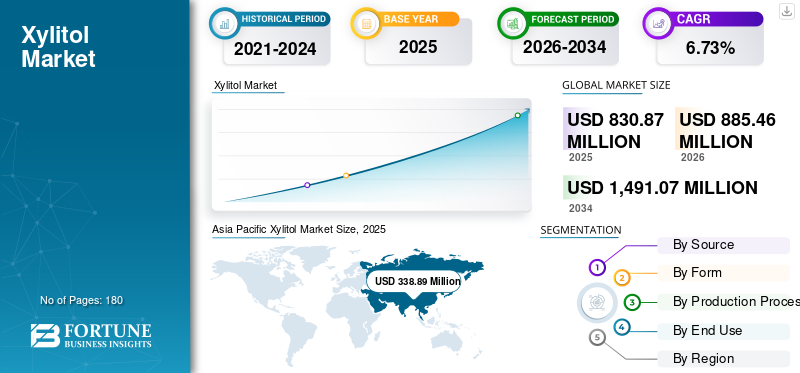
The global xylitol market size was valued at USD 830.87 million in 2025 and is projected to grow from USD 885.46 million in 2026 to USD 1,491.07 million by 2034, exhibiting a CAGR of 6.73% during the forecast period. Asia Pacific dominated the xylitol market with a market share of 40.79% in 2025.
Xylitol is a sugar alcohol utilized as a sweetener in oral care, food & beverages, pharmaceuticals and personal care products. It offers sweetness similar to conventional sugar but with a lower glycemic index and minimal calories. This ingredient is mainly manufactured by extracting plant-based raw materials and xylose and converting it to xylitol via catalytic hydrogenation. Key raw materials used for the production include hemicellulose-rich agricultural biomass, corn cobs, and birch wood. Regarding end-users, it caters this sugar substitute to nutraceutical firms, personal care product makers, oral care players, and confectionery brands. The rising consumer preferences for sugar free products and improved awareness of the health benefits of xylitol fuel the market’s growth.
Companies such as Zhejiang Huakang Pharmaceutical Co., Ltd., Cargill, Incorporated, and zuChem Inc. are prominent players in the market. New product launches are a pivotal strategy adopted by key players to improve their position.
Download Free sample to learn more about this report.
Xylitol Market Key Takeaways
 Global Market Size & Forecast
- 2025 Market Size: USD 830.87 million
- 2026 Market Size: USD 885.46 million
- 2034 Forecast Market Size: USD 1,491.07 million
- CAGR: 6.73% (2026–2034)
 Market Share
- Asia Pacific dominated the market with a 40.79% share in 2025.
- The sugarcane residue-based xylitol segment is projected to grow at a 9.98% CAGR during the forecast period.
- The fermentation-based production segment is projected to grow at a 10.29% CAGR during the forecast period.
 Key Regional Highlights
Asia Pacific
Asia Pacific generated USD 338.89 million in 2025, maintaining its leading market position.
North America
North America is supported by increasing demand for xylitol and growing consumer interest in natural sweeteners.
Europe
Europe generated USD 175.81 million in 2025, ranking third and projected to grow at a 5.47% rate.
U.S.
U.S. market was estimated at approximately USD 179.28 million in 2025.
Japan
Japan market reached approximately USD 65.78 million in 2025.
Read More

XYLITOL MARKET TRENDS
Growing Functional Oral Care Positioning Boosts the Use of Xylitol
The rising use of xylitol in oral care products is a key trend as the majority of the brands gravitate toward preventive dental care and functional positioning. Today, individuals are seeking mouthwash, toothpaste, lozenges, and dental mints that provide added advantages beyond breath freshness and taste. This sudden shift is encouraging producers to use xylitol as it supports tooth-friendly and sugar-free formulations. Its strong association with enamel support, cavity protection, and plaque control makes it ideal for pediatric oral care and family-focused products. This alternative also enhances the sensory appeal of oral care items by providing mild sweetness, which is necessary in sugar free chewing gums, medicated lozenges, and children’s toothpaste. After witnessing such advantages, the oral care product brands are trying to diversify their portfolio by introducing xylitol-based products.
MARKET DYNAMICS
MARKET DRIVERS
Download Free sample to learn more about this report.
Surging Demand for Low-Calorie/Sugar-Free Products Propels the Market’s Growth
The increasing demand for sugar-free or low-calorie products is a major driver of the market. In this modern era, individuals are seeking sweetening options that support healthier eating without eliminating sweetness from their daily diets. Health concerns related to diabetes, high sugar intake, and other lifestyle diseases are necessitating firms to reformulate their items with reduced sugar content. Xylitol aligns well with this demand as it offers sweetness similar to sugar while providing fewer calories than traditional sugar, making it suitable for the bakery and candies sector. Moreover, its low glycemic index positioning makes it captivating for end products targeted at sugar-conscious and diabetic consumers. Additionally, it is useful in functional confectionery as it offers dental care appeal, sweetness, and freshness in one component.
MARKET RESTRAINTS
High Manufacturing Cost Compared to Traditional Sweeteners Hampers Industry’s Growth
One of the main obstacles in the market is the capital-intensive and complex production process of xylitol compared to other alternatives. Xylitol is primarily derived from plant-based residues, birch wood, and corn cobs, which need purification, pretreatment, crystallization, and catalytic conversion before it can be used as an ingredient. These processing steps fuel equipment requirements, quality control costs, specifically for pharmaceutical and food-grade use, and energy use. In comparison, maltitol, sugar, and various other high-intensity sweeteners are mostly economical for large-scale beverage and food production. This huge cost difference makes producers less willing to adopt xylitol in mass-market formulations, particularly where component costs directly impact profit margins. As a result, the aforementioned factors hinder the global xylitol market share.
MARKET OPPORTUNITIES
Technological Advancements in Sugar Substitutes Sector Create Growth Opportunities
The adoption of advanced technologies in the sugar alternatives industry opens several growth opportunities. In this sector, biomass pretreatment technology is considered highly important as it enhances xylose recovery and minimizes the formation of unwanted by-products, which can interfere with fermentation and purification. Enzymatic conversion technologies are another method being explored by producers as they are known to enhance product consistency. Moreover, crystallization and purification technologies are gaining attention in the substitutes market as they help in attaining higher purity. In addition, researchers and producers are evaluating microbial-based fermentation, which uses yeasts, bacteria, and other engineered microorganisms to easily convert xylose to xylitol.
Segmentation Analysis
By Source
Corn-based Xylitol Dominated the Market Due to Strong Commercial Availability
Depending on the source, the market is divided into corn-based xylitol, birch-based xylitol, sugarcane residue-based xylitol, and other biomass-based xylitol.
The corn-based xylitol sector dominated the market in 2025. The segment has robust commercial availability as corn-processing residue and corn cobs are largely available in key producing countries, particularly in China. This type of xylitol is economical as compared to birch-based xylitol, which adds value to the growth. Moreover, it is appropriate for mass production as the conversion process of xylose to xylitol is already established. Additionally, corn-sourced xylitol has better price stability for buyers, which boosts the segment’s potential.
The sugarcane residue-based xylitol segment is projected to grow at a high CAGR of 9.98% over the forecast period.
By Form
Powder Form Led the Market Due to Easier Handling
On the basis of form, the market is bifurcated into powder and liquid.
In 2025, the powder segment led the global market. Compared with liquid, the powdered form is easy to pack, distribute, and store as it doesn’t need leakage-resistant handling systems, drums, and pumps. This ingredient provides better shelf stability as it has a reduced moisture content compared to liquid. Moreover, it allows accurate dosage and has improved blending properties. Additionally, it has wide commercial acceptance and reduced transportation burden, further fueling the segment’s potential.
The liquid is projected to grow at a high CAGR of 11.26% over the forecast period.
By Production Process
Chemical Hydrogenation Segment Led the Industry Owing to Established Infrastructure
Based on the production process, the market is distributed into chemical hydrogenation, fermentation-based production, enzymatic/biocatalytic production, and others.
The chemical hydrogenation segment led the industry in 2025. As compared to enzymatic and fermentation-based production, chemical hydrogenation is the most well-known production route, which has been utilized at an industrial level for years. This production process is ideal for large-volume xylitol production as it can easily process huge volumes in a controlled production setup. Moreover, the majority of the xylitol manufacturers have well-designed infrastructure for crystallization units, quality testing facilities, and reactors. As a result, the above-mentioned instances propel the global xylitol market growth.
The fermentation-based production segment is projected to grow at a high CAGR of 10.29% over the forecast period.
By End Use
To know how our report can help streamline your business, Speak to Analyst
Chewing Gum & Confectionery Segment Led the Market Due to High Use of Xylitol in Sugar-Free Gums and Confectionery Items
Depending on the end use, the market is segmented into chewing gum & confectionery, food & beverages, oral care, pharmaceuticals & nutraceuticals, cosmetics & personal care, and others.
The chewing gum & confectionery category dominated the global industry in 2025. The confectionery and chewing gum sector utilizes xylitol in large quantities as these products gain advantage from its tooth-friendly image and sweetness. As compared to cosmetics and animal feed, individuals are more familiar with this sugar alternative in dental chewing gums, candies, and mints. Moreover, it improves sensory performance as it offers a cooling effect, which aligns well with lozenges, hard candies, and flavored gums. Additionally, minimal formulation complexity further boosts the segment’s growth.
The pharmaceuticals & nutraceuticals segment is projected to grow at a high CAGR of 10.26% over the forecast period.
Xylitol Market Regional Outlook
By region, the market is categorized into Europe, North America, Asia Pacific, South America, and the Middle East & Africa.
Asia Pacific
Asia Pacific Xylitol Market Size, 2025 (USD Million)
To get more information on the regional analysis of this market, Download Free sample
Asia Pacific dominated the market, reaching USD 338.89 million in 2025. The increasing demand for xylitol as a natural sweetener and growing health conscious consumers drive the regional growth.
India Xylitol Market
The Indian market size in 2025 was estimated at around USD 33.83 million, accounting for roughly 4.07% of the global market revenues.
China Xylitol Market
China's market is projected to be one of the largest worldwide, with revenues estimated at around USD 149.44 million in 2025, accounting for roughly 17.99% of the global market sales.
Japan Xylitol Market
The Japan market size in 2025 was estimated at around USD 65.78 million, accounting for approximately 7.92% of the global market revenues.
North America
North America reached a valuation of USD 219.92 million in 2025, securing the second position in the market. The flourishing functional confectionery sector and increasing prevalence of dental ailments boost the market’s potential.
U.S. Xylitol Market
Based on North America's strong contribution and the U.S. dominance within the region, the U.S. market was analytically approximated at around USD 179.28 million in 2025, accounting for roughly 21.58% of global sales.
Europe
The Europe market size reached USD 175.81 million in 2025, recording a growth rate of 5.47% in the coming years, and ranking third among all regions. The adoption of advanced technology and the surging use of xylitol in the oral care industry are propelling the regional growth potential.
Germany Xylitol Market
The German market size in 2025 was estimated at around USD 44.86 million, representing roughly 5.40% of the global market revenues.
U.K. Xylitol Market
The U.K. market value reached approximately USD 27.00 million in 2025, equivalent to around 3.25% of the global market sales.
South America and the Middle East & Africa
South America and the Middle East & Africa regions are expected to witness moderate growth in this market space during the forecast period. The South America market reached a valuation of USD 56.04 million in 2025. The growing imports of sugar alternatives and expanding distribution network are expected to drive demand. The Middle East & Africa market reached USD 40.22 million in 2025.
South Africa Xylitol Market
The South African market reached around USD 17.88 million in 2025, representing roughly 2.15% of global revenues.
COMPETITIVE LANDSCAPE
Key Industry Players
Product Innovation Helps Companies to Improve Market Penetration
The xylitol industry is moderately consolidated, with most competition led by Asian polyol producers and renowned ingredient manufacturers. Key enterprises such as Zhejiang Huakang Pharmaceutical Co., Ltd., Cargill, Incorporated, and zuChem Inc., compete on new product launches, production capacity, and application support. Moreover, brands operating in the global space are seeking acquisitions, collaborations, and promotional campaigns to improve their market reach.
LIST OF KEY XYLITOL COMPANIES PROFILED
- Roquette Frères (France)
- International Flavors & Fragrances Inc. (U.S.)
- Foodchem International Corporation (China)
- Cargill, Incorporated (U.S.)
- Zhejiang Huakang Pharmaceutical Co., Ltd. (China)
- zuChem Inc. (U.S.)
- Shandong Longlive Bio-technology Co., Ltd. (China)
- Mitsubishi Corporation Life Sciences Ltd. (Japan)
- Yucheng Lujian Biological Technology Co., Ltd. (China)
- Futaste Group (China)
KEY INDUSTRY DEVELOPMENTS
- November 2025: Lotte Wellfood, a South Korean confectionery firm, released a new campaign for “Lotte Xylitol,” a health functional gum. Through this campaign, the company promoted regular tooth care habits amongst consumers.
- May 2024: Wisdom Natural Brands, an American sugar substitute brand, expanded its product portfolio by introducing its first single-ingredient, “Sweet Leaf Xylitol Reduced Calorie Sweetener,” available at Sprouts Farmers Market, a supermarket chain in the U.S.
- November 2023: P2X Solutions Ltd., a Finnish producer of synthetic methane and green hydrogen, and Danisco Sweeteners Ltd., a sugar substitute subsidiary of International Flavors & Fragrances Inc., a U.S.-based enterprise, entered into a contract. The primary aim of this agreement was to enable Danisco’s Sweeteners Kotka factory to manufacture xylitol using green hydrogen in the coming years.
REPORT COVERAGE
The global xylitol market analysis provides an in-depth study of the market size & forecast by all the market segments included in the market report. The global market forecast analysis includes details on the market dynamics and global market trends expected to drive the market during the forecast period. The global market analysis offers information on the technological advancements, new product launches, key industry developments, and details on partnerships, mergers & acquisitions. The global market report forecast also encompasses a detailed competitive landscape with information on the market segmentation, market share, and profiles of key operating players.
Request for Customization to gain extensive market insights.
Report Scope & Segmentation
| ATTRIBUTE | DETAILS |
| Study Period | 2021-2034 |
| Base Year | 2025 |
| Estimated Year | 2026 |
| Forecast Period | 2026-2034 |
| Historical Period | 2021-2024 |
| Growth Rate | CAGR of 6.73% from 2026-2034 |
| Unit | Value (USD Million) |
| Segmentation | By Source, Form, Production Process, End Use, and Region |
| By Source |
|
| By Form |
|
| By Production Process |
|
| By End Use |
|
| By Region |
|
Frequently Asked Questions
Fortune Business Insights says that the global market value stood at USD 830.87 million in 2025 and is projected to reach USD 1,491.07 million by 2034.
In 2025, the market value stood at USD 338.89 million.
The market is expected to exhibit a CAGR of 6.73% during the forecast period.
By form, the powder segment led the global market in 2025.
Surging demand for low-calorie/sugar-free products propels the growth of the market.
Zhejiang Huakang Pharmaceutical Co., Ltd., Cargill, Incorporated, and zuChem Inc. are among the key players in the market.
Asia Pacific held the largest market share in 2025.
Growing functional oral care positioning boosts the use of xylitol.



- 2021-2034
- 2025
- 2021-2024
- 180
-
(Offer valid till 31st Oct 2026)
Get 30-60 hrs Free Customization
Expand Regional and Country Coverage, Segments Analysis, Company Profiles, Competitive Benchmarking, and End-user Insights.




















Related Reports
-
US +1 833 909 2966 ( Toll Free )
-
Get In Touch With Us