Video Conferencing Market Size, Share & Industry Analysis, By Component (Hardware, Software, and Services), By Platform Type (Standalone Platforms, Unified Communication Platforms, and Browser-based), By Meeting Type (One-to-One, Team Collaboration, Webinars & Virtual Events, Training & Distance Learning, and Telehealth Consultation), By Deployment (Cloud and On-Premises), By Enterprise Type (Small & Medium Enterprises and Large Enterprises), By Industry (IT & Telecom, Government, Healthcare, Manufacturing, BFSI, Education, and Media & Entertainment), and Regional Forecast, 2026-2034
 Download Free Sample
Video Conferencing Market Analysis
 Listen to Audio Version
The video conferencing market size was valued at USD 18.64 billion in 2025. The market is projected to grow from USD 20.32 billion in 2026 to USD 37.45 billion by 2034, exhibiting a CAGR of 7.9% during the forecast period. North America dominated the video conferencing market with a market share of 39.27% in 2025.
Video conferencing refers to software and hardware-enabled communication platforms that facilitate real-time audio, video, and content collaboration between individuals and groups across multiple locations. Modern video conferencing solutions have evolved beyond virtual meetings to become integral components of unified communications (UC), enabling instant messaging, screen sharing, webinar platforms, virtual events, AI-powered meeting intelligence, and enterprise collaboration through cloud-native platforms. These solutions are extensively deployed across corporate enterprises, government organizations, educational institutions, healthcare providers, and financial services to enhance communication efficiency while supporting geographically distributed workforces.
The growing adoption of hybrid work models, increasing enterprise investments in digital workplace transformation, and rapid migration toward cloud-based collaboration platforms are significantly accelerating market growth. Organizations are increasingly integrating Artificial Intelligence (AI), automation, and advanced analytics into video conferencing platforms to improve meeting productivity, automate administrative tasks, enhance communication quality, and strengthen enterprise collaboration. Furthermore, the expansion of unified communication ecosystems, rising demand for secure virtual engagement, and increasing adoption of video-enabled customer interactions across industries continue to create favorable growth opportunities for market participants.
Major companies operating in the market include Microsoft Corporation, Zoom Communications, Inc., Cisco Systems, Inc., Google LLC, and Logitech International S.A. These companies collectively account for a significant share of the global market owing to their extensive product portfolios, continuous investments in AI-powered collaboration technologies, cloud-based communication platforms, enterprise productivity solutions, and global partner ecosystems.
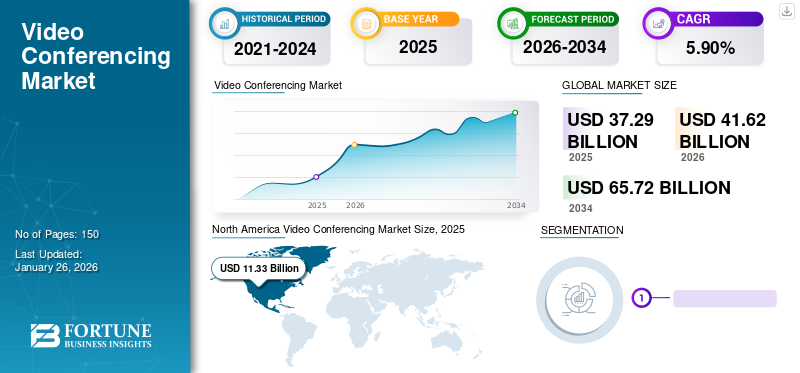
Download Free sample to learn more about this report.
IMPACT OF GENERATIVE AI
Integration of Generative AI into Enterprise Collaboration Platforms Will Boost Industry Growth
Generative AI is significantly transforming the market by enhancing meeting productivity, improving user engagement, and automating routine collaboration tasks. Leading platform providers are increasingly embedding generative AI capabilities such as intelligent meeting summaries, automated note generation, real-time transcription, multilingual translation, speaker identification, action-item extraction, and contextual search to simplify virtual collaboration. These capabilities reduce administrative workloads, improve meeting efficiency, and enable employees to focus on strategic decision-making rather than manual documentation.
Furthermore, generative AI is improving communication quality through AI-powered noise suppression, intelligent camera framing, background enhancement, meeting analytics, and virtual meeting platforms capable of answering meeting-related queries. As enterprises continue adopting hybrid work environments, AI-enabled collaboration platforms are expected to become a key differentiator by delivering personalized meeting experiences, improving workforce productivity, and strengthening enterprise-wide knowledge management.
- For instance, In June 2026, Zoom Communications announced the new AI features developed for Zoom Virtual Agent (ZVA), which is a conversational AI-powered agent. The additional features include Agent Architect and Agent Performance Suite along with enhancements to the customer context layer across Zoom CX.
VIDEO CONFERENCING MARKET TRENDS
Rising Adoption of Industry-Specific Video Collaboration Solutions to Reshape Market Growth
Video conferencing platforms are increasingly being customized for industry-specific workflows across healthcare, education, banking, manufacturing, and government sectors. Organizations are adopting specialized collaboration capabilities such as telehealth consultations, virtual classrooms, remote inspections, customer advisory sessions, and secure government communications to improve operational efficiency and customer engagement.
Moreover, enterprise software providers are continuously integrating video conferencing platforms with productivity suites, customer relationship management (CRM) systems, workflow automation tools, and unified communication ecosystems to deliver seamless digital workplace experiences. The growing demand for intelligent collaboration platforms capable of supporting hybrid work, virtual customer engagement, and global workforce connectivity is expected to remain a key trend driver for market expansion throughout the forecast period.
- For instance, in June 2025, HP Inc. unveiled newly developed HP Dimension with Google Beam. This is an AI-powered 3D video based web conferencing solutions designed to transform the future of workplace communications by combining breakthrough 3D imaging, natural eye contact, spatial audio, and adaptive lighting into an elegant solution for small meeting spaces.
MARKET DYNAMICS
MARKET DRIVERS
Download Free sample to learn more about this report.
Growing Adoption of Hybrid Work Models and Distributed Workforce Collaboration to Drive Product Demand
The widespread adoption of hybrid work models has become one of the primary factors driving the video conferencing market growth. Organizations across industries are increasingly investing in enterprise-grade video conferencing platforms to enable seamless communication between distributed teams, remote employees, clients, and business partners. As businesses continue to embrace flexible workplace strategies, video conferencing solutions have become essential for improving workforce collaboration, accelerating decision-making, and maintaining employee productivity across geographically dispersed locations. Furthermore, continuous investments in cloud collaboration platforms, AI-powered meeting experiences, and unified communication ecosystems are expected to further accelerate market growth throughout the forecast period.
- For instance, an Archie report published in May 2026 revealed that 64% of business leaders indicated their organizations operate under a hybrid work model. The report further noted that large enterprises increasingly rely on hybrid work to recruit specialized talent beyond local markets, thereby accelerating demand for secure, scalable, and high-quality video conferencing solutions that enable seamless collaboration across geographically distributed teams.
|
Rank |
Market Driver |
Overall Impact Rank |
CAGR Contribution (2026–2034) |
Impact: 2026-2028 |
Impact: 2029-2031 |
Impact: 2032-2034 |
|
1 |
Increasing adoption of hybrid work models and distributed workforce collaboration |
High |
3.0% |
High |
High |
High |
|
2 |
Increasing enterprise investments in AI-powered collaboration and unified communication platforms |
High |
2.1% |
High |
High |
High |
|
3 |
Rising demand for cloud-based video conferencing and digital workplace transformation |
Medium-High |
1.7% |
High |
Medium |
Medium |
|
4 |
Growing integration of generative AI capabilities including meeting summaries, live transcription, and intelligent collaboration |
Medium |
1.3% |
Medium |
Medium |
Medium |
|
5 |
Increasing adoption of video collaboration across education, healthcare, BFSI, and government sectors |
Medium-Low |
1.0% |
Low |
Medium |
Medium |
|
6 |
Others (5G expansion, improved network infrastructure, UCaaS adoption, strategic partnerships, and product innovations) |
Low |
0.9% |
Low |
Low |
Low |
|
|
Total Positive Growth Contribution |
|
10.0% |
|
|
|
MARKET RESTRAINTS
Data Privacy, Cybersecurity, and Regulatory Compliance Concerns Restricts Market Growth
As organizations increasingly rely on video conferencing for business-critical communications, concerns regarding data privacy, cybersecurity, and regulatory compliance continue to challenge market growth. Enterprises handling confidential business information, financial transactions, healthcare records, and government communications require secure collaboration platforms that comply with evolving data protection regulations. Moreover, the growing sophistication of cyber threats, unauthorized meeting access, data breaches, and compliance requirements under regulations such as GDPR, HIPAA, and other regional data protection frameworks have encouraged organizations to invest heavily in secure communication infrastructure, increasing deployment complexity and implementation costs.
|
Rank |
Market Restraint |
Overall Impact Rank |
CAGR Contribution (2026–2034) |
Impact: 2026-2028 |
Impact: 2029-2031 |
Impact: 2032- 2034 |
|
1 |
Data privacy, cybersecurity, and regulatory compliance concerns |
High |
-0.8% |
High |
High |
High |
|
2 |
Meeting fatigue and user engagement challenges in virtual collaboration |
Medium-High |
-0.5% |
Medium |
Medium |
High |
|
3 |
High deployment and integration costs for enterprise-grade conferencing infrastructure |
Medium |
-0.4% |
Medium |
Medium |
Medium |
|
4 |
Others (bandwidth limitations, interoperability challenges, legacy system integration, and organizational resistance to change) |
Low |
-0.4% |
Low |
Low |
Low |
|
Total Negative Growth Contribution |
-2.1% |
MARKET OPPORTUNITIES
Growing Adoption of AI-powered Unified Communication Platforms to Create Significant Market Opportunities
The increasing convergence of video conferencing with unified communications, workflow automation, and enterprise productivity platforms is creating significant opportunities for market participants. Organizations are increasingly seeking integrated collaboration ecosystems that combine messaging, voice communications, video meetings, document collaboration, and AI-powered productivity tools within a single platform. This transition toward Unified Communication-as-a-Service (UCaaS) is encouraging vendors to develop intelligent collaboration solutions capable of supporting hybrid workforces, improving customer engagement, and streamlining enterprise workflows.
Furthermore, rapid advancements in generative AI, conversational intelligence, immersive collaboration technologies, and intelligent virtual assistants are expected to create new revenue opportunities for solution providers. As enterprises continue modernizing their digital workplace infrastructure, demand for scalable cloud-native video conferencing platforms with advanced AI capabilities is increasing substantially.
- For instance, In April 2026, RingCentral announced the expansion of its collaboration with Google Cloud to enable AI-driven business communications and customer engagement. Collectively they are focused on transforming the browser into an AI-powered collaboration hub - eliminating the need to switch between applications and embedding enterprise-grade calling, messaging, and AI into everyday workflows.
SEGMENTATION ANALYSIS
By Meeting Type
Increasing Enterprise Demand for Team-based Digital Collaboration Boosted Team Collaboration Segment Growth
Based on meeting type, the market is segmented into one-to-one meetings, team collaboration, webinars & virtual events, training & distance learning, telehealth consultation, and others.
The team collaboration segment accounted for the largest video conferencing market share of 38.3% in 2025. The segment's growth is attributed to the widespread adoption of hybrid work models and increasing reliance on virtual collaboration across geographically distributed teams. Organizations are increasingly utilizing video conferencing platforms to support project discussions, cross-functional collaboration, brainstorming sessions, and day-to-day operational meetings. The growing integration of AI-powered meeting assistance, document collaboration, and workflow management capabilities within enterprise collaboration platforms is further strengthening demand for team collaboration solutions.
The telehealth consultation segment is projected to register the highest CAGR of 11.2% during the forecast period. The growth is driven by the increasing adoption of virtual healthcare services, remote patient monitoring, digital consultations, and telemedicine platforms. Rising investments in digital healthcare infrastructure, coupled with growing demand for accessible and cost-effective patient care, are expected to accelerate the adoption of secure video conferencing solutions across hospitals, healthcare providers, and specialty clinics.
To know how our report can help streamline your business, Speak to Analyst
By Component
Growing Adoption of AI-powered Collaboration Platforms Encouraged Software Segment Growth
By component, the market is segmented into hardware, software, and services.
The software segment dominated the market and accounted for a 55.7% share in 2025. The segment's growth is attributed to increasing enterprise adoption of cloud-native video conferencing software that integrate video conferencing, messaging, file sharing, AI-powered meeting intelligence, workflow automation, and unified communications into a single solution. Continuous advancements in generative AI, intelligent meeting assistants, automated transcription, and enterprise productivity tools are further strengthening software adoption across organizations of all sizes.
The services segment is anticipated to grow at a 7.6% CAGR during the forecast period. The growth is supported by increasing demand for consulting, deployment, integration, managed services, employee training, and technical support as organizations modernize their communication infrastructure and migrate toward enterprise-wide collaboration ecosystems.
By Platform Type
Growing Preference for Integrated Workplace Collaboration Boosted Unified Communication Platforms Segment Growth
Based on platform type, the market is categorized into standalone platforms, unified communication platforms, browser-based platforms, and API/embedded platforms.
The unified communication platforms segment accounted for the largest market share of 43.3% in 2025. The growth is attributed to organizations increasingly adopting integrated collaboration solutions that combine video conferencing, messaging, voice calling, file sharing, and workflow applications within a single platform. These unified platforms simplify communication, improve employee productivity, reduce IT complexity, and provide a consistent collaboration experience across distributed workforces, making them the preferred choice for enterprises undergoing digital workplace transformation.
The API/embedded platforms segment is projected to register the highest CAGR of 11.9% during the forecast period. The growth is driven by the increasing integration of real-time video communication capabilities into enterprise applications, customer engagement platforms, healthcare systems, financial services, learning management systems, and business workflow applications. Growing demand for customizable communication experiences and embedded collaboration capabilities is expected to further accelerate segment growth.
By Deployment
Accelerating Adoption of Cloud-Based Collaboration Platforms Driving Cloud Deployment Leadership
Based on deployment, the market is segmented into cloud and on-premises.
The cloud segment accounted for the largest global market share in 2025. The growth is attributed to increasing enterprise preference for scalable, subscription-based collaboration platforms that offer simplified deployment, automatic software updates, enhanced accessibility, and lower infrastructure costs. Cloud-based deployment also enables seamless integration with enterprise productivity suites, AI-powered online collaboration tools, and unified communication platforms while supporting geographically distributed workforces.
The on-premises segment is expected to expand at a 5.6% CAGR during the forecast period. This growth is primarily supported by organizations operating in highly regulated industries, including government, defense, banking, and healthcare, where stringent security, compliance, and data sovereignty requirements continue to drive investments in dedicated on-premises collaboration infrastructure.
By Enterprise Type
Growing Enterprise-wide Digital Collaboration Initiatives Encouraged Large Enterprise Segment Growth
Based on enterprise type, the market is segmented into small and medium enterprises and large enterprises.
The large enterprises segment dominated the market in 2025. The segment's growth is attributed to significant investments in enterprise collaboration platforms, unified communication solutions, and AI-enabled workplace technologies to improve workforce productivity and streamline communication across multiple business locations. The increasing need to support hybrid work environments and global operations continues to strengthen adoption among large organizations.
The small and medium enterprises segment is projected to register the highest CAGR of 9.1% during the forecast period. The growth is driven by the increasing availability of affordable cloud-based collaboration platforms, subscription-based pricing models, and AI-powered communication tools that enable SMEs to enhance customer engagement, improve operational efficiency, and support flexible work environments without substantial infrastructure investments.
By Industry
Growing Digital Workplace Investments Encouraged IT & Telecom Segment Growth
Based on industry, the market is segmented into IT & telecom, government, healthcare, manufacturing, BFSI, education, media & entertainment, retail & e-commerce, and others.
The IT & telecom segment accounted for the largest market share of 22.1% in 2025. The growth is attributed to the sector's early adoption of cloud computing, unified communications, and AI-powered collaboration technologies to support software development, global project management, customer engagement, and distributed workforce operations. Continuous investments in digital workplace transformation and enterprise productivity solutions are expected to sustain segment growth.
The healthcare segment is projected to expand at the highest CAGR of 12.3% during the forecast period. The growth is driven by increasing adoption of telehealth services, virtual consultations, remote patient monitoring, multidisciplinary care coordination, and digital healthcare delivery models. Rising investments in healthcare digitization and secure virtual meeting platforms are expected to further accelerate the deployment of video conferencing solutions across hospitals, clinics, and healthcare networks.
Video Conferencing Market Regional Outlook
By geography, the market is categorized into North America, South America, Europe, the Middle East & Africa, and Asia Pacific.
North America
North America Video Conferencing Market Size, 2025 (USD Billion)
To get more information on the regional analysis of this market, Download Free sample
North America held the largest market share in 2024, valued at USD 7.08 billion, and also maintained the leading share in 2025, with USD 7.32 billion. The region leadership is primarily driven by the early adoption of cloud-based collaboration technologies, strong enterprise IT spending, and the presence of leading unified communication platform providers. Organizations across the U.S. and Canada are increasingly investing in AI-powered collaboration platforms to support hybrid work, digital workplace transformation, and enterprise productivity initiatives. Furthermore, continuous innovation in generative AI, unified communications, and enterprise software ecosystems is strengthening the region's leadership in the global market.
U.S. Video Conferencing Market
The U.S. market in 2025, held 75.8% of regional sales supported by the presence of major technology companies including Microsoft, Google, Cisco, Zoom, and HP. Enterprises across industries are rapidly integrating AI-powered meeting assistants, intelligent team collaboration tools, and cloud-native communication platforms to improve workforce productivity and customer engagement. In addition, growing investments in digital transformation, enterprise AI adoption, and unified communication-as-a-service (UCaaS) solutions continue to drive demand for advanced video conferencing platforms across the country.
Europe
Europe accounted for the second-largest share of 28.2% in 2025, supported by widespread enterprise digitalization, strong regulatory emphasis on secure communications, and increasing adoption of unified collaboration platforms across both public and private sectors. Organizations are increasingly replacing legacy communication systems with cloud-enabled collaboration solutions that comply with stringent data protection regulations while improving workforce productivity. Moreover, growing investments in digital workplace modernization and cross-border enterprise collaboration continue to support sustained market expansion across the region.
- In January 2026, France government announced their plan to develop and integrate a homegrown platform Visio for their organizational level virtual communication. The government discusses that this platform will be rolled out for integration in current year for Defense Ministry, finance tax offices, health insurance, and other big agencies.
U.K. Video Conferencing Market
The U.K. market in 2025 reached USD 1.21 billion, representing roughly 6.5% of global revenues.
Germany Video Conferencing Market
Germany’s market was at USD 1.03 billion in 2025, equivalent to around 5.5% of global sales.
Asia Pacific
The Asia Pacific region is estimated to reach USD 4.91 billion in 2026 and is projected to reach USD 11.49 billion in 2034 with a CAGR of 11.2% during the forecast period. The region's growth is primarily driven by rapid digital transformation, expanding cloud infrastructure, increasing adoption of Software-as-a-Service (SaaS) solutions, and the growing number of small and medium-sized enterprises embracing digital collaboration platforms. Governments and enterprises across China, India, Japan, South Korea, and Southeast Asia are accelerating investments in digital workplace technologies to improve business continuity, workforce productivity, and customer engagement, positioning Asia Pacific as the fastest-growing regional market.
China Video Conferencing Market
China's market in 2025 was valued at USD 1.35 billion, representing roughly 7.2% of global revenues. China continues to lead the regional market owing to its large enterprise base, rapid cloud adoption, and increasing investments in domestic collaboration platforms, enterprise software, and digital workplace transformation initiatives.
India Video Conferencing Market
The Indian market in 2025 was at USD 0.89 billion, accounting for roughly 4.8% of global revenues.
Japan Video Conferencing Market
The Japanese market in 2025 was at USD 0.85 billion, accounting for roughly 4.6% of global revenues.
Middle East & Africa
The Middle East & Africa region is expected to grow at the second-fastest CAGR of 9.9% during the forecast period. The growth is supported by increasing government investments in digital transformation, smart city initiatives, and next-generation communication infrastructure. Organizations across the GCC countries are increasingly deploying cloud-based collaboration platforms to support hybrid work, digital government services, and enterprise modernization programs. Furthermore, growing investments in AI, cloud computing, and advanced connectivity technologies are expected to accelerate adoption of intelligent video conferencing solutions across the region.
GCC Video Conferencing Market
The GCC market is reached USD 0.35 billion in 2025, representing roughly 1.9% of global revenues.
South America
South America is projected to grow from 0.90 billion in 2025 to 1.61 billion in 2034 during the forecast period. This growth is driven by increasing cloud adoption, enterprise digitalization, and rising demand for cost-effective collaboration solutions among small and medium-sized businesses. Organizations across the region are increasingly leveraging video conferencing platforms to improve operational efficiency, facilitate remote workforce collaboration, and expand digital customer engagement. The continued expansion of broadband infrastructure and cloud services is expected to further support market development.
Brazil Video Conferencing Market
The Brazilian market in 2025 was at USD 0.53 billion, accounting for roughly 2.8% of global revenues.
COMPETITIVE LANDSCAPE
Key Industry Players
Continuous AI Innovation and Strategic Partnerships Strengthening Competition Among Market Providers
The video conferencing market is moderately consolidated, with leading companies focusing on artificial intelligence integration, unified communications, strategic partnerships, and cloud platform expansion to strengthen their competitive positions. Market participants are increasingly embedding generative AI capabilities such as intelligent meeting assistants, automated transcription, multilingual translation, meeting summaries, and workflow automation into their collaboration platforms to improve user experience and enterprise productivity.
In addition, companies are investing heavily in expanding unified communication ecosystems by integrating video conferencing with messaging, voice communication, customer engagement, productivity applications, and enterprise workflow platforms. Strategic acquisitions, technology partnerships, API ecosystem expansion, and continuous product innovation remain key growth strategies adopted by major vendors to strengthen their global presence and address the evolving collaboration requirements of hybrid workplaces.
LIST OF KEY VIDEO CONFERENCING COMPANIES PROFILED
- Cisco Systems, Inc. (U.S.)
- Enghouse Systems Limited (Canada)
- Google LLC (U.S.)
- GoTo Technologies USA, LLC (U.S.)
- HP Inc. (U.S.)
- Jitsi (U.S.)
- Logitech International S.A. (Switzerland)
- Microsoft Corporation (U.S.)
- RingCentral, Inc. (U.S.)
- Vonage Holdings Corp. (U.S.)
- Zoom Communications, Inc. (U.S.)
KEY INDUSTRY DEVELOPMENTS
- July 2026: Google expanded Gemini integration across Google Meet, introducing AI-powered note-taking, multilingual meeting translation, intelligent meeting summaries, and contextual collaboration features to improve enterprise productivity.
- March 2026: Zoom Communications expanded its AI Companion capabilities by introducing advanced agentic AI features capable of automating meeting preparation, intelligent task execution, document generation, and post-meeting workflow management across enterprise collaboration environments.
- November 2025: Microsoft introduced new Copilot enhancements for Microsoft Teams, enabling intelligent meeting facilitation through automated meeting summaries, contextual recommendations, action-item generation, and AI-powered collaboration capabilities.
- September 2025: Cisco launched next-generation Webex AI Agent and enhanced Webex Suite capabilities to improve customer engagement, automate enterprise workflows, and strengthen AI-powered collaboration experiences across hybrid workplaces.
- April 2025: HP Inc. expanded its Poly collaboration portfolio by launching AI-enabled meeting room solutions featuring intelligent camera framing, advanced noise suppression, and integrated device management capabilities designed for hybrid work environments.
- February 2025: RingCentral announced the expansion of its business communication software with AI-powered capabilities across RingCentral Video, enabling intelligent meeting insights, automated conversation summaries, and enhanced collaboration workflows for enterprise customers.
REPORT COVERAGE
The video conferencing market report provides a comprehensive analysis of the industry by evaluating key market trends, growth drivers, restraints, opportunities, and emerging technologies shaping market development. It offers detailed insights into advancements in AI-powered collaboration, unified communications, cloud-based conferencing platforms, meeting intelligence, workflow automation, and enterprise communication platforms.
Request for Customization to gain extensive market insights.
REPORT SCOPE & SEGMENTATION
| ATTRIBUTE | DETAILS |
| Study Period | 2021-2034 |
| Base Year | 2025 |
| Estimated Year | 2026 |
| Forecast Period | 2026-2034 |
| Historical Period | 2021-2024 |
| Growth Rate | CAGR of 7.9% from 2026-2034 |
| Unit | Value (USD Billion) |
| Segmentation | By Component, Meeting Type, Platform Type, Deployment, Enterprise Type, Industry, and Region |
| By Component |
|
| By Meeting Type |
|
| By Platform Type |
|
| By Deployment |
|
| By Enterprises Type |
|
| By Industry |
|
| By Region |
|
Frequently Asked Questions
Fortune Business Insights says that the global market value stood at USD 18.64 billion in 2025 and is projected to reach USD 37.45 billion by 2034.
In 2025, the North America market value stood at USD 7.32 billion.
The market is expected to grow at a CAGR of 7.9% over the forecast period.
The team collaboration segment dominated the market, by meeting type, in 2025.
The growing adoption of hybrid work environments and enterprise collaboration platforms is a major factor driving market growth.
Major companies operating in the market include Cisco Systems, Inc., Microsoft Corporation, Zoom Communications, Inc., Google LLC, RingCentral, Inc., and Logitech International S.A., HP Inc.
Asia Pacific is projected to record the highest CAGR during the forecast period.



- 2021-2034
- 2025
- 2021-2024
- 150
Get 30-60 hrs Free Customization
Expand Regional and Country Coverage, Segments Analysis, Company Profiles, Competitive Benchmarking, and End-user Insights.




















Related Reports
-
US +1 833 909 2966 ( Toll Free )
-
Get In Touch With Us