Activin Signaling Inhibitors Market Size, Share & Industry Analysis, By Drug Class (ActRII Ligand Traps/Fusion Proteins, Activin Receptor-Targeting Monoclonal Antibodies, and Others), By Indication (Hematologic Disorders, Cardiopulmonary Disorders, Muscle/Neuromuscular Disorders, Metabolic/Cardiometabolic disorders, and Others), By Age Group (Pediatric and Adults), By Route of Administration (Subcutaneous, Intravenous, and Others), By Distribution Channel (Hospital Pharmacies, Specialty Pharmacies, Drug Stores & Retail Pharmacies, and Others), and Regional Forecast, 2026-2034
 Download Free Sample
Activin Signaling Inhibitors Market Size and Future Outlook
 Listen to Audio Version
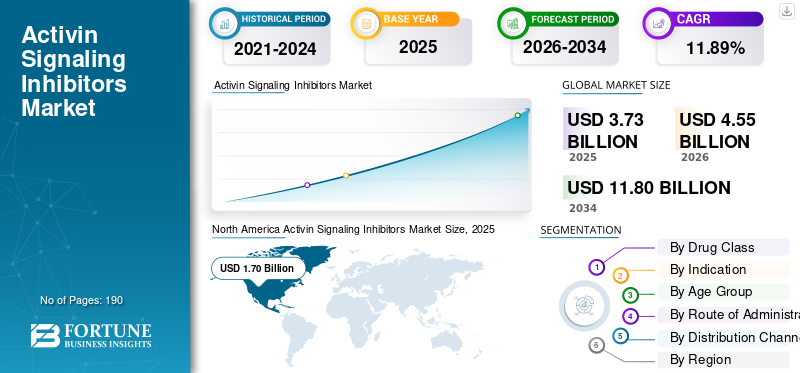
The global activin signaling inhibitors market size was valued at USD 3.73 billion in 2025. The market is projected to grow from USD 4.55 billion in 2026 to USD 11.80 billion by 2034, exhibiting a CAGR of 11.89% during the forecast period. North America dominated the activin signaling inhibitors market with a market share of 45.57% in 2025.
The global market focuses on therapies for diseases linked with abnormal cell growth, muscle wasting, anemia, pulmonary vascular remodeling, and rare genetic disorders. Demand for these therapies is increasing as drug developers focus on targeted biologics that address disease mechanisms rather than manage symptoms. As a result, activin signaling inhibitors are gaining commercial importance and are poised for significant growth over the forecast period. The market remains in a still emerging stage; however, the regulatory approval of first-in-class products and the expansion of late-stage clinical programs are creating new growth opportunities for specialty pharmaceutical companies.
- For instance, in March 2024, Merck & Co., Inc. announced that the U.S. FDA approved WINREVAIR (sotatercept-csrk) for the treatment of adults with pulmonary arterial hypertension. WINREVAIR is an Activin signaling inhibitor therapy for PAH, marking an important commercial milestone for this treatment class and supporting wider clinical acceptance of therapies targeting the activin receptor signaling pathway.
Major players, such as Bristol Myers Squibb Company, Merck & Co., Inc., Regeneron Pharmaceuticals, Inc., and Keros Therapeutics, Inc., are realigning resources toward expanding their pipelines, investment initiatives, and new product launches to strengthen their market presence.
Download Free sample to learn more about this report.
Activin Signaling Inhibitors Market KEY TAKEAWAYS
 Global Market Size & Forecast
- 2025 Market Size: USD 3.73 billion
- 2026 Market Size: USD 4.55 billion
- 2034 Forecast Market Size: USD 11.80 billion
- CAGR: 11.89% from 2026–2034
 Market Share
- North America dominated the activin signaling inhibitors market with a 45.57% share in 2025
- The myostatin/activin pathway inhibitors segment is projected to grow at the fastest CAGR of 39.27%
- The metabolic/cardiometabolic disorders segment is projected to grow at the fastest CAGR of 45.09%
 Key Regional Highlights
Asia Pacific
Asia Pacific is projected to reach USD 0.91 billion by 2026, driven by biologics investment.
North America
North America reached USD 1.70 billion in 2025, supported by strong biologics adoption.
Europe
Europe is projected to reach USD 1.24 billion by 2026, driven by specialty biologic approvals.
U.S.
U.S. is projected to reach USD 1.91 billion by 2026, fueled by advanced specialty care.
Japan
Japan is projected to reach USD 0.22 billion by 2026, driven by growing rare disease awareness.
Read More

ACTIVIN SIGNALING INHIBITORS MARKET TRENDS
Growing Use of the Product in Rare and Specialty Disease Treatment to Boost Industry Development
The growing use of activin signaling inhibitors and the treatment of rare and specialty diseases is emerging as a key trend in the global market. Companies focus on conditions where disease biology is strongly linked to abnormal signaling in the Activin, myostatin, and TGF-β superfamily. These diseases often have limited treatment options, high unmet medical needs, and smaller but clinically valuable patient populations, making them suitable for targeted biologic development. As a result, drug developers are advancing monoclonal antibodies, ligand traps, and receptor-based therapies to cater to these unmet needs. The trend is strengthening the market, as successful clinical outcomes in specialty indications can support faster regulatory pathways and increased investment in next-generation, pathway-specific inhibitors.
- For instance, in September 2025, Regeneron Pharmaceuticals, Inc. announced positive Phase 3 OPTIMA trial results for garetosmab in adults with ultra-rare fibrodysplasia ossificans progressiva (FOP). Garetosmab met the primary endpoint and reduced new heterotopic ossification lesions by 94% and 90% at the two evaluated doses versus placebo, supporting its potential as an Activin A-targeting therapy for a severe, rare genetic disorder.
MARKET DYNAMICS
MARKET DRIVERS
Download Free sample to learn more about this report.
Increasing Prevalence of Rare and Specialty Diseases to Drive Market Growth
The growing burden of rare and specialty diseases is creating strong global market demand. Patients with diseases such as pulmonary arterial hypertension, fibrodysplasia ossificans progressiva, anemia linked to myelodysplastic syndromes, and neuromuscular disorders often have limited disease-modifying treatment options. These factors encourage companies to develop targeted biologics that act directly on the disease pathway rather than only controlling symptoms. As a result, activin signaling inhibitors are gaining importance as specialty therapies, supported by increasing clinical activity in small but high-need patient populations.
- For instance, in June 2025, Scholar Rock Holding Corporation announced positive Phase 2 EMBRAZE proof-of-concept results for apitegromab in combination with tirzepatide for preservation of lean mass during weight loss.
MARKET RESTRAINTS
High Development Cost and Safety Complexity to Restrain Market Growth
The high development costs linked with targeted biologics are limiting the global activin signaling inhibitors market growth. Most products in this class are monoclonal antibodies, ligand traps, or receptor-fusion proteins that require complex discovery, long clinical development, and advanced biologics manufacturing. This increases financial risk, particularly for smaller biotechnology companies. As a result, market participation remains concentrated among companies with strong funding capacity, while extended trial timelines and high manufacturing costs can delay product launches and limit broader patient access.
- For instance, in May 2025, Keros Therapeutics, Inc. discontinued development of cibotercept (KER-012) for pulmonary arterial hypertension after the Phase II TROPOS study raised safety concerns, including fluid-related adverse events. The company also announced a workforce reduction linked to the program discontinuation, underscoring how safety complexity and high clinical development risk can restrain growth in the market.
MARKET OPPORTUNITIES
Favorable Orphan Drug Development Incentives and Premium Specialty-Drug Positioning to Offer Growth Opportunities
The global activin signaling inhibitors market is expected to gain strong growth opportunities from rare disease and orphan indications, as many of these conditions have limited treatment options. This creates a favorable opportunity for companies to develop pathway-specific biologics that can directly modify disease mechanisms rather than merely manage symptoms. Orphan indications also offer advantages such as faster regulatory attention, smaller but focused clinical trials, and premium specialty-drug positioning, which can improve commercial returns despite limited patient populations. As a result, the expansion of activin inhibitor pipelines across rare genetic, hematology, pulmonary, and neuromuscular disorders is likely to widen the market base and strengthen long-term product development.
- For instance, in March 2026, Biohaven Ltd. announced that its Phase 2 obesity study of taldefgrobep alfa, a novel myostatin-activin pathway inhibitor, had completed enrollment. The study is evaluating once-weekly and once-monthly taldefgrobep alfa as monotherapy for obesity, supporting the potential expansion of activin/myostatin pathway inhibition into metabolic disease management and high-quality weight-loss treatment focused on fat reduction and lean-mass preservation.
MARKET CHALLENGES
Limited Number of Approved Products to Deter Product Demand
The market faces a key challenge due to the limited number of approved products, as most activin, myostatin, and ActRII-targeting therapies are still in clinical or early-stage development. This limits physicians' real-world experience with these therapies and slows adoption compared with established drug classes that have longer safety histories, broader prescribing guidelines, and greater payer familiarity. As the activin pathway is still a relatively new therapeutic approach, companies must generate strong long-term safety, efficacy, and differentiation data before physicians can confidently use these therapies across broader patient groups, and regulatory scrutiny can also limit adoption.
- For instance, in September 2025, Scholar Rock Holding Corporation received a Complete Response Letter (CRL) from the U.S. FDA for the Biologics License Application of apitegromab for spinal muscular atrophy. The CRL did not cite any other approvability concerns, including apitegromab’s efficacy and safety data or the third-party drug substance manufacturer.
Segmentation Analysis
By Drug Class
Commercial Success of Approved Activating-Pathway Therapies Boosted ActRII Ligand Traps/Fusion Proteins Segment Growth
Based on drug class, the market is categorized into ActRII ligand traps/fusion proteins, activin receptor-targeting monoclonal antibodies, myostatin/activin pathway inhibitors, and other activin-signaling modulators.
ActRII ligand traps/fusion proteins dominated the market. The segment’s leadership is attributed to the commercial success of approved activating-pathway therapies that utilize receptor-fusion or ligand-trap mechanisms that capture selected TGF-β superfamily ligands and rebalance disease-related signaling. This drug class has gained greater commercial acceptance and demonstrated clinical value in high-need indications, leading to the segment’s dominance.
- For instance, Merck & Co., Inc., received approval from the U.S. FDA to update the product label based on the Phase 3 ZENITH trial for WINREVAIR (sotatercept-csrk) for injection, 45mg and 60mg. WINREVAIR. The approval expanded WINREVAIR’s indication to include components of clinical worsening events, such as hospitalization for PAH, lung transplantation, and death.
The myostatin/activin pathway inhibitors segment is expected to grow at a CAGR of 39.27% over the forecast period.
To know how our report can help streamline your business, Speak to Analyst
By Indication
Larger Commercial Base of Hematologic Disorders Encouraged the Segment Growth
Based on indication, the market is segmented into hematologic disorders, cardiopulmonary disorders, muscle/neuromuscular disorders, metabolic/cardiometabolic disorders, and others.
In 2025, the hematology disorders segment held the dominant market share, as activin pathway inhibition is already established in anemia management, especially in patients with lower-risk myelodysplastic syndromes and beta-thalassemia who require red blood cell transfusions. These patient groups have a clear treatment need, measurable clinical endpoints, and regular specialist follow-up, which supports faster adoption of approved products. As a result, hematology disorders represent a larger commercial base, while most assets in other indications remain under clinical development. Novel product launches and strategic collaborations by key companies further strengthen the segment’s dominance.
- For instance, in June 2023, Bristol Myers Squibb Company announced that the U.S. FDA approved REBLOZYL (luspatercept-aamt) as a first-line treatment for anemia in adults with lower-risk myelodysplastic syndromes who may require transfusions.
The metabolic/cardiometabolic disorders segment is projected to grow at a CAGR of 45.09% during the forecast period.
By Age Group
Adult Segment Dominated due to Concentration of Activin Signaling Inhibitor Therapies
Based on age group, the market is segmented into pediatric and adult.
In 2025, the adults dominated the market as most approved activin signaling inhibitor therapies and late-stage clinical programs are focused on adult patients with chronic conditions. Adult indications usually have larger treatment populations, stronger clinical trial evidence, and clearer safety monitoring protocols than pediatric indications. As a result, physicians and payers are more comfortable adopting these therapies in adult populations.
- For instance, in February 2026, Bristol Myers Squibb Company announced positive top-line results from its ongoing ex-U.S. registrational Phase 2 study of REBLOZYL (luspatercept-aamt) in adults with alpha-thalassemia. The non-transfusion-dependent and transfusion-dependent cohorts met their primary and secondary endpoints, supporting the continued expansion of activin-pathway therapy in adult anemia indications.
The pediatric segment is projected to grow at a CAGR of 20.94% during the forecast period.
By Route of Administration
Increased Preference for convenience Subcutaneous Biologics Boosted the Segment Growth
Based on route of administration, the market is segmented into subcutaneous, intravenous, and others.
The subcutaneous segment captured the dominant activin signaling inhibitors market share. The segment’s high share is attributed to the fact that key activin signaling inhibitor products are designed as injectable biologics that can be administered at scheduled intervals, supporting chronic disease management without the need for continuous intravenous infusion. Additionally, this route is more convenient for long-term specialty treatment as it reduces dependence on infusion centers, supports outpatient care, and allows trained patients or caregivers to administer therapy when appropriate.
- For instance, in May 2026, Scholar Rock Holding Corporation reported that development of a subcutaneous formulation of apitegromab is progressing. The formulation was intended as a small-volume, self- or caregiver-administered anti-myostatin antibody suitable for use with an autoinjector, supporting market preference for convenient subcutaneous biologics that can reduce treatment burden and improve long-term patient access.
The intravenous segment is projected to grow at a CAGR of 30.35% during the forecast period.
By Distribution Channel
Availability of High-Cost Biologics in Hospital Pharmacies Led the Dominance of the Segment
Based on distribution channel, the market is segmented into hospital pharmacies, specialty pharmacies, drug stores & retail pharmacies, and online pharmacies.
In 2025, hospital pharmacies dominated the market, as activin signaling inhibitors are high-cost specialty biologics used in complex diseases that require specialist diagnosis, dose monitoring, lab review, and coordination with treatment centers. Hospitals often manage patients with pulmonary arterial hypertension, hematologic anemia, and rare disorders, which makes institutional pharmacy channels important for therapy initiation, clinical supervision, and reimbursement support.
- For instance, in February 2025, the NHS dm+d listing for WINREVAIR 45 mg powder and solvent for solution for injection identifies it as a hospital-only pack, supporting the role of hospital pharmacy channels in controlled access and specialist-supervised use.
The online pharmacies segment is projected to grow at a CAGR of 16.10% over the forecast period.
Activin Signaling Inhibitors Market Regional Outlook
By geography, the market is categorized into Europe, North America, Asia Pacific, Latin America, and the Middle East & Africa.
North America
North America Activin Signaling Inhibitors Market Size, 2025 (USD Billion)
To get more information on the regional analysis of this market, Download Free sample
North America held the dominant share in 2024, valued at USD 1.01 billion, and maintained its leading position in 2025 at USD 1.70 billion. The market is growing in North America due to early access to approved activin-pathway therapies, strong specialty-care infrastructure, and higher adoption of biologics for PAH and hematology.
U.S. Activin Signaling Inhibitors Market
Given North America's substantial contribution and the U.S. dominance within the region, the U.S. market is likely to reach around USD 1.91 billion by 2026, accounting for roughly 41.93% of the global sales.
Europe
Europe is projected to grow at a CAGR of 11.44% over the forecast period, the second-highest among all regions. The market is expected to reach a valuation of USD 1.24 billion by 2026. The market is growing due to increasing regulatory acceptance of novel specialty biologics and wider treatment access through advanced hospital and rare-disease care networks.
U.K. Activin Signaling Inhibitors Market
The U.K.’s market is estimated to reach around USD 0.25 billion by 2026, representing roughly 4.47% of the global sales.
Germany Activin Signaling Inhibitors Market
Germany's market is projected to reach approximately USD 0.25 billion by 2026, equivalent to around 5.41% of the global sales.
Asia Pacific
Asia Pacific is estimated to reach USD 0.91 billion by 2026 and secure the position of the third-largest region in the market. The market is growing as biologics investment, hematology drug development, and rare-disease awareness continue to improve across Japan, China, and other major markets.
Japan Activin Signaling Inhibitors Market
The Japanese market is estimated to reach around USD 0.22 billion by 2026, accounting for approximately 4.78% of the global sales.
China Activin Signaling Inhibitors Market
China's market is projected to be among the largest worldwide, with 2026 revenues standing at around USD 0.27 billion, accounting for approximately 5.87% of global sales.
India Activin Signaling Inhibitors Market
The Indian market is poised to touch around USD 0.10 billion by 2026, accounting for roughly 2.16% of global revenues.
Latin America and the Middle East & Africa
The Latin America and Middle East & Africa regions are expected to witness steady growth in this market during the forecast period. The market in Latin America is estimated to reach a valuation of USD 0.21 billion by 2026. The market is growing gradually in Latin America as access to specialty biologics improves in major private and hospital-based treatment centers. In the Middle East & Africa, the GCC is set to reach USD 0.06 billion by 2026.
South Africa Activin Signaling Inhibitors Market
The South African market is projected to reach approximately USD 0.02 billion by 2026, accounting for roughly 0.54% of global revenues.
COMPETITIVE LANDSCAPE
Key Industry Players
Key Players Focus on Advancing Clinical Trials to Improve Their Competitive Position
The global activin signaling inhibitors market is semi-consolidated, with competition led by companies with approved therapies and strong late-stage pipeline assets. Major players such as Merck & Co., Inc., Bristol Myers Squibb Company, Regeneron Pharmaceuticals, Inc., Keros Therapeutics, Inc., Takeda Pharmaceutical Company Limited, Scholar Rock Holding Corporation, Biohaven Ltd., Eli Lilly and Company, GSK plc, and Laekna, Inc. are strengthening their market positions through product approvals, licensing agreements, acquisitions, and clinical development programs. The increasing success of approved products and the expansion of investigational assets are expected to improve commercial acceptance and widen the future treatment base for activin signaling inhibitors.
- For instance, in March 2024, Merck & Co., Inc. received U.S. FDA approval for WINREVAIR (sotatercept-csrk) for adults with pulmonary arterial hypertension. The approval marked an important milestone for the activin pathway, as WINREVAIR became the first FDA-approved activin signaling inhibitor therapy for PAH and helped strengthen the commercial visibility of this drug class.
Other notable participants in the market include Takeda Pharmaceutical Company Limited, Keros Therapeutics, Regeneron Pharmaceuticals, Inc., Scholar Rock Holding Corporation, Biohaven Ltd., Eli Lilly and Company, GSK plc, and Laekna, Inc. These companies are expected to focus on advancing clinical trials, developing next-generation biologics, and pursuing strategic partnerships to improve their competitive position. The market remains strongly innovation-driven, with approved product leaders holding near-term share, while pipeline-stage companies compete to capture future opportunities.
LIST OF KEY ACTIVIN SIGNALING INHIBITORS COMPANIES PROFILED
- Bristol Myers Squibb Company (U.S.)
- Merck & Co., Inc. (U.S.)
- Regeneron Pharmaceuticals, Inc. (U.S.)
- Keros Therapeutics, Inc. (U.S.)
- Takeda Pharmaceutical Company Limited (Japan)
- Scholar Rock Holding Corporation (U.S.)
- Biohaven Ltd. (U.S.)
- Eli Lilly and Company (U.S.)
- GSK plc (U.K.)
- Laekna, Inc. (China)
KEY INDUSTRY DEVELOPMENTS
- April 2026: NorthStrive Biosciences Inc. announced a key development milestone for its asset, EL-32: the successful transfer of the EL-32, a myostatin and activin-A antigen Working Cell Bank, to a U.S.-based third-party fermentation facility. The transfer initiated a manufacturing optimization program designed to increase production yield and establish a cost-efficient, scalable process in support of future clinical and commercial development.
- March 2026: Biohaven Ltd. completed enrollment in a Phase 2 proof-of-concept (PoC) study with its myostatin-activin pathway inhibitor (MAPI), taldefgrobep alfa, which offers the potential to achieve high-quality weight loss in people living with obesity.
- February 2026: GSK plc entered an agreement to acquire 35Pharma Inc., which provided the company access to HS235, an investigational medicine that completed phase I healthy volunteers’ clinical trials, with studies to start imminently in pulmonary arterial hypertension (PAH) and pulmonary hypertension due to heart failure with preserved ejection fraction (PH-HFpEF).
- September 2025: Regeneron Pharmaceuticals, Inc. announced updated analyses from the ongoing Phase 2 COURAGE trial investigating novel combinations of semaglutide (GLP-1 receptor agonist) and trevogrumab (anti-GDF8/anti-myostatin) with or without garetosmab (anti-activin A) for the treatment of obesity. The results were consistent with previously reported interim data, demonstrating that the addition of trevogrumab, with or without garetosmab, could significantly reduce the loss of lean mass associated with semaglutide-induced weight loss.
- June 2025: Laekna showcased the results of the phase I SAD study of LAE102 (an ActRIIA-selective antibody) for the treatment of obesity at the American Diabetes Association (ADA) meeting. The company also presented pre-clinical data on LAE102, LAE103 (an ActRIIB-selective antibody), and LAE123 (an ActRIIA/IIB dual antagonistic monoclonal antibody) as potential therapeutics for muscle growth and fat reduction.
REPORT COVERAGE
The report provides a comprehensive global activin signaling inhibitors market analysis. It covers a detailed market assessment across drug class, indication, age group, route of administration, distribution channel, and region. It examines the demand for therapies across various disease indications. The study evaluates the role of emerging drug classes in current and future treatment practice. It also includes a detailed analysis of market drivers, restraints, challenges, and growth opportunities, including rising demand for targeted biologics, increased orphan-disease development, reimbursement pressure, and pipeline expansion. The report further provides regional insights, competitive landscape analysis, company profiling, product benchmarking, revenue share estimates, recent developments, and an evaluation of new products that may shape the market's future growth.
Request for Customization to gain extensive market insights.
Report Scope & Segmentation
| ATTRIBUTE | DETAILS |
| Study Period | 2021-2034 |
| Base Year | 2025 |
| Estimated Year | 2026 |
| Forecast Period | 2026-2034 |
| Historical Period | 2021-2024 |
| Growth Rate | CAGR of 11.89% from 2026 to 2034 |
| Unit | Value (USD Billion) |
| Segmentation | By Drug Class, Indication, Age Group, Route of Administration, Distribution Channel, and Region |
| By Drug Class |
|
| By Indication |
|
| By Age Group |
|
| By Route of Administration |
|
| By Distribution Channel |
|
| By Region |
|
Frequently Asked Questions
According to Fortune Business Insights, the global market value stood at USD 3.73 billion in 2025 and is projected to reach USD 11.80 billion by 2034.
In 2025, the market value stood at USD 1.70 billion.
The market is expected to grow at a CAGR of 11.89% over the forecast period.
The ActRII ligand traps/fusion proteins segment is expected to lead the market.
Increasing prevalence of rare and specialty diseases is the key factor driving market growth.
Bristol Myers Squibb Company, Merck & Co., Inc., Regeneron Pharmaceuticals, Inc., and Keros Therapeutics, Inc. are among the major players in the global market.
North America dominated the market.



- 2021-2034
- 2025
- 2021-2024
- 190
Get 30-60 hrs Free Customization
Expand Regional and Country Coverage, Segments Analysis, Company Profiles, Competitive Benchmarking, and End-user Insights.













.webp)






Related Reports
-
US +1 833 909 2966 ( Toll Free )
-
Get In Touch With Us