Advanced Node Logic Semiconductor Market Size, Share & Industry Analysis, By Technology Node (7 nm, 5 nm, 4 nm, 3 nm, and 2 nm and Below), By Product Type (CPUs, GPUs, AI Accelerators, FPGAs, and Others), By End User (Consumer Electronics, Automotive, IT & Telecom, Data Centers and Cloud Service Providers, and Others), and Regional Forecast, 2026 – 2034
 Download Free Sample
ADVANCED NODE LOGIC SEMICONDUCTOR MARKET SIZE AND FUTURE OUTLOOK
 Listen to Audio Version
The global advanced node logic semiconductor market size was valued at USD 62.31 billion in 2025. The market is projected to grow from USD 70.78 billion in 2026 to USD 229.62 billion by 2034, exhibiting a CAGR of 15.8% during the forecast period. Asia Pacific dominated the advanced node logic semiconductor market with a market share of 43.36% in 2025.
The market represents logic chips built using a 7nm or smaller manufacturing process. CPUs, GPUs, AI Accelerators, ASICs, FPGAs, and application processors use these chips in high-speed computing, AI workloads, data centers, mobile devices such as smartphones, automotive electronics, and telecom infrastructure. The demand for high-performance, power-efficient chips for AI applications, cloud computing, premium consumer goods, and advanced automotive systems is driving growth in this market.
Key players in the market include TSMC, Samsung Electronics Co., Ltd., Intel Corporation, NVIDIA Corporation, and Advanced Micro Devices, Inc. They are focusing on adopting strategies such as advanced-node technology development, foundry partnerships, expansion of their AI chip portfolio, capacity investments, and ecosystem collaborations to strengthen their market position.
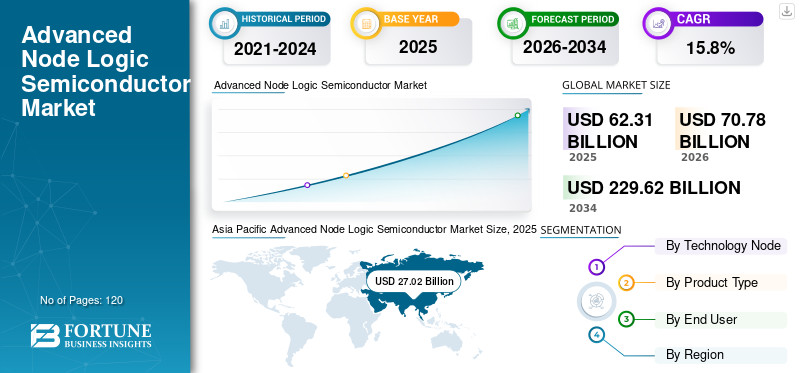
Download Free sample to learn more about this report.
Advanced Node Logic Semiconductor Market KEY TAKEAWAYS
 Global Market Size & Forecast
- 2025 Market Size: USD 62.31 billion
- 2026 Market Size: USD 70.78 billion
- 2034 Forecast Market Size: USD 229.62 billion
- CAGR: 15.8% from 2026–2034
 Market Share
- Asia Pacific dominated the advanced node logic semiconductor market with a 43.36% share in 2025.
- The 2 nm and below segment is projected to grow at the fastest CAGR of 30.3% during the forecast period.
- The AI accelerators segment is projected to grow at the fastest CAGR of 23.6% during the forecast period.
 Key Regional Highlights
Asia Pacific
Asia Pacific reached USD 27.02 billion in 2025, driven by strong semiconductor manufacturing and AI chip demand.
North America
North America reached USD 25.70 billion in 2026, supported by rising demand for AI accelerators and advanced chips.
Europe
Europe reached USD 11.30 billion in 2026, driven by semiconductor investments and automotive computing demand.
U.S.
U.S. reached USD 19.13 billion in 2026, fueled by AI infrastructure expansion and advanced semiconductor manufacturing.
Japan
Japan reached USD 5.68 billion in 2026, driven by automotive computing, AI electronics, and government-backed chip investments.
Read More

IMPACT OF GENERATIVE AI
Rising Generative AI Workloads Accelerating Demand for Advanced Node Logic Chips
Generative AI is significantly driving market growth due to the need for training and inference workloads that require high-performance GPUs, AI accelerators, custom ASICs, and datacenter CPUs built using 7 nm, 5 nm, 4 nm, 3 nm, and below process nodes. For instance,
- In April 2025, TSMC stated in its 2024 Annual Report that rapid AI deployment increased demand for advanced-node chips, while its 3 nm technology accounted for 18% of total wafer revenue in 2024, driven by smartphone and high-performance computing applications.
- In February 2025, NVIDIA reported an over 100% increase in its annual revenue to USD 130.5 billion due to increased demand for AI compute infrastructure and Blackwell-based chips, thereby indicating the extent to which GenAI workloads have directly increased demand for advanced logic processors.
Overall, the impact of generative AI has shifted demand for semiconductors from general-purpose computing to AI-optimized logic chips, making it critical to produce advanced node-manufactured products that deliver higher performance and lower power consumption with greater datacenter efficiency.
ADVANCED NODE LOGIC SEMICONDUCTOR MARKET TRENDS
Rising Automotive Compute and Edge AI Adoption Accelerates Advanced Node Logic Demand
The trend toward greater use of Automotive Edge and Compute AI is growing, with a focus on adopting higher-performance, lower-latency, and more efficient processors for ADAS, automated driving, smart interior designs, sensor fusion, and real-time AI. For instance,
- In October 2024, Qualcomm launched its Snapdragon Cockpit Elite and Snapdragon Ride Elite automotive platforms, stating that the platforms use its Oryon CPU and deliver up to 3x faster CPU performance and 12x higher AI performance compared with prior automotive platforms, supporting stronger demand for advanced-node automotive logic chips.
- In January 2025, NVIDIA introduced its Blackwell-based DRIVE AGX Thor platform for software-defined vehicles, designed to support autonomous driving, driver monitoring, and generative AI-enabled in-vehicle experience.
More edge AI processing is being moved from cloud-only infrastructure to on-device processing, such as in vehicles, cameras, and robotics. Consequently, market demand for more advanced logic semiconductors manufactured using newer technologies will be influenced by the increasing global adoption of edge AI.
MARKET DYNAMICS
MARKET DRIVERS
Download Free sample to learn more about this report.
Surge in Expansion of Data Centers and Cloud Computing Infrastructure Drives Market Growth
The expanding cloud computing infrastructure and data center growth have been driving demand for advanced node CPUs, GPUs, AI accelerators, custom ASICs, and Networking Processors in hyperscale data centers. In addition, cloud service providers are expanding cloud computing capacity to support the development of AI, enterprise AI, high-performance computing, real-time analytics, and large-scale digital applications. Using advanced node logic chips in data centers enables greater processing of larger workloads while simultaneously increasing energy efficiency, as energy and cooling costs continue to rise. Consequently, the continued growth of AI-ready servers and accelerated computing infrastructure is driving increased demand for logic semiconductors at 7 nm, 5 nm, 3 nm, and lower technology nodes.
MARKET RESTRAINTS
Complex Design and Verification Requirements May Hinder Market Growth
Complex design and verification requirements act as a restraint for the advanced node logic semiconductor market growth. Chips built on 7 nm, 5 nm, 3 nm, and below nodes require highly sophisticated design architectures, advanced EDA tools, validated IP blocks, and extensive simulation before manufacturing, hindering product demand. As transistor densities increase, the amount of power (leakage), heat, signal integrity, timing, and reliability becomes increasingly difficult for design engineers to manage; therefore, the chip design cycle is lengthened due to the additional effort required to design, verify, and produce high-performance ASICs. Concerning AI accelerators, GPUs, CPUs, and custom ASICs, these chips contain billions of transistors, which add tremendous complexity and pose significant challenges to design and verification, as they must operate reliably while processing large volumes of data.
MARKET OPPORTUNITIES
Rising AI Infrastructure Demand in Emerging Regions Creating New Opportunities for Market Growth
The market is experiencing significant demand for AI infrastructure from emerging regions, driven by increasing investment from the GCC, India, Southeast Asia, and other developing markets in AI data centers, sovereign AI platforms, and cloud infrastructure. For instance,
- In May 2025, NVIDIA announced partnerships with the Kingdom of Saudi Arabia for AI factory development and sovereign AI infrastructure, showcasing the acceleration of large-scale machine learning computing in the GCC and the resulting need for advanced GPU, AI accelerator, networking processor, and data center CPU technologies.
Investments in infrastructure generate demand for 5 nm, 4 nm, 3 nm, and future 2nm logic semiconductor devices to support AI training, inference, high-speed networking, and cloud workloads. Overall, emerging regions are transitioning from basic digital infrastructure to AI-enabled compute ecosystems, creating a long-term growth opportunity for chip designers, foundries, and cloud silicon manufacturers working with advanced node technology.
Segmentation Analysis
By Technology Node
Manufacturing Maturity and Cost Efficiency Boosted 7 nm Segment Growth
Based on the technology node, the market is divided into 7 nm, 5 nm, 4 nm, 3 nm, and 2 nm and below.
The 7 nm segment captured the largest market share in 2025. The 7 nm technology node is widely adopted across CPUs, GPUs, AI accelerators, network processors, and high-performance SoCs due to its mature manufacturing ecosystem, better yields, and relatively lower cost compared with newer 5 nm, 4 nm, and 3 nm nodes. Its strong installed base across data centers, smartphones, telecom infrastructure, and automotive compute supported continued demand, even as leading players gradually shifted premium and AI-focused chips toward smaller process nodes.
The 2 nm and below segment is anticipated to grow at the highest CAGR of 30.3% over the forecast period. This is owing to leading chipmakers and cloud AI players increasingly shifting toward next-generation process nodes to achieve higher transistor density, improved power efficiency, and faster performance for AI accelerators, high-performance computing, premium mobile processors, and advanced data center chips.
By Product Type
CPUs Led Market Due to Their Widespread Use in Servers, PCs, and Embedded Systems
Based on the product type, the market is categorized into CPUs, GPUs, AI accelerators, FPGAs, and others (ASICs, network processors).
CPUs held the highest market share in 2025, as they are widely used across data centers, cloud servers, personal computers, smartphones, and enterprise and telecommunications infrastructure. Even as AI accelerators and GPUs are advancing rapidly, the CPU remains the primary processor in most computing architectures, driving consistent demand for advanced-node logic chips.
AI accelerators are anticipated to grow at the highest CAGR of 23.6% over the forecast period, driven by rising demand for generative AI, machine learning, cloud inference, and high-performance computing workloads. Strong demand for specialized advanced-node chips that deliver faster parallel processing and higher power efficiency than general-purpose processors is fueling segment growth.
By End User
To know how our report can help streamline your business, Speak to Analyst
High Adoption of Advanced-Node Logic Chips in Premium Devices Fueled Consumer Electronics Segment Growth
Based on the end user, the market is classified into consumer electronics, automotive, IT & telecom, data centers and cloud service providers, and others (industrial).
The consumer electronics segment held the dominating market share in 2025. This is owing to the increased adoption of advanced-node logic chips within high-end devices such as premium smartphones, tablets, laptops, game consoles, wearables, and AI-enabled devices. The continued growth of consumer demand for improved performance of products across many areas of consumer electronics is driving the demand for more advanced nodes of silicon processors (i.e., 7nm, 5nm, 4nm, and 3nm) to be utilized in consumer devices due to the desire for increased processing speed, longer battery life, improved on-device AI functionality, and enhanced graphics performance.
Data centers and cloud service providers are anticipated to grow at the highest CAGR of 20.1% during the forecast period. This is owing to the rapid expansion of generative AI, cloud computing, high-performance computing, and accelerated server infrastructure, which is driving strong demand for advanced-node CPUs, GPUs, AI accelerators, custom ASICs, and networking processors.
Advanced Node Logic Semiconductor Market Regional Outlook
By geography, the market is categorized into North America, South America, Europe, the Middle East & Africa, and Asia Pacific.
Asia Pacific
Asia Pacific Advanced Node Logic Semiconductor Market Size, 2025 (USD Billion)
To get more information on the regional analysis of this market, Download Free sample
Asia Pacific accounted for the largest advanced node logic semiconductor market share in 2024, valued at USD 24.42 billion, and also maintained the leading share in 2025, with USD 27.02 billion. The Asia Pacific market is expected to grow, driven by a strong semiconductor manufacturing ecosystem led by Taiwan, South Korea, China, and Japan, along with high demand for smartphones, consumer electronics, AI hardware, and advanced packaging supply chains. Demand exists across virtually every electronics device segment, including smartphones, consumer electronics, AI hardware, and the advanced packaging supply chain. Other favorable influences are foundries, OEMs, chip manufacturers, and testing/assembly services. As a result of this positioning, Asia Pacific will account for 100% of advanced-node logic semiconductor demand & production. In the region, India and China are both estimated to reach USD 4.08 billion and USD 6.98 billion, respectively, in 2026. For instance,
- In July 2024, Samsung announced it would provide 2 nm GAA process and 2.5D packaging solutions to Preferred Networks for AI accelerator chips, supporting Asia Pacific’s role in advanced logic and AI chip manufacturing.
China Advanced Node Logic Semiconductor Market
China’s market is projected to be one of the largest worldwide, with 2026 revenues estimated at around USD 6.98 billion, representing roughly 9.9% of global sales.
To know how our report can help streamline your business, Speak to Analyst
Japan Advanced Node Logic Semiconductor Market
The Japanese market in 2026 is estimated at around USD 5.68 billion, accounting for roughly 8.0% of global revenues. This is owing to rising demand for automotive compute, AI-enabled electronics, high-performance computing, semiconductor equipment strength, and government-backed investments to rebuild domestic advanced chip manufacturing and design capabilities.
India Advanced Node Logic Semiconductor Market
The Indian market in 2026 is estimated at around USD 4.08 billion, accounting for roughly 5.8% of global revenues.
North America
North America is estimated to reach USD 25.70 billion in 2026 and secure the position of the second-largest region in the market. This is owing to increased demand for AI accelerators, GPUs, cloud ASICs, high-performance CPUs, and network processors from hyperscalers, semiconductor design firms, and data center operators. Other supporting factors include increases in domestic semiconductor investments, the expansion of advanced-node fabs, and product innovations from major players in the industry, such as NVIDIA, Intel, AMD, Qualcomm, Broadcom, and Apple. For instance,
- In November 2024, Intel finalized up to USD 7.86 billion in CHIPS Act direct funding to support its U.S. semiconductor manufacturing and technology leadership plans, including advanced manufacturing expansion.
U.S. Advanced Node Logic Semiconductor Market
Given North America’s significant contribution and the U.S. dominance in the region, the U.S. market can be estimated at around USD 19.13 billion in 2026, accounting for roughly 27.0% of global sales.
Europe
Europe is projected to grow at a CAGR of 15.2% over the coming years, the highest among all regions, and reach a valuation of USD 11.30 billion in 2026. This is owing to increased demand for automotive computing systems, industrial automation, AI-enabled edge devices, cloud infrastructures, and high-performance chips tailored for connected vehicles, smart factories, and data centers. At the same time, Europe is also benefiting from various programs targeting semiconductor sovereignty, strategic partnerships focused on advanced manufacturing capabilities, and investment initiatives aimed at building local chip capacity, primarily in Germany, France, Belgium, and the Netherlands. For instance,
- In August 2024, ESMC, a joint venture between TSMC, Bosch, Infineon, and NXP, broke ground on its first semiconductor fab in Dresden, Germany, marking a major step toward strengthening Europe’s semiconductor manufacturing ecosystem.
U.K. Advanced Node Logic Semiconductor Market
The U.K. market in 2026 is estimated at around USD 1.97 billion, representing roughly 2.8% of global revenues.
Germany Advanced Node Logic Semiconductor Market
Germany’s market is projected to reach approximately USD 2.52 billion in 2026, equivalent to around 3.6% of global sales.
South America
South America is expected to witness moderate growth in this market space during the forecast period. The South America market is set to reach a valuation of USD 1.36 billion in 2026. The market growth in South America is driven by rising cloud adoption, telecom modernization, digital banking expansion, consumer electronics demand, and gradual AI infrastructure investments, particularly in Brazil and Argentina.
Middle East & Africa
The Middle East & Africa region is estimated to reach USD 2.39 billion in 2026 and is expected to grow at a prominent rate in the coming years. Market growth in the region is driven by rising investment in AI data centers, sovereign AI infrastructure, cloud computing, smart cities, telecom modernization, and digital government programs across the GCC, Israel, and South Africa. Additionally, as these countries move toward developing AI-ready compute ecosystems, demand is growing for advanced GPUs, AI accelerators, Cloud CPUs, and networking processors. In the Middle East & Africa, the GCC is set to reach USD 0.80 billion in 2026. For instance,
- In May 2025, the U.S. and UAE announced plans for a 5 GW AI data center campus in Abu Dhabi, to be built by G42 and operated with American hyperscalers, strengthening the GCC’s demand base for advanced AI chips.
COMPETITIVE LANDSCAPE
Key Industry Players
Focus on Expanding Advanced Node Logic Capabilities by Key Players to Propel Market Growth
The global advanced node logic semiconductor market holds a semi-consolidated structure, with prominent players such as TSMC, Samsung Electronics Co., Ltd., Intel Corporation, NVIDIA Corporation, and Advanced Micro Devices, Inc., holding significant positions. These companies are investing in 7 nm, 5 nm, 4 nm, 3 nm, and emerging 2 nm process technologies to meet rising demand for AI accelerators, GPUs, CPUs, custom ASICs, and high-performance application processors. Their focus on advanced-node capacity expansion, AI chip development, foundry partnerships, and process innovation is supporting adoption across data centers, cloud computing, consumer electronics, automotive, telecom, and high-performance computing.
Other notable players in the global market include Qualcomm Incorporated, Broadcom Inc., Apple Inc., MediaTek, Inc., and Marvell Technology, Inc. These companies are strengthening advanced logic chip portfolios, developing custom silicon, and optimizing performance per watt to serve growing demand from AI, premium smartphones, networking, and data infrastructure applications.
LIST OF KEY ADVANCED NODE LOGIC SEMICONDUCTOR COMPANIES PROFILED
- Taiwan Semiconductor Manufacturing Company Limited (TSMC) (Taiwan)
- Samsung Electronics Co., Ltd. (South Korea)
- Intel Corporation (U.S.)
- NVIDIA Corporation (U.S.)
- Advanced Micro Devices, Inc. (AMD) (U.S.)
- Qualcomm Incorporated (U.S.)
- Broadcom, Inc. (U.S.)
- Apple, Inc. (U.S.)
- MediaTek Inc. (Taiwan)
- Marvell Technology, Inc. (U.S.)
KEY INDUSTRY DEVELOPMENTS
- May 2026: AWS secured a USD 6 billion multi-year deal with Snowflake for Graviton chips, highlighting growing cloud workload demand for custom CPUs and AI-ready compute infrastructure. This supports the broader trend of hyperscalers using advanced logic processors to optimize cloud and AI workloads.
- November 2025: STMicroelectronics introduced the STM32V8, described as the industry’s first 18 nm microcontroller for high-performance applications, supporting Europe’s role in advanced industrial, aerospace, and edge computing semiconductor applications.
- May 2025: NVIDIA and Saudi Arabia announced partnerships to build AI factories and sovereign AI infrastructure, supporting cloud, enterprise computing, digital twins, and robotics use cases in the Kingdom.
- March 2025: Microsoft announced plans to invest USD 300 million by the end of 2027 to expand cloud and AI infrastructure in South Africa to meet rising Azure demand.
- June 2024: Samsung announced new foundry technologies for the AI era, including 2 nm and 4 nm process nodes and turnkey AI semiconductor solutions, strengthening South Korea’s role in Asia Pacific advanced-node logic ecosystem.
- March 2024: NVIDIA launched its Blackwell platform, designed for real-time generative AI and trillion-parameter large language models, stating that it can reduce inference operating costs and energy consumption by up to 25x compared to the previous generation.
- August 2023: TSMC, Bosch, Infineon, and NXP announced plans to jointly invest in the European Semiconductor Manufacturing Company in Dresden, with total investment expected to exceed USD 11 billion, supported by the EU and German government.
REPORT COVERAGE
The global advanced node logic semiconductor market analysis includes a comprehensive study of the market size & forecast across all market segments covered in the report. It includes details on the market dynamics and market trends expected to drive the market over the forecast period. It provides information on key aspects, including technological advancements, pipeline candidates, the regulatory environment, and product launches. Additionally, it details partnerships, mergers & acquisitions, and key industry developments, as well as their prevalence by key regions. The global market research report also provides a detailed competitive landscape, including market share and profiles of key players.
Request for Customization to gain extensive market insights.
Report Scope & Segmentation
| ATTRIBUTE | DETAILS |
| Study Period | 2021-2034 |
| Base Year | 2025 |
| Estimated Year | 2026 |
| Forecast Period | 2026-2034 |
| Historical Period | 2021-2024 |
| Growth Rate | CAGR of 15.8% from 2026 to 2034 |
| Unit | Value (USD Billion) |
| Segmentation | By Technology Node, Product Type, End User, and Region |
| By Technology Node |
|
| By Product Type |
|
| By End User |
|
| By Region |
|
Frequently Asked Questions
According to Fortune Business Insights, the global market value stood at USD 62.31 billion in 2025 and is projected to reach USD 229.62 billion by 2034.
In 2025, the market value in Asia Pacific stood at USD 27.02 billion.
The market is growing at a CAGR of 15.8% during the forecast period of 2026-2034.
By end user, the consumer electronics segment led the market.
Surge in expansion of data centers and cloud computing infrastructure drives market growth.
TSMC, Samsung Electronics Co., Ltd., Intel Corporation, NVIDIA Corporation, and Advanced Micro Devices, Inc. are the major players in the global market.
Asia Pacific dominated the market in 2025.


- 2021-2034
- 2025
- 2021-2024
- 120
Get 30-60 hrs Free Customization
Expand Regional and Country Coverage, Segments Analysis, Company Profiles, Competitive Benchmarking, and End-user Insights.




















Related Reports
-
US +1 833 909 2966 ( Toll Free )
-
Get In Touch With Us