AI in Pharma Manufacturing Market Size, Share & Industry Analysis, By Component (Platforms & Services), By Deployment (Cloud-Based, On-Premise & Hybrid), By Technology (Computer Vision, Machine & Deep Learning), By Manufacturing Stage (R&D/Tech Transfer, Upstream & Downstream Processing, Fill-Finish & Packaging), By Application (Planning & Scheduling, Optimization & Control, Inspection & Assurance), By Product (Small Molecule Drugs, Biologics, Vaccines, Cell & Gene Therapies), By End User (Pharmaceutical, Biotechnology, CDMOs/CMOs, Cell & Gene Therapy), and Regional Forecast, 2026-2034
 Download Free Sample
AI in Pharma Manufacturing Market Size and Future Outlook
 Listen to Audio Version
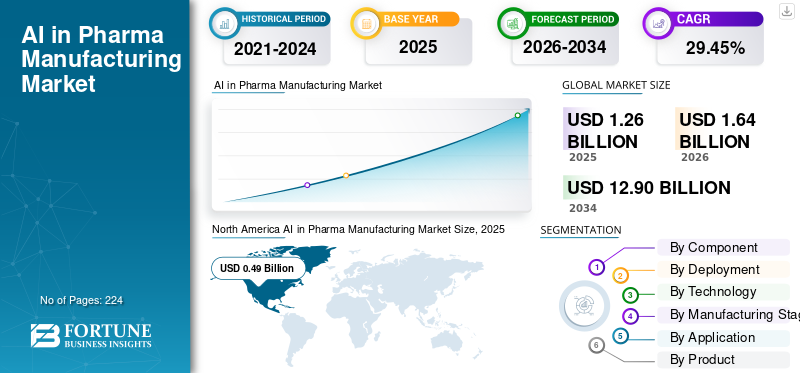
The global AI in pharma manufacturing market size was valued at USD 1.26 billion in 2025 and is projected to grow from USD 1.64 billion in 2026 to USD 12.90 billion by 2034, exhibiting a CAGR of 29.45% during the forecast period. North America dominated the AI in pharma manufacturing market with a market share of 38.88% in 2025.
The global AI in pharma manufacturing market includes AI-enabled software/platforms and services used to improve pharmaceutical production across R&D/tech transfer, upstream and downstream processing, fill-finish, packaging, quality control, batch review, predictive maintenance, and supply chain operations. The market demand is supported by the growing complexity of biologics, vaccines, cell & gene therapies, and high-volume small molecule manufacturing, where companies need faster production cycles, better batch consistency, and real-time visibility across plants. AI adoption is also increasing since pharma companies are under pressure to reduce downtime, improve technology transfer, manage global supply chains, and shorten time-to-market while meeting strict regulatory and quality requirements.
Key market players in the global market consist of Siemens, Rockwell Automation, Honeywell, Emerson Electric, and Schneider Electric. The leadership of these companies is supplemented by strong product portfolios, wide geographic network, and broad customer base.
Download Free sample to learn more about this report.
AI in Pharma Manufacturing Market Key Takeaways
 Global Market Size & Forecast
- 2025 Market Size: USD 1.26 billion
- 2026 Market Size: USD 1.64 billion
- 2034 Forecast Market Size: USD 12.90 billion
- CAGR: 29.45% from 2026–2034
 Market Share
- North America dominated the AI in pharma manufacturing market with a 38.88% share in 2025.
- The services segment is projected to grow at a CAGR of 23.95% during the forecast period.
- The hybrid segment is expected to register a CAGR of 28.09% during the forecast period.
 Key Regional Highlights
North America
North America was valued at USD 0.49 billion in 2025, maintaining its leading position in the global market.
Asia Pacific
Asia Pacific is projected to reach USD 0.49 billion in 2026.
Europe
Europe is expected to witness steady growth during the forecast period.
U.S.
The U.S. market is estimated to reach USD 0.57 billion in 2026.
Japan
The Japan market is estimated to reach USD 0.10 billion in 2026.
Read More

AI in PHARMA MANUFACTURING MARKET TRENDS
Growing Use of AI for Quality Control and Compliance Automation is a Remarkable Market Trend
The market is experiencing a significant movement toward utilizing AI for automating compliance and ensuring quality control. Pharmaceutical production entails stringent GMP standards, intricate batch records, and elevated expectations for product quality, prompting firms to increasingly adopt AI to spot deviations, assess process risks, and minimize human review mistakes. AI-driven systems can examine batch data, equipment performance, visual inspection results, and quality documentation in real time, assisting manufacturers in transitioning from reactive quality assessments to proactive quality assurance. This trend is particularly significant for biologics, vaccines, and cell & gene therapies, as minor process variations can impact product uniformity and release schedules. AI additionally aids in automated documentation, prioritizing events, monitoring corrective actions, and ensuring audit readiness, assisting organizations in diminishing compliance burdens and enhancing operational efficiency. These factors are supporting the overall global AI in pharma manufacturing market growth during the forecast period.
- For instance, in April 2025, Honeywell launched TrackWise Manufacturing, an AI-assisted, cloud-native platform designed to help life sciences companies automate and digitalize manufacturing operations, bridge digital and physical manufacturing workflows, and improve process efficiency.
MARKET DYNAMICS
MARKET DRIVERS
Download Free sample to learn more about this report.
Increasing Demand for Advanced Digital Manufacturing Infrastructure is Driving Market Growth
The growing need for advanced digital manufacturing systems is a significant factor propelling the global market growth. Pharmaceutical companies are departing from paper-based, disjointed, and manually operated production systems due to the fact that these processes hinder batch release speed, elevate deviation risks, and complicate compliance. Digital manufacturing platforms powered by AI facilitate real-time connections among plant equipment, batch records, quality systems, operators, and production data, enhancing visibility throughout the manufacturing lifecycle. This is particularly crucial for biologics, vaccines, and cell & gene therapies, where variability in processes is significant and production breakdowns can be quite expensive. With the adoption of Pharma 4.0 models by manufacturers, AI facilitates quicker technology transfer, predictive process oversight, automated workflow organization, and improved first-pass production efficiency. All these factors cumulatively drive the overall market growth.
- For instance, in October 2025, Aizon pre-announced a major upgrade to its GxP Intelligent Manufacturing platform with Agentic AI capabilities.
MARKET RESTRAINTS
High Implementation and Integration Cost to Hamper Market Growth
High implementation and integration cost is a key restraint for the global market. AI adoption in pharma plants is not limited to buying software; it often requires MES upgrades, equipment connectivity, data historians, cloud infrastructure, cybersecurity layers, validation support, and employee training. These requirements increase the total cost of ownership and make implementation difficult for small and mid-sized pharma companies, biotechnology firms, and CDMOs. In regulated GMP environments, companies also need documented validation, audit trails, change control, and lifecycle monitoring, which further adds to project timelines and cost. As a result, many manufacturers adopt AI in phases instead of deploying it across full production lines, slowing overall market penetration.
- For example, in May 2025, Rockwell Automation launched FactoryTalk PharmaSuite 12.00, noting that the release was designed to simplify system management, improve deployment flexibility, and reduce time-to-value for pharmaceutical and biopharmaceutical manufacturers, reflecting industry concerns around complex and costly MES modernization.
MARKET OPPORTUNITIES
Rising Use of AI in Quality Inspection and Assurance to Offer Market Growth Opportunities
The growing emphasis on quality inspection and assurance is generating a significant opportunity for the global market. Pharmaceutical producers encounter significant expenses due to batch rejections, incorrect rejections, contamination threats, packaging flaws, and postponed product launches, particularly in sterile injectables, biologics, vaccines, and advanced therapies. AI-driven computer vision and machine learning can enhance defect detection in vials, syringes, ampoules, tablets, labels, and packaging lines by consistently identifying particles, cracks, cosmetic flaws, foreign objects, and labeling mistakes compared to manual inspection. This presents a chance for vendors to provide solutions for AI-driven visual inspection, predictive quality analytics, batch review, and real-time release assistance. As organizations transition to Pharma 4.0, quality assurance is evolving from final-stage inspections to ongoing, data-informed oversight throughout the production workflow. All these factors will drive the market growth in the coming years.
- For instance, in June 2025, Antares Vision Group and Oròbix unveiled AI-GO, an AI powered visual inspection platform for pharmaceutical and manufacturing packaging sectors, designed to detect complex anomalies such as chromatic impurities, glass fragments, cosmetic defects, and foreign bodies while reducing false scrap and improving production quality.
MARKET CHALLENGES
Regulatory Uncertainty and GMP Validation Complexity Pose a Prominent Challenge to Market Growth
Regulatory uncertainty and GMP validation complexity remain key challenges for the global market. Pharma companies cannot use AI freely in critical manufacturing activities as every model used for process control, quality decisions, batch review, or release support must be validated, documented, risk-assessed, and monitored throughout its lifecycle. This becomes difficult when AI models learn from changing production data, as companies must prove that the model remains accurate, traceable, explainable, and compliant after updates. In GMP environments, unclear expectations around model retraining, data integrity, audit trails, and change control can increase implementation time and cost. As a result, many companies first use AI in lower-risk areas such as predictive maintenance or planning, while adoption in real-time quality and release decisions remains slower. All the factors cumulatively affect the market growth.
- For instance, in January 2025, the U.S. FDA announced draft guidance on the use of AI to support regulatory decision-making for drug and biological products, showing that regulators are still defining expectations around AI credibility, risk assessment, and documentation for safety, effectiveness, and quality decisions.
Segmentation Analysis
By Component
Software/Platforms Segment Dominated Due to Strong Need for Real-time Process Control, Digital Batch Execution, and AI-enabled Compliance
In terms of component, the market is divided into services and software/platforms.
The software/platforms segment accounted for the dominant global AI in pharma manufacturing market share in 2025. The segment benefits from the growing shift toward cloud-based and scalable systems that allow pharma companies, biotech firms, and CDMOs to connect plant data, reduce manual errors, and support faster batch release. Moreover, strong demand for real-time visibility, automated workflows, and GMP-ready digital operations makes software/platforms the leading component segment in the global market.
- For instance, in September 2025, Körber released PAS-X MES 3.4, a cloud- and AI-powered manufacturing execution system for life sciences manufacturing.
The services segment is anticipated to rise with a CAGR of 23.95% over the forecast period.
To know how our report can help streamline your business, Speak to Analyst
By Deployment
Cloud-Based Segment Dominated Due to Faster Deployment, Scalable Manufacturing Data Access, and Lower Infrastructure Burden
On the basis of deployment, the market is divided into cloud-based, on-premise, and hybrid.
The cloud-based segment dominated the global market in 2025. Cloud deployment helps companies scale AI models faster, support remote monitoring, reduce dependence on heavy on-site IT infrastructure, and enable quicker updates compared with traditional on-premise systems. Cloud-based platforms also support AI-enabled workflow automation, predictive analytics, digital batch review, and cross-site performance benchmarking, which strengthens their adoption in Pharma 4.0 environments. As a result, cloud-based deployment has become the leading model in the global market. Furthermore, the segment is set to hold 54.2% share in 2026.
- For instance, in May 2025, Rockwell Automation launched FactoryTalk PharmaSuite 12.00, the latest version of its MES for regulated pharmaceutical and biopharmaceutical manufacturing environments.
The hybrid segment is growing at a CAGR of 28.09% over the forecast period.
By Technology
Computer Vision Segment to Grow Fastest as Need For Faster, More Consistent, and Auditable Visual Inspection Rises
Based on technology, the market is classified into machine learning & deep learning, computer vision, and others.
The computer vision segment is expected to grow at the fastest CAGR during the forecast period as visual inspection and quality verification are among the most direct, high-value use cases for AI on the manufacturing floor. As manufacturers increase the production of biologics, vaccines, injectables, and specialty drugs, the need for faster, more consistent, and auditable visual inspection rises, contributing to the segmental growth.
The others segment accounted for the dominant market share as pharma manufacturers use a wider mix of technologies such as digital twins, generative AI, advanced process analytics, robotics, natural language processing, industrial IoT, and automation intelligence across manufacturing workflows. These technologies are used beyond image-based inspection or model-based prediction, covering areas such as tech transfer, plant simulation, batch documentation support, operator guidance, production scheduling, anomaly detection, and real-time process monitoring. Digital twins are especially important as they help manufacturers simulate process changes, detect risks, and optimize plant operations before applying changes on the production floor. Generative AI and NLP are also gaining traction in MES, batch record review, deviation management, and operator support, increasing the value of the others category. This broader applicability across R&D/tech transfer, production, quality, and supply chain operations makes others the leading technology segment in the global market. Furthermore, the segment is set to hold 45.0% share in 2026.
- For instance, in August 2025, CARES, A*STAR SIMTech, and industry partners announced a digital twin technology project with AI to boost efficiency and reliability in pharmaceutical manufacturing. The platform automates the development of production-line digital twins to optimize plant operations, detect anomalies early, and support data-driven decision-making.
By Manufacturing Stage
High Compliance Pressure, Batch Release Needs, and Product Quality Risks Supported Quality Control/ QA Segment Leadership
In terms of manufacturing stage, the market is divided into R&D/tech transfer, upstream processing, downstream processing, fill-finish & packaging, quality control/QA, and others.
The quality control/QA segment captured the highest share of the global market in 2025. This can be attributed to the fact that pharmaceutical manufacturing is highly regulated and every batch must meet strict GMP, safety, purity, and documentation requirements before release. Additionally, QC/QA has broader AI use across visual inspection, anomaly detection, data integrity checks, predictive quality, and compliance monitoring. As a result, quality control/QA remains the largest revenue-generating manufacturing stage in the global market. Furthermore, the segment is set to hold 21.1% share in 2026.
- For instance, in December 2025, UiPath partnered with Veeva through the Veeva AI Partner Program to streamline application testing and validation for life sciences companies. The collaboration combines UiPath’s agentic testing automation with Veeva Validation Management to create end-to-end, audit-ready, and paperless validation workflows, reducing manual regulated testing complexity and improving accuracy, compliance, and inspection readiness.
The fill-finish & packaging segment is anticipated to rise with a CAGR of 30.29% over the forecast period.
By Application
Process Optimization & Control Segment Dominated Due to Need for Higher Yield, Real-time Monitoring, and Reduced Manufacturing Variability
On the basis of application, the market is divided into production planning & scheduling, process optimization & control, quality inspection & assurance, predictive maintenance, batch record review & compliance, supply chain & inventory optimization, and others.
The process optimization & control segment captured the highest share of the global market in 2025. This is owing to pharmaceutical manufacturers needing to continuously improve yield, reduce process variability, control critical parameters, and minimize batch failures. Also, process optimization directly improves productivity, cost efficiency, right-first-time production, and plant utilization, making it a priority investment area. As pharma companies move toward smart factories and Pharma 4.0, AI-based process optimization is becoming central to achieving consistent, scalable, and compliant manufacturing operations. Furthermore, the segment is set to hold 25.0% share in 2026.
- For instance, in May 28, 2025, Sanofi highlighted the launch of its third Digital Accelerator focused on the digital transformation of its global Manufacturing & Supply network. The initiative supports Sanofi’s ambition to scale AI across biopharma production and improve manufacturing efficiency.
The batch record review & compliance segment is anticipated to rise with a CAGR of 30.61% over the forecast period.
By Product
Small Molecule Drugs Segment Dominated Due to Large-scale Production Volume, Established Manufacturing Base, and Strong Need for Process Efficiency
In terms of product, the market is segmented into small molecule drugs, biologics, vaccines, cell & gene therapies, and others.
The segment of small molecule drugs held the largest market share in 2025 since these products continue to constitute a significant part of global pharmaceutical production and are manufactured in high commercial quantities in forms such as tablets, capsules, injectables, and APIs. The production of small molecules includes various phases such as synthesis, formulation, granulation, compression, coating, packaging, and quality testing, driving significant demand for AI-driven process control, production scheduling, deviation detection, and batch optimization. AI platforms assist manufacturers in enhancing yield, minimizing solvent and raw material waste, accelerating scale-up timelines, and ensuring uniform product quality across extensive production batches. The sector gains from established manufacturing facilities, CDMOs, and generic medicine producers that are progressively adopting digital technologies to enhance cost efficiency. Consequently, small molecule medications continue to be the dominant product segment in the global market. Furthermore, the segment is set to hold 38.8% share in 2026.
- For instance, in October 2025, Merck and Siemens deepened their strategic partnership to accelerate AI- and data-driven drug development and manufacturing. The agreement focuses on integrated software solutions, automation, data, and AI to connect drug discovery, development, and manufacturing, supporting faster and more efficient production workflows for pharmaceutical products, including small molecule pipelines.
The biologics segment is anticipated to rise with a CAGR of 30.35% over the forecast period.
By End User
Pharmaceutical Companies Segment Dominated Due to Large Manufacturing Networks, Higher AI Budgets, and Strong Need for GMP Efficiency
In terms of end user, the market is segmented into pharmaceutical companies, biotechnology companies, CDMOs/CMOs, cell & gene therapy manufacturers, and others.
In 2025, the pharmaceutical companies segment held the leading position in the global market. These companies manage high-volume small molecule production along with complex biologics and vaccine manufacturing, which creates strong demand for real-time process control, batch consistency, and faster product release. Pharmaceutical companies also face strict GMP requirements, supply continuity pressure, and cost-efficiency targets, making AI adoption important for reducing deviations, downtime, and manual documentation burden. Compared with smaller biotechnology firms or specialized manufacturers, large pharma companies have stronger digital transformation teams, larger data sets, and wider enterprise deployment opportunities. Furthermore, the segment is set to hold 47.8% share in 2026.
- For instance, in September 5, 2024, Takeda announced manufacturing digital transformation initiatives under its global “Factory of the Future” program. The company highlighted the use of AI and digital technologies to improve pharmaceutical quality, strengthen supply stability, and deploy successful manufacturing use cases across global sites, supporting the strong role of large pharmaceutical companies in AI-led manufacturing adoption.
In addition, CDMOs/CMOs are projected to witness 32.43% growth rate during the forecast period.
AI in Pharma Manufacturing Market Regional Outlook
By geography, the market is divided into North America, Latin America, Asia Pacific, Europe, and the Middle East & Africa.
North America
North America AI in Pharma Manufacturing Market Size, 2025 (USD Billion)
To get more information on the regional analysis of this market, Download Free sample
The North America market reached USD 0.39 billion in 2024 and led the global market. In 2025, the region continued to hold its leading position, with USD 0.49 billion. North America is expected to remain a leading region due to the strong presence of large pharmaceutical companies, advanced biopharma manufacturing sites, and early adoption of AI-enabled manufacturing technologies.
U.S. AI in Pharma Manufacturing Market
The U.S. market dominated the North American market and can be analytically approximated at around USD 0.57 billion in 2026, accounting for roughly 35.1% of global market.
Europe
Europe’s market size is anticipated to grow at 27.69% CAGR during the forecast period. Europe is growing steadily due to its strong pharmaceutical manufacturing base, high GMP compliance standards, and increasing focus on Pharma 4.0 transformation.
U.K. AI in Pharma Manufacturing Market
The U.K. market is estimated at around USD 0.08 billion in 2026, representing roughly 5.0% of global revenues.
Germany AI in Pharma Manufacturing Market
Germany’s market size is projected to reach approximately USD 0.10 billion in 2026, equivalent to around 6.1% of global sales.
Asia Pacific
The Asia Pacific’s market is expected to reach a valuation of USD 0.49 billion by 2026. Asia Pacific is expected to show strong growth due to rapid expansion of pharmaceutical manufacturing in China, India, Japan, South Korea, and Singapore. The region has a large base of generic drug, API, biologics, vaccine, and CDMO manufacturers that are increasingly adopting AI to improve scale, quality, cost efficiency, and global regulatory compliance.
Japan AI in Pharma Manufacturing Market
The Japanese market is estimated at around USD 0.10 billion in 2026, accounting for roughly 6.2% of global revenues.
China AI in Pharma Manufacturing Market
China’s market is projected to reach revenues of around USD 0.16 billion in 2026, representing roughly 9.9% of global sales.
India AI in Pharma Manufacturing Market
The Indian market is estimated at around USD 0.07 billion in 2026, accounting for roughly 4.1% of global revenues.
Latin America and Middle East & Africa
The Middle East & Africa and Latin America regions are likely to witness a slower growth throughout the forecast period. The market in Latin America is projected to attain a valuation of USD 0.07 billion by 2026. Prominent factors such as rising demand for vaccines, biologics, and essential medicines, along with efforts to improve supply chain resilience and GMP-compliant manufacturing capacity are boosting the market growth in these regions.
India AI in Pharma Manufacturing Market
The GCC market is projected to reach approximately USD 0.01 billion by 2026, representing about 0.7% of global revenues.
COMPETITIVE LANDSCAPE
Key Industry Players
AI-enabled MES, Process Control, Quality Automation, Digital Twins, and Manufacturing Intelligence Platforms to Support Market Position
The global AI in pharma manufacturing market reflects a moderately competitive landscape, consisting of large industrial automation companies, pharma-specific MES vendors, digital manufacturing software providers, quality management platforms, and bioprocess automation companies. Key players include Siemens, Rockwell Automation, Honeywell, Emerson Electric, and Schneider Electric. Their market position is supported by strong installed bases in regulated manufacturing, GMP workflow expertise, enterprise software portfolios, and partnerships with pharmaceutical, biotechnology, and CDMO customers.
- For instance, in April 2026, Rockwell Automation and Cytiva launched a platform to accelerate digital transformation for biopharma companies. The solution focuses on next-generation process control, centralized alarms, real-time monitoring, process intensification, and batch reporting for bioprocess workflows.
Additional key contributors include ABB, Dassault Systèmes, Körber AG, and MasterControl. These companies are also emphasizing advanced solutions and collaborations to strengthen their market presence.
LIST OF KEY AI IN PHARMA MANUFACTURING COMPANIES PROFILED IN REPORT
- Siemens AG (Germany)
- Rockwell Automation, Inc. (U.S.)
- Honeywell International Inc. (U.S.)
- Emerson Electric Co. (U.S.)
- Schneider Electric (France)
- ABB (Switzerland)
- Körber AG (Germany)
- Dassault Systèmes (France)
- Danaher Corporation (Cytiva) (U.S.)
- MasterControl Solutions, Inc. (U.S.)
KEY INDUSTRY DEVELOPMENTS
- May 2025: Emerson introduced a new suite of life sciences software within its DeltaV Automation Platform to improve data mobility from R&D through commercial manufacturing. The platform supports recipe development, tech transfer, MES/DCS connectivity, real-time release, and flexible manufacturing.
- March 2025: MasterControl acquired Qualer, a cloud-native asset management company, to expand its life sciences quality and manufacturing platform with CMMS capabilities for equipment tracking, calibration, maintenance, compliance, and asset performance management.
- January 2025: Cytiva and Cellular Origins entered a collaboration to deliver automated robotic manufacturing capabilities for cell and gene therapies. The partnership combines Cytiva’s Sefia platform with Cellular Origins’ Constellation robotic platform to support digitally connected, automated CGT manufacturing.
- May 2024: Cytiva launched its next-generation Sefia cell therapy manufacturing platform, developed with Kite. The platform automates key CAR-T manufacturing workflow steps, reduces variability, improves efficiency, and supports commercial-scale advanced therapy manufacturing.
- November 2023: AWS and Amgen expanded their collaboration to create generative AI solutions for drug discovery, development, and manufacturing throughput. Amgen also planned to use AWS services, Amazon SageMaker, sensors, machine vision, and predictive maintenance tools at its advanced assembly and final product packaging facility.
REPORT COVERAGE
The global AI in pharma manufacturing market analysis encompasses an extensive examination of the market size and projections for all market segments featured in the report. It provides information on the market dynamics and trends that are anticipated to propel the market during the forecast period. It offers insights into crucial elements, such as innovations in products, the regulatory landscape, and the introduction of new products. Furthermore, it outlines collaborations, mergers & acquisitions, along with significant advancements within the market. The global forecast report additionally offers a comprehensive competitive landscape with details on market share and profiles of major active participants.
Request for Customization to gain extensive market insights.
Report Scope & Segmentation
| ATTRIBUTE | DETAILS |
| Study Period | 2021-2034 |
| Base Year | 2025 |
| Estimated Year | 2026 |
| Forecast Period | 2026-2034 |
| Historical Period | 2021-2024 |
| Growth Rate | CAGR of 29.45% from 2026-2034 |
| Unit | Value (USD Billion) |
| Segmentation | By Component, Deployment, Technology, Manufacturing Stage, Application, Product, End User, and Region |
| By Component |
|
| By Deployment |
|
| By Technology |
|
| By Manufacturing Stage |
|
| By Application |
|
| By Product |
|
| By End User |
|
| By Region |
|
Frequently Asked Questions
According to Fortune Business Insights, the global market value stood at USD 1.26 billion in 2025 and is projected to reach USD 12.90 billion by 2034.
In 2025, the North Americas market value stood at USD 0.49 billion.
The market is expected to exhibit a CAGR of 29.45% during the forecast period of 2026-2034.
By component, the software/platforms segment led the market in 2025.
Rising need to reduce batch failures and deviations coupled with growth of biologics, vaccines, and cell & gene therapies are primarily driving market expansion.
Siemens AG, Rockwell Automation, Inc., and Honeywell International Inc. are the top players in the global market.
North America held the largest market share in 2025.



- 2021-2034
- 2025
- 2021-2024
- 224
Get 30-60 hrs Free Customization
Expand Regional and Country Coverage, Segments Analysis, Company Profiles, Competitive Benchmarking, and End-user Insights.













.webp)






Related Reports
-
US +1 833 909 2966 ( Toll Free )
-
Get In Touch With Us