Aircraft Electricals Drive Market Size, Share, Industry Analysis, By Aircraft Type (Commercial Aircraft, Military Aircraft, Helicopters, and UAVs), By Component (Electric Motor, Power Electronics & Controllers, and Others), By System Application (Flight Control Actuations, Landing Gear Systems, Utility & Environmental Systems, Engine Systems, and Others), By Power Rating (Micro Drives (Below 100W), Low Power (100W - 1kW), Medium Power (1-10kW), and Others, By End Users (OEMs, MROs, and Aircraft Operators), By Installation (Line fit and Retrofit), and Regional Forecast, 2026-2034
 Download Free Sample
KEY MARKET INSIGHTS
 Listen to Audio Version
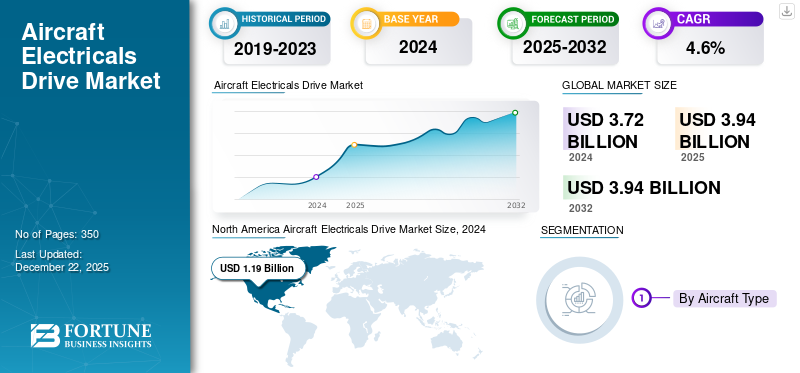
The global aircraft electricals drive market size was valued at USD 3.94 billion in 2025. It is projected to grow from USD 4.17 billion in 2026 to USD 5.32 billion by 2034, exhibiting a CAGR of 3.09% during the forecast period. North America dominated the global market with a share of 31.92% in 2025.
Aircraft electrical drive is a range of electric-motor-driven system components used in new-age aircraft. To perform numerous functions and mechatronic functions. These functions were previously operated by mechanical, pneumatic, and modern hydraulic systems; however, with the emergence of more electric and electric aircraft, components such as actuators, motors, converters, and inverters are readily being used in the aircraft. Aircraft electrical drive is used in various applications such as in-flight control, landing gears, cargo doors, and thrust, environmental control systems. Electrical drive plays a major role in reducing leaks, enabling motion control with precision, and providing aid in regular aircraft operations. Aircraft electrical systems have to maintain appropriate airworthiness aviation standards for thermal management, and power density, making it a technologically intensive component in the aircraft.
The growth in the aircraft electrical market is due to the drive of the global aviation industry toward hybrid-electric and more-electric aircraft. Growing emphasis on fuel saving, system integration and automation, and emission control has led many OEMs to replace traditional electrical units to be replaced by technologically advanced and equipped electrical drives. Additionally, the growth of urban Air Mobility (UAM) and electric vertical take-off and landing (eVTOL) is leading to a growth in compact, efficient, and electrically propelled aircraft, thereby leading to the growth of aircraft electrical drives. Key market players such as Safran, Moog, and Honeywell Aerospace are leading market growth due to advancements in aircraft electrical systems and electrical drives. This growth is further fueled by the growing demand for electric aircraft, leading to sustainable aviation technologies in the forthcoming years, thereby leading to substantial market growth.
Download Free sample to learn more about this report.
Aircraft Electricals Drive Market KEY TAKEAWAYS
 Global Market Size & Forecast
- 2025 Market Size: USD 3.94 Billion
- 2026 Market Size: USD 4.17 Billion
- 2034 Forecast Market Size: USD 5.32 Billion
- CAGR: 3.09% from 2026–2034
 Market Share
- North America dominated the aircraft electricals drive market with a 31.92% share in 2025.
- The commercial aircraft segment is projected to hold a 54.71% share in 2026.
- The electric motor segment accounted for the largest market share in 2025.
 Key Regional Highlights
Asia Pacific
Asia Pacific reached USD 1.00 billion in 2025, driven by expanding airport infrastructure and increasing investments in electric aircraft technologies.
North America
North America accounted for USD 1.26 billion in 2025, supported by aircraft modernization and growing demand for electric and hybrid-electric aircraft.
Europe
Europe reached USD 1.11 billion in 2025, driven by stringent environmental regulations and advancements in sustainable aviation technologies.
U.S.
The U.S. market is projected to reach USD 0.96 billion in 2026, supported by aircraft modernization and strong aerospace manufacturing.
Japan
Japan is projected to reach USD 0.20 billion in 2026, driven by government support for electric aircraft technologies and aviation infrastructure.
Read More

Market Dynamics
Market Drivers
Transition to More Electric Aircraft (MEA) to Boost Market Growth
A major driver in the growth of the aircraft electrical drive market is a major transition toward more electric aircraft (MEA) and electric/hybrid propulsion aircraft. These aircraft aim to reduce emissions and improve fuel efficiency. Conventional aircraft heavily relied on pneumatic and hydraulic systems to power landing gears, actuators, and other mechanical subsystems. Traditional systems thereby added weight, risked leakage, and also required complex maintenance. In contrast, electrical drives comprise lightweight components such as actuators, motors, and controllers, which are also easier to maintain and monitor.
The growing demand for UAM and eVTOL aircraft is further accentuating demand for compact and high-power electrical drives. With a rise in electric propulsion, the platforms highly depend on electric propulsion and flight control systems, thereby making electric propulsion supporting components vital.
With a rise in emission regulations, the adoption of lightweight, technologically advanced, and emissions-reducing components is expected to drive a boom, due to stricter regulations around carbon emissions to fulfil net-zero goals. Therefore, the adoption of more electric systems is expected to increase in the forthcoming years and become a standard across various future aviation platforms.
Market Restraints
Power Density and Thermal Management to Limit Market Growth
Despite numerous reasons for high growth, the market is expected to witness challenges in growth due to high thermal loads and management of power density in high-performance, compact environments. Aircraft electrical drives in high-voltage and rugged areas of the aircraft, such as the landing gear, require higher torque, power electronics, and lightweight motors to deliver performance under extreme conditions. Thus, due to overheating of these systems could cause a hindrance in the operations.
Furthermore, high-voltage distribution systems, primarily found in more electric aircraft pose additional risk of electromagnetic interference (EMI) and partial discharge leading to damaged insulation. Unless advances are made in effective cooling technology, the operational issues will limit the scalability of electrical drives.
Market Opportunities
Retrofitting of Older Aircraft with Electric Drive System to Fuel Market Growth Opportunities
A key opportunity in the market is with retrofitting legacy aircraft platforms equipped with advanced systems. While newer aircraft are being designed with more-electric architectures, the pre-existing fleet globally includes a higher portion of serviceable aircraft, relying heavily on pneumatics and conventional power sources. Retrofitting older aircraft with electric drive systems is indeed a significant growth opportunity for the aircraft electrical drive market, as it allows for the modernization of existing fleets and the potential reduction of emissions and operating costs. This trend is driven by increasing demand for sustainable aviation solutions and the advancements in electric propulsion technologies.
Retrofitting older aircraft with electric or hybrid-electric propulsion systems allows airlines to modernize their fleets and reduce their environmental footprint without the high cost of purchasing new aircraft. This trend creates substantial growth opportunities for companies involved in electric propulsion systems, including electric motor manufacturers, battery technology providers, and system integrators.
Aircraft Electrical Drive Market Trends
Adoption of High-Voltage DC (HVDC) Power Distribution Framework to Amplify Product Demand
A transition from traditional 115V AC & 28V DC power systems to HVDCs with a range of up to 1,000V DC is shaping the trend for high voltage power distribution systems in the market. With a rise in production and development of more electric aircraft, flight actuators, and increased focus on environment control, there’s a surge in demand for high power density. Thus, such density can be provided better with HVDC electrical systems.
An HVDC comprises electrical drives, actuators, and motors that generate and circulate power through high-voltage buses, thereby reducing the need for a heavy step-down transformer. High voltage DC helps with light wiring, improves thermal resistance, reduces electromagnetic interference (EMI), and therefore is ideal for high-intensity flight operations.
Currently, the F-35 Lightning II aircraft uses a 270V DC power bus that the upcoming more electric aircraft (MEA) are expected to use in the forthcoming years. This enables an integration of high-power electric actuators and motors in applications such as landing gear, aircraft environment control (HVAC), and others. Additionally, with a rise in wide-bandgap semiconductors such as GaN and SiC that support high-efficiency power conversion for high voltage switching frequencies, the market is expected to bolster growth in the forecast period.
Download Free sample to learn more about this report.
SEGMENTATION ANALYSIS
By Aircraft Type
Advancements In Electrical Systems Propelled by Technological Advancements to Fuel Growth in Commercial Aircraft Segment
By aircraft type, the market is divided into commercial aircraft, military aircraft, helicopters, and UAVs. Commercial aircraft are further divided into narrow body, wide body, regional jets, and business jets. Military aircraft are further divided into fighter jets, military transport aircraft, and military trainer aircraft. Helicopters are further bifurcated into military helicopters and commercial helicopters. UAVs are further segmented into commercial UAVs and military UAVs.
The commercial aircraft segment is anticipated to hold a dominant market share of 54.71% in 2026 and is expected to grow at a significant CAGR in the forthcoming years. The need for greater fuel efficiency, reduced emissions, and lower operating costs primarily drives the increasing adoption of electrical drives in commercial aircraft. This shift toward electrification is further fueled by advancements in electrical systems, including higher voltage systems and more efficient power generation and distribution. Electrical systems, particularly in hybrid-electric and all-electric aircraft, can significantly reduce fuel consumption compared to traditional systems. By reducing fuel burn, electrical systems contribute to lower greenhouse gas emissions, aligning with growing environmental regulations and sustainability initiatives. The development of hybrid-electric propulsion systems, which combine electric motors with traditional engines, allows for optimized power usage and further fuel savings.
- In 2026, the narrow body segment is projected to lead the market with a 26.32% share.
- The Fighter jets segment is anticipated to hold a dominant market share of 7.66% in 2026.
- The Commercial Helicopters segment is expected to lead the market, contributing 17.45% globally in 2026.
The UAVs segment is expected to grow at the highest CAGR in the forecast period. Advances in battery technology, such as higher energy density and faster charging capabilities, have made electric propulsion more practical for UAVs. The miniaturization of electronic components and advancements in control systems have enabled the development of more sophisticated and efficient electric propulsion systems for UAVs. Integration with artificial intelligence and autonomous flight control systems enhances the capabilities of electric-powered UAVs, allowing for more complex missions and operations.
To know how our report can help streamline your business, Speak to Analyst
By Component
Increasing Demand for More Fuel-Efficient, Eco-Friendly Aircraft Led to Dominance of Electric Motor Segment
By component, the market is divided into electric motor, power electronics & controllers, and mechanical transmission components.
The electric motor segment accounted for a dominating market share in 2024. A shift toward more electric aircraft (MEA) and the development of hybrid-electric and fully electric aircraft is a major driver for demand for electric motor components. Increasing demand for more fuel-efficient, eco-friendly aircraft, technological advancements in electric propulsion, and government regulations focused on reducing emissions are expected to bolster market growth further in the forthcoming years. Additionally, developments in electric motor design, energy storage (such as lithium-ion batteries), and power electronics are making electric propulsion systems more viable and efficient.
The mechanical transmission components segment is expected to grow at the highest CAGR in the forecast period. Mechanical transmission components include actuators and conductors, which are used in electrical systems for multiple functions in modern aircraft. Mechanical transmission components are essential for transferring power from the engine to these electrical systems, such as generators and auxiliary power units. Furthermore, an increase in investments in military and defense aviation also contributes to the growth of the market.
By System Application
High Demand for Advanced Electrical Systems to Drive Power Generation & Distribution Segmental Growth
By system application, the market is divided into flight control actuations, landing gear systems, utility & environmental systems, engine systems, cabin systems, and power generation & distribution.
The power generation & distribution segment dominated the market in 2024 and is expected to grow at a significant CAGR in the forthcoming years. The growth in air travel demands more sophisticated power distribution systems to handle the increasing number of flights. Aircraft modernization programs and the replacement of older fleets are also contributing to the demand for advanced electrical systems. The expansion of the commercial aviation industry, particularly in regions with growing air travel, is further driving the market.
The flight control actuations segment is expected to grow at the highest CAGR in the forecast period. The increasing demand for more efficient, reliable, and safer aircraft is the primary driver for the growth of flight control actuation applications in the aircraft electrical drives market, particularly with the adoption of fly-by-wire systems. This shift is fueled by the advantages fly-by-wire offers, including enhanced performance, improved safety features including envelope protection and reduced weight compared to traditional hydraulic systems, thereby leading to high market growth.
By Power Rating
Emergence of Fully Electric and Hybrid Electric Aircraft Led to Medium Power Segment’s Dominance
By power rating, the market is divided into micro drives (below 100W), low power (100W - 1kW), medium power (1-10kW), high power (10kW - 100kW), and very high power (above 100kW).
The medium power (1-10Kw) segment dominated the global market in 2024 and is expected to grow at a significant CAGR in the forecast period. Electric propulsion technologies are gaining traction for both fully electric and hybrid-electric aircraft. These technologies offer potential benefits such as reduced emissions, improved fuel burn, and lower noise levels. Development of fault-tolerant systems is crucial for ensuring reliability in electric aircraft, and these systems are often implemented at the component level, including electric drives within the 1-10kW range. Modern control techniques, such as direct torque control (DTC) and model predictive control (MPC), are being implemented to optimize the performance of electric drives.
The very high power (above 100Kw) segment is estimated to grow at the second-highest rate during the forecast period. Increasing demand for more electric aircraft (MEA) and the need for higher power density in aircraft systems are key drivers for the growth of very high power (above 100kW) electrical drives in the aircraft market. This trend is fueled by the desire to reduce fuel consumption, lower emissions, and improve overall aircraft performance. Modern aircraft incorporate numerous electrical systems, including cabin air conditioning, entertainment systems, and advanced avionics. These systems, along with the electrification of previously mechanical or hydraulic components, are increasing the overall power requirements of aircraft. High-power electrical drives are needed to meet these growing demands and ensure reliable operation.
By End-User
Increase in Aircraft Production and Procurement Led to Growth for OEM Segment
The market is segmented into OEMs, MROs, and aircraft operators.
The OEMs segment accounted for a dominating market share in 2024 and is expected to grow at the highest CAGR in the forthcoming years. The expanding commercial aviation industry, driven by a growing number of air passengers, necessitates the production of new aircraft, boosting demand for OEM components such as electrical drives. Stringent environmental regulations and rising fuel costs are pushing manufacturers to adopt more electric systems, leading to greater fuel efficiency and reduced emissions. Additionally, innovations in electric power plants and the development of more electric aircraft (MEA) are further driving the adoption of electric drives.
The MROs segment is expected to grow at a significant CAGR in the forthcoming years. The growth of the MRO (Maintenance, Repair, and Overhaul) end-user segment in the aircraft electrical drive market is primarily driven by the increasing number of aircraft in operation, the rising demand for air travel, and the trend toward more complex, electrically driven systems in modern aircraft. This growth is further fueled by the need to maintain airworthiness standards, comply with safety regulations, and extend the operational lifespan of aging aircraft fleets.
By Installation
Retrofit Segment Dominated Market Growth Due to Modernization, Cost-Effectiveness, and Sustainability Initiatives
By installation, the market is divided into line fit and retrofit.
The retrofit segment dominated the global aircraft electricals drive market growth in 2024. Primarily driven by the need for modernization, cost-effectiveness, and sustainability initiatives, the market is expected to grow at a substantial rate. Retrofitting allows airlines to upgrade existing aircraft with newer and more efficient electrical systems without the expense of purchasing entirely new planes. This includes incorporating advanced technologies for power generation, distribution, and management, as well as improved electrical components.
The line fit segment is estimated to grow at the highest rate during the forecast period. Line-fit installations allow for the integration of safety features such as lightning protection systems and the implementation of energy-efficient electrical systems, aligning with both safety regulations and environmental concerns. As aviation embraces electrification and digitalization, line-fit installations allow for the seamless integration of new technologies such as electric and hybrid propulsion systems, advanced power management, and IoT and AI-driven systems.
Aircraft Electricals Drive Market Regional Outlook
By region, the market is studied into North America, Europe, Asia Pacific, and the rest of the World.
North America
North America Aircraft Electricals Drive Market Size, 2025 (USD Billion)
To get more information on the regional analysis of this market, Download Free sample
North America accounted for USD 1.26 billion in 2025, representing 31.92% of the global market share, and is projected to reach USD 1.33 billion in 2026. North America accounts for the dominant region in the market, accounting for the largest aircraft electricals drive market share. North America, particularly the U.S., is growing rapidly due to the rise in aircraft modernization and an increase in demand for more electric and hybrid electric aircraft. Additionally, the prevalence of major market players such as Honeywell Aerospace and Moog, Inc. is leading to higher demand, fueling the growth of the region in the market. The U.S. market is projected to reach USD 0.96 billion by 2026.
Europe
The Europe market was valued at USD 1.11 billion in 2025, capturing 28.11% of global revenue, and is estimated to reach USD 1.17 billion in 2026. Europe is the second-dominant region in terms of market share. The growth in this region is attributed to significant growth in the aircraft electrical drive market due to a combination of factors, including stringent environmental regulations, a strong aerospace industry focused on innovation, and increasing investments in sustainable aviation technology. The region's commitment to net-zero carbon emissions and the development of "more electric aircraft" are key drivers. The UK market is projected to reach USD 0.32 billion by 2026, while the Germany market is projected to reach USD 0.28 billion by 2026.
Asia Pacific
In 2025, Asia Pacific held 25.48% of the global market, reaching a valuation of USD 1 billion, and is projected to grow to USD 1.06 billion in 2026. The Asia Pacific region is witnessing the highest CAGR in the market during the forecast period. Governments across the Asia Pacific region are investing heavily in airport infrastructure, including runways, terminals, and air traffic control systems, to support the growing air traffic. Governments are also implementing policies and regulations that encourage the development and adoption of electric aircraft technologies. The Japan market is projected to reach USD 0.2 billion by 2026, the China market is projected to reach USD 0.29 billion by 2026, and the India market is projected to reach USD 0.25 billion by 2026.
Rest of the World
Rest of the World maintained a strong presence in the global market, reaching USD 0.57 billion in 2025, accounting for 14.49% share, and is expected to reach USD 0.6 billion in 2026. The rest of the world is anticipated to witness moderate growth during the forecast period. The Middle East, Africa, and Latin America are experiencing growth in the aircraft electrical drive market due to a combination of factors, including increased investment in aerospace infrastructure, rising air travel demand, and a focus on advanced technologies for enhanced safety and efficiency.
Competitive Landscape
Key Market Players
Leading Players Are Focusing on Integrating Advanced Technologies for More Electric Aircraft (MEA)
The aircraft electrical drive market is experiencing intense competition among major players, including both established aerospace companies and emerging startups focused on electrification. Key trends include a shift toward more electric aircraft (MEA) and electric propulsion, driven by sustainability goals, rising fuel costs, and technological advancements in electrical systems.
The market is characterized by intense competition, with players constantly striving to gain market share through product innovation, strategic partnerships, and cost optimization. Government regulations and policies also play a significant role in shaping the competitive landscape.
LIST OF KEY AIRCRAFT ELECTRICALS DRIVE COMPANIES PROFILED
- Honeywell International Inc. (U.S.)
- Safran Group (France)
- Raytheon Technologies Corporation (U.S.)
- Thales Group (France)
- GE Aviation (U.S.)
- Moog Inc. (U.S.)
- Eaton Corporation (Ireland)
- Meggitt PLC (U.K.)
- Parker Hannifin Corporation (U.S.)
- Liebherr Aerospace (France)
KEY INDUSTRY DEVELOPMENTS
- January 2025- OMV partnered with Airbus to sign a memorandum of understanding to advance the decarbonization of the aviation industry via the use of Sustainable Aviation Fuel (SAF). The partnership aimed at supporting the reduction of CO2 emissions in the aviation sector, with sustainable aviation fuel playing a pivotal role in achieving the goal of net carbon neutrality by 2050.
- January 2025- Honeywell Aerospace and NXP Semiconductors N.V. unveiled a partnership at CES 2025 to accelerate aviation product development and chart the path for autonomous flight.
- November 2024- Safran Electrical & Power and Safran Ventilation Systems renewed the distribution partnership contract with China Aviation Supplies Co., Ltd, an aircraft parts distributor and maintenance services provider that will allow both Safran companies to continue expanding their spares and equipment footprint and availability across mainland China.
- June 2023: Volocopter, a major company operating in Urban Air Mobility (UAM), and Safran Electrical & Power, one of the world's leaders in aircraft electrical systems, unveiled an agreement signifying their intention to collaborate on developing a next-generation power train for electric vertical takeoff and landing (eVTOL) aircraft.
- September 2021- Rolls-Royce, a global pioneer in aircraft electrical drives and components, unveiled an all-electric aircraft. The plane took to the skies propelled by its powerful 400kW (500+hp) electric powertrain with the most power-dense battery pack ever assembled for an aircraft.
REPORT COVERAGE
The report provides a detailed analysis of the market and focuses on important aspects, such as key players, products, applications, and platforms, depending on various countries. Moreover, it offers deep insights into the market trends, competitive landscape, market competition, pricing of aircraft electrical drives, market status, and highlights key industry developments. In addition, it encompasses several direct and indirect factors that have contributed to the global market growth in recent years.
Request for Customization to gain extensive market insights.
Report Scope & Segmentation
|
ATTRIBUTE |
DETAILS |
|
Study Period |
2021-2034 |
|
Base Year |
2025 |
|
Estimated Year |
2026 |
|
Forecast Period |
2026-2034 |
|
Historical Period |
2021-2024 |
|
Growth Rate |
CAGR of 3.09% from 2026 to 2034 |
|
Unit |
Value (USD Billion) |
|
Segmentation
|
By Aircraft Type
|
|
By Component
|
|
|
By System Application
|
|
|
By Power Rating
|
|
|
By End-user
|
|
|
By Installation
|
|
|
By Region
|
Frequently Asked Questions
According to the Fortune Business Insights study, the global market was valued at USD 4.17 billion in 2026 and is anticipated to be USD 5.32 billion by 2034.
The market is likely to grow at a CAGR of 3.09% during the forecast period.
The top players in the industry are Honeywell International Inc. (U.S.), Safran Group (France), and Raytheon Technologies Corporation.
North America dominated the global market with a share of 31.92% in 2025.
Increasing demand for more fuel-efficient, eco-friendly aircraft led to the dominance of the electric motor segment



- 2021-2034
- 2025
- 2021-2024
- 350
Get 30-60 hrs Free Customization
Expand Regional and Country Coverage, Segments Analysis, Company Profiles, Competitive Benchmarking, and End-user Insights.




















Related Reports
-
US +1 833 909 2966 ( Toll Free )
-
Get In Touch With Us