Aircraft Noise Reduction Components Market Size, Share & Industry Analysis, By Component (Nacelle & Duct Acoustic Liners, Propulsion Source Noise-Reduction, Airframe Noise-Reduction), By Technology (Acoustic Absorption, Aerodynamic Source Noise-Control), By Aircraft Type (Commercial Transport, Business & General Aviation), By Propulsion Type (Turbofan, Turboprop, Turboshaft, Piston Engine), By Installation Type (Line-Fit / OEM, Retrofit, and Maintenance), By Customer Type (Aircraft OEMs, Engine OEMs, Nacelle & Aerostructure Manufacturers, Airline ), and Regional Forecast, 2026-2034
 Download Free Sample
Aircraft Noise Reduction Components Market Size and Future Outlook
 Listen to Audio Version
The global aircraft noise reduction components market size was valued at USD 4.21 billion in 2025. The market is projected to grow from USD 4.59 billion in 2026 to USD 9.08 billion by 2034, exhibiting a CAGR of 8.9% during the forecast period. North America dominated the aircraft noise reduction components market with a market share of 31.35% in 2025.
Aircraft noise reduction components are critical aviation elements that manage and mitigate acoustic emissions from airframes and propulsion systems to meet regulatory limits, improve passenger comfort, and reduce community noise impact. Global demand for advanced noise-reduction solutions is growing rapidly as aircraft types diversify across regional turboprops, single-aisle and widebody airliners, business jets, Urban Air Mobility (UAM) vehicles, and military platforms driven by stricter ICAO noise regulations, community acceptance pressures, tighter airport operating constraints, and airline demand for improved cabin experience and environmental performance.
Industry leaders and specialized suppliers such as Safran S.A., RTX Corporation (U.S.)
GE Aerospace (U.S.), and a range of niche acoustics and composite specialists are developing integrated noise-mitigation suites that combine advanced engine nacelle liners and chevrons, adaptive and hybrid acoustic liners, airframe treatments (wing and flap fairings, landing-gear doors), acoustic fairings and serrations, and active aircraft noise control systems.
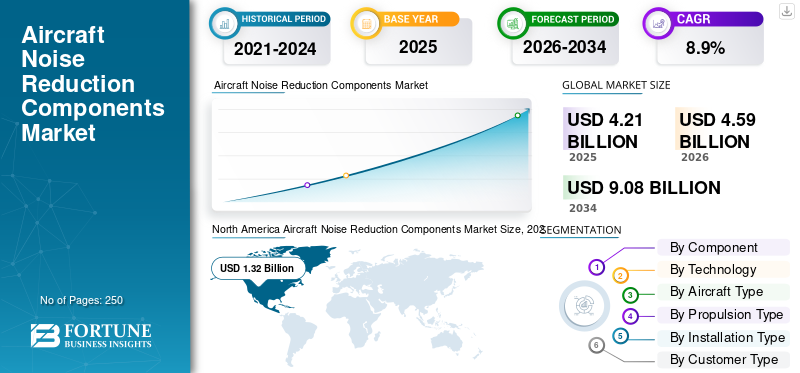
Download Free sample to learn more about this report.
Aircraft Noise Reduction Components Market Key Takeaways
 Global Market Size & Forecast
- 2025 Market Size: USD 4.21 billion
- 2026 Market Size: USD 4.59 billion
- 2034 Forecast Market Size: USD 9.08 billion
- CAGR: 8.9% from 2026–2034
 Market Share
- North America dominated the aircraft noise reduction components market with a 31.35% share in 2025.
- The active noise & vibration control hardware segment is projected to grow at the fastest CAGR of 14.0% during the forecast period.
- The smart/tunable acoustic technology segment is expected to register the fastest CAGR of 11.8% during the forecast period.
 Key Regional Highlights
North America
North America led the market with USD 1.32 billion in 2025 and is projected to reach USD 1.42 billion in 2026.
Europe
Europe is projected to grow at a CAGR of 8.6% during the 2026–2034 forecast period.
Asia Pacific
Asia Pacific is expected to witness the fastest regional growth, driven by fleet expansion, airport development, and rising demand for quieter aircraft.
U.S.
The market was valued at USD 1.16 billion in 2025.
Japan
The market was valued at USD 0.14 billion in 2025, accounting for approximately 3.2% of global revenue.
Read More

AIRCRAFT NOISE REDUCTION COMPONENTS MARKET TRENDS
Shift Toward Lightweight, Compact, and Integrated Acoustic Architectures is Emerging as a Defining Market Trend
The market is witnessing a clear transition toward lightweight, compact, aerodynamically efficient, and aircraft-integrated acoustic architectures as aircraft OEMs, engine manufacturers, nacelle suppliers, and MRO providers work to reduce aircraft noise without adding unnecessary weight, drag, or maintenance complexity. Aircraft platforms are increasingly being designed with nacelle acoustic liners, duct acoustic treatments, low-noise fan and guide-vane designs, cabin insulation systems, vibration damping layers, landing gear noise-reduction devices, flap-edge treatments, and active noise/vibration control hardware and aircraft noise suppression systems integrated earlier in the aircraft development cycle.
- For instance, in November 2024, Safran Nacelles presented its FAA CLEEN III LeAD project, which proposed adding acoustic surface treatment in the D-duct area while supporting de-icing functionality. The project highlighted the trade-off between shorter nacelles for fuel-burn reduction and the need for greater acoustic treatment area to improve noise performance.
This trend is expected to increase demand for nacelle and duct acoustic liners, lightweight composite acoustic panels, compact acoustic treatment surfaces, low-noise propulsion components, active vibration-control hardware, advanced cabin insulation, airframe noise-reduction devices, and smart/tunable acoustic materials. Due to the rise in demand for quieter aircraft with lower fuel burn and lower community noise impact, the market grows substantially during the forecast period.
MARKET DYNAMICS
MARKET DRIVERS
Download Free sample to learn more about this report.
Rising Aircraft Deliveries, Fleet Utilization, and Noise-at-Source Regulations is Propelling Market Growth
The market is being driven by the recovery and expansion of aircraft deliveries, growing aircraft utilization, stricter airport/community noise expectations, and continued regulatory emphasis on reducing noise at the source. Aircraft noise reduction is no longer limited to engine design; it now involves nacelle systems, acoustic liners, cabin insulation, landing gear treatments, high-lift device treatments, vibration isolation, APU/ECS aerospace acoustic solutions, and active noise-control systems. Rising fleet renewal is also strengthening demand as newer aircraft programs are designed with FAA aircraft noise standards.
- For instance, in January 2026, Airbus reported that it delivered 793 commercial aircraft in 2025 and ended the year with a record backlog of 8,754 aircraft, while Boeing reported 600 commercial aircraft deliveries in 2025. IATA also reported that total passenger demand rose 5.3% in 2025, with record full-year passenger load factor of 83.6%, supporting stronger aircraft utilization and aftermarket demand for acoustic and vibration-control components.
This driver is anticipated to increase demand for engine nacelle acoustic liners, anti-vibration, mounts, resonator components, fan and duct noise-reduction components, cabin acoustic insulation, vibration isolators, airframe noise-reduction devices, APU/ECS acoustic treatments, and replacement fiberglass acoustic materials across OEM and aftermarket channels.
MARKET RESTRAINTS
Weight, Cost, Certification, and Integration Trade-Offs to Limit Market Expansion
A key restraint for the aircraft noise reduction components market growth is the difficult balance between acoustic performance, aircraft weight, aerodynamic efficiency, cost, maintainability, and certification compliance. Noise-reduction components must reduce sound without creating unacceptable penalties in fuel burn, drag, thermal performance, structural weight, de-icing capability, or maintenance complexity. This is especially important in nacelles and engine ducts, where additional acoustic lining can improve noise absorption but may compete with requirements for shorter nacelles, lower drag, lower weight, and tighter engine-airframe integration.
For instance, the FAA’s CLEEN-related Safran Nacelles briefing highlighted two opposing design requirements: fuel-burn reduction favors shorter nacelles to reduce drag and weight, while higher noise-reduction requirements favor more acoustic treated surface and longer nacelles.
This restraint is likely to affect aircraft OEMs, engine OEMs, nacelle manufacturers, cabin interior suppliers, airlines, and MRO providers. While demand for quieter aircraft is increasing, suppliers must still prove that acoustic liners, vibration-control systems, damping layers, aerospace-grade soundproofing materials, and active noise-control hardware can meet performance, durability, weight, fire-safety, environmental, and certification requirements which in turn hampers market growth.
MARKET OPPORTUNITIES
Smart Acoustic Liners, Active Noise Control, and eVTOL Noise Reduction Presents Growth Opportunities for the Market
A major opportunity in the market lies in the development of smart acoustic liners, active noise and vibration control systems, compact low-frequency acoustic treatments, and eVTOL noise reduction technologies. Traditional passive acoustic liners and insulation materials will remain important, but next-generation aircraft architectures are creating demand for more adaptive and space-efficient solutions. Ultra-high-bypass-ratio engines are pushing nacelle designs toward compact acoustic treatments capable of reducing lower-frequency noise, while electric and hybrid-electric aircraft introduce new challenges around rotor/propulsor noise, tonal noise, cabin vibration, and urban community acceptance.
- For instance, the EU-backed SALUTE project focused on smart acoustic lining for ultra-high-bypass-ratio engine technologies, noting that future engine designs create significant challenges for acoustic treatment. Separately, NASA’s Advanced Air Mobility noise research is supporting the industry’s need to design quiet eVTOL aircraft and operations by developing validated aeroacoustic models.
This opportunity is expected to increase demand for smart/tunable acoustic liners, electroactive acoustic materials, active noise-control sensors and actuators, rotor and propulsor acoustic components, lightweight cabin acoustic barriers, advanced vibration isolation systems, and low-frequency nacelle acoustic treatments.
MARKET CHALLENGES
Integration of Advanced Acoustic Components with New Propulsion and Airframe Architectures to Challenge Market
A major challenge for the market is integrating advanced acoustic components into evolving propulsion and airframe architectures without compromising aircraft performance, maintainability, or certification timelines. New high-bypass and ultra-high-bypass engines generate different acoustic profiles, including lower-frequency noise, while shorter and slimmer nacelle designs reduce the available space for traditional acoustic liners.
At the same time, airframe noise from landing gear, flaps, slats, and rotor systems is becoming more important as engine noise is gradually reduced. This pushes suppliers to develop more specialized solutions, including compact nacelle liners, porous landing gear fairings, flap-edge treatments, active vibration-control systems, and eVTOL propulsor-noise solutions.
Segmentation Analysis
By Component
Compact Nacelle Integration and Fan-Noise Attenuation Requirements to Support Segment Dominance
Based on component, the market is divided into nacelle & duct acoustic liners, propulsion source noise-reduction components, airframe noise-reduction components, cabin acoustic insulation & barrier components, vibration, damping & isolation components, propeller & rotor acoustic components, APU & ECS acoustic components, and active noise & vibration control hardware.
The nacelle & duct acoustic liners segment is expected to hold a leading aircraft noise reduction components market share as aircraft OEMs, engine manufacturers, and nacelle suppliers continue to prioritize fan-noise reduction, lower community noise, and acoustic performance within increasingly compact nacelle architectures. Modern turbofan aircraft require acoustic treatment across inlet ducts, fan ducts, bypass ducts, thrust reverser areas, and nacelle inner barrel structures to reduce engine and fan noise without adding excessive weight or drag.
- For instance, in November 2024, Safran Nacelles presented its FAA CLEEN III LeAD project, which focused on adding acoustic surface treatment in the nacelle D-duct area while retaining de-icing functionality. The project highlighted the industry challenge of maintaining acoustic performance as nacelle designs become shorter and more compact.
Active noise & vibration control hardware segment is anticipated to rise with a fastest CAGR of 14.0% over the forecast period.
By Technology
Broad Use of Acoustic Liners, Insulation, and Sound-Absorbing Materials to Drive Segment Growth
By technology, the market is segmented into acoustic absorption technology, aerodynamic source noise-control technology, structural damping & vibration isolation technology, active noise & vibration control technology, and smart / tunable acoustic technology.
The acoustic absorption technology segment is expected to dominate the market as sound-absorbing materials remain the most widely deployed method for reducing aircraft noise across engines, nacelles, ducts, cabins, APUs, and airframe structures. Acoustic absorption technologies are used in nacelle liners, sound insulation blankets for cabin, overframe blankets, damping composites, carpet pads, sidewall insulation, and duct acoustic treatments. The segment benefits from its wide applicability across both OEM-installed components and aftermarket replacement cycles, making it one of the most commercially scalable technology groups in the market.
Smart / tunable acoustic technology segment is expected to register the fastest CAGR of 11.8% over the forecast period.
To know how our report can help streamline your business, Speak to Analyst
By Aircraft Type
Large Fleet Renewal and High Aircraft Utilization to Support Commercial Transport Aircraft Segment Dominance
On basis of aircraft type, the market is segmented into commercial transport aircraft, business & general aviation aircraft, military fixed-wing aircraft, helicopters / rotorcraft, and eVTOL / advanced air mobility aircraft.
The commercial transport aircraft segment is expected to hold a leading share in the market as narrow-body and wide-body aircraft account for the largest installed base of high-value noise-reduction components. Commercial aircraft require nacelle acoustic liners, fan duct liners, cabin insulation, APU/ECS acoustic treatments, vibration damping materials, and airframe noise-reduction components to meet regulatory requirements, improve passenger comfort, and reduce airport community noise. The segment is also supported by fleet renewal, higher aircraft utilization, and airline demand for quieter, fuel-efficient aircraft platforms.
- For instance, in January 2026, Airbus reported that it delivered 793 commercial aircraft in 2025 and ended the year with a record backlog of 8,754 aircraft, reflecting sustained demand for new-generation commercial aircraft platforms.
eVTOL / advanced air mobility aircraft segment is projected to grow fastest with a CAGR of 11.4% over the forecast period.
By Propulsion Type
High-Bypass Engine Adoption and Fan-Noise Control Requirements to Strengthen Turbofan Segment Dominance
By propulsion type, the market is segmented into turbofan, turboprop, turboshaft, piston engine, and electric / hybrid-electric propulsion.
The turbofan segment is expected to dominate the market as turbofan-powered aircraft account for the largest share of commercial jet, business jet, and military fixed-wing aircraft noise-reduction demand. Turbofan aircraft require extensive acoustic treatment around the fan, inlet, bypass duct, exhaust system, nacelle, and cabin structure. As high-bypass and geared turbofan architectures continue to evolve, acoustic component suppliers are under pressure to reduce fan and broadband noise while maintaining fuel efficiency, durability, and compact engine integration.
Electric / hybrid-electric propulsion segment is projected to be grow with fastest CAGR of 12.6% over the forecast period.
By Installation Type
High Strength-to-Weight Requirements to Support Line-Fit/OEM Segment Dominance
By installation type, the market is segmented into line-fit / OEM installation, retrofit installation, and replacement / maintenance.
The line-Fit / OEM Installation segment is expected to account for a major share of the market as aircraft noise-reduction components are increasingly integrated during aircraft, engine, nacelle, and cabin system design rather than added later as standalone upgrades. Line-fit installation is especially important for nacelle acoustic liners, propulsion source noise-reduction components, cabin insulation packages, airframe acoustic treatments, and vibration-control systems since these components must be validated with aircraft structure, thermal systems, engine architecture, de-icing systems, and certification requirements.
- For instance, Boeing’s 2025 Commercial Market Outlook forecasts 43,600 new commercial aircraft deliveries through 2044, with the global commercial fleet projected to approach 50,000 aircraft by 2044. This long-term production outlook supports sustained OEM integration of acoustic liners, insulation systems, vibration-control components, and aircraft propulsion noise-reduction technologies.
Retrofit installation segment is projected to register the fastest CAGR of 10.5% over the forecast period.
By Customer Type
New Aircraft Production and Integrated Acoustic Design Requirements Needs to Sustain Airlines & Commercial Aircraft Operators Segment Leadership
On the basis of customer type, the market is divided into aircraft OEMs, engine OEMs, nacelle & aerostructure manufacturers, airlines & commercial aircraft operators, business aviation operators, military & government operators, MRO providers, and AAM / eVTOL operators.
The airlines & commercial aircraft operators segment is expected to hold a leading customer share as airlines are the largest operational users of aircraft noise-reduction components across both new aircraft deliveries and aftermarket maintenance. Airlines require these components to support passenger comfort, regulatory compliance, cabin acoustic performance, airport noise limits, and aircraft reliability during high-utilization operations. Demand is further supported by replacement of acoustic insulation, liner repairs, cabin refurbishment programs, APU/ECS acoustic maintenance, and fleet modernization using quieter aircraft platforms.
- For instance, in November 2025, Emirates ordered 65 additional Boeing 777-9 aircraft powered by GE9X engines at the Dubai Airshow, increasing its 777X commitment and supporting long-term wide-body fleet expansion.
AAM / eVTOL operators segment is estimated to register the fastest growth with CAGR of 13.4% over the forecast period.
Aircraft Noise Reduction Components Market Regional Outlook
By geography, the market is segmented into North America, Europe, Asia Pacific, the Middle East & Africa, and Latin America.
North America
North America Aircraft Noise Reduction Components Market Size, 2025 (USD Billion)
To get more information on the regional analysis of this market, Download Free sample
North America dominated the market with a valuation of USD 1.32 billion in 2025, growing to USD 1.42 billion in 2026. The region is expected to remain the largest market, primarily driven by the U.S. aircraft manufacturing base, strong engine and nacelle supplier ecosystem, mature business aviation industry, defense aviation programs, and high aftermarket demand for acoustic insulation, vibration damping components, nacelle acoustic liners, and APU/ECS acoustic components. Demand is supported by production of new commercial aircraft, replacement of acoustic materials in the installed fleet, business jet cabin comfort upgrades, and regulatory pressure to reduce aircraft noise at source.
- For instance, in January 2026, Boeing reported 600 commercial aircraft deliveries in 2025, including 447 Boeing 737s and 88 Boeing 787s, along with continued deliveries across defense platforms such as AH-64, CH-47, F-15, F/A-18, KC-46, MH-139, and P-8 aircraft. This supports demand for nacelle liners, cabin acoustic systems, vibration isolation, and engine-related noise-reduction components across commercial and defense aviation platforms.
U.S. Aircraft Noise Reduction Components Market
Based on North America’s strong contribution and the U.S. dominance within the region, the U.S. market was valued at USD 1.16 billion in 2025. The U.S. is expected to remain the largest country-level market due to its concentration of commercial aircraft production, aircraft engine manufacturing, nacelle/aerostructure systems, cabin acoustic material suppliers, business aviation, defense aviation, and aftermarket MRO activity. Growth is supported by fleet modernization, business jet deliveries, higher aircraft utilization, acoustic insulation replacement, vibration-control upgrades, and continued development of lower-noise propulsion and nacelle technologies.
- For instance, in February 2026, GAMA reported that preliminary 2025 general aviation aircraft deliveries were valued at USD 35.7 billion, while business jet and piston airplane shipments increased compared with 2024.
Europe
Europe is projected to record a growth rate of 8.6% during 2026 to 2034. The region is expected to remain the second-largest market, supported by Airbus aircraft production, Safran Nacelles, Rolls-Royce, MTU Aero Engines, FACC, Leonardo, GKN Aerospace, Lufthansa Technik, and a dense aircraft systems and MRO supplier base. European demand is also strongly supported by nacelle acoustic liners, duct acoustic treatments, propulsion noise-reduction components, cabin insulation, airframe noise treatments, and vibration damping systems. The region also benefits from strict aircraft noise certification and airport noise-management requirements, as EASA certification noise levels are established in compliance with ICAO Annex 16, Volume I.
- For instance, in November 2024, Safran Nacelles presented its FAA CLEEN III LeAD project, focused on adding acoustic surface treatment in the nacelle D-duct area while maintaining de-icing functionality. The project directly addressed the industry trade-off between shorter nacelles for drag and weight reduction and the need for more acoustic treatment area to improve aircraft noise performance.
U.K. Aircraft Noise Reduction Components Market
The U.K. market was valued at USD 0.23 billion in 2025, representing roughly 5.5% of global revenues.
Germany Aircraft Noise Reduction Components Market
Germany’s market reached a valuation of USD 0.26 billion in 2025, equivalent to around 6.2% of global sales.
Asia Pacific
Asia Pacific is projected to witness the fastest growth in the market. The region’s growth is driven by rapid aircraft fleet expansion in China, India, Southeast Asia, Japan, South Korea, and Australia, along with rising airline capacity, MRO localization, airport infrastructure growth, and increasing demand for quieter next-generation aircraft. Demand is supported by commercial aircraft cabin insulation, nacelle acoustic liners, APU/ECS acoustic components, vibration-control parts, and replacement acoustic materials used across expanding airline fleet.
- For instance, in January 2026, Air India ordered 30 additional Boeing 737 MAX aircraft, including 20 737-8s and 10 737-10s, as part of its fleet expansion and modernization strategy. Such fleet additions support future demand for line-fit acoustic systems, nacelle and duct liners, cabin noise-reduction materials, and aftermarket replacement components across high-utilization commercial aircraft fleets.
Japan Aircraft Noise Reduction Components Market
The Japanese market was valued at USD 0.14 billion in 2025, accounting for roughly 3.2% of global revenues.
China Aircraft Noise Reduction Components Market
China’s market is projected to be one of the largest globally, with 2025 revenues valued at USD 0.44 billion representing roughly 10.3% of global sales.
India Aircraft Noise Reduction Components Market
The Indian market was valued at USD 0.19 billion in 2025, accounting for roughly 4.5% of global revenues.
Middle East & Africa
The region’s demand is primarily driven by large wide-body fleets in the UAE, Qatar, Saudi Arabia, and Turkey, premium cabin comfort expectations, long-haul airline operations, fleet renewal, and expanding MRO activity. Demand is strongest for wide-body cabin acoustic insulation, nacelle acoustic liners, APU/ECS acoustic system, vibration damping materials, and aftermarket replacement components.
- For instance, in November 2025, Emirates ordered 65 additional Boeing 777-9 aircraft powered by GE9X engines at the Dubai Airshow, raising its total 777X order to 270 aircraft. The order supports long-term wide-body fleet expansion in the Middle East and strengthens future demand for nacelle acoustic liners, cabin acoustic systems, vibration-control components, and wide-body aircraft noise-reduction materials.
UAE Aircraft Noise Reduction Components Market
UAE market was valued at USD 0.09 million in 2025, accounting for roughly 2.2% of global revenues.
Latin America
Regional demand is supported by Brazil’s aerospace manufacturing base, Embraer’s commercial, executive, and defense aircraft activity, Mexico’s aerospace supply chain and nearshoring momentum, airline fleet modernization, and MRO demand across Brazil, Mexico, Colombia, Chile, and other regional markets. The market is more aftermarket- and operator-driven than OEM-heavy, with stronger demand for cabin acoustic insulation, vibration damping, rotorcraft acoustic components, APU/ECS acoustic components, and replacement materials for in-service fleets.
Brazil America Aircraft Noise Reduction Components Market
Brazil market was valued at USD 0.09 billion in 2025, accounting for roughly 2.1% of global revenues.
COMPETITIVE LANDSCAPE
Key Industry Players
Acoustic Integration, Lightweight Materials, and Aviation Acoustic Engineering Drive Competitive Leadership
The global aircraft noise reduction components market is characterized by competition among nacelle system suppliers, engine OEMs, aerostructure manufacturers, cabin acoustic material providers, vibration-control specialists, MRO suppliers, and advanced acoustic technology developers. Competitive leadership is increasingly shaped by companies that can deliver certified, lightweight, durable, and aircraft-integrated noise-reduction solutions across commercial aircraft, business jets, military aircraft, rotorcraft, turboprops, and emerging eVTOL platforms. Suppliers are differentiated by their ability to provide nacelle and duct acoustic liners, propulsion source noise-reduction components, cabin acoustic insulation, vibration damping and isolation systems, APU/ECS acoustic treatments, rotor/propeller noise-control components, and active noise and vibration control hardware.
LIST OF KEY AIRCRAFT NOISE REDUCTION COMPONENT COMPANIES PROFILED IN REPORT
- Safran S.A. (France)
- RTX Corporation (U.S.)
- GE Aerospace (U.S.)
- Rolls-Royce Holdings plc (U.K.)
- FACC AG (Austria)
- Hexcel Corporation (U.S.)
- 3M Company (U.S.)
- Hutchinson S.A. (France)
- Parker-Hannifin Corporation / Parker LORD (U.S.)
- Triumph Group, Inc. (U.S.)
KEY INDUSTRY DEVELOPMENTS
- May 2026: Collins Aerospace signed a five-year agreement with Air New Zealand to maintain and repair nacelles for the airline’s wide-body and narrow-body aircraft, supporting aftermarket demand for nacelle structures, acoustic panels, thrust reverser systems, and related noise-reduction components.
- November 2024: Pratt & Whitney advanced its FAA CLEEN III fan-technology program covering additively manufactured acoustic liners, low-loss intra-stage liners, and low-count/low-noise guide vanes, with the company reporting finalized AM polymer/manufacturing processes, completed detailed design reviews, and hardware procurement for engine demonstration.
- November 2024: Safran Nacelles presented progress on its FAA CLEEN III LeAD acoustic inlet-lip project, designed to add acoustic treated surface in the nacelle D-duct area while retaining de-icing functionality. The project supports shorter nacelle architectures while maintaining or improving acoustic performance.
- November 2024: Honeywell presented its FAA CLEEN III quiet aircraft engine technologies, including an advanced quiet fan and stator, novel acoustic wall treatments in fan inlet and bypass duct liners, quiet high-pressure compressor bleed extraction, and acoustic treatment in the low-pressure turbine flow path and exhaust centerbody.
- May 2024: GE Aerospace presented its CLEEN III Advanced Acoustics work, targeting novel acoustic liners and fan source-strength reduction concepts, with anticipated benefits including a 2 EPNdB cumulative noise reduction from novel liners and a 1 EPNdB cumulative reduction from fan source-strength reduction concepts.
REPORT COVERAGE
The global aircraft noise reduction components market analysis provides an in-depth study of market size & forecast by all the segmentation included in the report. It includes details on the market dynamics, and market trends, and regional analysis expected to drive the market during the forecast period. The market report includes Porter’s five forces analysis which illustrates the potency of buyers and suppliers in the market. The market forecast offers information on the technological advancements, new product launches, key trends, major industry developments, and details on partnerships, mergers & acquisitions. The market analysis also encompasses detailed competitive landscape with information on the market share and profiles of key players.
Request for Customization to gain extensive market insights.
Report Scope & Segmentation
| ATTRIBUTE | DETAILS |
| Study Period | 2021-2034 |
| Base Year | 2025 |
| Estimated Year | 2026 |
| Forecast Period | 2026-2034 |
| Historical Period | 2021-2024 |
| Growth Rate | CAGR of 8.9% from 2026-2034 |
| Unit | Value (USD Billion) |
| Segmentation | By Component, By Technology, By Aircraft Type, By Propulsion Type, By Installation Type, By Customer Type, and By Region |
| By Component |
|
| By Technology |
|
| By Aircraft Type |
|
| By Propulsion Type |
|
| By Installation Type |
|
| By Customer Type |
|
| By Region |
|
Frequently Asked Questions
According to Fortune Business Insights, the global market value stood at USD 4.21 billion in 2025 and is projected to reach USD 9.08 billion by 2034.
In 2025, the North America’s market value stood at USD 1.32 billion.
The market is expected to exhibit a CAGR of 8.9% during the forecast period of 2026-2034.
By component, the nacelle & duct acoustic liners segment is expected to lead the market.
Rising aircraft deliveries, fleet utilization, and noise-at-source regulations is driving market expansion.
Safran S.A., RTX Corporation, GE Aerospace, and Rolls-Royce Holdings plc are the top players in the market.
North America held the largest market share in 2025.



- 2021-2034
- 2025
- 2021-2024
- 250
Get 30-60 hrs Free Customization
Expand Regional and Country Coverage, Segments Analysis, Company Profiles, Competitive Benchmarking, and End-user Insights.




















Related Reports
-
US +1 833 909 2966 ( Toll Free )
-
Get In Touch With Us