Blockchain in Healthcare Market Size, Share & Industry Analysis By Component (Software and Services), By Solution Type (Blockchain Platforms, Smart Contract Solutions, Interoperability Solutions, Identity & Consent Solutions, and Others), By Deployment (Cloud-Based, On-Premise, and Hybrid), By Application (Data Exchange, Claims & Billing, Drug Traceability, Identity & Consent, and Others), By Network Type (Private and Public), By End User (Healthcare Providers, Pharmaceutical & Biotechnology Companies, Healthcare Payers, Medical Device Companies, and Others), and Regional Forecast, 2026-2034
 Download Free Sample
Blockchain in Healthcare Market Size and Future Outlook
 Listen to Audio Version
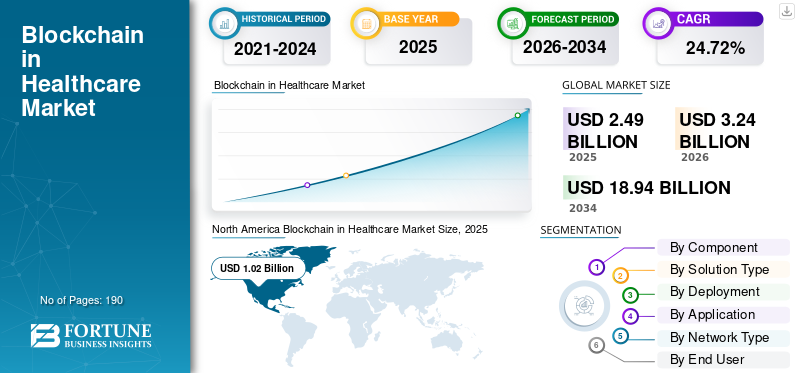
The global blockchain in healthcare market size was valued at USD 2.49 billion in 2025 and is projected to grow from USD 3.24 billion in 2026 to USD 18.94 billion by 2034, exhibiting a CAGR of 24.72% during the forecast period. North America dominated the blockchain in healthcare market with a market share of 40.96% in 2025.
The global market comprises blockchain-based platforms and networks that enhance the security, traceability, transparency, and interoperability of healthcare data and transactions. The market is gaining momentum as healthcare systems overcome challenges such as fragmented medical records, slow claims processing, weak data trust, and complex multi-party coordination. As providers, payers, and health technology companies demand more secure and auditable ways to exchange information, blockchain is being adopted to support functions such as medical record integrity, claims workflows, identity management, and decentralized healthcare administration. Key companies are engaging in strategic collaborations to strengthen their positions.
- For instance, in September 2025, Health In Tech partnered with AlphaTON Capital Corp. for the joint development of a healthcare insurance claims processing platform called The new platform is blockchain-enabled and has been built on The Open Network (TON). This supports market growth as companies are using blockchain to improve payment speed, transparency, and trust across healthcare administration.
Furthermore, major players, such as IBM, Oracle Corporation, Guardtime, and BurstIQ, are focusing on technological advancements.
Download Free sample to learn more about this report.
Blockchain in Healthcare Market KEY TAKEAWAYS
 Market Size & Forecast
- 2025 Market Size: USD 2.49 billion
- 2026 Market Size: USD 3.24 billion
- 2034 Forecast Market Size: USD 18.94 billion
- CAGR: 24.72% from 2026–2034
 Market Share
- North America dominated the blockchain in healthcare market with a 40.96% share in 2025.
- The blockchain platforms segment accounted for the largest market share in 2025.
- The data exchange segment held the leading market share in 2025.
 Key Regional Highlights
North America
North America remained the leading regional market, reaching a valuation of USD 1.02 billion in 2025.
Europe
Europe is projected to reach USD 0.93 billion in 2026, supported by a strong CAGR of 23.99% during the forecast period.
Asia Pacific
Asia Pacific is estimated to attain a market value of USD 0.71 billion in 2026, making it the third-largest regional market.
U.S.
U.S. The market is projected to reach USD 1.20 billion in 2026, driven by increasing adoption of secure healthcare data management solutions.
Japan
Japan The market is estimated to reach USD 0.13 billion in 2026, supported by growing digital healthcare initiatives and blockchain integration.
Read More

BLOCKCHAIN IN HEALTHCARE MARKET TRENDS
Increasing Use of Blockchain in Drug Supply Chain Traceability is an Emerging Trend
The soaring use of blockchain in drug supply chain traceability is a key trend in the global market. Healthcare and pharmaceutical supply chains face problems such as counterfeit drug risk, limited product visibility, weak data coordination across trading partners, and rising compliance pressure. As a result, blockchain-based traceability solutions are being adopted to create secure, verifiable records of product movement, improve chain-of-custody tracking, and strengthen trust among manufacturers, distributors, pharmacies, and healthcare providers. Due to these factors, companies increasingly view blockchain as a practical tool for improving transparency, patient safety, and regulatory readiness in medicine distribution.
- For instance, in January 2026, p-Chip Corporation, Choice One Rx, and RxERP announced a trial to demonstrate end-to-end digital traceability of drug supply chains and chain-of-identity for DSCSA compliance, co-sponsored by Avantor. As such initiatives expand, they are expected to strengthen the adoption of blockchain-enabled traceability platforms in healthcare and support wider global market growth.
MARKET DYNAMICS
MARKET DRIVERS
Download Free sample to learn more about this report.
Soaring Need for Secure and Tamper-Proof Healthcare Data Management to Drive Market Growth
The rising need for secure, tamper-proof healthcare data management is a major driver of the global blockchain in healthcare market growth. Healthcare organizations handle large volumes of sensitive patient, clinical, claims, and operational data, and any data breach, record manipulation, or unauthorized access can result in financial losses, compliance risks, and loss of trust. Thus, healthcare stakeholders are increasingly seeking technologies that can create immutable records, enhance auditability, and build confidence in data sharing across multiple parties. These factors are driving the adoption of blockchain-based platforms.
- For instance, in May 2025, SurgiBox Inc. secured a U.S. patent for a blockchain-based data management system designed to improve the security and accessibility of medical procedure data for AI applications. As more healthcare companies invest in secure data infrastructure, the demand for blockchain in healthcare is expected to increase further.
MARKET RESTRAINTS
High Implementation Cost and Uncertain Return on Investment to Restrain Market Growth
High implementation costs and uncertain returns on investment remain significant restraints on the global market for blockchain in healthcare. Blockchain deployment in healthcare often requires spending on platform development, system integration, cybersecurity, compliance management, and partner onboarding across a multi-stakeholder ecosystem. As many healthcare organizations already operate under tight budgets and depend on legacy IT systems, they tend to delay investments when the financial benefits are not immediate or clearly measurable. As a result, even when blockchain offers long-term value in data integrity, traceability, and trust, the upfront cost burden and difficulty in proving short-term commercial impact can slow decision-making and limit market expansion.
- For instance, in April 2025, Healthcare IT News published findings from the Health IT Industry Outlook Report, which stated that hospital IT buyers were under strong pressure to justify technology spending with clear ROI, while organizations remained highly selective about digital investments due to resource strain and financial pressure. These instances indicate that cost sensitivity and an unclear implementation payoff continue to slow broader commercialization.
MARKET OPPORTUNITIES
Increasing Use of Blockchain in Claims Processing and Payment Automation to Create Strong Growth Opportunities
The global blockchain in healthcare market is seeing a strong growth opportunity in claims processing and payment automation. Healthcare claims workflows still involve fragmented data, repeated verification steps, delayed reimbursements, and frequent administrative errors, which increase the cost for both payers and providers. As a result, healthcare organizations are seeking technologies that can improve real-time data exchange, reduce manual intervention, and create more transparent transaction records.
Blockchain-based, decentralized network models are creating opportunities by enabling faster validation, more accurate coverage, lower denial risk, and smoother payment coordination among healthcare stakeholders. As adoption expands in revenue cycle and payer-provider workflows, this is expected to open new commercial opportunities for blockchain platforms in healthcare administration.
- For instance, in May 2024, Avaneer Health launched Avaneer Coverage Direct, a solution on its decentralized network that provides accurate, near-real-time insurance coverage information for payers and providers. As more healthcare organizations adopt such decentralized, blockchain-aligned workflow models, the market is likely to gain new opportunities in payment automation and claims-related process improvement.
MARKET CHALLENGES
Limited Standardization across Healthcare Ecosystems to Challenge Market Expansion
The market faces a key challenge of limited standardization across healthcare ecosystems. Healthcare data flows across multiple stakeholders, including hospitals, payers, pharmacies, technology vendors, and regulators, but these participants often use different systems, formats, and interoperability frameworks. Due to this, blockchain solutions cannot scale smoothly unless there is broader alignment on data standards, governance rules, and integration methods. This creates delays in implementation, increases integration complexity, and slows the pace at which blockchain platforms can move from the pilot stage to wider commercial adoption. As a result, the lack of ecosystem-wide standardization continues to challenge market growth, even as the demand for trusted data exchange rises.
- For instance, in July 2025, Oracle Corporation announced support for the CMS Digital Health Ecosystem and Interoperability Framework. The development highlights the current challenges in the market as major healthcare technology players still need to align on common standards and data-sharing frameworks before interoperability becomes seamless at scale. That means blockchain adoption in healthcare remains dependent on broader ecosystem coordination and standard-setting.
Segmentation Analysis
By Component
Software Segment Led the Market with Rising Software Adoption for Various Applications
Based on component, the market is categorized into software and services.
Among these, the software segment dominated the market in 2025 as blockchain adoption in healthcare is primarily driven by platforms, data management layers, interoperability engines, smart contract logic, and security architecture rather than by stand-alone consulting services. Healthcare organizations first need working software that can secure records, enable trusted transactions, connect ecosystem participants, and integrate with existing digital systems. Due to this, software captures the core functional value of blockchain deployment, while services usually play a supporting role in implementation, customization, and maintenance. As more healthcare buyers prioritize scalable, reusable, and workflow-oriented blockchain tools, software continues to account for the largest share of the market.
- For instance, in May 2025, SurgiBox Inc. secured a U.S. patent for a blockchain-based data management system designed to improve the security and accessibility of medical procedure data for AI healthcare applications. The development reflected the market's growing value for blockchain-based healthcare software, especially as secure data handling and digital workflow enablement become central to adoption.
The services segment is expected to grow at a CAGR of 26.25% over the forecast period.
To know how our report can help streamline your business, Speak to Analyst
By Solution Type
Increasing Preference for Blockchain Platforms to Support the Dominance of the Segment
Based on solution type, the market is segmented into blockchain platforms, smart contract solutions, interoperability solutions, identity & consent solutions, supply chain traceability solutions, privacy & security solutions, and others.
In 2025, the blockchain platforms segment dominated the market as healthcare organizations preferred a broader foundation that supported multiple use cases on a single infrastructure layer. A platform approach gives users better scalability, easier ecosystem onboarding, and stronger long-term value than isolated point solutions. Due to this, buyers often prioritize core blockchain platforms first, then build smart contracts, interoperability, or traceability applications on top of them. As healthcare adoption matures, the demand continues to center on platform-based models that support multiple stakeholders and workflows within a single connected environment.
- For instance, in October 2025, PranaChain, a decentralized blockchain-powered healthcare platform that allows for secure, consent driven and transparent exchange of medical data was launched in India.
The smart contract solutions segment is projected to grow at a CAGR of 25.87% during the forecast period.
By Deployment
Flexibility Offered by Cloud-Based Deployment to Boost Segmental Growth
Based on deployment, the market is segmented into cloud-based, on-premise, and hybrid.
In 2025, the cloud-based segment dominated the global blockchain in healthcare market share as healthcare blockchain projects often require faster implementation, easier updates, lower upfront infrastructure burden, and smoother multi-party connectivity across dispersed stakeholders. Driven by this, cloud-based deployment is more practical for healthcare buyers seeking flexibility, recurring innovation, and lower operational complexity. As more blockchain solutions are positioned as digital platforms and network-based services, cloud-based models continue to take the lead.
- For instance, in November 2021, FFF Enterprises Inc. (FFF) collaborated with Chronicled for MediLedger Network, a cloud-based platform. Through MediLedger, FFF intends to eliminate chargeback errors and enhance pricing accuracy among FFF's pharmaceutical supplier and group purchasing organization (GPO) trading partners, while streamlining its dispenser customers’ procurement process.
The hybrid segment is projected to grow at a CAGR of 27.07% during the forecast period.
By Application
Significance in Addressing Critical Applications to Boost Data Exchange Segmental Growth
Based on application, the market is segmented into data exchange, claims & billing, drug traceability, identity & consent, clinical trials, credentialing, and others.
In 2025, the data exchange segment accounted for the largest market share as it assists in addressing one of the critical problems in healthcare. The clinical, administrative, and operational information remains fragmented across systems and stakeholders. Blockchain gains relevance when organizations need a trusted way to exchange information without losing integrity, control, or auditability. Due to this, data exchange is a more immediate and broadly applicable use case than several narrower applications, as it supports providers, payers, life sciences companies, and public health systems simultaneously. As healthcare organizations continue to focus on interoperability, coordinated care, and faster information sharing, the demand for blockchain remains the strongest in data -exchange-oriented applications.
- For instance, in March 2026, b.well Connected Health and Perplexity announced a partnership to enable consumers to securely connect their complete health records to an AI-powered search via b.well’s health data network. This supports the dominance of data exchange in the blockchain healthcare market, as secure, connected record sharing remains one of the most commercially relevant use cases.
The claims & billing segment is projected to grow at a CAGR of 25.57% during the forecast period.
By Network Type
Private Segment Dominated the Market Owing to Sensitive Nature of Healthcare Data
Based on network type, the market is segmented into private and public.
In 2025, the private segment dominated the market as healthcare data is highly sensitive and governed by strict privacy, compliance, and access-control requirements. Public blockchain models may offer transparency. However, healthcare organizations usually need permissioned participation, controlled data visibility, and stronger governance over who can validate or access information. Driven by this, private blockchain networks are better aligned with enterprise healthcare needs such as patient record security, payer-provider transactions, and regulated data exchange. As the adoption of private networks expands in real-world healthcare environments, they remain the preferred model as they offer a better fit for compliance and lower operational risk.
- For instance, in March 2025, Hashgraph unveiled HashSphere, a private blockchain built with Hedera technology for regulated enterprises. The development reinforces the dominance of private networks by showing that solution providers are continuing to build blockchain infrastructure focused on security, compliance, and controlled participation requirements, which are highly relevant in healthcare.
The public segment is projected to grow at a CAGR of 29.36% during the forecast period.
By End User
Large Volume of Patient Data Generated by Healthcare Providers to Support Segmental Dominance
Based on end user, the market is segmented into healthcare providers, pharmaceutical & biotechnology companies, healthcare payers, medical device companies, CROs & research institutes, government & public health agencies, and others.
By end user, the healthcare providers segment accounted for the largest share of the market in 2025. Hospitals, clinics, and care delivery networks generate and use large volumes of patient, treatment, diagnostic, billing, and coordination data every day. This makes providers among the first end-user groups to feel the impact of fragmented records, administrative inefficiency, and a lack of trusted interoperability. Due to this, providers have a stronger immediate need for blockchain-enabled tools that can improve secure data sharing, workflow coordination, and transaction transparency. As provider organizations continue to invest in digital infrastructure that supports better care delivery and smoother collaboration with payers and other stakeholders, they are likely to account for the largest share of the market.
- For instance, in March 2023, Avaneer Health announced the launch of its decentralized network and platform designed to connect payers, providers, and innovators to simplify healthcare administration. The development shows that providers are central participants in blockchain-based healthcare networks, especially where real-time data sharing and administrative coordination are key use cases.
The CROs & research institutes segment is projected to grow at a CAGR of 25.68% over the forecast period.
Blockchain in Healthcare Market Regional Outlook
By geography, the market is categorized into Europe, North America, Asia Pacific, Latin America, and the Middle East & Africa.
North America
North America Blockchain in Healthcare Market Size, 2025 (USD Billion)
To get more information on the regional analysis of this market, Download Free sample
North America held the dominant share in 2024 with a value of USD 0.80 billion and maintained its leading position in 2025 with a value of USD 1.02 billion. The regional market is growing as it has a strong digital health infrastructure, high healthcare IT spending, and a rising focus on secure data exchange. At the same time, healthcare providers, payers, and life sciences companies are exploring blockchain to reduce fraud, improve interoperability, and strengthen administrative efficiency.
U.S. Blockchain in Healthcare Market
Given North America's substantial contribution and the U.S. dominance in the region, the U.S. market is estimated to touch around USD 1.20 billion in 2026, accounting for roughly 37.2% of the global market.
Europe
Europe is projected to grow at a CAGR of 23.99% over the forecast period and reach a valuation of USD 0.93 billion in 2026. The market is growing due to the increasing emphasis on data privacy, healthcare interoperability, and cross-border health information exchange. As healthcare systems modernize under stricter compliance frameworks, blockchain is gaining attention as a tool for secure and transparent data management.
U.K. Blockchain in Healthcare Market
The U.K. market is estimated to reach around USD 0.16 billion in 2026, representing roughly 5.0% of the global market.
Germany Blockchain in Healthcare Market
The Germany market is projected to reach approximately USD 0.19 billion in 2026, equivalent to around 5.9% of the global market.
Asia Pacific
Asia Pacific is estimated to reach USD 0.71 billion in 2026 and secure the position of the third-largest region in the market. The regional market is expanding as many countries rapidly digitize their healthcare systems and invest in health technology transformation. Growing patient volumes, fragmented records, and rising demand for efficient data sharing are creating a stronger need for blockchain-based solutions.
Japan Blockchain in Healthcare Market
The Japan market is estimated to touch around USD 0.13 billion in 2026, accounting for approximately 4.15% of the global market.
China Blockchain in Healthcare Market
The China market is projected to be one of the largest worldwide, with 2026 revenues estimated to reach around USD 0.23 billion, representing approximately 7.17% of global sales.
India Blockchain in Healthcare Market
The India market is estimated to reach around USD 0.07 billion in 2026, accounting for roughly 2.17% of global revenue.
Latin America and the Middle East & Africa
Latin America and the Middle East & Africa regions are expected to witness moderate growth in this market during the forecast period. The market in Latin America is estimated to reach a valuation of USD 0.16 billion in 2026. The market is growing as healthcare systems in the region focus on improving transparency, reducing inefficiencies, and strengthening digital health capabilities. Blockchain is gaining traction as it can help support better record management, claims coordination, and supply chain management. In the Middle East & Africa, the GCC market is set to reach USD 0.05 billion in 2026.
South Africa Blockchain in Healthcare Market
The South Africa market is projected to reach approximately USD 0.02 billion by 2026, accounting for roughly 0.49% of the global revenues.
COMPETITIVE LANDSCAPE
Key Industry Players
Key Players’ Emphasis on Payment Workflow Modernization to Propel Market Progress
The global blockchain in healthcare market is moderately fragmented. Companies such as International Business Machines Corporation, Oracle Corporation, Guardtime, Patientory Inc., BurstIQ, Chronicled, Inc., Solve.Care, and Avaneer Health account for a notable share of market activity. These companies hold strong positions due to their early focus on secure health data exchange, modernization of claims and payment workflows, pharmaceutical supply chain traceability, and privacy-led network infrastructure across healthcare ecosystems. Their market presence is further supported by enterprise technology capabilities, healthcare-specific platform development, and growing collaborations with providers, payers, life sciences companies, and digital health stakeholders. Ongoing platform launches, interoperability-focused partnerships, and workflow-oriented product expansion are further helping these companies strengthen their market positions.
- For instance, in August 2025, Patientory Inc. announced that its AI-Enterprise Analytics Dashboard became available on the Oracle Healthcare Marketplace. The development expanded Patientory’s ability to support proactive care, clinical trial recruitment, and enterprise decision-making through integration with Oracle Health technologies. It also reflects how market participants are strengthening their competitive position through healthcare-focused product integration and broader commercial accessibility.
Other notable participants in the global market include Hashed Health, Medicalchain, Embleema, and Microsoft Corporation. These companies are expected to focus on network expansion, healthcare data-integrity solutions, research-oriented blockchain applications, and strategic collaborations to improve their competitive standing as healthcare organizations continue to invest in secure, transparent digital infrastructure.
LIST OF KEY BLOCKCHAIN IN HEALTHCARE COMPANIES PROFILED
- IBM (U.S.)
- Oracle Corporation (U.S.)
- Guardtime (Estonia)
- BurstIQ (U.S.)
- Avaneer Health (U.S.)
- ai (U.S.)
- Patientory Inc. (U.S.)
- Care (Estonia)
- Embleema (U.S.)
- Medicalchain (U.K.)
KEY INDUSTRY DEVELOPMENTS
- April 2026: Wellgistics Health, Inc. and Kare PharmTech formed a joint venture combining Wellgistics Hub and KareRx Hub technology and operations. The combined platform is aimed at expanding access to, fulfillment of, and commercialization of pharmaceuticals across provider and patient networks.
- March 2026: well Connected Health and Perplexity announced a partnership that lets consumers securely connect their complete health records to an AI-powered search through b.well’s national health data network.
- February 2026: Wellgistics Health, Inc. selected its top five blockchain platforms to initiate its patent-protected PharmacyChain smart contracts-enabled pharmaceutical drug tracking system. The program is designed to support healthcare industry-wide serialization mandates and improve traceability across the prescription-drug workflow.
- January 2026: Wellgistics Health, Inc. and DataVault AI, Inc. expanded their strategic licensing partnership to add quantum key encryption to the PharmacyChain™ platform. The partnership brings blockchain-enabled tokenization and smart contract capabilities to pharmacy processes, transactions, and supply chain assets.
- September 2025: Apierion and Triangle Digital launched a global blockchain initiative to monetize health data and enable carbon-offset markets. As stated by Apierion, its distributed-ledger architecture supports smart contracts, secure medical solutions, HIPAA-compliant data exchange, and collaboration with hospital networks, payers, pharmacies, and government entities.
- August 2025: EVERSANA and Waltz Health announced a merger to form a unified healthcare platform focused on pharmaceutical commercialization and prescription drug access.
REPORT COVERAGE
The report provides a comprehensive global blockchain in healthcare market analysis. It covers a detailed market assessment across component, solution type, deployment, application, network type, and end user. It examines the demand for blockchain-enabled platforms and solutions used in secure data exchange, claims and billing, drug traceability, identity and consent management, clinical trials, and credentialing, while also evaluating the role of private and public network models across healthcare workflows. The study further provides regional insights across key geographies, competitive landscape analysis, company profiling, recent developments, and evaluation of the major factors driving, restraining, and shaping future opportunities in the market.
Request for Customization to gain extensive market insights.
Report Scope & Segmentation
| ATTRIBUTE | DETAILS |
| Study Period | 2021-2034 |
| Base Year | 2025 |
| Estimated Year | 2026 |
| Forecast Period | 2026-2034 |
| Historical Period | 2021-2024 |
| Growth Rate | CAGR of 24.72% from 2026 to 2034 |
| Unit | Value (USD Billion) |
| Segmentation | By Component, Solution Type, Deployment, Application, Network Type, End User, and Region |
| By Component |
|
| By Solution Type |
|
| By Deployment |
|
| By Application |
|
| By Network Type |
|
| By End User |
|
| By Region |
|
Frequently Asked Questions
According to Fortune Business Insights, the global market value stood at USD 2.49 billion in 2025 and is projected to reach USD 18.94 billion by 2034.
In 2025, the market value stood at USD 1.02 billion.
The market is expected to grow at a CAGR of 24.72% over the forecast period of 2026-2034.
Based on component, the software segment dominated the market in 2025.
The growing need for secure, tamper-proof healthcare data management is a key factor driving the market.
IBM, Oracle Corporation, Inc., Guardtime, Inc, BurstIQ, and Avaneer Health are the major players in the global market.
North America dominated the market in 2025.



- 2021-2034
- 2025
- 2021-2024
- 190
Get 30-60 hrs Free Customization
Expand Regional and Country Coverage, Segments Analysis, Company Profiles, Competitive Benchmarking, and End-user Insights.













.webp)






Related Reports
-
US +1 833 909 2966 ( Toll Free )
-
Get In Touch With Us