Canine Vaccines Market Size, Share & Industry Analysis, By Technology (Inactivated, Live Attenuated, Recombinant, and Others), By Disease Type (Canine Influenza, Lyme Disease, Rabies, Leptospirosis, and Others), By Route of Administration (Oral, Parenteral, and Intranasal), By Distribution Channel (Veterinary Hospitals, Veterinary Clinics, Pharmacies & Drug Stores, and Others), and Regional Forecast, 2026-2034
 Download Free Sample
KEY MARKET INSIGHTS
 Listen to Audio Version
The global canine vaccines market size was valued at USD 1.95 billion in 2025 and is projected to grow from USD 2.05 billion in 2026 to USD 3.64 billion by 2034, exhibiting a CAGR of 7.42% during the forecast period. North America dominated the canine vaccines market with a market share of 44.85% in 2025.
The canine vaccines market is expected to witness a significant growth trajectory during the forecast period. The increasing number of dog owners, rising disposable income, and humanization of pets are few factors propelling the product demand for adequate vaccination and prevention of canine diseases and outbreaks of zoonotic diseases.
Moreover, increasing government initiatives and focus on canine disease prevention to maintain the health of dogs, as well as public from zoonotic diseases. In contrast, increasing research and development activities are being conducted to launch novel vaccines for canines, thus bolstering the market growth during the forecast period.
- For instance, in March 2024, Researchers from Yale School of Medicine developed a cancer vaccine targeting EGFR/HER2 proteins common in canine tumors.
Furthermore, the global market has grown robust, with predictions indicating a continued growth trajectory. Few key players operating in the market, including Zoetis Services LLC, Merck & Co. Inc., and Elanco, offer robust solutions for canine vaccination in the market.
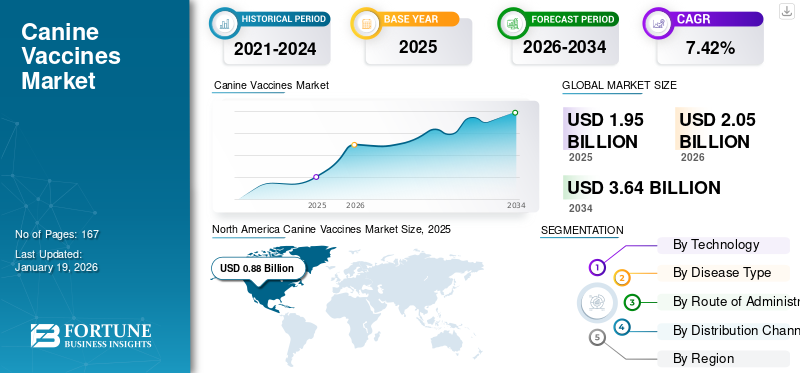
Download Free sample to learn more about this report.
Canine Vaccines Market Key Takeaways
 Global Market Size & Forecast
- 2025 Market Size: USD 1.95 billion
- 2026 Market Size: USD 2.05 billion
- 2034 Forecast Market Size: USD 3.64 billion
- CAGR: 7.42% from 2026–2034
 Market Share
- North America dominated the canine vaccines market with a 44.85% share in 2025.
- The inactivated vaccines segment held the leading market share by technology.
- The canine influenza segment dominated the market by disease type.
 Key Regional Highlights
North America
North America generated USD 0.88 billion in 2025, accounting for 44.85% of the global market.
Europe
Europe reached USD 0.48 billion in 2025, representing 24.39% of the global market.
Asia Pacific
Asia Pacific accounted for USD 0.30 billion in 2025, capturing 15.55% of the global market.
U.S.
The U.S. dominated the North American market, supported by strong veterinary infrastructure and leading vaccine manufacturers.
Japan
Japan is expected to witness steady market growth, supported by rising pet healthcare awareness and vaccination adoption.
Read More

MARKET DYNAMICS
MARKET DRIVERS
Increasing Pet Ownership to Drive the Market Growth
Rising pet ownership worldwide and increasing willingness of pet owners to invest in advanced healthcare, including regular vaccinations and preventive care for their pets, tends to drive the market growth. Additionally, increasing focus of owners toward vaccinating their dogs to prevent diseases in their pets, such as kennel cough, Lyme, and canine influenza, also contributes to the market growth.
- For instance, in September 2022, according to the Global Animal Health Association, around 85.0 million pet dogs are present in U.S. households. The large number of dogs as pets is expected to propel the vaccine adoption and the global canine vaccines market growth.
MARKET RESTRAINTS
Vaccine Hesitancy amongst Pet Owners to Hamper Market Growth
Vaccine hesitancy among dog owners is evolving as a significant restraint to the growth of the canine vaccines market. The concerns about vaccine safety, potential side effects, and the necessity of regular vaccinations for their pets are leading to unwillingness among the owners and thus lower vaccination rates. Such reluctance increases the risk of preventable diseases in dogs, hampers market growth, and poses challenges for veterinary vaccine manufacturers.
- For instance, in January 2025, as per the GAVI, the vaccine alliance, about 4.0% of dogs and 12.0% of cats remain unvaccinated against rabies, which poses risks for society.
MARKET OPPORTUNITIES
Development and Approval of Novel Combination Vaccines Cater to Market Growth
The rising prevalence of canine diseases and increasing spread of zoonotic diseases have shifted the focus of key players to develop novel vaccines for dogs. The development of combination vaccines may offer broad-spectrum protection against several diseases and decrease outbreaks associated with them.
Furthermore, market players are focusing on the development of vaccines with increasing focus on comprehensive pet health management. This is leading toward the growth of the canine vaccines market during the forecast period.
- For instance, in July 2025, Elanco received approval from the U.S. Department of Agriculture (USDA) for TruCan Ultra CIV H3N2/H3N8, a canine influenza vaccine. This vaccine is a convenient combination vaccine, which is developed using PureFil Technology to offer comprehensive protection against respiratory diseases, minimize adverse reactions, and enhance the overall experience.
MARKET CHALLENGES
Decline in Veterinary Visits and Lack of Skilled Professionals To Challenge Market Growth
One significant challenge in the canine vaccines market is decline in the veterinary visits by pet owners. This is due to rising cost of veterinary services and delay in visits to veterinarian due to scarcity of skilled professionals.
- For instance, as per the American Veterinary Medical Association, from August 2021 to 2023, the number of client visits fell by 2.7%. Also, as per the Global Animal Health Association, there is a need for around 41,000 veterinarians by 2030 to meet pet care needs, and 15,000 practitioners are short of this number. Such scenarios hamper the product adoption and challenge the market growth.
CANINE VACCINES MARKET TRENDS
Development of Easy Delivery Modes is a Key Industry Trend
The development of easy-to-administer delivery modes, such as intranasal vaccines, is a significant emerging trend in the canine vaccine industry. The increasing demand for convenient, non-invasive, and efficient delivery methods to reduce the stress on pets is boosting the development and launch of intranasal vaccines. Intranasal vaccines facilitate quick immune responses and can be administered without the need for specialized medical personnel or equipment.
- For instance, in March 2025, Zoetis Services LLC launched the Vanguard B Intranasal vaccine. This vaccine is available in a 0.5 mL dose for protection against Bordetella bronchiseptica, also known as kennel cough. Such development reflects a broader shift toward user-friendly, efficient, and effective vaccination solutions in the pet care industry.
Download Free sample to learn more about this report.
SEGMENTATION ANALYSIS
By Technology
Ongoing Product Launches of New Inactivated Vaccines to lead to Segment Dominance
On the basis of technology, the global market is segmented into live attenuated, inactivated, recombinant, and other segments.
The inactivated vaccines segment is expected to hold a dominant global canine vaccines market share during the forecast period. The strong safety profiles and acceptance by practitioners are few factors increasing the adoption of inactivated vaccines. Additionally, the presence of key players in the market with recent product launches for various canine diseases bolsters the segment’s growth.
- For instance, in November 2024, Boehringer Ingelheim International GmbH launched Eurican L4, an inactivated vaccine for dogs to protect against leptospirosis.
The live attenuated segment is expected to grow significantly during the forecast timeframe. The ongoing adoption of live attenuated vaccines drives the growth of the segment, It also mimics natural infection, and offers long-lasting protection with fewer booster doses. Moreover, major players are offering combination live attenuated products thus driving the segment’s growth.
- For example, Merck Co. & Inc. offers NOBIVAC CANINE 1-DAPPv, which is a live attenuated vaccine combination vaccine approved for protection against canine distemper virus, adenovirus type 1 and 2, canine parainfluenza virus, and canine parvovirus.
The recombinant vaccines and others segment is anticipated to grow with a substantial CAGR during the forecast period. The increasing demand for precise targeting, safer, and effective vaccines to boost the segment’s growth during 2025-2032.
By Disease Type
Rising Prevalence of Rabies and Spread of it to Humans to Augment the Segment’s Growth
Based on the disease type, the segment is divided into canine influenza, Lyme disease, and rabies, Leptospirosis, and others.
The canine influenza segment is expected to hold the maximum portion of the market. The growth of this segment is driven by increasing canine influenza cases worldwide and rising number of product approvals and launches.
- For instance, in June 2024, Merck Co. & Inc. received approval from the U.S. Department of Agriculture (USDA) for NOBIVAC NXT Canine Flu H3N2 vaccines to safeguard dogs against the highly contagious respiratory disease. Such launches propel the segment’s growth.
The rabies segment held a significant portion of the market in 2024. The increasing prevalence of animal diseases such as rabies in dogs and the spread from animals to humans due to dog bites has raised serious issues; thus, vaccination is one of the prominent measures to avoid this spread. Moreover, increasing government initiatives for mass vaccination of dogs against rabies to propel the segment’s growth in the market.
- For instance, in September 2022, as per the World Health Organization report, until June 2022, about 2.25 million rabies vaccine doses were used to vaccinate dogs in 64 districts of Bangladesh, covering around 81.57% of the stray dog population. Such initiatives increase the demand for canine vaccines and propel the segment’s growth.
The Lyme disease and Leptospirosis segment is expected to grow substantially during the forecast period. The increasing number of cases associated with disease and increase in serious conditions associated with it, such as lameness, joint inflammation, and kidney damage. Such conditions increase the demand for preventive care and boost the adoption of vaccines.
By Route of Administration
Ease of Administration and Quick Immune Response to Boost Oral Segment Growth
Based on the route of administration, the global market is divided into oral, parenteral, and intranasal.
The oral segment is expected to hold a dominating portion of the market. The ease of administration to canines and ease of use for veterinarians/veterinary technicians, and comfort for canine patients, are factors boosting the segment’s growth in the market.
- For instance, in September 2022, Merck Co. & Inc. launched Nobivac Intra-Trac Oral BbPi in the U.S. It is used to prevent Bordetella bronchiseptica and canine parainfluenza virus vaccine.
The intranasal segment is expected to grow significantly during the forecast period. The new product launches of intranasal vaccines by the key players for prevention of infectious diseases in dogs are expected to boost the segment’s growth.
The parenteral segment is likely to witness a substantial portion of the global market in 2024. The rising prevalence of canine diseases and increasing government programs for vaccination to propel the segment’s growth.
By Distribution Channel
Rising Awareness Programs to Boost Veterinary Hospitals' Growth
On the basis of distribution channel, the market is segmented into veterinary hospitals, veterinary clinics, pharmacies & drug stores, and others.
The veterinary hospitals segment held a leading portion of the global canine vaccines market. The presence of advanced facilities for animal care and the shift of pet owners toward these settings for vaccination and routine check-ups are expected to bolster the segment’s growth.
- For instance, in August 2025, the Royal Veterinary College’s (RVC) Beaumont Sainsbury Animal Hospital (BSAH) won Dog Friendly Clinic accreditation. This accreditation helps ensure that dogs and their owners receive the highest level of comfort and best possible veterinary care experience.
The veterinary clinics are poised for substantial growth, with an increasing focus on the adoption of advanced technologies to improve animal care at clinics and offer better patient comfort.
- For instance, in January 2025, VetRec, an artificial intelligence (AI) assistant for veterinarians, partnered with Bond Vet, a veterinary clinic. This partnership aimed to strengthen the human-animal bond to enhance pet care and improve the overall experience for both pets and their owners.
The pharmacies & drug stores, and others segment is anticipated to grow with a moderate CAGR during the forecast period.
CANINE VACCINES MARKET REGIONAL OUTLOOK
Geographically, the market is segmented into North America, Asia Pacific, Europe, Latin America, and the Middle East & Africa.
North America
North America Canine Vaccines Market Size, 2025 (USD Billion)
To get more information on the regional analysis of this market, Download Free sample
North America maintained a strong presence in the global market, reaching USD 0.88 billion in 2025, accounting for 44.85% share, and is expected to reach USD 0.92 billion in 2026. The presence of advanced veterinary care facilities, research institutions, and an increasing number of pet owners to propel the market growth in the region.
- For instance, as per the reports of Government of Canada, in 2024, around 17.2 million pets were owned in Canada amongst which 8.3 million were dogs.
U.S.
In the North America region, the U.S. dominates the market. Presence of key players with robust product offerings, stringent veterinary healthcare guidelines, and adequate government support, aids in maintaining its share during the forecast period.
Europe
In 2025, Europe generated USD 0.48 billion, contributing 24.39% to global market revenue, and is projected to grow to USD 0.5 billion in 2026. Factors driving market growth across the region are increasing pet ownership among adults and awareness regarding adequate vaccination to avoid the spread of canine diseases.
- According to the data published in the PDSA Animal Wellbeing Report 2024, 51.0% of the U.K. adults own a pet, out of that, 28.0% of adults have a dog as a pet. Such scenarios increase the demand for vaccines and drive the market growth.
Asia Pacific
The Asia Pacific market accounted for USD 0.3 billion in 2025, representing 15.55% of the global industry, and is expected to reach USD 0.32 billion in 2026. Rising focus of the emerging country population toward pet ownership and increasing emphasis of key players to expand their footprints in the region are expected to bolster the market growth.
- For instance, in September 2024, Bioveta, a.s. partnered with Vetina Healthcare LLP to launch the Biocan NOVEL canine vaccine range in Indian markets.
Latin America and the Middle East & Africa
Latin America and the Middle East & Africa are expected to grow with a moderate CAGR during the forecast period. In 2025, Middle East & Africa represented USD 0.09 billion, accounting for 4.74% of the worldwide market, and is projected to grow to USD 0.1 billion in 2026. Increasing government initiatives for dog vaccination to prevent rabies in the region are expected to drive the market growth. Latin America contributed 10.48% to the global market in 2025, with a valuation of USD 0.2 billion, and is projected to reach USD 0.22 billion in 2026.
- For instance, in December 2024, Boehringer Ingelheim International GmbH collaborated with Vétérinaires sans Frontières Germany (VSF Germany) to eradicate and fight rabies in Kenya. This was done by initiating vaccination drives, community awareness, and educational programs in schools.
COMPETITIVE LANDSCAPE
KEY INDUSTRY PLAYERS
Strong Product Portfolio and Extended Research Activities Boost Key Companies' Growth in the Market
The canine vaccines market has a semi-fragmented competitive structure comprising major companies, including Zoetis Services LLC, Merck & Co., Inc., and Elanco. The prominent market share of these companies is attributable to new product launches, strong research and development initiatives, key product offerings, and important strategic partnerships to maintain their market presence.
A few major companies in the market are Boehringer Ingelheim International GmbH, Ceva, Bioveta, a.s. Such players are focusing on launches of new solutions and strategic partnerships/collaborations to further sustain their revenue share across 2025-2032.
LIST OF KEY CANINE VACCINES COMPANIES PROFILED
- Elanco (U.S.)
- Boehringer Ingelheim International GmbH (Germany)
- Virbac (France)
- Merck & Co., Inc. (U.S.)
- Zoetis Services LLC (U.S.)
- Ceva (France)
- Bioveta, a.s. (Czech Republic)
- Indian Immunologicals Ltd. (IIL) (India)
- HIPRA (Spain)
- Brilliant Bio Pharma (India)
KEY INDUSTRY DEVELOPMENTS
- August 2025- Bioveta, a.s. Launched Biocan, a new line of vaccines for dogs in Venezuela.
- November 2024- Ceva announced the establishment of a new vaccine manufacturing facility in Hungary.
- July 2024- Indian Immunologicals Limited (IIL) conducted a vaccination drive for anti-rabies vaccination for millions of canines across India on the Zoonosis Day.
- March 2024- Merck & Co., Inc. (Merck Animal Health) donated NOBIVAC rabies vaccines to the Mission Rabies program initiative of the Worldwide Veterinary Service (WVS).
- November 2023- Virbac launched a new state-of-the-art companion animal vaccines production line in France.
REPORT COVERAGE
The global canine vaccines market report provides a detailed analysis of the market. The report focuses on key segmental analysis according to the technology, disease type, route of administration, and distribution channels. Additionally, the global canine vaccines market analysis comprises insights on the market dynamics, such as drivers, restraints, opportunities, and market trends. Besides this, the global canine vaccines market industry report offers regulatory guidelines, vaccination guidelines for canines, key industry developments, and new product launches. In addition to the factors mentioned above, the report encompasses several factors that have contributed to the growth of the market over recent years.
Request for Customization to gain extensive market insights.
Report Scope & Segmentation
|
ATTRIBUTE |
DETAILS |
|
Study Period |
2021-2034 |
|
Base Year |
2025 |
|
Estimated Year |
2026 |
|
Forecast Period |
2026-2034 |
|
Historical Period |
2021-2024 |
|
Growth Rate |
CAGR of 7.42% from 2026 to 2034 |
|
Unit |
Value (USD Billion) |
|
Segmentation |
By Technology
|
|
By Disease Type
|
|
|
By Route of Administration
|
|
|
By Distribution Channel
|
|
|
By Region
|
Frequently Asked Questions
Fortune Business Insights says that the market stood at USD 2.05 billion in 2026.
In 2025, the North America market stood at USD 0.88 billion.
By registering a CAGR of 7.42%, the market will exhibit steady growth during the forecast period (2026-2034).
Based on the products, the inactivated segment is expected to lead the market during the forecast period.
The rising prevalence of canine diseases and increased pet ownerships, would drive the adoption of canine vaccines.
Zoetis Services LLC, Merck & Co., Inc., and Elanco are the top players in the market.
North America is expected to hold the largest share of the market.
The current market trends are development of new vaccine technologies and increased government awareness programs.



- 2021-2034
- 2025
- 2021-2024
- 167
Get 30-60 hrs Free Customization
Expand Regional and Country Coverage, Segments Analysis, Company Profiles, Competitive Benchmarking, and End-user Insights.













.webp)






-
US +1 833 909 2966 ( Toll Free )
-
Get In Touch With Us