 Download Free Sample



Get a Quote
Receive a tailored pricing based on your needs.
- Choose license type
- Multiple user options
- Custom scope & coverage
- Fast turnaround
"Designing Growth Strategies is in our DNA"
 Listen to Audio Version
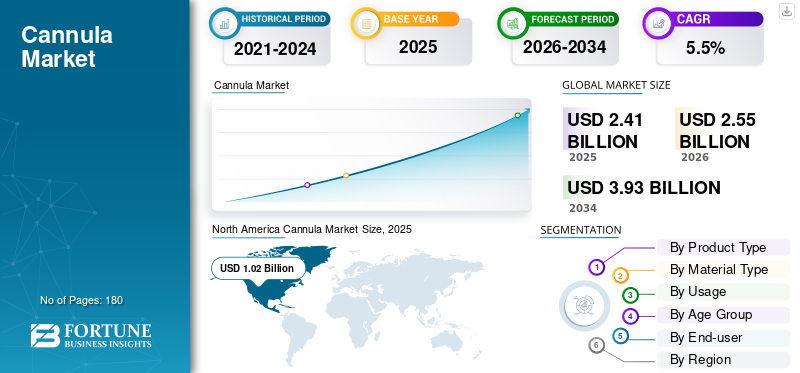
The global cannula market size was valued at USD 2.41 billion in 2025 and is projected to grow from USD 2.55 billion in 2026 to USD 3.93 billion by 2034, exhibiting a CAGR of 5.5% during the forecast period. North America dominated the cannula market with a market share of 42.32% in 2025.
A cannula is a thin, flexible tube inserted into the body to administer medication, drain fluids, or deliver oxygen to the patient's body. The market growth is primarily driven by the high volume of hospital admissions, surgical procedures, emergency care, infusion therapy, dialysis, chemotherapy, respiratory support, and cardiac procedures, which is increasing the utilization of cannulas.
BD, Teleflex Incorporated, B. Braun SE, and Medtronic held the highest market share in 2025 due to their well-established presence in key countries and broad product portfolios.
Download Free sample to learn more about this report.
 Global Market Size & Forecast
 Market Share
 Key Regional Highlights
North America
North America led the market, reaching USD 1.02 billion in 2025.
Asia Pacific
Asia Pacific is projected to become the second-largest market, reaching USD 0.74 billion in 2026.
Europe
Europe is projected to grow at a 4.8% CAGR and reach USD 0.62 billion in 2026.
U.S.
The market is anticipated to reach USD 0.99 billion in 2026, accounting for approximately 38.9% of global revenues.
Japan
The market is projected to reach USD 0.21 billion in 2026, representing nearly 8.1% of global revenues.
Read More

Shift Toward Disposable, Closed-System, and User-Friendly Cannula Platforms to Emerge as a Key Trend
Currently, healthcare providers are increasingly shifting toward disposable, single-use, closed-system, and procedure-ready platforms that reduce infection risk, standardize clinical workflow, and improve staff safety. Also, hospitals are adopting products that minimize blood exposure, accidental disconnection, contamination, and needlestick injury. Moreover, the preference for these cannulas is higher in cardiopulmonary and respiratory care. This is influencing key players to innovate disposable cannulas, enhancing workflow efficiency, safety, comfort, and compatibility with modern hospital protocols.
Download Free sample to learn more about this report.
Rising Hospital Procedures and Need for Reliable Vascular Access to Fuel Market Expansion
Over the past few years, there has been an increasing need for reliable vascular access across inpatient, emergency, oncology, critical care, dialysis, and surgical settings. Peripheral IV cannulas and central venous access devices are among the most frequently used invasive devices in hospitals, supporting fluid administration, antibiotics, anesthesia, blood sampling, chemotherapy, parenteral nutrition, and contrast delivery due to an increase in such procedures.
Market growth is further supported by the shift toward patient-safety-focused products, including blood-control IV catheters, closed IV systems, antimicrobial/CHG-impregnated catheters, and ultrasound-compatible insertion systems.
Risk of Cannula-Associated Complications and Infection to Restrict Market Growth
Cannulas carry risks such as phlebitis, infiltration, occlusion, dislodgement, extravasation, thrombosis, bloodstream infection, needlestick injury, and blood exposure despite their essential role. These risks increase treatment delays, length of stay, product replacement costs, and clinical workload. As a result, hospitals restrict the use of certain cannula types, require strict insertion protocols, or favor higher-priced safety devices, limiting adoption in cost-sensitive healthcare facilities. Moreover, product recalls, sterilization concerns, and user-training requirements are also expected to slow down the penetration of newer devices, hindering the cannula market growth.
Growth in Safety-Engineered, Extended-Dwell, and Difficult Vascular Access Solutions to Offer Lucrative Opportunities
In recent years, an aging population, obesity, chronic diseases, oncology therapy, renal disease, ICU care, and repeated hospitalization have increased the number of patients requiring more reliable cannulation.
In such a scenario, advanced cannula-based solutions such as safety IV cannulas, extended-dwell peripheral cannulas, midline catheters, PICCs, intraosseous access cannulas, and blood-control IV catheters are gaining traction, which is anticipated to create a significant opportunity for key players to develop newer products and expand their distribution network globally.
Pricing Pressure, Training Needs, and Supply Chain Reliability to Challenge Market Expansion
Basic peripheral IV cannulas are commoditized in many markets, creating strong pricing pressure and limiting margins for key players. At the same time, premium cannulas with safety features, antimicrobial properties, pressure-injectable capability, or extended dwell performance must demonstrate clear clinical and economic value to gain procurement approval.
Training is also critical as improper insertion, maintenance, or removal reduces the benefits of advanced devices and increases complications. Moreover, supply chain disruption remains another concern as cannulas are high-volume consumables used daily in hospitals and emergency settings. Such factors together are anticipated to challenge the market expansion in the coming years.
High Usage of Vascular Access Cannulas in Diverse Applications Fueled Segment Growth
Based on product type, the market is segmented into vascular access cannulas, nasal cannulas, cardiovascular & cardiopulmonary cannulas, surgical cannulas, and others.
The vascular access cannulas segment accounted for the largest global cannula market share in 2025. The segment’s growth is attributed to higher usage of these cannulas in emergency care, surgery, oncology, ICUs, radiology, dialysis, and general wards, which is driving their purchase among hospital procurements.
The nasal cannulas segment is projected to grow at a 6.4% CAGR during the forecast period.
To know how our report can help streamline your business, Speak to Analyst
Plastic Cannulas Led Market Due to Their Flexibility and Cost-Effectiveness
By material type, the market is segmented into plastic cannulas, silicone cannulas, metal cannulas, and others.
The plastic cannulas segment accounted for the largest market share in 2025. The segment’s growth is attributed to its flexibility, patient comfort, cost-effectiveness, disposability, and compatibility with high-volume manufacturing. Moreover, the segment is estimated to hold a 74.1% share in 2026.
The silicone cannulas segment is anticipated to grow at a 6.8% CAGR over the forecast period.
Elimination of Need for Reprocessing Boosted Disposable Segment Growth
By usage, the market is segmented into disposable and reusable.
The disposable segment accounted for the largest market share in 2025. Disposable cannulas remove the need for reprocessing, lower the risk of cross-contamination, and deliver reliable performance across procedures, thereby supporting wider adoption and driving segment growth.
The reusable segment is anticipated to grow at a 2.9% CAGR over the forecast period.
Increasing Aging Population and Number of Surgeries Propelled Adult Segment Growth
By age group, the market is classified into adult and pediatric.
The adult segment accounted for the largest market share in 2025. The growth is attributed to the increasing incidence of chronic diseases, surgeries, and hospital admissions in elderly individuals. Furthermore, a surge in the aging population is also anticipated to contribute to the segment’s growth.
The pediatric segment is expected to grow at a 4.8% CAGR during the forecast period.
Increasing Diagnostic and Interventional Endoscopic Procedures in Hospitals & ASCs Fostered Segment Growth
On the basis of end-user, the market is segmented into hospitals & ASCs, specialty clinics, homecare settings, and others.
In 2025, hospitals & ASCs dominated the market. Hospitals use large volumes of vascular access cannulas, arterial catheters, nasal cannulas, surgical cannulas, and cardiopulmonary cannulas for routine and complex care. ASCs also contribute to demand through day surgeries, endovascular procedures, anesthesia delivery, and IV medication administration. Moreover, an increasing number of ASCs and hospitals worldwide is expected to support this demand, further driving the segment’s growth. Furthermore, the segment is set to hold a 64.9% share in 2026.
The specialty clinics segment is projected to grow at a CAGR of 6.1% during the forecast period.
Based on geography, the market is classified into North America, Europe, Asia Pacific, Latin America, and the Middle East & Africa.
North America Cannula Market Size, 2025 (USD Billion)
To get more information on the regional analysis of this market, Download Free sample
North America accounted for the largest share and was valued at USD 0.97 billion in 2024 and USD 1.02 billion in 2025. The region’s growth is attributed to advanced critical care infrastructure, strong adoption of safety-engineered vascular access devices, and the presence of leading manufacturers.
In 2026, the U.S. is anticipated to reach USD 0.99 billion, accounting for approximately 38.9% of global revenues.
Europe is projected to record a 4.8% growth rate during the forecast period, the third-highest globally, reaching USD 0.62 billion in 2026. The region’s growth is supported by established healthcare systems, rising surgical procedures, an increasing geriatric population, and strong demand for vascular access, oxygen delivery, and cardiopulmonary support products.
The U.K. market is projected to reach USD 0.11 billion in 2026, representing approximately 4.5% of global revenues.
Germany's market is expected to reach USD 0.16 billion in 2026, accounting for approximately 6.3% of global revenues.
In 2026, the Asia Pacific market is projected to reach approximately USD 0.74 billion, making it the second-largest market globally. The growth is attributed to expanding hospital infrastructure, increasing access to critical care, and growing demand for infusion therapy, oncology treatment, dialysis, and respiratory care.
Japan is projected to generate approximately USD 0.21 billion in 2026, representing nearly 8.1% of global revenues.
China’s market is anticipated to reach around USD 0.30 billion in 2026, accounting for nearly 11.6% of global revenues.
India’s market is expected to reach approximately USD 0.10 billion in 2026, accounting for around 3.9% of global revenues.
Both Latin America and the Middle East & Africa are anticipated to witness moderate growth. The Latin America market is estimated to reach approximately USD 0.07 billion in 2026. The growth is due to growing private healthcare investment, expanding medical device distribution channels, and increasing demand for emergency care, infusion therapy, dialysis, and respiratory support.
In 2026, the GCC market is estimated to reach approximately USD 0.02 billion, representing around 0.7% of global revenues.
Broad Product Offerings Combined with Robust Distribution Networks Will Strengthen Market Positions of Leading Companies
In 2025, BD, Teleflex Incorporated, B. Braun SE, and Medtronic held the largest global market share. This share is attributed to their breadth of portfolio, hospital contracts, safety features, infection-control technologies, distribution strength, and procedure-specific innovation. Moreover, other key players are focusing on expanding their market share through expanding their global footprint by strategic partnerships, new facility launches, acquisitions, and collaborations with other firms.
The cannula market report offers a comprehensive assessment of the market across all key segments, outlining the major growth drivers, emerging trends, opportunities, restraints, and challenges influencing industry development. It also covers technological advancements, reimbursement scenarios, notable industry developments, market share analysis, and detailed profiles of leading companies operating in the market.
Request for Customization to gain extensive market insights.
| ATTRIBUTE | DETAILS |
| Study Period | 2021-2034 |
| Base Year | 2025 |
| Estimated Year | 2026 |
| Forecast Period | 2026-2034 |
| Historical Period | 2021-2024 |
| Growth Rate | CAGR of 5.5% from 2026 to 2034 |
| Unit | Value (USD Billion) |
| Segmentation | By Product Type, Material Type, Usage, Age Group, End-user, and Region |
| By Product Type |
|
| By Material Type |
|
| By Usage |
|
| By Age Group |
|
| By End-user |
|
| By Region |
|
Fortune Business Insights says that the global market value stood at USD 2.41 billion in 2025 and is projected to reach USD 3.93 billion by 2034.
In 2025, the market value in North America stood at USD 1.02 billion.
The market is expected to exhibit a CAGR of 5.5% during the forecast period of 2026-2034.
The vascular access cannulas segment led the market by product type.
The key factor driving the market is the rising number of hospital procedures and the need for reliable vascular access.
BD, Teleflex Incorporated, B. Braun SE, and Medtronic are among the prominent players in the market.
North America dominated the market in 2025.

Get 30-60 hrs Free Customization
Expand Regional and Country Coverage, Segments Analysis, Company Profiles, Competitive Benchmarking, and End-user Insights.













.webp)






Related Reports
Get In Touch With Us
US +1 833 909 2966 ( Toll Free )
Receive a tailored pricing based on your needs.
Discuss your questions with our industry experts.
Have questions? Get quick answers before you purchase.

