Cognitive Collaboration Market Size, Share & Industry Analysis, By Component (Solutions and Services), Deployment (On-premise and Cloud-based), By Application (Communication & Collaboration, Knowledge Management, Workflow Automation, Decision Management, and Others), By End User (BFSI, IT & Telecom, Retail, Manufacturing, Healthcare, and Others), and Regional Forecast, 2026 – 2034
 Download Free Sample
COGNITIVE COLLABORATION MARKET SIZE AND FUTURE OUTLOOK
 Listen to Audio Version
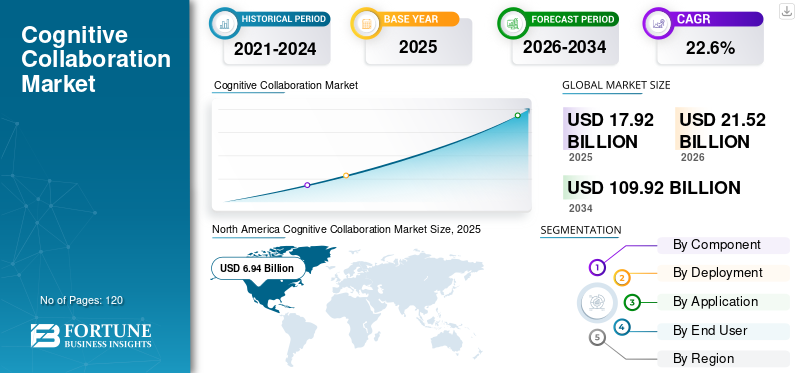
The cognitive collaboration market size was valued at USD 17.92 billion in 2025 and is projected to grow from USD 21.52 billion in 2026 to USD 109.92 billion by 2034, exhibiting a CAGR of 22.6% during the forecast period. North America dominated the cognitive collaboration market with a market share of 38.73% in 2025.
The market is associated with using AI-enabled collaboration tools and services to help companies facilitate better communications, improve knowledge management systems. It also helps to automate business processes and create more value for both employees and customers through intelligent, contextual, and efficient ways to work together. The primary reason for the market's growth is that organizations are increasingly implementing AI-enabled workplace tools such as intelligent assistants, automated workflows, and knowledge-based management systems to increase employee productivity, automate the tasks they manually do, and enable faster decision-making within their organizations.
Furthermore, many key market players, such as Microsoft Corporation, Cisco Systems, Inc., Zoom Communications, Inc., Alphabet Inc., and Salesforce, Inc., operating in the market, are focusing on using AI technology to integrate products and develop their own ecosystems. Companies are also embedding various types of assistants, such as virtual assistants and workflow automation, into their existing collaboration platforms in order to improve their ability to retain customers, increase the value of their subscriptions, and enable the enterprise to adopt digital workplaces.
Download Free sample to learn more about this report.
IMPACT OF GENERATIVE AI
Generative AI is Transforming Enterprise Collaboration Platforms from Typical Communication Tool to Intelligent Work Solutions
The market is being transformed by generative AI through the transition of enterprise collaboration away from just providing basic communication tools toward intelligent, context-sensitive work platforms. Generative AI provides different capabilities for employees collaborating with one another, including meeting summaries, automated action items, smart search, draft documents, recommended workflows, virtual assistants, and support for decision-making across different collaboration tools. As generative AI automates manual co-ordination work, employees will spend less time coordinating with other employees and more time collaborating on their projects by accessing the right information more quickly. In turn, as companies continue to add AI co-pilots, agents, and premium AI features to their current collaboration and workflow product offerings, vendors will have greater opportunities to monetize. For instance,
- In March 2024, Zoom launched Zoom Workplace, an AI-powered open collaboration platform integrated with Zoom AI Companion to improve teamwork, productivity, communication, and flexible work experiences.
COGNITIVE COLLABORATION MARKET TRENDS
Focus on Employee Productivity and Hybrid Work Fuels Market Growth
Focus on employee productivity and hybrid work is a key trend in the market as enterprises are adopting AI-enabled tools to support distributed teams, reduce meeting fatigue, and improve coordination across remote and office-based employees. They use cognitive collaboration platforms to summarize meetings, capture action items, retrieve past conversations, compose messages, and automate follow-up tasks. This helps in improving productivity by minimizing time spent on repetitive tasks, allowing employees to devote more time and energy toward work that creates value. This trend will continue to grow in large organizations where hybrid work has increased demand for intelligent and real-time collaborative tools that enable sharing of knowledge. For instance,
- In March 2024, Microsoft announced new Copilot in Teams enhancements to make hybrid meetings smarter, including AI-powered meeting support, collaboration improvements, and productivity-focused features for Microsoft Teams users.
MARKET DYNAMICS
MARKET DRIVERS
Download Free sample to learn more about this report.
Increasing Implementation of Generative AI and AI Copilots in Collaboration Platforms Drives Market Growth
The rapid rise in the use of generative AI and AI copilots within collaboration platforms is driving demand for these technologies as businesses globally continue to integrate AI assistants into their workplace tools to automate repetitive communications, assist in making better decisions, and help employees be more productive. AI copilots provide capabilities such as summarizing meeting notes in real time, creating intelligent content, retrieving contextually relevant knowledge from a wide variety of sources, and automating task management throughout the collaboration environment. All of these capabilities reduce the need for manual workflows and greatly expedite the completion of business processes across distributed teams. Consequently, organizations are moving away from traditional collaboration solutions toward AI-natively designed platforms that are creating strong demand for all businesses around the world. Thus, this factor fuels the cognitive collaboration market growth.
|
Rank |
Market Driver |
Expected Impact on Market Growth |
Estimated Gross Market Growth Contribution (USD Billion) |
Impact: 2026-2028 |
Impact: 2029-2031 |
Impact: 2032-2034 |
|
1 |
Rapid adoption of generative AI and AI copilots in collaboration platforms |
High |
3.40 |
High |
High |
High |
|
2 |
Rising demand for enterprise productivity and intelligent workflow automation across hybrid work environments |
High |
3.05 |
High |
High |
High |
|
3 |
Expansion of cloud-based collaboration platforms and SaaS subscription models enabling scalable AI integration |
High |
2.60 |
High |
High |
High |
|
4 |
Increasing adoption of knowledge management systems and enterprise AI search |
Medium-High |
2.15 |
Medium |
High |
High |
|
5 |
Growth of digital transformation initiatives and integration of collaboration tools with CRM, ERP, and workflow systems |
Medium |
1.70 |
Medium |
Medium-High |
High |
|
6 |
Others (Rising adoption of AI-enabled customer engagement and virtual assistance tools within collaboration ecosystems, etc.) |
Low |
0.90 |
Low |
Low |
Medium |
|
Total Gross Growth Contribution |
13.80 |
MARKET RESTRAINTS
Data Privacy and Security Concerns May Hinder Market Growth
Concerns around data privacy/security are a key restraint in market due to growing reliance on AI-driven platforms which process sensitive communication, documents and workflow data. This will lead to higher awareness from organizations in association with cloud-based AI systems and their exposure of confidential business data. Data leakage, unauthorized access, and cyber-attacks present many risks for organizations as a result of adopting generative/third party AI models or cloud-based solutions. These concerns are further exacerbated in regulated industries and by virtue of the stringent data protection obligations that exist within these industries, limiting the full-scale implementation of cognitive collaboration tools.
|
Rank |
Market Restraint |
Expected Impact on Market Growth |
Estimated Reduction in Market Size (USD Billion) |
Impact: 2026-2028 |
Impact: 2029-2031 |
Impact: 2032-2034 |
|
1 |
Data privacy, security concerns, and enterprise data governance risks in AI-enabled collaboration platforms |
High |
0.72 |
High |
High |
Medium |
|
2 |
High implementation cost and integration complexity of AI copilots with legacy enterprise systems |
Medium-High |
0.55 |
High |
Medium |
Medium |
|
3 |
AI model limitations, including hallucinations, inaccuracy, and lack of explainability in decision support systems |
Medium |
0.40 |
Medium |
Medium |
Low |
|
4 |
Others (Regulatory compliance challenges and organizational resistance to AI-driven workplace transformation, etc.) |
Low |
0.25 |
Low |
Low |
Low |
|
Total Market Reduction |
1.92 |
MARKET OPPORTUNITIES
Increasing Integration of Collaboration Tools with Enterprise Ecosystems Creates New Opportunities for Market Growth
Organizations are linking their collaboration platforms, such as CRM, ERP, IT service management, and business intelligence tools, to core enterprise systems. When these applications are integrated together, they enable an uninterrupted flow of data between different applications for employees to be able to gain access to contextual insight from their communications and workflows. Additionally, they help to increase the speed of making decisions by embedding AI-based recommendations and analytics into their day-to-day processes of businesses. Furthermore, as enterprises seek to develop a unified digital workplace strategy, there has been an increase in demand for interoperable API-based collaborative ecosystems that remove data silos to provide increased operational efficiency. For instance,
- In March 2024, Salesforce expanded its integration of Slack with Einstein AI and Customer 360 platforms, enabling unified workflows across CRM, communication, and AI-driven productivity tools.
Segmentation Analysis
By Component
Growing Enterprise Preference for Integrated Collaboration Solutions Fueling Segment Dominance
Based on the component, the market is categorized into solutions and services.
Solutions segment is accounted for the largest market share in 2025. This is owing to enterprises investing heavily in AI-enabled collaborative platforms, copilot integrations, and workflow automation software. These solutions form the core of cognitive collaboration, enabling organizations to enhance productivity, streamline operations, and support intelligent decision-making across teams.
Services segment is anticipated to grow at the highest CAGR of 25.5% over the forecast period. This is owing to increasing reliance on these services for integration, customization, deployment of AI models, configuration of workflows, and managed support, which are necessary for successfully implementing and scaling cognitive collaboration platforms within complex IT environments.
By Deployment
Cost Effectiveness of Cloud Deployment Models Accelerates Segment Dominance
Based on the deployment, the market is categorized into on-premise and cloud-based.
Cloud-based segment held the largest market share in 2025 and is expected to grow at the highest CAGR of 24.0% during the forecast period. It provides scalable solutions, less expensive initial infrastructure costs, and integration of AI-powered collaborative tools into distributed and hybrid enterprise environments.
On-premise segment is anticipated to grow at a moderate CAGR of 19.5% over the forecast period. As enterprises in regulated industries and sectors with strict data security requirements continue to adopt localized infrastructure to maintain full control over their collaboration and AI-enabled systems.
By Application
Growing Demand for Managing Real-Time Communications and Meetings Across Different Departments Leads to Dominance of Communication & Collaboration Segment
Based on the application, the market is divided into communication & collaboration, knowledge management, workflow automation, decision management, and others (customer engagement, virtual assistance, etc.).
Communication & collaboration segment accounted for the largest market share in 2025. This is owing to its core functionality in cognitive collaboration platforms. This allows organizations to manage real-time communications, meetings, messaging, and coordinate teams across multiple departments. Therefore, it is critical for enabling organizations' daily business to occur across industries.
Workflow automation segment is anticipated to grow at the highest CAGR of 24.6% over the forecast period. As enterprises rely on AI-enabled processes for optimization, with companies leveraging automated workflows, tasks, and agent-based systems to support the reduction of the amount of manual effort required by their organization, as well as improve the operational performance of interconnected business functions.
To know how our report can help streamline your business, Speak to Analyst
By End User
Increasing Reliance on Real-Time Communication in IT & Telecom Strengthening Segment Dominance
Based on the end user, the market is classified into BFSI, IT & telecom, retail, manufacturing, healthcare, and others (government, education, etc.).
IT & telecom segment dominated the market in 2025. This sector is an early adopter of collaborative platforms powered by AI for organizing big/small geographically dispersed teams, managing global operations, and facilitating communications across multiple systems. Additionally, they rely heavily on digital infrastructures, cloud-based server systems, and performing services in real-time (24/7). Therefore, the use of cognitive collaboration tools will be integral to improving operational efficiency and customer responsiveness.
Manufacturing sector is anticipated to grow at the highest CAGR of 25.4% during the forecast period. This is owing to increasing adoption of AI-enabled workflow automation, predictive maintenance coordination, and cross-functional collaboration tools that enhance operational efficiency, reduce downtime, and support smart factory transformation initiatives.
Cognitive Collaboration Market Regional Outlook
By geography, the market is categorized into North America, South America, Europe, Middle East & Africa, and Asia Pacific.
North America
North America Cognitive Collaboration Market Size, 2025 (USD Billion)
To get more information on the regional analysis of this market, Download Free sample
North America held the largest cognitive collaboration market share in 2024, valuing at USD 5.88 billion, and also maintained the leading share in 2025, with USD 6.94 billion. This is owing to the availability of major technology vendors and early adoption of AI-powered collaboration tools by enterprise customers, as well as the overall high level of digital maturity in North America. Additionally, widespread cloud infrastructure and rapid implementation of generative AI tools across multiple industries including IT & telecom, BFSI, and healthcare help to solidify North America's position as dominant region in market.
U.S. Cognitive Collaboration Market
Based on North America’s strong contribution, the U.S. market can be analytically approximated at around USD 6.75 billion in 2026, accounting for roughly 31.2% of global sales.
To know how our report can help streamline your business, Speak to Analyst
Europe
Europe market is projected to record a growth rate of 21.3% in the coming years, which is the fourth highest among all regions, and reach a valuation of USD 5.79 billion by 2026. The market in Europe is experiencing growth, owing to the increased use of AI-assisted collaboration solutions by businesses to increase efficiencies, collaborate more efficiently with one another, and digitize their workplaces. Industries such as manufacturing, BFSI, and professional services are particularly enjoying the benefits of these technologies. Organizations throughout Europe are increasingly using collaboration platforms that meet regulatory requirements regarding data privacy and sovereign cloud, which is encouraging enterprises to deploy secure/complying platforms that use AI to enable collaborative work. For instance,
- In November 2024, SAP announced enhancements to its Joule AI copilot within SAP Business Technology Platform (BTP), expanding generative AI capabilities across enterprise collaboration, workflow automation, and decision-making tools for European enterprises focused on sovereign cloud and compliant AI adoption.
U.K. Cognitive Collaboration Market
The U.K. market in 2026 is estimated at around USD 1.23 billion, representing roughly 5.8% of global revenues.
Germany Cognitive Collaboration Market
Germany’s market is projected to reach approximately USD 1.07 billion in 2026, equivalent to around 5.0% of global sales.
Asia Pacific
Asia Pacific region is estimated to reach USD 5.29 billion in 2026 and grow at the highest CAGR of 27.2% during the forecast period. This is owing to rapid digital transformation efforts, improved use of cloud technology, and the widespread adoption of AI-driven collaborative tools in China, India, Japan, and South Korea. Demand for intelligent collaboration solutions continues to grow rapidly due to the expansion of many new IT services, a growing remote workforce ecosystem, and an increased investment in enterprise AI platforms. For instance,
- In June 2024, Google announced the expansion of Gemini for Google Workspace across the Asia Pacific region, integrating generative AI capabilities into Gmail, Docs, Meet, and Chat to enhance enterprise collaboration, content creation, and workflow automation.
China Cognitive Collaboration Market
China’s market is projected to be one of the largest worldwide, with 2026 revenues estimated at around USD 1.50 billion, representing roughly 5.8% of global sales. This is owing to rapid enterprise digitalization, large-scale adoption of AI-powered workplace tools, and strong government support for AI infrastructure and intelligent automation across industries.
Japan Cognitive Collaboration Market
The Japan market in 2026 is estimated at around USD 1.05 billion, accounting for roughly 4.8% of global revenues.
India Cognitive Collaboration Market
The India market in 2026 is predicted at around USD 1.03 billion, accounting for roughly 3.4% of global sales.
South America
South America is expected to witness moderate growth in this market space during the forecast period. The South America market is set to reach a valuation of USD 0.94 billion in 2026. This is owing to increasing adoption of cloud, continuing digital transformations for businesses, and increased need for cost efficient AI-enabled collaboration tools to enhance productivity and operational efficiency. In the South America, the Brazil is set to reach a value of USD 0.47 billion in 2026.
Middle East & Africa
The Middle East & Africa is estimated to reach USD 1.28 billion in 2026 and grow at a prominent growth rate in the coming years. This is owing to increasing enterprise spending on digital transformation, cloud infrastructure, and AI-based workplace solutions, especially in the government, oil and gas, and BFSI sectors. Also, increased use of hybrid working models and smart cities is fueling demand for intelligent collaboration platforms that will allow companies to operate more efficiently and make faster decisions in real time. In the Middle East & Africa, the GCC is set to reach a value of USD 0.50 billion in 2026.
COMPETITIVE LANDSCAPE
Key Industry Players
Focus on Expanding AI-Enabled Cognitive Collaboration Capabilities by Key Players to Propel Market Growth
The cognitive collaboration market holds a semi-consolidated market structure, with prominent players such as Microsoft Corporation, Cisco Systems, Inc., Zoom Communications, Inc., Alphabet Inc., and Salesforce, Inc. holding significant positions. These companies are heavily investing in AI-powered collaboration ecosystems that integrate communication platforms, workflow automation, knowledge management, decision intelligence, and virtual assistant capabilities to enhance enterprise productivity and support hybrid work environments.
Other notable players in the global market are also strengthening their market positioning through strategic partnerships, cloud ecosystem integrations, and development of industry-specific cognitive collaboration solutions, which are expected to further accelerate market adoption over the forecast period.
LIST OF KEY COGNITIVE COLLABORATION COMPANIES PROFILED
- Microsoft Corporation (U.S.)
- Cisco Systems, Inc. (U.S.)
- Zoom Communications, Inc. (U.S.)
- Alphabet Inc. (U.S.)
- Salesforce, Inc. (U.S.)
- Atlassian Corporation (Australia)
- ServiceNow, Inc. (U.S.)
- IBM Corporation (U.S.)
- Oracle Corporation (U.S.)
- SAP SE (Germany)
KEY INDUSTRY DEVELOPMENTS
- June 2025: IBM collaborated with Inclusive Brains to combine artificial intelligence, quantum computing, and neurotechnology to develop advanced brain-inspired computing systems. This initiative is expected to enhance next-generation cognitive computing by enabling more adaptive and human-centric AI-driven systems.
- March 2025: Microsoft announced a collaboration with Inait to deploy AI systems based on “digital brains” across multiple industries, aiming to enhance advanced decision-making and intelligent automation capabilities. This partnership strengthens Microsoft’s AI ecosystem and further supports the evolution of cognitive and generative AI-driven enterprise collaboration
- June 2024: Cisco announced enhancements to Webex AI features, including AI Assistant capabilities for meeting summaries, real-time translation, and intelligent collaboration workflows across enterprise communication systems.
- June 2024: Alibaba Cloud expanded its Tongyi Qianwen large language model integration across enterprise collaboration and productivity tools, enabling AI-powered workplace automation, communication enhancement, and knowledge management capabilities for businesses across Asia Pacific.
- May 2024: IBM expanded watsonx Assistant and watsonx Orchestrate, integrating generative AI for enterprise productivity, workflow automation, and collaborative decision-making across business applications.
- May 2024: ServiceNow launched Now Assist for Creator and IT workflows, enabling generative AI-powered automation, knowledge creation, and enterprise workflow optimization across digital collaboration environments.
- April 2024: Atlassian expanded Atlassian Intelligence, embedding generative AI across Jira, Confluence, and Jira Service Management to support automated summaries, content generation, and workflow assistance.
REPORT COVERAGE
The global cognitive collaboration market analysis includes a comprehensive study of the market size & forecast by all the market segments included in the report. It includes details on the market dynamics and market trends expected to drive the market over the forecast period. It provides information on key aspects, including an overview of technological advancements, pipeline candidates, the regulatory environment, and product launches. Additionally, it details partnerships, mergers & acquisitions, as well as key industry developments and prevalence by key regions. The global market research report also provides a detailed competitive landscape with information on the market share and profiles of key operating players.
Request for Customization to gain extensive market insights.
Report Scope & Segmentation
| ATTRIBUTE | DETAILS |
| Study Period | 2021-2034 |
| Base Year | 2025 |
| Estimated Year | 2026 |
| Forecast Period | 2026-2034 |
| Historical Period | 2021-2024 |
| Growth Rate | CAGR of 22.6% from 2026-2034 |
| Unit | Value (USD Billion) |
| Segmentation | By Component, Deployment, Application, End User, and Region |
| By Component |
|
| By Deployment |
|
| By Application |
|
| By End User |
|
| By Region |
|
Frequently Asked Questions
According to Fortune Business Insights, the global market value stood at USD 17.92 billion in 2025 and is projected to reach USD 109.92 billion by 2034.
In 2025, the North America market value stood at USD 6.94 billion.
The market is growing at a CAGR of 22.6% during the forecast period of 2026-2034.
By end user, IT & telecom segment is expected to lead the market.
Growing adoption of generative AI and AI copilots in collaboration platforms drives market growth.
Microsoft Corporation, Cisco Systems, Inc., Zoom Communications, Inc., Alphabet Inc., and Salesforce, Inc. are the major players in the global market.
North America dominated the market in 2025.



- 2021-2034
- 2025
- 2021-2024
- 120
Get 30-60 hrs Free Customization
Expand Regional and Country Coverage, Segments Analysis, Company Profiles, Competitive Benchmarking, and End-user Insights.




















Related Reports
-
US +1 833 909 2966 ( Toll Free )
-
Get In Touch With Us