Dielectric Materials Market Size, Share & Industry Analysis, By Material Type (Ceramic & Inorganic Dielectrics, Polymer & Fluoropolymer Dielectrics, Composite & Hybrid Dielectrics, Semiconductor Dielectric Materials, and Others), By Application (Capacitors, Semiconductors, Printed Circuit Boards, Power Cables, Electronic Components, and Others), and Regional Forecast, 2026-2034
 Download Free Sample
DIELECTRIC MATERIALS MARKET SIZE AND FUTURE OUTLOOK
 Listen to Audio Version
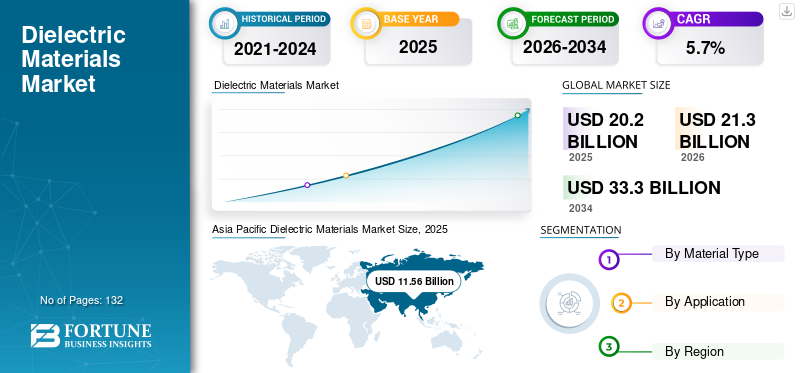
The dielectric materials market size was valued at USD 20.2 billion in 2025. The market is projected to grow from USD 21.3 billion in 2026 to USD 33.3 billion by 2034, exhibiting a CAGR of 5.7% during the forecast period. Asia Pacific dominated the dielectric materials market with a market share of 57.23% in 2025.
The market comprises materials that store electrical energy, resist electrical conduction, support signal insulation, and enable controlled electrical performance across capacitors, semiconductors, printed circuit boards, power cables, electronic components, telecommunications systems, and other electrical applications. These materials include ceramic and inorganic dielectrics, polymer and fluoropolymer dielectrics, composite and hybrid dielectrics, mica-based insulation materials, semiconductor dielectric materials and precursors, and other specialty dielectric systems.
The market is growing due to rising demand from semiconductors, high-performance electronics, multilayer ceramic capacitors, printed circuit boards, EV power systems, data centers, power cables, and telecom infrastructure. This growth is also supported by increased chip production, the miniaturization of electronic components, the wider use of high-frequency circuit materials, rising electrification, and the need for reliable insulation in power and industrial equipment. Key players in the market include Qnity Electronics, Inc., FUJIFILM Corporation, Rogers Corporation, Panasonic Industry Co., Ltd., and Murata Manufacturing Co., Ltd.
Download Free sample to learn more about this report.
Dielectric Materials Market Key Takeaways
 Global Market Size & Forecast
- 2025 Market Size: USD 20.2 Billion
- 2026 Market Size: USD 21.3 Billion
- 2034 Forecast Market Size: USD 33.3 Billion
- CAGR: 5.7% from 2026–2034
 Market Share
- Asia Pacific dominated the dielectric materials market with a 57.23% share in 2025.
- Polymer & fluoropolymer dielectrics held the leading share by material type in 2025.
- Semiconductors accounted for the dominant share by application in 2025.
 Key Regional Highlights
Asia Pacific
Asia Pacific led the market with a size of USD 11.56 billion and accounted for 57.23% of the global market in 2025.
North America led the global market with a 49.53% share in 2025.
North America held a significant share, supported by strong semiconductor, aerospace, and advanced electronics demand.
Europe
Europe registered a significant market share, driven by automotive electronics, industrial machinery, and renewable energy applications.
U.S.
The U.S. market was valued at USD 3.23 billion in 2025, representing approximately 16.0% of global market sales.
Japan
Japan remains a key market, supported by its advanced electronics manufacturing and semiconductor industry.
Read More

DIELECTRIC MATERIALS MARKET TRENDS
Shift Toward High-frequency, Miniaturized, and Semiconductor-Grade Dielectric Materials is Emerging Market Trend
A major trend in the market is the shift from conventional electrical insulation materials toward high-performance dielectric systems used in semiconductors, miniaturized passive components, high-speed interconnects, and RF communication devices. Semiconductor manufacturing is creating strong demand for high-purity dielectric and dopant sources, CVD/ALD precursors, low-k and high-k materials, oxide layers, and advanced packaging dielectrics.
Similarly, printed circuit boards, IC substrates, RF laminates, and telecom electronics are pushing demand for low-loss, thermally stable, and high-frequency dielectric materials. Rogers’ RT/duroid portfolio includes filled PTFE glass or ceramic-composite laminates for high-reliability aerospace, defense, antenna, and communications applications, underscoring the increasing importance of composite dielectric laminates in high-frequency systems.
Download Free sample to learn more about this report.
MARKET DYNAMICS
MARKET DRIVERS
Rising Demand for Semiconductor and PCB Drives Market Growth
One of the strongest drivers for the dielectric materials market growth is the rapid demand for semiconductors, printed circuit boards, MLCCs, and electronic components. Semiconductor devices require dielectric materials for isolation, gate structures, interlayer insulation, CVD/ALD deposition, dopant delivery, and advanced packaging.
The expansion of printed circuit boards and high-frequency electronic materials also supports this driver. In capacitors, Murata describes multilayer ceramic capacitors as components composed of ceramic dielectric and electrode layers stacked alternately, confirming the direct role of ceramic dielectric materials in miniaturized electronics.
MARKET RESTRAINTS
High Material Purity Requirements, Processing Complexity, and Cost Pressure to Restrict Market Growth
A major restraint for the market is the high level of purity, consistency, and technical control required for dielectric materials used in semiconductors, MLCCs, RF laminates, and high-voltage insulation systems. Semiconductor dielectric precursors require tight control of impurities, moisture, stability, and delivery performance, while MLCC-grade barium titanate and ceramic powders require fine particle size, high purity, and uniform morphology. Fujifilm’s dielectric and dopant source portfolio underscores the need for high-purity precursors, supported by analytical testing and controlled production, and highlights the technical challenges of serving semiconductor-grade applications.
Cost pressure is another restraint, especially for high-performance materials such as fluoropolymers, polyimide films, ceramic-filled laminates, mica tapes, and high-purity oxide or titanate powders. These materials often require advanced synthesis, precision coating, lamination, calcination, or purification processes. For buyers of power cables, consumer electronics, telecom hardware, and industrial insulation, material selection is often constrained by a balance among dielectric performance, thermal resistance, processability, and cost.
MARKET OPPORTUNITIES
Expansion of EVs, Renewable Energy, Data Centers, and High-Voltage Infrastructure to Create Growth Opportunities
A major opportunity for the market lies in EV power electronics, battery insulation, renewable energy systems, transformers, power cables, and grid infrastructure. EVs require dielectric films, mica sheets, potting materials, encapsulants, inverter insulation, capacitor films, and high-voltage cable insulation.
Renewable energy and grid expansion also create opportunities for dielectric materials used in transformers, inverters, capacitors, cable systems, and electrical insulation. International Renewable Energy Agency (IRENA) reported that global renewable power capacity reached 4,448 GW in 2024, with 585 GW added during the year. This expansion supports demand for mica insulation, resins, varnishes, potting compounds, polymer films, and high-voltage dielectric systems used in renewable power and grid-connected equipment.
MARKET CHALLENGES
Supply-chain Concentration, Raw Material Sensitivity, and Application-specific Qualification Requirements Challenges Market Growth
A major challenge for the market is the concentration of advanced dielectric material production among a limited number of qualified suppliers. High-end applications such as semiconductors, MLCCs, aerospace RF laminates, high-voltage machines, and EV battery insulation often require long qualification cycles. Once materials are approved, customers may be reluctant to switch suppliers due to performance risks, compliance requirements, and concerns about process compatibility.
Raw material sensitivity also creates challenges. Ceramic dielectric powders depend on a consistent supply of titanium, barium, strontium, zirconium, and other specialty inorganic inputs, while polymer and fluoropolymer dielectrics depend on specialty monomers, resins, solvents, and film-processing capacity. In high-voltage and RF applications, small changes in dielectric constant, dissipation factor, thermal expansion, moisture absorption, or breakdown strength can affect final product reliability, making scale-up and substitution difficult.
RESEARCH AND DEVELOPMENT (R&D) TRENDS
R&D in the market is increasingly focused on low-loss materials, high-k and low-k semiconductor dielectrics, ultra-thin films, advanced ceramic powders, thermally stable polymer systems, and composite laminates for high-frequency electronics. Semiconductor suppliers are developing high-purity CVD and thin-film chemicals for next-generation chip manufacturing, while Fujifilm positions its CVD precursor and dielectric source portfolio for semiconductor isolation and electrical or physical property modification.
Innovation is also moving toward high-reliability insulation systems for EVs, power electronics, motors, and renewable energy equipment. ELANTAS offers wire enamels, infusing resins and varnishes, casting and potting resins, flexible electrical insulation materials, electronic protection materials, specialty coatings, and printed electronics materials, showing how R&D is expanding beyond conventional insulation into multifunctional protection and electronic material systems.
SEGMENTATION ANALYSIS
By Material Type
Polymer & Fluoropolymer Dielectrics Dominate Due to its Broad Use Across Films, Cables, PCBs, Capacitors, and Electrical Insulation
Based on material type, the market is segmented into ceramic & inorganic dielectrics, polymer & fluoropolymer dielectrics, composite & hybrid dielectrics, semiconductor dielectric materials, and others.
The polymer & fluoropolymer dielectrics segment holds the dominant share of market. Its dominance is supported by extensive use of polyimide films, PTFE, FEP, PVDF, polypropylene films, cable insulation materials, flexible circuit films, capacitor films, and other polymer-based dielectric systems. DuPont’s Kapton polyimide film is positioned for applications requiring strong physical, electrical, and mechanical properties across a wide temperature range, supporting its role in demanding electrical and electronics applications.
The semiconductor dielectric materials segment accounts for a significant share, with a 6.0% CAGR. This segment is supported by high-value semiconductor applications, including CVD/ALD precursors, high-k and low-k materials, thin-film dielectrics, oxide layers, dielectric dopant sources, and advanced packaging materials.
The composite & hybrid dielectrics segment also holds a prominent share due to demand for PTFE/glass, ceramic-filled PTFE, hydrocarbon-ceramic, and other low-loss laminates used in high-frequency PCBs, antennas, telecom systems, aerospace, and defense electronics.
By Application
To know how our report can help streamline your business, Speak to Analyst
Semiconductors Segment Leads Due to High Use of Dielectric Precursors, Isolation Layers, and Advanced Packaging Materials
Based on application, the market is segmented into capacitors, semiconductors, printed circuit boards, power cables, electronic components, and others.
The semiconductors segment holds the leading dielectric materials market share. This dominance is supported by strong demand for high-purity dielectric precursors, CVD/ALD materials, interlayer dielectric materials, high-k and low-k dielectrics, oxide films, isolation layers, and advanced packaging dielectrics. Semiconductor requirement is expanding due to its increasing use in AI chips, data centers, memory, logic, automotive electronics, and industrial electronics.
The printed circuit boards segment holds a significant share due to the use of dielectric laminates, prepregs, substrate materials, polyimide films, PTFE composites, ceramic-filled laminates, and low-loss materials in rigid, flexible, high-speed, and RF boards. The segment expected to grow at a CAGR of 6.0% during the forecast period.
The capacitors segment is supported by MLCCs, ceramic capacitors, film capacitors, and power capacitors. Sakai Chemical states that barium titanate and other high-purity dielectric powders are important for electronic components and laminated ceramic capacitors, supporting the capacitor application base.
DIELECTRIC MATERIALS MARKET REGIONAL OUTLOOK
By region, the market is segmented into North America, Europe, Asia Pacific, Latin America, and the Middle East & Africa.
Asia Pacific
Asia Pacific Dielectric Materials Market Size, 2025 (USD Billion)
To get more information on the regional analysis of this market, Download Free sample
Asia Pacific holds the dominant share of the market. The region leads due to its large semiconductor materials consumption base, strong PCB and electronics manufacturing ecosystem, major MLCC and capacitor production, expanding EV manufacturing, and large telecom hardware and consumer electronics industries.
China Dielectric Materials Market
China’s market is one of the largest globally, with 2025 revenue at USD 5.73 billion, representing roughly 28.4% of global sales.
To know how our report can help streamline your business, Speak to Analyst
North America
North America registered a significant share in the market. The region is supported by semiconductor investment, aerospace and defense electronics, data centers, EVs, high-performance PCBs, telecom infrastructure, power equipment, and specialty electrical insulation materials. The U.S. dominates regional demand due to its stronger semiconductor, defense, advanced electronics, and high-performance materials base.
U.S. Dielectric Materials Market
In 2025, the U.S. market was valued at USD 3.23 billion, driven primarily by strong demand from the industrial sector. The U.S. accounts for roughly 16.0% of global market sales.
Europe
Europe registers significant product demand, driven by automotive electronics, industrial machinery, electrical equipment, renewable energy, high-voltage insulation, power cables, and specialty materials. The region is also important in mica insulation, varnishes, resins, and advanced electrical insulation systems used in motors, generators, transformers, and power equipment.
Germany Dielectric Materials Market
The Germany market in 2025 was valued at USD 1.10 billion, representing roughly 5.4% of global market revenues.
U.K. Dielectric Materials Market
The U.K. market in 2025 was valued at USD 0.43 billion, representing roughly 2.1% of global market sales.
Latin America
Latin America holds a smaller but growing share of the market. Automotive manufacturing, power cables, grid infrastructure, renewable energy systems, appliances, electronics assembly, and industrial electrical equipment supports product demand across the region.
Brazil Dielectric Materials Market
Brazil market in 2025 was valued at USD 0.46 billion, representing roughly 2.3% of global market revenues.
Middle East & Africa
Power cables, grid infrastructure, transformers, oil & gas electrical systems, industrial equipment, renewable energy projects, and high-voltage insulation support the Middle East & Africa market growth.
GCC Dielectric Materials Market
GCC market in 2025 was valued at USD 0.36 billion, representing roughly 1.8% of global market revenues.
COMPETITIVE LANDSCAPE
KEY INDUSTRY PLAYERS
Key Players are Focusing on High-purity Materials, Electronic Laminates, and Electrical Insulation Portfolios to Secure Their Market Positions
Competitive intensity in the market is shaped by material purity, dielectric performance, customer qualification cycles, application-specific formulation capability, regional supply reliability, and integration with high-growth applications such as semiconductors, MLCCs, printed circuit boards, power cables, telecommunications, EVs, and high-voltage electrical equipment. Market leadership is increasingly linked to companies that can supply high-purity dielectric precursors, ceramic dielectric powders, low-loss PCB laminates, polyimide and fluoropolymer films, mica insulation systems, and resin-based electrical insulation materials.
LIST OF KEY DIELECTRIC MATERIALS COMPANIES PROFILED
- Qnity Electronics, Inc. (U.S.)
- FUJIFILM Corporation (Japan)
- Rogers Corporation (U.S.)
- Panasonic Industry Co., Ltd. (Japan)
- Murata Manufacturing Co., Ltd (Japan)
- TDK Corporation (Japan)
- Sakai Chemical Industry Co., Ltd. (Japan)
- Nippon Chemical Industrial Co., Ltd. (Japan)
- ELANTAS GmbH (Germany)
- Syensqo SA (Belgium)
KEY INDUSTRY DEVELOPMENTS
- April 2026: Murata Manufacturing completed a new production building at Izumo Murata Manufacturing in Shimane, Japan, to support MLCC-related production. The company stated that distributing MLCC production across Japan, ASEAN, and China will help it respond flexibly to market changes and growing demand.
- April 2026: Nippon Chemical Industrial and TDK announced the establishment of a joint venture to develop electronic component materials and manufacturing processes. This strengthens the linkage between barium titanate-based electronic ceramic materials and advanced capacitor manufacturing.
- November 2025: Fujifilm completed a new development and evaluation building at the Shizuoka Factory of FUJIFILM Electronic Materials Co., Ltd. The facility is intended to accelerate the development of new materials for next-generation semiconductors and to support a stable supply of high-quality products.
REPORT COVERAGE
The dielectric materials market report provides a detailed analysis of the market. It focuses on key aspects, such as leading companies, material type, and application. Besides this, it offers insights into the market and current industry trends and highlights key industry developments. In addition to the factors mentioned above, the report also covers several factors contributing to market growth.
Request for Customization to gain extensive market insights.
Report Scope & Segmentation
| ATTRIBUTE | DETAILS |
| Study Period | 2021-2034 |
| Base Year | 2025 |
| Estimated Year | 2026 |
| Forecast Period | 2026-2034 |
| Historical Period | 2021-2024 |
| Unit | Value (USD Billion) |
| Growth Rate | CAGR of 5.7% from 2026 to 2034 |
| Segmentation | By Material Type, By Application, By Region |
| By Material Type |
|
| By Application |
|
| By Region |
|
Frequently Asked Questions
Fortune Business Insights says that the global market was valued at USD 20.2 billion in 2025 and is projected to reach USD 33.3 billion by 2034.
Recording a CAGR of 5.7%, the market is slated to exhibit steady growth during the forecast period of 2026-2034.
The semiconductors application segment is expected to lead the market during the forecast period.
Asia Pacific held the highest market share in 2025.
Rising demand for semiconductor and PCB drive market growth.



- 2021-2034
- 2025
- 2021-2024
- 132
Get 30-60 hrs Free Customization
Expand Regional and Country Coverage, Segments Analysis, Company Profiles, Competitive Benchmarking, and End-user Insights.


















-
US +1 833 909 2966 ( Toll Free )
-
Get In Touch With Us