Digestive Enzyme Supplements Market Size, Share & Industry Analysis, By Enzyme Composition (Multi-Enzyme Supplements & Single-Enzyme Supplements), By Source (Microbial-Derived, Plant-Derived, & Animal-Derived), By Form (Capsules, Tablets, Powders, Chewables / Gummies, & Liquids / Drops), By Distribution Channel (Supermarket & Hypermarket, Health & Wellness Stores, Online / D2C, & Pharmacies & Drug Stores), By Functional Claim (General Digestive Support, Bloating & Gas Reduction, Protein & Fat Digestion, Lactose Intolerance Support, & Gut Comfort / Meal Support), & Regional Forecast, 2026-2034
 Download Free Sample
(Offer valid till 30th Sep 2026)

Digestive Enzyme Supplements Market Size and Future Outlook
 Listen to Audio Version
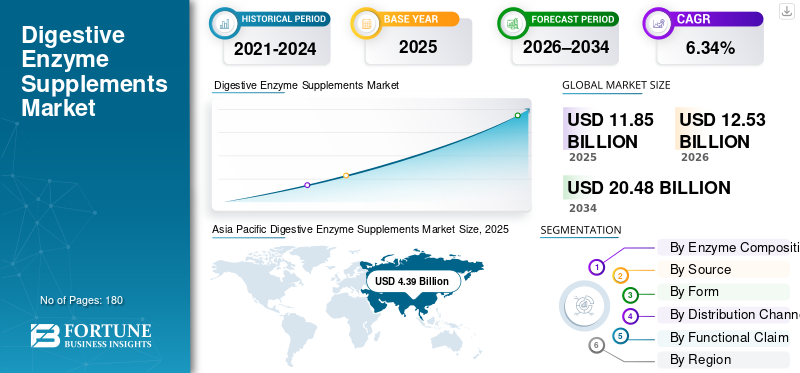
The global digestive enzyme supplements market size was valued at USD 11.85 billion in 2025. The market is projected to grow from USD 12.53 billion in 2026 to USD 20.48 billion by 2034, exhibiting a CAGR of 6.34% during the forecast period. Asia Pacific dominated the digestive enzyme supplements market with a market share of 37.04% in 2025.
Digestive enzyme supplements are dietary products that help the body break down carbohydrates, proteins, fats, and fibers so they can be absorbed as nutrients. These supplements usually include enzymes including amylase, protease, lipase, and lactase, which come from microbes, plants, or animals. People often use these supplements to ease digestive discomfort, enhanced nutrient absorption, reduce irritable bowel syndrome, and support digestion, especially if they have fewer enzymes due to age, lactose intolerance, or stress from certain diets. Wider access in pharmacies and online stores, along with new clean-label and plant-based options, is helping more people around the world try these supplements.
Companies such as Abbott Laboratories, Nestlé Health Science, Amway Corporation, and others are some of the key players operating in this market. New product launch is the key strategy which is boosting product sales and supporting the market growth.
Download Free sample to learn more about this report.
DIGESTIVE ENZYME SUPPLEMENTS MARKET KEY Takeaways
 Market Size & Forecast
- 2025 Market Size: USD 11.85 billion
- 2026 Market Size: USD 12.53 billion
- 2034 Forecast Market Size: USD 20.48 billion
- CAGR: 6.34% from 2026–2034
 Market Share
- Asia Pacific dominated the digestive enzyme supplements market with a 37.04% share in 2025.
- The Multi-Enzyme Supplements segment accounted for the largest market share in 2025.
- The Microbial-Derived segment accounted for the largest market share in 2025.
 Key Regional Highlights
Asia Pacific
Asia Pacific reached USD 4.39 billion in 2025, driven by high consumption and growing demand for digestive health supplements.
North America
North America reached USD 3.08 billion in 2025, supported by strong consumer awareness and premium supplement demand.
Europe
Europe reached USD 2.69 billion in 2025, driven by pharmacy-led sales and rising digestive health awareness.
U.S.
The market reached USD 2.75 billion in 2025, fueled by strong demand for premium digestive enzyme supplements.
Japan
The market reached USD 0.48 billion in 2025, supported by a mature pharmacy market and growing digestive health awareness.
Read More

DIGESTIVE ENZYME SUPPLEMENTS MARKET TRENDS
Shift Toward Multi-Enzyme Formulations and Online Channels Is Reshaping Market Consumption Patterns
One important trend in the market is the move toward multi-enzyme, broad-spectrum products, as consumers look for more complete digestive solutions. Microbial-derived enzymes continue to gain traction due to scalability, stability, and compatibility with vegetarian and halal requirements. Capsules are still the most common form, but chewables and gummies are quickly gaining popularity, especially with younger and lifestyle-focused consumers. Online and direct-to-consumer sales are growing faster than traditional stores, owing to educational marketing and the ease of subscriptions. Digestive enzymes are also being marketed more as daily wellness and meal-support supplements, not just for symptom relief.
Download Free sample to learn more about this report.
MARKET DYNAMICS
MARKET DRIVERS
Rising Digestive Health Awareness and Lifestyle-Driven Dietary Shifts are Driving Demand for Digestive Enzyme Supplements
The digestive enzyme supplements market is growing as more people are aware of digestive health, diets are changing, and digestive issues are becoming more common with modern lifestyles. Consuming more processed foods, following protein-heavy diets, irregular meal times, and an aging population all lower natural enzyme production, which leads more people to use supplements. The market is also growing as more people accept over-the-counter supplements, especially in pharmacies and online. Enzymes are now seen as ways to prevent problems and support meals, not just as treatments. Multi-enzyme products that meet several digestive needs at once are popular as they are convenient and encourage people to buy them again.
MARKET RESTRAINTS
Regulatory Constraints, Pricing Sensitivity, and Competing Digestive Solutions are Restricting Market Expansion
Even though there is a growing demand, the digestive enzyme supplements market growth is held back by complex regulations, consumer doubts, and concerns about pricing. In regions such as Europe, stringent regulations on health claims limit marketing flexibility and restrict premium positioning. Differences in how well enzymes work, no standard dosing, and not enough clinical proof for some products can make consumers, especially first-time users, less trusting. In emerging markets, price is still a big obstacle as people see digestive enzymes as optional supplements, not necessities. All these factors together can limit how quickly people start using these products and slow down growth in markets that otherwise have a lot of potential.
MARKET OPPORTUNITIES
Premiumization, Clean-Label Innovation, and Digital Distribution are Creating New Growth Opportunities
The market has strong opportunities owing to trends such as premium products, personalized options, and growth in new regions. More people want clean-label, plant-based, vegan, and halal-certified enzymes, which helps brands stand out, especially in developed and Middle Eastern markets. There is growing potential for products made for specific needs, as those for seniors, athletes, or people who are lactose-intolerant. Digital health platforms, subscription services, and expert-led online sites help companies connect more with customers and increase their long-term value. Emerging markets in Asia Pacific, South America, and Africa offer new opportunities as few people use these products now and cities are growing. Working with pharmacies, nutritionists, and wellness platforms can help companies reach more customers and build trust.
Segmentation Analysis
By Enzyme Composition
Demand for Comprehensive, One-Solution Digestive Support Led to Dominance of Multi-Enzyme Supplements Segment
The market is segmented by enzyme composition into multi-enzyme supplements and single-enzyme supplements.
The multi-enzyme supplements segment held the largest digestive enzyme supplements market share in 2025 as they provide digestive support for carbohydrates, proteins, fats, and fibers all in one product. This wide-ranging support matches what consumers want including convenient, all-in-one products, especially for mixed meals or unpredictable eating habits. Multi-enzyme blends can be sold at higher prices as they are marketed for overall digestive health, not just for specific issues. These supplements work in many forms and sell well both online and in pharmacies, which helps boost sales and encourages customers to buy again.
The single-enzyme supplements holds the second-largest market share, and is expected to grow at a CAGR of 5.97% during the forecast period as they are used for specific needs, such as treating lactose intolerance and certain digestive problems. Lactase and similar products are popular and sell in large quantities, especially in major retail stores. However, as these supplements have a limited use and usually cost less, they add less value than multi-enzyme blends. This keeps single-enzyme supplements behind in total market share, even though demand remains steady.
By Source
Cost-Efficient, Scalable Fermentation Led to Dominance of Microbial-Derived Digestive Enzymes
Based on source, the market is segmented into microbial-derived, plant-derived, and animal-derived.
Microbial-derived segment accounted for the largest market share in 2025. Microbial enzymes are more shelf-stable, making them suitable for capsules, tablets, and powders sold through various channels. They also meet vegetarian and halal standards, which helps reach a wider range of consumers. Their ability to work well in multi-enzyme blends makes them even more popular, especially in pharmacy and online markets. Expanding consumer use of additional supplements is driving digestive enzymes to be adopted as complementary products within daily wellness routines.
Plant-derived enzymes make up the second-largest share of the market is expected to grow at a CAGR of 6.62% during the forecast period due to growing interest in clean-label, natural, and plant-based supplements. Enzymes from papaya, pineapple, and fungi are especially popular with health-conscious, vegan, and premium buyers, particularly in developed countries. Although plant-based enzymes cost more, people see them as more natural and easier to digest, which helps them stand out as premium products.
By Form
Superior Enzyme Stability and High-Potency Delivery Led to Dominance of Capsule-Based Digestive Enzyme Supplements
The market is segmented, by form into capsules, tablets, powders, chewables / gummies, and liquids / drops.
The capsules segment led the global market in 2025 as they keep enzymes stable, offer accurate dosing, and protect them from moisture and stomach acid. Capsules keep enzyme activity steady over time, working better than other formats and making sure the product stays effective throughout its shelf life.
Chewables / gummies is another major segment that has a CAGR of 7.29% during the forecast period. Chewable and gummy are the second most popular choice as they have better taste, easy use, and growing popularity with children and people focused on lifestyle make them appealing. These options help people who do not like swallowing pills and are becoming more popular in online stores and wellness markets. Diverse enzyme types, led by multi-enzyme and lactase-based formulations, are shaping product differentiation and value growth in the market.
By Distribution Channel
High Consumer Trust and Pharmacist-Led Guidance Led to Dominance of Pharmacies & Drug Stores
The market is segmented, by distribution channel into supermarkets & hypermarkets, health & wellness stores, online / D2C, and pharmacies & drug stores.
The pharmacies & drug stores segment led the global market in 2025. Pharmacies and drug stores sell the most supplements as people trust them, rely on their professional advice, and connect them with digestive health. Many people see digestive enzymes as products for specific health issues, not just for general wellness, so advice from a pharmacist is often the main reason they buy them. Pharmacies carry a wide range of digestive enzyme brands at different prices, including clinical and imported options, which helps them sell both large quantities and higher-value products.
Health & wellness stores segment accounted for the second largest market share in 2025 and are expected to register a CAGR of 6.50% during the forecast period. The growth is driven by rising demand for premium, clean-label, and plant-based supplements. These stores appeal to health-conscious shoppers who want specialized formulas and stronger multi-enzyme blends. However, as these stores have fewer locations and a smaller customer base than pharmacies, their total sales volume is lower. This keeps them behind pharmacies, even though they have higher average prices and faster growth in premium products.
By Functional Claim
To know how our report can help streamline your business, Speak to Analyst
Wide Range of Everyday Digestive Needs Led to Dominance of General Digestive Support Segment
The market is segmented, by functional claim into general digestive support, bloating & gas reduction, protein & fat digestion, lactose intolerance support, and gut comfort / meal support.
The general digestive support segment led the global market in 2025 and holds the largest market share as they meet a wide range of everyday digestive needs instead of focusing on just one issue. More people are using digestive enzymes with their meals to help with irregular eating habits, heavy foods, and digestion issues that come with age.
Bloating & gas reduction segment accounted for the second largest market share in 2025 and are expected to register CAGR of 6.33% during the forecast period as many people experience digestive discomfort related to modern diets and stress. People usually take these products only when needed, and they are especially popular in pharmacy-led markets.
Digestive Enzyme Supplements Market Regional Outlook
By geography, the market is categorized into Europe, North America, Asia Pacific, South America, and the Middle East & Africa.
Asia Pacific
Asia Pacific Digestive Enzyme Supplements Market Size, 2025 (USD Billion)
To get more information on the regional analysis of this market, Download Free sample
The Asia Pacific market was valued at USD 4.39 billion in 2025 and is the leading region in the world. Asia Pacific leads in market value, owing to high consumption in densely populated countries including China, India, and those in Southeast Asia. Digestive enzymes are a regular part of daily health routines and are often connected to diet, lactose intolerance, and digestive issues. The region is diverse. China relies heavily on e-commerce, Japan has a mature pharmacy market, and India and Southeast Asia are growing quickly from a smaller starting point. Single-enzyme products, especially lactase, are still important. However, multi-enzyme blends are becoming more popular in cities.
India Digestive Enzyme Supplements Market
The India market in 2025 was valued around USD 0.72 billion, accounting for roughly 6.61% of global market revenues.
China Digestive Enzyme Supplements Market
China’s market in 2025 was valued around USD 1.57 billion, representing roughly 13.266% of global market revenues. The growth of the digestive enzyme supplements market size is being fueled by expanding consumer adoption, premiumization of multi-enzyme formulations, and wider access through pharmacy and online channels
Japan Digestive Enzyme Supplements Market
The Japan market in 2025 reached a valuation of around USD 0.48 billion, accounting for roughly 4.46% of global market revenues.
North America
The market in North America reached a valuation of USD 3.08 billion in 2025. North America has a well-established and valuable market for digestive enzyme supplements. This is due to strong consumer awareness, a focus on premium products, and the common use of enzymes to support meals. More consumers now see digestive enzymes as part of daily wellness, not just for solving problems. This is especially true for people who eat high-protein, high-fat, or convenience foods.
U.S. Digestive Enzyme Supplements Market
In 2025, the U.S. market reached USD 2.75 billion. The U.S. is the largest national market in the world, with high spending per person and a strong focus on premium products. Digestive enzyme supplements are a regular part of many people’s routines, including sports nutrition, weight management, and gut health plans. In the U.S., people prefer multi-enzyme capsules made from microbes, usually marketed for overall digestive health instead of specific conditions. New products and updates come out often. Although the market is mature and volume growth is limited, value is still rising owing to higher prices, better formulas, and new uses linked to today’s eating habits.
Europe
The European market reached a valuation of USD 2.69 billion in 2025. In Europe, the market is steady and mainly led by pharmacies. This is due to cautious consumer habits and strict regulations. Most people buy enzyme supplements in Europe to help with digestive comfort and manage symptoms, not for lifestyle reasons. As a result, they use these products less often than consumers in North America. Pharmacies and drug stores are the main places where people buy these supplements, showing that many trust pharmacists’ advice, especially in Germany, France, Italy, and Spain. Lactase and general digestive support products remain structurally important. This growth is driven by an aging population, more digestive issues related to diet, and the slow rise of online sales, especially in the U.K. and Northern Europe.
Germany Digestive Enzyme Supplements Market
The market in Germany in 2025 reached around USD 0.34 billion, representing roughly 3.16% of global market revenues. Rising awareness of the product is encouraging increased investment, product innovation, in this country.
U.K. Digestive Enzyme Supplements Market
The U.K. market reached approximately USD 0.47 billion in 2025, equivalent to around 4.28% of global market sales.
South America and Middle East & Africa
Over the forecast period, South America is expected to experience significant growth in this market. The South America market in 2025 recorded USD 1.09 billion. South America's market for digestive enzyme supplements is still developing. Pharmacies play a major role in sales, and customers are very sensitive to price. Brazil leads the region in demand, with Argentina, Chile, and Colombia following behind. Most consumers use digestive enzymes to relieve symptoms, not for prevention or lifestyle reasons. This means they use these products less often. Local brands and simple products make up most sales. Premium and imported options are still limited to a few urban areas. Middle East & Africa region reached a valuation of USD 0.59 billion in 2025. The Middle East & Africa is the smallest regional market, but it is growing the fastest. It has low current penetration and strong long-term potential. Most demand comes from the GCC, Turkey, South Africa, and Israel. These areas have modern pharmacies and higher purchasing power, which help drive supplement use. In the UAE and Saudi Arabia, there is strong demand for premium products, especially those that are imported, plant-based, or halal-compliant. In Africa, cost and access are still major challenges. However, urban growth and more retail pharmacies are making these products easier to find.
UAE Digestive Enzyme Supplements Market
UAE market is set to grow at a CAGR of 4.71% during the forecast period. Growth is driven by rising health awareness, changing diets, and accelerating online and cross-border e-commerce adoption. More people are turning to digestive aid products because many jobs involve long hours of sitting, and diets often include a lot of processed foods.
COMPETITIVE LANDSCAPE
Key Industry Players
Fragmented Brand Competition and Rapid Formulation Innovation are Intensifying Competitive Dynamics in Market
The digestive enzyme supplements market is somewhat fragmented and is becoming more competitive, with both large consumer health companies and specialized supplement brands taking part. Major companies use their strong brands, global distribution, and regulatory know-how to expand into pharmacies, online stores, and direct-to-consumer sales. Mid-sized and regional brands compete by offering niche products, including vegan, halal-certified, or blends made for specific needs such as lactose intolerance, bloating, or high-protein diets. The market changes quickly, with new products and updates often released to improve enzyme stability and effectiveness. Online platforms make it easier for new brands to enter the market, which increases competition, but they also make it more expensive to attract customers.
LIST OF DIGESTIVE ENZYME SUPPLEMENTS COMPANIES PROFILED IN REPORT
- Abbott Laboratories (U.S.)
- Nestlé Health Science (Switzerland)
- Amway Corporation (U.S.)
- The Procter & Gamble Company (P&G Health) (U.S.)
- GSK Consumer Healthcare (Haleon) (U.K.)
- Blackmores Limited (Australia)
- Nature’s Way Products, LLC (U.S.)
- Garden of Life (U.S.)
- NOW Health Group (U.S.)
- Herbalife Nutrition (U.S.)
KEY INDUSTRY DEVELOPMENTS
- January 2026: The Procter & Gamble Company (P&G) acquired "free-from" digestive wellness brand named “Wonderbelly”. This acquisition strengthened P&G’s Personal Health Care (PHC) portfolio, including its Over-the-Counter (OTC) digestive relief sector.
- July 2025: NutriLeads launched Enescene Probio 3+, a new synbiotic supplement which is suitable for adults seeking a convenient method to optimize their digestive health and immunity.
- March 2025: Nature Made, one of the leading vitamin and supplement brand from Pharmavite, launched new products and formulations related to digestive health portfolio that supports daily gut health support.
- July 2022: Perseo pharma entered into a strategic research and development partnership with Nestlé Health Science S.A. and developed up to three programs that target enzyme deficiencies in patients who are suffering from digestive diseases.
- February 2022: Nestlé Health Science acquired U.S. collagen product producer Vital Proteins offering supplements, beverages and food products.
REPORT COVERAGE
Request for Customization to gain extensive market insights.
Report Scope & Segmentation
|
ATTRIBUTE |
DETAILS |
|
Study Period |
2021-2034 |
|
Base Year |
2025 |
|
Estimated Year |
2026 |
|
Forecast Period |
2026-2034 |
|
Historical Period |
2021-2024 |
|
Growth Rate |
CAGR of 6.34% from 2026-2034 |
|
Unit |
Value (USD Billion) |
|
Segmentation |
By Enzyme Composition, By Source, By Form, By Distribution Channel, By Functional Claim, and Region |
|
By Enzyme Composition |
|
|
By Source |
|
|
By Form |
|
|
By Distribution Channel |
|
|
By Functional Claim |
|
|
By Region |
|
Frequently Asked Questions
Fortune Business Insights says that the global market value stood at USD 11.85 billion in 2025 and is projected to reach USD 20.48 billion by 2034.
In 2025, the Asia Pacific’s market value stood at USD 4.39 billion.
The market is expected to exhibit a CAGR of 6.34% during the forecast period.
By end use, general digestive support segment led the global market in 2025.
Rising digestive health awareness and lifestyle-driven dietary shifts are driving demand for digestive enzyme supplements.
Abbott Laboratories, Nestlé Health Science, Amway Corporation and others and others are a few of the players in the digestive enzyme supplements market.
Asia Pacific held the largest market share in 2025.
Shift toward multi-enzyme formulations and online channels is reshaping market consumption patterns.



- 2021-2034
- 2025
- 2021-2024
- 180
-
(Offer valid till 30th Sep 2026)
Get 30-60 hrs Free Customization
Expand Regional and Country Coverage, Segments Analysis, Company Profiles, Competitive Benchmarking, and End-user Insights.




















Related Reports
-
US +1 833 909 2966 ( Toll Free )
-
Get In Touch With Us