Digital Twin in Shipbuilding Market Size, Share & Industry Analysis, By Offering (Hardware, Software, SaaS / Cloud Subscription, and Others), By Twin Object (Vessel / Product Digital Twin, Shipyard / Facility Digital Twin, and Others), By Shipbuilding Lifecycle Stage, By Technology Layer (CAD / CAE / CAM / Naval Architecture, and Others), By Application (Production Planning & Optimization, Digital Ship Design & Engineering, and Others), By Vessel Type, By Ship System (Hull & Structure, Hydrodynamics, Propulsion, and Others), By Deployment Model, By End User and Regional Forecast 2026-2034
 Download Free Sample
Digital Twin in Shipbuilding Market Size and Future Outlook
 Listen to Audio Version
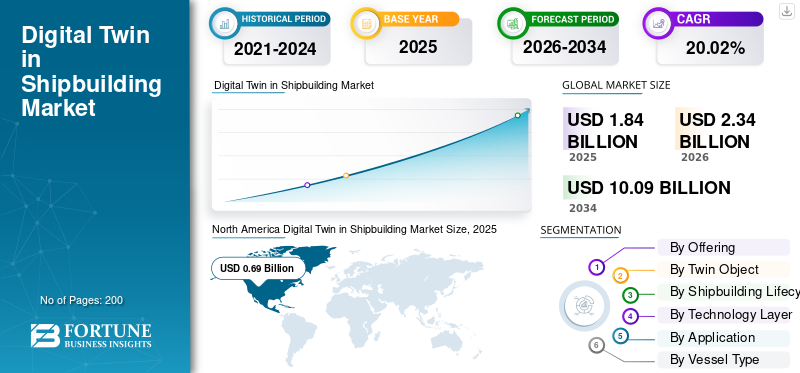
The digital twin in shipbuilding market size was valued at USD 1.84 billion in 2025. The market is projected to grow from USD 2.34 billion in 2026 to USD 10.09 billion by 2034, exhibiting a CAGR of 20.02% during the forecast period. North America dominated the digital twin in shipbuilding market with a market share of 37.5% in 2025.
The market covers software platforms and services that create a virtual, data-linked replica of a vessel, shipyard, or production process across design, engineering, construction, commissioning, and operations. In shipbuilding, the value is not just 3D visualization, it is digital continuity between CAD, PLM, simulation, yard planning, class compliance, maintenance, and fleet performance. Siemens AG, Dassault Systèmes SE, AVEVA Group Limited, Hexagon AB, and CADMATIC Oy are among the key players active in this space.
The market is being driven by the need to cut rework, shorten vessel design cycles, improve yard productivity, manage complex naval/commercial ship programs, and support sustainability-linked vessel optimization. IMO’s 2023 GHG strategy, which targets net-zero GHG emissions from international shipping by or around 2050, is also pushing shipbuilders and owners toward simulation-led design, lifecycle performance monitoring, and compliance-ready digital records.
Overall, key players are growing the market through cloud-based shipyard platforms, integrated CAD/PLM ecosystems, virtual twin/simulation capabilities, digital thread integration, and partnerships with classification bodies.
Download Free sample to learn more about this report.
Digital Twin in Shipbuilding Market Key Takeaways
 Global Market Size & Forecast
- 2025 Market Size: USD 1.84 billion
- 2026 Market Size: USD 2.34 billion
- 2034 Forecast Market Size: USD 10.09 billion
- CAGR: 20.02% from 2026–2034
 Market Share
- North America dominated the digital twin in shipbuilding market with a 37.5% share in 2025.
- The hardware segment accounted for the largest share of 28.26% in 2025.
- Naval shipbuilders held the largest end-user share of 46.30% in 2025.
 Key Regional Highlights
North America
North America reached USD 0.69 billion and held a 37.5% market share in 2025.
Asia Pacific
Asia Pacific recorded a market size of USD 0.50 billion in 2025.
Europe
Europe reached USD 0.47 billion in 2025.
U.S
Market size reached USD 0.61 billion in 2025.
Japan
Market size reached USD 0.07 billion in 2025.
Read More

Digital Twin in Shipbuilding Market Trends
Shift from 3D Models to AI-Enabled Digital Thread Platforms is Prominent Market Trend
The key trend reshaping the market is the shift from static 3D visualization to live, connected digital thread platforms. Modern solutions are now linking CAD, PLM, simulation, manufacturing planning, automation, quality systems, IIoT data, and class workflows. Siemens’ Digital Twin Composer, announced on January 6, 2026, shows this direction clearly as it combines 2D/3D digital twin data driven with real-time physical information in a secure, photorealistic environment using NVIDIA Omniverse libraries.
For instance, in February 2026, Siemens stated that HD Hyundai would be among the first companies to pilot Digital Twin Composer as part of an industrial-metaverse-based shipyard and ship representation program.
Market Dynamics
MARKET DRIVERS
Download Free sample to learn more about this report.
Growing Focus on Faster Delivery, Lower Rework, And Stronger Lifecycle Control Drives Market Growth
The main driver for digital twin in shipbuilding market growth is the pressure to build complex naval and commercial vessels faster while reducing downtime redesign, production delays, and cost overruns. Implementing digital twins help shipyards connect design, engineering, procurement, production planning, testing, class approval, and operations into one controlled digital flow. This is becoming more important as ship programs now involve advanced propulsion, automation, sensors, cybersecurity, and emissions-performance requirements. NAVSEA describes digital twins as virtual models using real-time sensor data, physics-based modeling, and machine learning to detect degradation and support smarter maintenance across the vessel life cycle.
For instance, in May 2026, CADMATIC released 2026H1 with upgrades for secure engineering data exchange, model coordination, and document-based digital twin workflows, showing how vendors are improving practical shipyard execution tools.
MARKET RESTRAINTS
Legacy Systems, Data Fragmentation, and High Integration Cost Hamper Market Growth
The biggest restraint for market growth is the difficulty of connecting old shipyard systems with modern CAD, PLM, ERP, MES, class, supplier, and fleet-operation platforms. Many shipyards still work through disconnected tools, drawings, spreadsheets, e-mails, and local practices, which makes a clean digital thread hard to build. CADMATIC directly identifies fragmentation across engineering, procurement, production, and project execution as a major source of slower decisions, avoidable rework, weak visibility, and delivery pressure.
For instance, in April 2026, GAO reported that U.S. Navy and Coast Guard shipbuilding programs remain billions of dollars over cost and years behind schedule, while also stressing the need for stronger design practices and digital tools.
MARKET OPPORTUNITIES
Growing Defense Shipbuilding Modernization Creates a Lucrative Market Opportunities
The strongest market opportunity lies in defense and government-backed shipbuilding, where maritime digital twins can improve planning, production control, sustainment, and fleet readiness. The U.S. Navy’s FY27 budget request includes USD 65.8 billion in shipbuilding funds to buy 18 battle-force ships and 16 auxiliary ships, creating a large modernization environment where digital engineering, AI-enabled planning, and digital twin platforms can scale. Digital twin vendors can benefit by offering solutions for design maturity, virtual commissioning, production sequencing, supply-chain visibility, predictive maintenance, and lifecycle sustainment.
For instance, in December 2025, the U.S. Navy announced a USD 448 million Shipbuilding Operating System investment with Palantir to apply artificial intelligence and autonomy across the maritime industrial base, where pilot deployments reportedly cut submarine schedule planning from 160 manual hours to under 10 minutes and reduced material review time from weeks to under one hour.
MARKET CHALLENGES
Cybersecurity, Model Trust, and Workforce Acceptance Limits Market Expansion
The biggest market challenge is that digital twins expand the cyber and data attack surface as shipyard systems, operational technology, connected assets, and remote data flows become more integrated. This is especially sensitive in naval shipbuilding, where design data, supply-chain information, and operational readiness data can have national-security value. On April 30, 2026, CISA, the Department of War, DOE, FBI, and State Department published guidance for applying Zero Trust to operational technology, noting that interconnected and remotely operated OT systems create new attack vectors and cybersecurity risks.
For instance, in April 2026, the U.S. government’s Zero Trust OT guidance directly reinforced that digitalized, interconnected operational environments must be secured carefully without disrupting mission-critical physical systems.
DIGITAL TWIN IN SHIPBUILDING MARKET SEGMENTATION ANALYSIS
By Offering
Implementation Services Segment is the Fastest Growing as Integration Complexity Rises
The market by offering is divided into hardware, software, SaaS / Cloud subscription, implementation services, engineering services, data services and training & support.
The implementation services segment is estimated to be the fastest growing with a highest CAGR of 22.47% during the forecast period of 2026-2034. This shows that shipyards are not only buying tools, they are paying heavily for integration, data migration, workflow redesign, and system customization. The market is moving from product purchase to digital transformation projects, where vendors and system integrators help shipyards connect CAD, PLM, ERP, MES, IoT, class documentation, and lifecycle maintenance platforms into one working digital thread.
The hardware segment accounted for the largest digital twin in shipbuilding market share of 28.26% in 2025. It is projected to grow at a CAGR of 19.19% during the forecast period.
By Twin Object
Shipyard/Facility Digital Twin Grows Fastest as Yards Increasingly Digitize Operations
By twin object, the market is divided into vessel / product digital twin, shipyard / facility digital twin, production process digital twin, supply chain digital twin, program / enterprise digital twin, operational vessel digital twin, MRO / lifecycle digital twin, and regulatory / classification digital twin.
The shipyard / facility digital twin segment is estimated to be the fastest growing with a highest CAGR of 22.63% during the forecast period of 2026-2034. This indicates a major shift from digitizing only the ship to digitizing the whole shipyard environment. Shipyards are using facility twins to simulate block movement, crane use, dock planning, worker allocation, welding flow, material handling, and production bottlenecks. This growth is driven by the need to improve yard throughput, reduce schedule slippage, and make shipbuilding more predictable.
The vessel / product digital twin segment accounted for the largest share of 24.35% in 2025. It is also projected to grow at a CAGR of 24.35% during the forecast period.
By Shipbuilding Lifecycle Stage
Production Engineering Leads and Grows Fastest as Shipyards Prioritize Execution Over Concept-Stage Digitization
The market, by shipbuilding lifecycle stage, is divided into concept / feasibility, basic / initial design, detailed design, production engineering, procurement / material management, fabrication, assembly / erection, commissioning / testing, delivery / handover, operations, and maintenance / repair / overhaul.
The production engineering segment is estimated to be the fastest growing with a highest CAGR of 22.88% during the forecast period of 2026-2034. In addition, the segment is also accounted for largest market share with a 17.63% in 2025. This position is strong as production engineering sits at the point where digital design becomes physical ship construction. Shipyards need digital twins to convert engineering models into build sequences, work packages, fabrication plans, assembly logic, material flows, and shop-floor instructions. Moreover, the high growth also shows that the market is shifting from design-only digitalization toward practical production performance. Shipbuilders are under pressure to reduce rework, improve module/block accuracy, optimize labor deployment, and avoid costly late-stage changes.
The detailed design segment accounted for the second largest share of 16.17% in 2025. Also the segment is projected to grow at a CAGR of 20.94% during the forecast period.
By Technology Layer
Cybersecurity/Data Governance Grows Fastest as Digital Shipyards Become More Connected
The market, by technology layer, is divided into CAD / CAE / CAM / naval architecture, PLM / PDM / digital thread, simulation / engineering analysis, MES / MOM / production execution, IoT / edge / sensor integration, AI / ML / analytics, reality capture / spatial computing, cloud / data platform, and cybersecurity / data governance.
The cybersecurity / data governance segment is estimated to be the fastest growing with a highest CAGR of 22.77% during the forecast period of 2026-2034. This is due to digital twins requiring large volumes of sensitive engineering, operational, supplier, class, and vessel-performance data. As shipyards connect OT systems, cloud platforms, IoT sensors, suppliers, naval authorities, and fleet operators, data protection becomes a business-critical requirement. Growth in this layer reflects rising concern over IP protection, secure collaboration, cyber resilience, and trusted digital-thread governance.
The PLM / PDM / digital thread segment accounted for the largest share of 16.69% in 2025. Also the segment is projected to grow at a CAGR of 19.76% during the forecast period.
By Application
Smart Yard/Shipyard 4.0 Grows at Fastest Rate as Shipbuilders Move from Isolated Tools to Connected Yard Operations
The global market, by application, is divided into production planning & optimization, digital ship design & engineering, smart yard / shipyard 4.0, predictive maintenance & asset health, digital handover & lifecycle data, quality management, energy / emissions / sustainability, autonomous / smart ship support, and others.
The smart yard / shipyard 4.0 segment is estimated to be the fastest growing with a highest CAGR of 22.41% during the forecast period of 2026-2034. This leadership shows that shipyards are no longer treating digital twins as only engineering tools. They are using them to modernize the complete yard environment, including production planning, fabrication, assembly, logistics, workforce coordination, equipment utilization, and real-time visibility. Furthermore, the reason this segment grows faster than other applications is that shipyards are facing strong pressure to deliver more vessels with limited skilled labor, tighter schedules, and more complex vessel designs.
The digital ship design & engineering segment accounted for the largest share of 19.32% in 2025. Also it is projected to grow at a CAGR of 19.31% during the forecast period.
By Vessel Type
Autonomous/Uncrewed Vessels Grow Fastest as Next-Generation Fleets Mature
The global market, by vessel type, is divided into commercial cargo vessels, passenger vessels, naval vessels, offshore & energy vessels, specialized vessels, autonomous / uncrewed vessels, inland / coastal vessels, and yachts / superyachts.
The autonomous / uncrewed vessels segment is estimated to be the fastest growing with a highest CAGR of 22.34% during the forecast period of 2026-2034. This growth is due to rising demand for unmanned surface vessels, autonomous patrol craft, mine-countermeasure vessels, and smart maritime platforms. These vessels depend heavily on software, sensors, autonomy stacks, control systems, and remote operations, integrating digital twins model essential for simulation, mission testing, safety validation, operator training, and lifecycle management upgrades.
The naval vessels segment accounted for the largest share of 33.00% in 2025. Also, it is projected to grow at a CAGR of 21.19% during the forecast period.
By Ship System
Automation & Control Grows Fastest as Vessels Become More Sensor-Driven and Software-Defined
The global market, by ship system, is divided into hull & structure, hydrodynamics, propulsion, power & electrical, machinery systems, piping & fluids, HVAC, automation & control, navigation & bridge and others.
The automation & control segment is estimated to be the fastest growing with a highest CAGR of 23.26% during the forecast period of 2026-2034. Modern ships are increasingly dependent on integrated automation, control logic, sensors, actuators, monitoring systems, bridge systems, machinery control, and smart diagnostics. A digital twin is most valuable when it can reflect how these systems perform in real time data or simulated operating conditions.
The hull & structure segment accounted for the largest share of 16.35% in 2025. Also, the segment is projected to grow at a CAGR of 20.20% during the forecast period.
By Deployment Model
Hybrid Cloud Dominates and Grows Fastest as Shipyards Need Cloud Scalability Without Losing Control of Sensitive Data
The global market, by deployment model, is divided into on-premise, private cloud, public cloud, hybrid cloud, edge deployment, and air-gapped / secure deployment.
The hybrid cloud segment is estimated to be the fastest growing with a highest CAGR of 21.74% during the forecast period of 2026-2034. Also the it accounted for the largest market share of 22.40% in 2025 year. Hybrid cloud is leading as shipyards need the scalability and collaboration benefits of cloud platforms, but they cannot move all engineering, defense, IP-sensitive, or operational data driven into public cloud environments. The growth of hybrid cloud also reflects how shipbuilding projects are structured. Large vessels involve OEMs, suppliers, classification bodies, naval authorities, operators, and engineering partners across different locations.
The private cloud segment accounted for the second-largest share of 20.01% in 2025. Also the segment is projected to grow at a CAGR of 20.38% during the forecast period.
By End User
To know how our report can help streamline your business, Speak to Analyst
Naval Shipbuilders Dominate and Grow Fastest as Defense Shipbuilding Has Highest Complexity and Lifecycle Value
The global market, by end user, is divided into commercial shipyards, naval shipbuilders, ship owners / operators, equipment OEMs, and port / offshore asset owners.
The naval shipbuilders segment is estimated to be the fastest growing with a highest CAGR of 21.01% during the forecast period of 2026-2034. The segment also accounted for largest market share of 46.30% of in 2025. Half of the opportunity is concentrated in defense-oriented shipbuilding. Naval yards have stronger digital twin demand as they build complex, high-value platforms with long service lives, strict documentation needs, mission-critical systems, and heavy sustainment requirements. The high growth is also supported by defense modernization, fleet readiness pressure, submarine and surface combatant construction demand, and the need to reduce schedule delays in military shipbuilding. Naval shipbuilders use digital twins model not only for design and production, but also for configuration management, combat-system integration, maintenance planning, training, and mid-life upgrades.
The commercial shipyards segment accounted for the second-largest share of 17.41% in 2025. Also, it is projected to grow at a CAGR of 19.51% during the forecast period.
Digital Twin in Shipbuilding Market Regional Outlook
By region, the market is categorized into Europe, North America, Asia Pacific, and Rest of the World.
North America
North America Digital Twin in Shipbuilding Market Size, 2025 (USD Billion)
To get more information on the regional analysis of this market, Download Free sample
North America held the dominant share in 2025, valued at USD 0.69 billion, and also will maintain the leading share in 2026, with USD 0.87 billion. The market is experiencing rapid growth, driven by massive investments in naval modernization, stringent emission regulations, and the need for efficiency. Key drivers include the adoption of shipbuilding Industry 4.0, virtual prototyping to cut costs, and the integration of robotic welding.
U.S. Digital Twin in Shipbuilding Market
Based on North America's strong contribution, the U.S. market reached USD 0.61 billion in 2025 and is estimated to have a CAGR of 19.01% during the forecast period.
Europe
Europe is projected to grow at fastest growing rate with a highest CAGR of 21.75% during the forecast period. In 2025, the market value stood at USD 0.47 billion. The growth is driven by stringent environmental regulations, a push for maritime Industry 4.0, and the need for predictive maintenance in complex vessel construction. The market focus centers on optimizing efficiency and lowering emissions.
U.K. Digital Twin in Shipbuilding Market
The U.K. market in 2025 was valued at USD 0.10 billion and is estimated to grow at a rate of 19.43% during the forecast period.
Nordic Countries Digital Twin in Shipbuilding Market
The Nordic Countries market in 2025 was valued at USD 0.07 billion and is estimated to grow at a rate of 23.80% during the forecast period.
Rest of Europe Digital Twin in Shipbuilding Market
The Rest of Europe market growth in 2025 was valued at USD 0.08 billion and is estimated to grow at a rate of 22.84% during the forecast period.
Asia Pacific
The Asia Pacific market was valued at USD 0.50 billion in 2025 and secures the position of the second-largest region in the market. Key drivers include massive shipbuilding volume in China, Japan, and South Korea, strict emission regulations requiring optimized fuel efficiency, and the adoption of smart, AI-driven, and IoT-enabled digital shipyards.
China Digital Twin in Shipbuilding Market
The China market in 2025 was at USD 0.16 billion and is estimated to grow at a rate of 19.05% during the forecast period.
India Digital Twin in Shipbuilding Market
The India market in 2025 reached USD 0.06 billion and is estimated to grow at a rate of 23.43% during the forecast period.
Japan Digital Twin in Shipbuilding Market
The Japan market in 2025 was valued at USD 0.07 billion and is estimated to grow at a rate of 20.64% during the forecast period.
Rest of the World
Rest of the World consist of Latin America and Middle East & Africa regions which are expected to witness moderate growth in this market space during the forecast period. The Latin America market was valued at USD 0.04 billion in 2025, whereas the Middle East & Africa market was at USD 0.11 billion in 2025.
COMPETITIVE LANDSCAPE
Key Industry Players
Integrated Digital Shipyard Platforms Are Replacing Standalone Design Tools and Propelling Market Competition
The competitive landscape is shifting from simple 3D ship models to end-to-end digital shipyard ecosystems. Leading players are competing by connecting CAD/CAE, PLM, MES/MOM, simulation, IoT/edge data, cloud collaboration, cybersecurity, and class-compliance workflows into one digital thread. This is visible in HD Hyundai’s February 2026 move to select Siemens Xcelerator for its “Future of Shipyard” program, where the goal is to manage the full shipbuilding process as a single data flow across global shipyards and use Digital Twin Composer for industrial-metaverse-based decision-making and collaboration.
Overall, the industry is growing through platform partnerships, AI-enabled shipyard planning, secure cloud/hybrid deployment, and lifecycle asset management rather than one-time software sales. The U.S. Navy’s, USD 448 million Shipbuilding Operating System investment in December 2025 shows how AI and autonomy are moving into the shipbuilding industrial base, while NAVSEA’s digital twin work highlights the value of predictive maintenance and higher fleet availability after delivery. Competition is no longer about who has the best design software alone, it is about who can help shipyards reduce delays, control data, improve production execution, secure sensitive information, and keep ships operational for longer.
LIST OF KEY DIGITAL TWIN IN SHIPBUILDING COMPANIES PROFILED
- Siemens AG (Germany)
- Dassault Systèmes SE (France)
- AVEVA Group Limited (U.K.)
- CADMATIC Oy (Finland)
- NAPA Oy (Finland)
- Hexagon AB (Sweden)
- ShipConstructor Software Inc. (Canada)
- Aras Corporation (U.S.)
- CONTACT Software GmbH (Germany)
- PROSTEP AG (Germany)
- Kongsberg Digital AS (Norway)
- American Bureau of Shipping / ABS (U.S.)
- Nippon Kaiji Kyokai / ClassNK (Japan)
- Digital Twin Marine LLC (U.S.)
- Fincantieri S.p.A. (Italy)
KEY DEVELOPMENT
- May 2026: Anduril Industries, ABS, and HD Hyundai signed an industrial MOU; the receiving/partner organization is HD Hyundai’s autonomous vessel business, the value was not disclosed, and the agreement focuses on end-to-end autonomous surface vessel design, production, autonomy integration, and classification support.
- April 2026: GrayMatter Robotics signed an MOU with HII, the value was not disclosed, and the partnership aims to integrate physical AI into shipbuilding operations, including autonomous surface preparation, coating, and inspection to improve throughput.
- February 2026: Path Robotics signed an MOU with HII, the value was not disclosed, and the agreement targets physical AI-based robotic welding for manned and unmanned shipbuilding production, including possible integration with HII’s ROMULUS unmanned surface vessel line.
- January 2026: Stantec–AECOM Joint Venture received a USD 150 million single-award contract from NAVFAC to support the U.S. Navy’s Shipyard Infrastructure Optimization Program, mainly for modernization planning and engineering at Portsmouth Naval Shipyard.
- January 2026: Cadmatic was selected by Ulstein Group ASA for CADMATIC Wave PLM, the value was not disclosed, and the project will create a stronger digital thread across design, engineering, production, procurement, project management, and lifecycle management ship data.
REPORT COVERAGE
The global digital twin in shipbuilding market growth analysis includes a comprehensive study of the market size & forecast by all the market segments included in the report. It contains details on the market dynamics and trends expected to drive the market over the forecast period. It provides information on key aspects, including an overview of technological advancements, pipeline candidates, the regulatory environment, and product launches. Additionally, it details partnerships, mergers & acquisitions, as well as key marine and shipbuilding industry developments and prevalence by key regions. The global market research report also provides a detailed competitive landscape with information on the market share and profiles of key operating players.
Request for Customization to gain extensive market insights.
Report Scope & Segmentation
| ATTRIBUTE | DETAILS |
| Study Period | 2021-2024 |
| Base Year | 2025 |
| Estimated Year | 2026 |
| Forecast Period | 2026-2034 |
| Historical Period | 2021-2024 |
| Growth Rate | CAGR of 20.02% from 2026-2034 |
| Unit | USD Billion |
|
Segmentation |
By Offering
By Twin Object
By Shipbuilding Lifecycle Stage
By Technology Layer
By Application
By Vessel Type
By Ship System
By Deployment Model
By End User
By Geography
|
Frequently Asked Questions
Fortune Business Insights says that the global market value stood at USD 1.84 billion in 2025 and is projected to reach USD 10.09 billion by 2034.
In 2025, the European market value stood at USD 0.47 billion.
The market is expected to exhibit a CAGR of 20.02% during the forecast period.
The naval shipbuilders segment is expected to hold the highest CAGR over the forecast period.
The growing shipyards focusing on faster delivery, lower rework, and stronger lifecycle control drives the market growth.
Siemens AG, Dassault Systèmes SE, AVEVA Group Limited, Hexagon AB, and CADMATIC Oy are the top key players in the market.
North America dominated the market in 2025.



- 2021-2034
- 2025
- 2021-2024
- 200
Get 30-60 hrs Free Customization
Expand Regional and Country Coverage, Segments Analysis, Company Profiles, Competitive Benchmarking, and End-user Insights.




















Related Reports
-
US +1 833 909 2966 ( Toll Free )
-
Get In Touch With Us